


How Macro Markets Compares Prediction Market Platforms

Macro Markets compares prediction market platforms with a documentation-first method. We verify the legal operator, regulatory status, current eligibility rules, contract disclosures, fee schedules, order tools, funding terms, and public support materials. We then compare executable costs and market fit—not promotional claims alone.
Our reviews do not treat a CFTC registration, a large headline volume, or a low advertised fee as proof that a platform is best for every user. The best choice depends on the contract, location, order size, price, liquidity, rules, and account needs.
We also distinguish research from hands-on testing. If we did not open, fund, trade, settle, and withdraw from an account during a documented test, we do not claim that we did.
Last methodology review: October 24, 2026.
Editorial disclosure: Platforms do not receive a higher score for buying ads, offering affiliate compensation, providing bonuses, or giving Macro Markets early access. Commercial relationships, when present, must be disclosed near the relevant comparison.
Our Platform Comparison Scorecard
Our standard scorecard totals 100 points. It creates a consistent baseline, but the published recommendation also considers fit for the reader’s use case.
| Category | Weight | What we evaluate |
|---|---|---|
| Regulation and legal access | 25 | Legal operator, CFTC registration, intermediary structure, customer eligibility, geographic restrictions, and current regulator or court notices |
| All-in cost and execution | 20 | Transaction and exchange fees, bid-ask spread, order-book depth, likely slippage, funding costs, withdrawal costs, and settlement charges |
| Market selection and liquidity | 20 | Useful event categories, contract availability, comparable market depth, trading activity, and ability to enter or exit |
| Rules and data transparency | 15 | Contract language, settlement source, deadlines, exception rules, price data, disclosures, and change history |
| Trading tools and usability | 10 | Order types, order status, portfolio controls, mobile and web clarity, accessibility, and error prevention |
| Funding, support, and operations | 10 | Deposit and withdrawal methods, processing disclosures, account controls, support channels, incident communication, and complaint process |
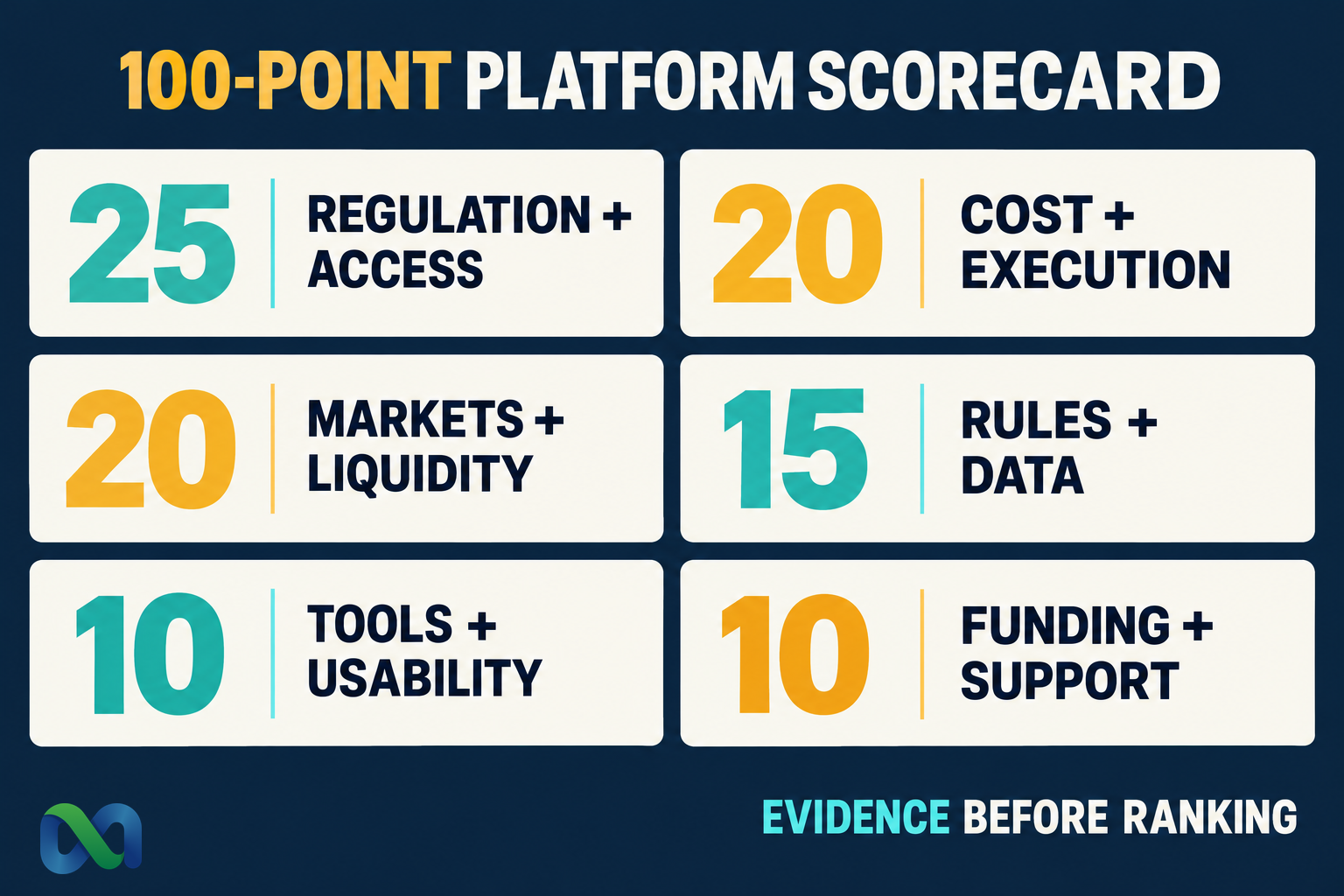
The weights reflect a simple principle: a polished interface cannot compensate for unclear legal access, hidden total cost, or weak contract rules.
Minimum eligibility for a US comparison
A platform must pass basic checks before it can rank in a US guide:
- We can identify the legal entity serving US customers.
- We can verify the relevant exchange, broker, or intermediary in an official registry.
- The platform publishes customer terms and risk disclosures.
- We can determine which product and location restrictions apply.
- We can inspect contract rules and a settlement source before an order.
If a platform fails one of these checks, we may discuss it for context, but we do not present it as an eligible US recommendation.
The Evidence Hierarchy We Use
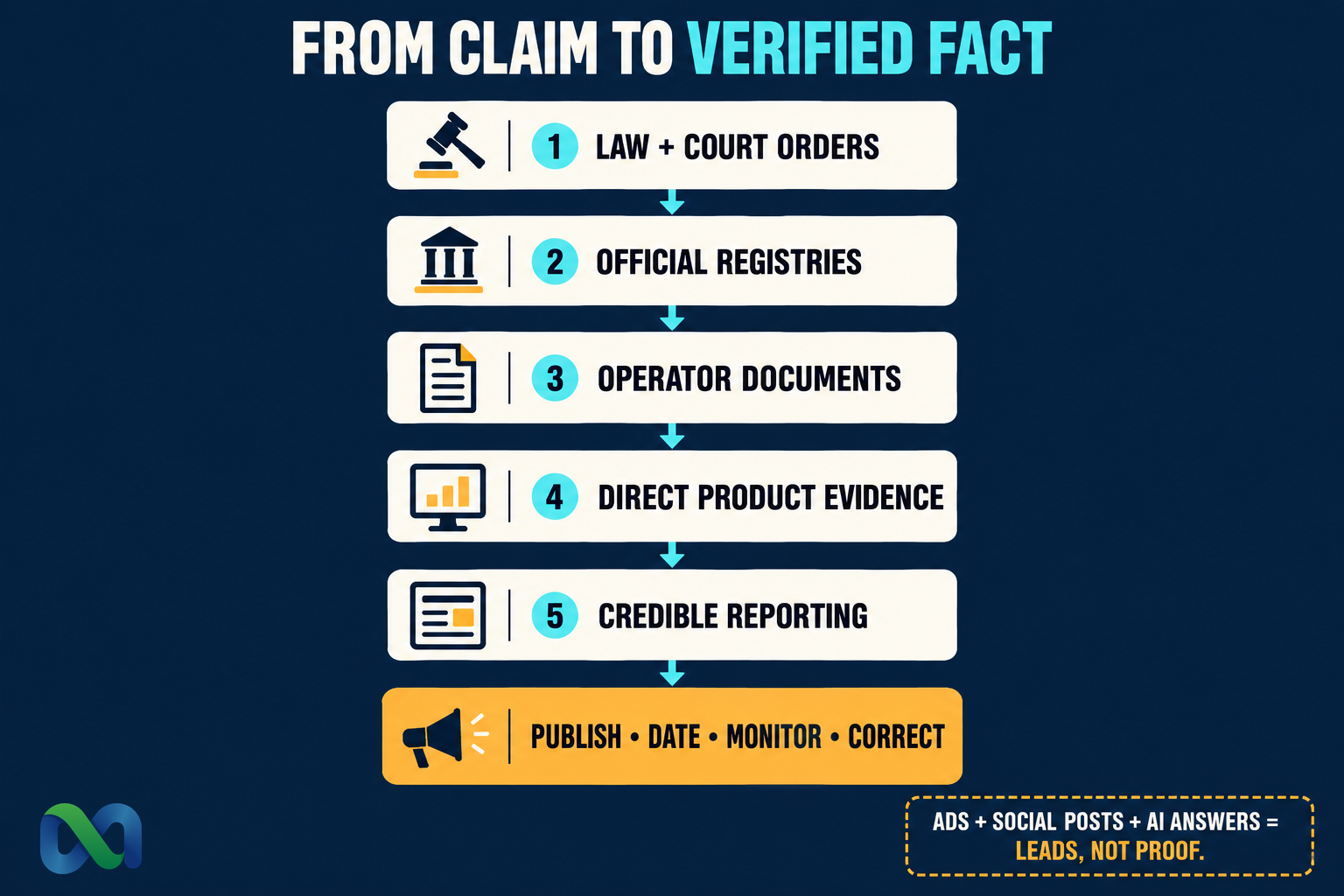
Not every source has the same weight. We use the following order when facts conflict:
- Law, regulation, and court orders: Statutes, the Code of Federal Regulations, filed opinions, and effective regulator orders.
- Official registries and filings: CFTC registration pages, designated contract market filings, product certifications, and state license lists.
- Current operator documents: Fee schedules, rulebooks, customer agreements, risk disclosures, eligibility pages, and help centers.
- Direct product evidence: Dated order previews, account notices, transaction records, and support responses when obtained through a disclosed test.
- Credible secondary reporting: Used to identify an issue or add context, then checked against primary evidence whenever possible.
Social posts, app-store descriptions, ads, influencer videos, search snippets, and AI answers are leads—not final evidence.
The CFTC’s prediction-market guide tells customers to verify registered entities and review costs, contract rules, and risk. We use the CFTC’s DCM registry to verify exchange status rather than relying on a platform badge.
How we handle conflicting sources
We record the source, publication or effective date, retrieval date, and the exact claim. A newer help-center page does not automatically override a court order. A proposed rule does not replace the current regulation. A complaint contains allegations; it is not a final judgment.
If the conflict cannot be resolved, we label the uncertainty and avoid a categorical recommendation.
How We Compare Costs and Execution
The lowest headline fee does not always produce the lowest trading cost. We use an all-in model:
all-in entry cost = contract price + transaction fee + exchange fee + spread impact + slippage + funding cost
For a planned early exit, we also estimate the exit spread, exit fee, and likely depth at the desired size.
Our same-contract snapshot procedure
When two platforms list comparable contracts, we record:
- the full contract title and rules;
- the settlement source and deadline;
- the best executable bid and ask;
- available quantity at relevant price levels;
- the order size used for comparison;
- the fee shown in the order preview;
- the timestamp and time zone; and
- whether the order would add or remove liquidity.
We do not compare a midpoint on one platform with an executable ask on another. We also do not treat contracts as identical when deadlines, overtime rules, cancellation terms, measurement sources, or resolution language differ.
Our bid-ask spread guide and slippage guide explain the execution costs included in this method.
Fee examples are labeled and dated
Any worked calculation states the assumptions, quantity, price, fee, and whether taxes or funding costs are excluded. Platform fees can change. The live order confirmation controls when it differs from an older article.
How We Evaluate Markets and Liquidity
A platform does not earn a high market score merely for listing many contracts. We look for useful selection and executable depth.
Our review considers:
- coverage across politics, economics, finance, weather, culture, technology, and sports where legally available;
- whether markets are duplicated or genuinely distinct;
- depth near the best bid and ask;
- spread width at a consistent order size;
- recent trading activity;
- availability of both entry and exit liquidity; and
- whether important markets remain accessible in the user’s location.
Volume is contextual. A large cumulative number can be concentrated in one event, measured across a long period, or reported differently by each platform. We do not compare volume figures unless the source, unit, period, and scope match.
How We Review Rules, Safety, and Legal Access
“Regulated” and “risk-free” are not synonyms.
For each platform, we identify:
- the exchange that lists the contract;
- the intermediary that opens the customer account, if different;
- the clearing or custody structure described in official documents;
- the regulator responsible for the venue or intermediary;
- state, tribal, or product restrictions;
- identity, age, and location requirements;
- market-surveillance and prohibited-conduct rules;
- customer-fund and withdrawal disclosures; and
- the complaint or dispute channel.
A registered exchange receives credit for verifiable oversight and public rules. It does not receive automatic credit for liquidity, customer service, price quality, or every contract it offers.
Our Is Kalshi legit? review uses this distinction between regulatory status and user risk. Our guide to the best prediction market apps in the US applies the broader scorecard to current platforms.
Product-level legal checks
Sports, election, economic, weather, and entertainment contracts can raise different legal or manipulation questions. We check the exact product rather than carrying a platform-level conclusion across every category.
When access is disputed, we cite the current regulator notice or court order, state the procedural stage, and avoid claims such as “legal in all 50 states” unless primary evidence supports them.
How We Test Usability
Documentation-based review and hands-on testing are reported separately.
Documentation review
Every platform can be evaluated for public sign-up requirements, supported devices, order types, disclosed fees, market rules, funding options, accessibility information, and support channels.
Hands-on testing
We call a review hands-on only when the test record identifies what was actually completed. A full account-flow test may include:
- creating and verifying an eligible account;
- funding with a small amount;
- finding and reading a contract;
- previewing an immediate and limit order;
- placing and confirming a small trade;
- canceling an open order where applicable;
- selling or holding through settlement; and
- requesting a withdrawal.
We record device, operating system, app or web version, date, location eligibility, order size, completion time, errors, and support contacts. We never create a first-person test result from screenshots, marketing copy, or another publisher’s experience.
What we do not score as investment performance
We do not rank a platform by whether a test trade won. The outcome of one event says nothing reliable about platform quality. We score execution, clarity, controls, and operational handling instead.
Recommendations, Ties, and Missing Data
A total score helps consistency, but one overall winner can hide meaningful differences. We therefore publish use-case labels such as:
- best for beginners;
- best for advanced order control;
- best for political markets;
- best for multi-asset users; or
- best for users who prioritize simple funding.
A platform must lead on the criteria relevant to the label. Brand familiarity alone is not evidence.
Tie-breaking order
When platforms finish within two points, we break the tie in this order:
- clearer legal access and regulatory structure;
- lower all-in executable cost for the compared use case;
- stronger rules and settlement transparency;
- better liquidity at the tested order size; and
- more useful account and risk controls.
Missing or private information
We mark a field “not verified” when public evidence is insufficient. We do not fill gaps with assumptions. Missing material information reduces the transparency score and can prevent a best-for recommendation.
Bonuses, Affiliates, and Commercial Independence
Sign-up bonuses do not affect the core score. Promotions are temporary, may require deposits or trading volume, and can distract from spread, fees, or withdrawal terms.
If Macro Markets receives affiliate compensation, the relationship must be disclosed. Editorial staff retain control of the score, ranking, criticism, and correction. A partner cannot buy a higher placement or remove a documented limitation.
We also separate advertising claims from independently verified facts. “Zero commission” does not mean zero spread, zero exchange fee, or zero funding cost. “Nationwide” does not prove every contract is available in every location.
Update and Fact-Check Policy
Comparison pages receive a full scheduled review at least once per quarter. We also trigger an earlier review after a material event, including:
- a license, registration, or legal-entity change;
- a new court or regulator order;
- a fee-schedule or funding-policy change;
- a market-category launch or removal;
- a major security or availability incident;
- a material app or order-flow redesign; or
- reliable evidence that a published fact is wrong.
Each article displays the date of its last substantive review. Changing a date without rechecking the facts does not count as an update.
Corrections
When a factual error is confirmed, we correct the page, update the affected comparison or score, and record the new review date. Material corrections should explain what changed. Minor grammar or formatting edits do not require a new fact-check date.
Readers and platforms may submit evidence, but a claim is not changed merely because it is disputed. We review the supporting primary source first.
Frequently Asked Questions
Does the highest score mean the platform is best for everyone?
No. The score measures the standard framework. A lower-scoring platform may fit a specific user better because it lists the needed market, supports the preferred funding method, or offers better execution at that moment.
Do you open and fund every platform account?
Not for every comparison. The article must state whether it is documentation-based or includes hands-on testing. We never imply an account test that did not occur.
Do affiliate payments change rankings?
No. Commercial relationships must be disclosed and do not add points. Regulation, cost, liquidity, transparency, tools, and operations determine the score.
How do you compare fees that use different formulas?
We calculate the cash cost for the same contract quantity and executable price, then include spread, slippage, exchange charges, and relevant funding or withdrawal costs.
Why can rankings change?
Fees, liquidity, product access, legal restrictions, and platform features change. A new primary source can also correct an earlier assumption. Rankings should move when the evidence moves.
Our editorial standard
Macro Markets comparisons should be reproducible. A reader should be able to follow the source links, inspect the assumptions, repeat the calculations, and understand why a platform received its label.
The method favors verified regulation, transparent rules, executable cost, useful liquidity, and honest disclosure. It penalizes missing evidence, stale claims, incomparable numbers, and marketing language presented as fact.
That standard matters more than forcing a winner. When the evidence does not support a confident recommendation, we say so.
