


Kalshi vs Polymarket: Which Is Better for US Users? (2026)
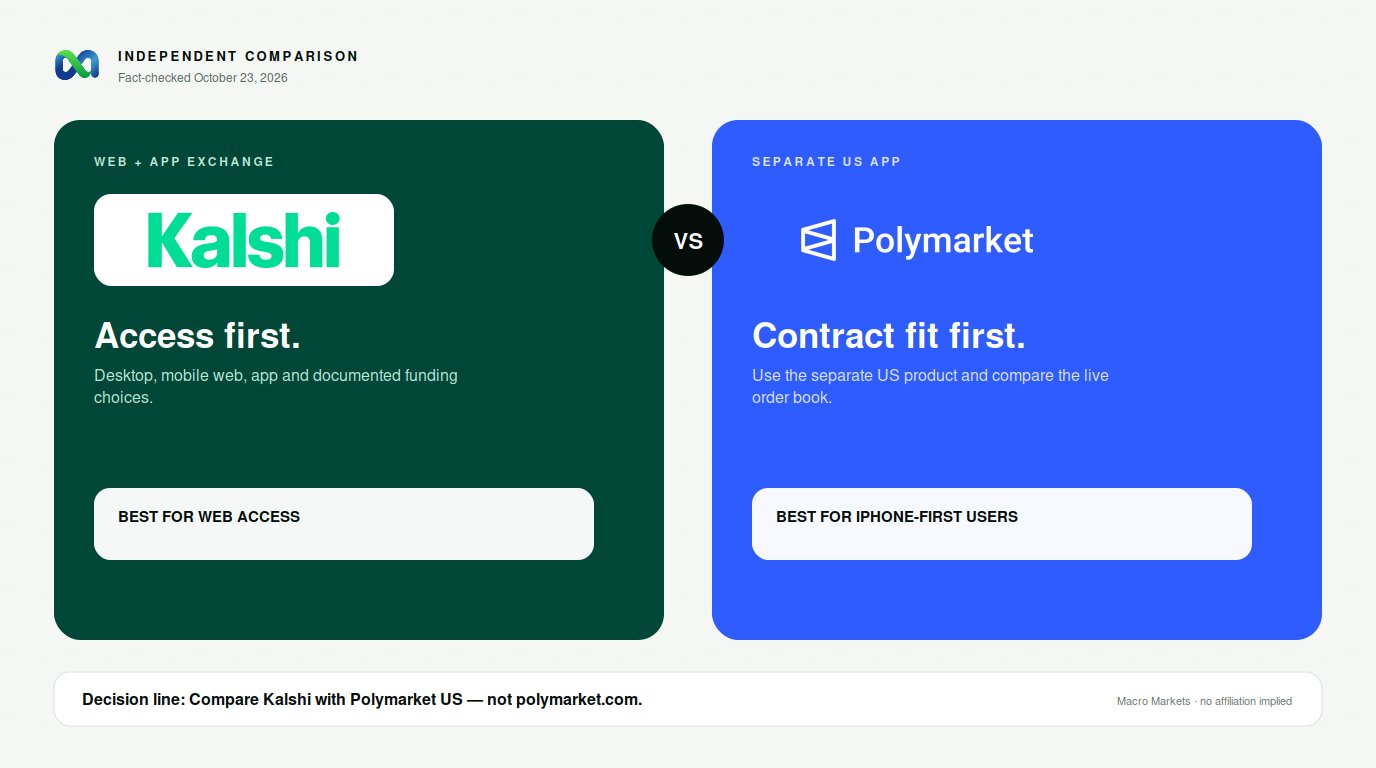
Kalshi and Polymarket US are both federally regulated prediction-market exchanges. There is no universal winner: the better choice depends on whether you need web access, which venue lists the exact contract you want, the live spread and depth, the fee shown before the order, and whether trading is available in your location.
For most US users, Kalshi is the more practical starting point if desktop or mobile-web access and a wider set of funding methods matter. Polymarket US may be the better fit for an iPhone user who prefers its separate US app or finds a stronger order book on a specific contract. If both list the same event, compare the contract rules and all-in execution cost—not brand familiarity.
Last reviewed and fact-checked: October 23, 2026. Product access, fees, markets, and legal restrictions can change quickly.
Editorial disclosure: Macro Markets does not choose a winner based on affiliate compensation. This comparison uses official exchange, clearing, regulatory, and help-center sources. It is educational, not financial or legal advice. Event contracts can settle at $0, and you can lose the full amount paid plus fees.
Kalshi vs Polymarket: The Short Answer
Choose Kalshi when you want to trade in a browser, prefer more documented US funding choices, or find the better price and liquidity there. Choose Polymarket US when its iOS app is available to you and it offers the specific market, rules, spread, or depth you prefer.
Do not choose based on screenshots of global Polymarket volume. US residents cannot trade on polymarket.com, and the international website is not the same product as Polymarket US. Accounts, support, access, markets, liquidity, and fee schedules can differ. Our standalone Polymarket US review verifies the current US fee formula, funding methods, order types, clearing structure and product limitations before this head-to-head comparison.
Here is the practical verdict:
- Best for web access: Kalshi.
- Best funding flexibility: Kalshi, based on currently documented options.
- Best for iPhone-first Polymarket users: Polymarket US.
- Best regulation: Tie; both US exchanges are CFTC-designated contract markets with registered clearing organizations.
- Best fees or liquidity: No permanent winner; compare the exact market at the moment you trade.
- Best overall: The venue with clearer rules and lower all-in cost for your specific contract.
First, Compare Kalshi With Polymarket US—not Polymarket.com
This distinction prevents the biggest mistake in Kalshi vs Polymarket comparisons.
The official Polymarket help center says polymarket.com is for international users and is not accessible to US residents for deposits or trading. Polymarket US is a separate US product with separate accounts and support. As of the help article's June 25, 2026 update, the US product is available as an iPhone app, while Android is described as coming soon.
That means a chart from polymarket.com does not prove that a US user can access the same contract or liquidity. A global fee page does not establish the fee on Polymarket US. And a global account cannot be assumed to connect to a Polymarket US account.
Kalshi, by contrast, documents trading through its website and app. This gives it a clear accessibility advantage for people who want a desktop browser or do not use an iPhone.
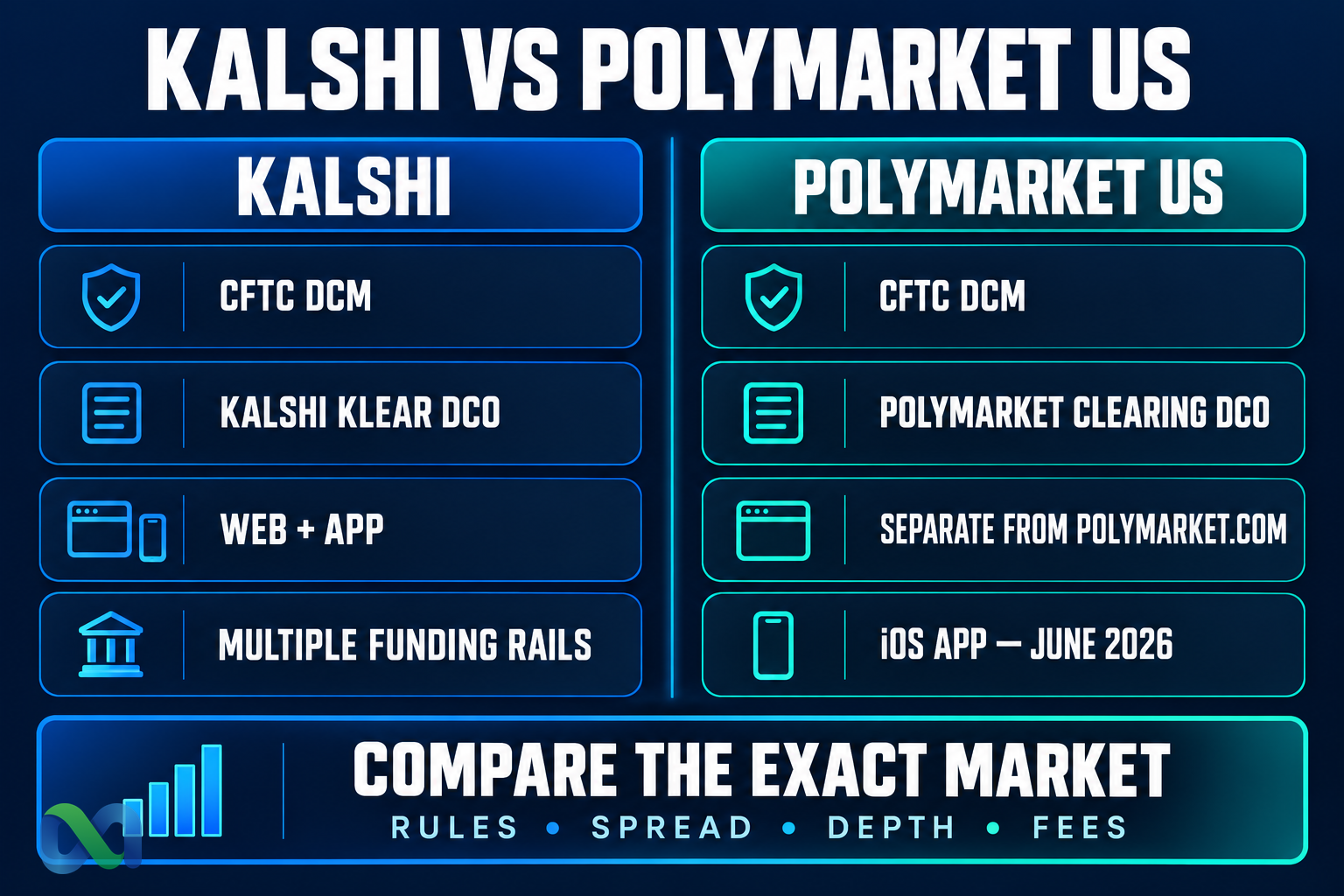
Kalshi vs Polymarket US at a Glance
| Feature | Kalshi | Polymarket US |
|---|---|---|
| US exchange | KalshiEX LLC, CFTC-designated contract market | QCX LLC d/b/a Polymarket US, CFTC-designated contract market |
| Clearing | Kalshi Klear LLC, registered derivatives clearing organization | QC Clearing LLC d/b/a Polymarket Clearing, registered derivatives clearing organization |
| US interface | Website and app | Separate US iOS app as of June 25, 2026; Android described as coming soon |
| International product | Kalshi documents access for eligible international users, subject to restrictions | polymarket.com is separate and not available to US residents for trading |
| Funding documented for US users | Debit card, ACH, PayPal, Venmo, Cash App deposits, crypto, and wire; availability and holds vary | Trust hub references ACH, debit card, and wire; check the app for current availability |
| Trading hours | 24/7 except regular Thursday maintenance, 3:00–5:00 a.m. ET | 24/7 except regular Thursday maintenance, 6:00–8:00 a.m. ET |
| Fees | Vary by contract and order type; some markets have maker fees | Current schedule and order preview control; do not substitute global-site fees |
| Market availability | Changes by listing, location, and legal developments | Changes by listing and location; current Trust hub says Nevada is unavailable |
| Liquidity | Market-specific | Market-specific |
| Our verdict | Better access and funding flexibility | A credible US alternative when its app and exact market fit your needs |
Regulatory status is not the same as a guarantee of profit, uninterrupted access, or bank-deposit insurance. Read Is Kalshi legit? for a deeper safety and regulation review, and see Is Kalshi gambling? for the current sports-contract legal dispute.
Regulation and Safety: Both Are CFTC-Regulated Exchanges
The old shorthand—“Kalshi is regulated, Polymarket is offshore”—is no longer accurate for a US comparison.
The CFTC's official registry lists KalshiEX as a designated contract market. It also lists QCX LLC d/b/a Polymarket US as a designated contract market, designated on July 9, 2025.
Both also use CFTC-registered clearing organizations. Kalshi contracts clear through Kalshi Klear, while Polymarket US uses Polymarket Clearing. Clearing is designed to manage collateral and settlement; it does not make a losing position refundable.
Polymarket US says its positions are fully collateralized and that customer identity is verified. It also states that funds under the clearing framework are not bank deposits and are not insured as bank deposits. The same practical warning applies broadly: CFTC oversight is meaningful, but it is not FDIC insurance and does not remove market, account, operational, or legal risk.
What regulation does—and does not—settle
Federal registration creates rules for market integrity, surveillance, capital, recordkeeping, and customer protection. It does not mean every listed contract is available in every state forever.
Sports event contracts remain contested by states and tribes. In 2026, federal appellate decisions allowed significant gaming-law challenges involving Kalshi sports contracts to proceed. Polymarket US currently says trading is unavailable in Nevada. Before trading a sports contract, check the platform's current location notice and any recent regulator or court order.
Never use a VPN to evade a geographic restriction. A market visible in an app is not a permanent legal opinion for your location.
Fees: Compare the Order, Not a Marketing Claim
Neither platform deserves a permanent “cheapest” label.
Kalshi's fee documentation says transaction fees are based on expected earnings and that some markets use different fees. It also says some contracts can carry maker fees. The order ticket displays fee information before purchase.
Polymarket US directs users to its current trading fee schedule. Its schedule has changed over time, so an old PDF or a fee page from polymarket.com should not be treated as the live US rate. Use the Polymarket US order preview and current documentation.
The fee line is only one part of cost. Your real comparison is:
all-in cost = platform fee + bid-ask spread + slippage + funding or withdrawal cost
A venue advertising a smaller explicit fee can still be more expensive if its order book is thin. A wide spread means you pay more to enter and may receive less when exiting. A market order can also move through several price levels, creating slippage.
A simple comparison example
Suppose the same Yes contract is offered at 57¢ on one venue and 59¢ on another. The first venue looks cheaper, but that conclusion may fail if only five contracts are available at 57¢ and your remaining order fills at 61¢. Add the displayed fee and compare the average fill for your entire order.
Before submitting:
- Match the exact event, deadline, and settlement source.
- Check the best bid and ask.
- Inspect depth near your intended size.
- Review the fee in the order preview.
- Estimate the cost of exiting before resolution.
Our guide to the bid-ask spread in prediction markets explains why the visible price is not always the executable price.
Markets and Liquidity: There Is No Platform-Wide Winner
“Which platform has more markets?” is less useful than “Which platform has the exact contract I can trade under rules I understand?”
Category counts change. Two contracts that sound similar may have different deadlines, official sources, cancellation provisions, tie rules, or definitions. One may ask whether an event happens by 11:59 p.m. ET; another may use UTC or a different publication date. Those are not interchangeable positions.
Liquidity is also local to each order book. One election market can be deep on Polymarket US while a macroeconomic release is deeper on Kalshi. Brand-level volume does not tell you whether your order can execute without moving the price.
For every trade, compare:
- the exact question and event definition;
- the close time and settlement time;
- the named resolution source;
- the cancellation, postponement, or ambiguity rule;
- the current spread;
- available size near the best price; and
- recent trading activity on the US venue itself.
If only one exchange lists the contract, the decision is simple—but the due diligence is not. Read the rules before funding the position.
Accounts, Funding, and Withdrawals
Both platforms require identity verification. Availability can depend on age, identity, sanctions checks, and physical location.
Kalshi currently documents a broader menu of transfer methods for US users: debit card, ACH, PayPal, Venmo, Cash App for deposits, crypto, and wire. Minimums, limits, state availability, processing time, and withdrawal holds vary. A fast deposit does not guarantee an instant withdrawal; Kalshi says security holds depend on the deposit method.
Polymarket US's Trust & Safety Hub references ACH, debit card, and wire funding. Check the app before relying on a particular method because options and limits can change by account.
Funding convenience should not outrank contract quality. Still, it matters when one platform supports your bank or payment method and the other does not. Before depositing, verify:
- minimum and maximum transfer amounts;
- deposit fees;
- withdrawal fees;
- settlement and security-hold periods;
- whether the withdrawal must return through the original rail; and
- whether the method is available in your state.
Trading Experience and Operating Hours
Both exchanges describe near-continuous trading with weekly maintenance.
Kalshi's official hours are 24/7 except a regular maintenance window on Thursdays from 3:00 to 5:00 a.m. ET. Polymarket US publishes a regular Thursday maintenance window from 6:00 to 8:00 a.m. ET.
These windows matter if a market moves quickly overnight. You may be unable to enter, exit, or adjust an order during maintenance. Unscheduled outages are also possible on any electronic venue.
Kalshi's browser access is the largest day-to-day interface advantage in this comparison. Polymarket US is a separate iOS product as of the official June 2026 documentation. If your workflow requires multiple desktop tabs, a physical keyboard, or browser-based research, Kalshi is the easier fit today.
Resolution Rules Matter More Than the Logo
Prediction markets settle according to written contract rules, not the outcome you think “obviously” happened.
Before buying, locate the primary settlement source. It might be an agency release, election authority, league record, court filing, or another defined publication. Then check what happens if data are revised, an event is delayed, a candidate withdraws, or no source publishes by the deadline.
Polymarket US says the exchange lists its markets and publishes the resolution terms; users cannot create their own markets. Kalshi also publishes contract rules for each market. On both venues, save or reread those terms before taking a meaningful position.
A clearer contract at a slightly worse displayed price may be safer than an ambiguous contract with a one-cent advantage. Resolution risk can dominate the fee difference.
Kalshi vs Polymarket: Which Should You Choose?
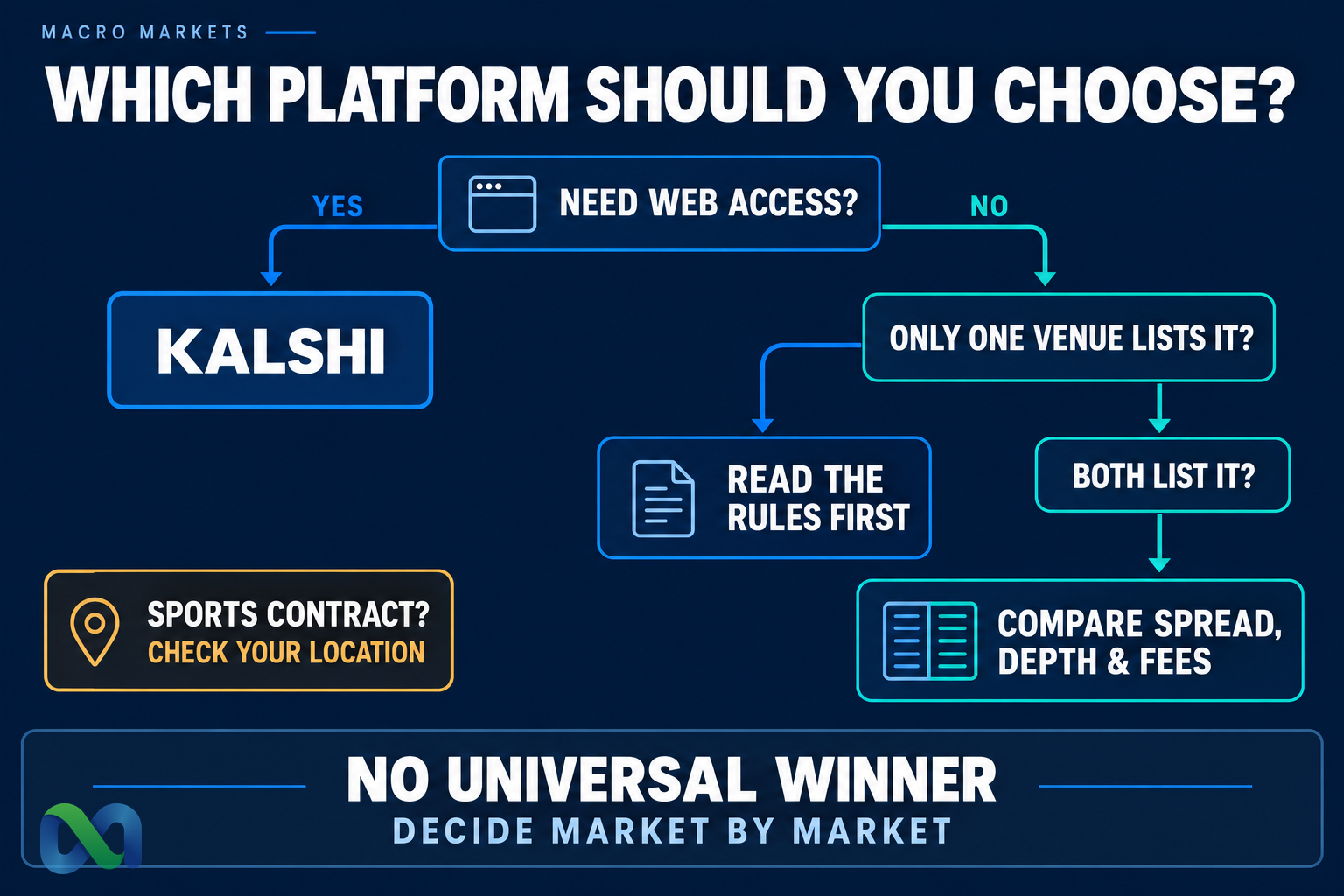
Use this decision order:
Choose Kalshi if:
- you need a website rather than an iPhone-only workflow;
- you prefer its currently documented funding methods;
- it is the only venue listing the contract;
- its spread, depth, and displayed fee produce the lower all-in cost; or
- its contract definition and resolution source are clearer.
Choose Polymarket US if:
- you are eligible to use the US app and prefer its interface;
- it is the only venue listing the contract;
- it has better executable liquidity for your order size;
- its live fee and spread produce the lower total cost; or
- its rules more precisely match the event you want to forecast.
Use neither if:
- the contract wording is ambiguous;
- you cannot verify current legal access where you are;
- the spread or slippage makes the trade unattractive;
- you need the deposited funds before the withdrawal hold may end; or
- losing the entire position would harm your finances.
For more exchange and broker choices, compare the best Polymarket US alternatives and the broader best prediction market apps in the US. If you are new to platform due diligence, read Is Kalshi legit? before placing a real order.
Frequently Asked Questions
Is Kalshi or Polymarket better in the US?
Kalshi is better for users who need browser access or want its broader documented funding menu. Polymarket US can be better when its iOS app, exact market, rules, or order-book liquidity fit your trade. Compare each contract rather than assigning one permanent winner.
Can US users trade on polymarket.com?
No. Polymarket's official help center says the international website is not accessible to US residents for deposits or trading. US users must use the separate Polymarket US product, subject to eligibility and location restrictions.
Are Kalshi and Polymarket US both regulated?
Yes. Both are CFTC-designated contract markets, and both use CFTC-registered derivatives clearing organizations. Regulation does not prevent losses or guarantee that every contract remains available in every state.
Which has lower fees, Kalshi or Polymarket?
There is no stable platform-wide answer. Fees can vary by market and change over time. Compare the live order preview, spread, depth, slippage, and transfer costs for the exact order. Do not use polymarket.com's global fee information for Polymarket US.
Does Polymarket US have a website?
The official help article updated June 25, 2026 describes Polymarket US as an iOS app and says Android is coming soon. The browser-based polymarket.com product is for international users, not US residents. Recheck official documentation because product access can change.
Which platform has more liquidity?
Liquidity varies by contract, price, time, and order size. Global Polymarket volume does not prove liquidity on Polymarket US. Inspect the live US order book and estimate your average fill before trading.
Is Polymarket US available in every state?
Its Trust & Safety Hub currently says trading is unavailable in Nevada. Other restrictions may change. Check the app and current notices from regulators before trading, especially sports contracts.
Can I lose all the money I put into a contract?
Yes. A binary contract that settles against your position can become worth $0. Fees and execution costs can increase the loss. Use money you can afford to lose and size positions conservatively.
Kalshi vs Polymarket: Final Verdict
Kalshi wins on practical access today because it supports a website and documents more US funding routes. Polymarket US is now a genuine federally regulated competitor, not a synonym for the separate international website.
But the platform-level verdict is only a starting point. The smarter choice is made one contract at a time. Compare the rules, settlement source, location restrictions, spread, depth, live fee, and withdrawal constraints. If one venue cannot pass those checks, use the other—or skip the trade.
Bottom line: start with Kalshi for broad access, consider Polymarket US when its specific market or liquidity is better, and never substitute global Polymarket data for the US product.
