Polymarket US Review 2026: Fees, Safety and How It Works
Polymarket US is a regulated American event-contract exchange, not a US login for the international Polymarket.com platform. It combines a prediction-first consumer experience with a central limit order book, market and limit orders, USD funding, formal exchange rules and an unusually extensive public API stack.
Our verdict: Polymarket US is a strong choice for an eligible US customer who wants a dedicated prediction-market product, direct exchange liquidity and modern developer tools. Its current strengths are clear legal roles, broad event discovery, conventional buy-and-sell mechanics and transparent fee formulas. Its main drawbacks are price-sensitive taker fees, volume-gated rebates, iOS-led consumer access, contract-specific liquidity and persistent confusion with Polymarket.com.
Last reviewed and fact-checked: November 3, 2026.
Fees and rebate window updated: November 7, 2026. Other product sections retain their November 3 review date.
Editorial disclosure: Macro Markets publishes this review and operates a prediction-market platform. We include Macro Markets as a disclosed crypto-native alternative and do not present it as a CFTC-designated US exchange. This review is based on current official documents and product materials; we did not place a synchronized funded test trade through every order, payment and withdrawal route. Event contracts can settle at $0, and regulation or full collateralization does not protect a customer from market loss. This page is educational, not financial, legal or tax advice.
Polymarket US Review: Quick Verdict
Polymarket US is legitimate and purpose-built for event trading. QCX LLC d/b/a Polymarket US is a Commodity Futures Trading Commission-designated contract market. QC Clearing LLC d/b/a Polymarket Clearing is a registered derivatives clearing organization permitted to clear fully collateralized positions.
That structure gives the product a clearer exchange identity than an intermediary app that routes to several partner venues. The Polymarket US exchange controls its contracts, order book and rules; Polymarket Clearing processes settlement. Customers still need to verify the exact contract, location eligibility, available depth, fee and withdrawal status before taking risk.
Polymarket US at a glance
| Review factor | Finding | Why it matters |
|---|---|---|
| Legal structure | QCX DCM plus Polymarket Clearing DCO | The exchange and clearing roles are identifiable |
| Consumer product | Separate Polymarket US account and iPhone app | Polymarket.com accounts, balances and volume do not transfer |
| Contracts | Event-based derivatives with Yes/No outcomes | A losing position can settle at $0 |
| Orders | Market and limit orders on a CLOB | Execution depends on available orders and depth |
| Standard taker fee | Θ × contracts × price × (1 − price); Θ = 0.0695–0.095, subject to account rules |
Cost is highest near a 50% price |
| Maker treatment | No rebate below $10 million qualifying maker volume; rolling daily tiers and account rules apply | A resting order is not automatically paid a rebate |
| Funding | Debit, ACH, Apple Pay, PayPal, Venmo, USDC where available and wire | Holds, provider checks and limits still apply |
| Minimum age | At least 18 and the age of majority where the customer resides | Verification and location controls apply |
| APIs | Public documentation for data, WebSockets, SDKs and institutional access | Trading permissions and credentials are not universal |
| Best fit | Eligible users seeking a dedicated regulated prediction exchange | Not ideal when another venue has better contract depth or rules |
Best for: an eligible US user who values direct exchange mechanics, prediction-first discovery, limit orders and developer documentation.
Skip it if: you need Android consumer access today, cannot pass KYC, expect guaranteed liquidity, want international Polymarket.com markets in the same account or would struggle with a total loss.
Main advantages
- Identifiable CFTC-designated exchange and registered clearinghouse.
- Dedicated event-contract order book rather than house-set odds.
- Market and limit orders, partial fills and standard time-price priority.
- Direct USD payment rails plus USDC where available.
- Public fee formulas, market rules and developer documentation.
- Ability to sell before settlement when executable liquidity exists.
Main limitations
- Polymarket US and Polymarket.com remain easy to confuse.
- Standard taker fees peak around the midpoint of the price range.
- Maker and taker rebates require significant qualifying volume; the rolling window and onboarding rules matter.
- Consumer access remains centered on the US iPhone app; Android is still described as coming soon.
- Displayed probabilities can differ from the average price available for the intended size.
- Verification, funding clearance, contract restrictions and settlement timing can delay access to cash.
What Is Polymarket US and How Does It Work?
Polymarket US is the assumed name of QCX LLC, the exchange that lists and matches event-based derivatives. Polymarket Clearing is the affiliated DCO that clears fully collateralized positions and processes settlement. The current exchange rulebook permits direct-access, FCM and broker participants, subject to approval and the applicable account arrangement.
For a consumer, the basic flow is:
- Create a separate Polymarket US account.
- Complete identity verification and any additional review.
- Deposit through an available rail.
- Select a US exchange-listed event contract.
- Read the market rules, source, deadline and restrictions.
- Submit a market or limit order to the central limit order book.
- Sell before resolution when sufficient liquidity exists, or hold through exchange resolution and clearing settlement.
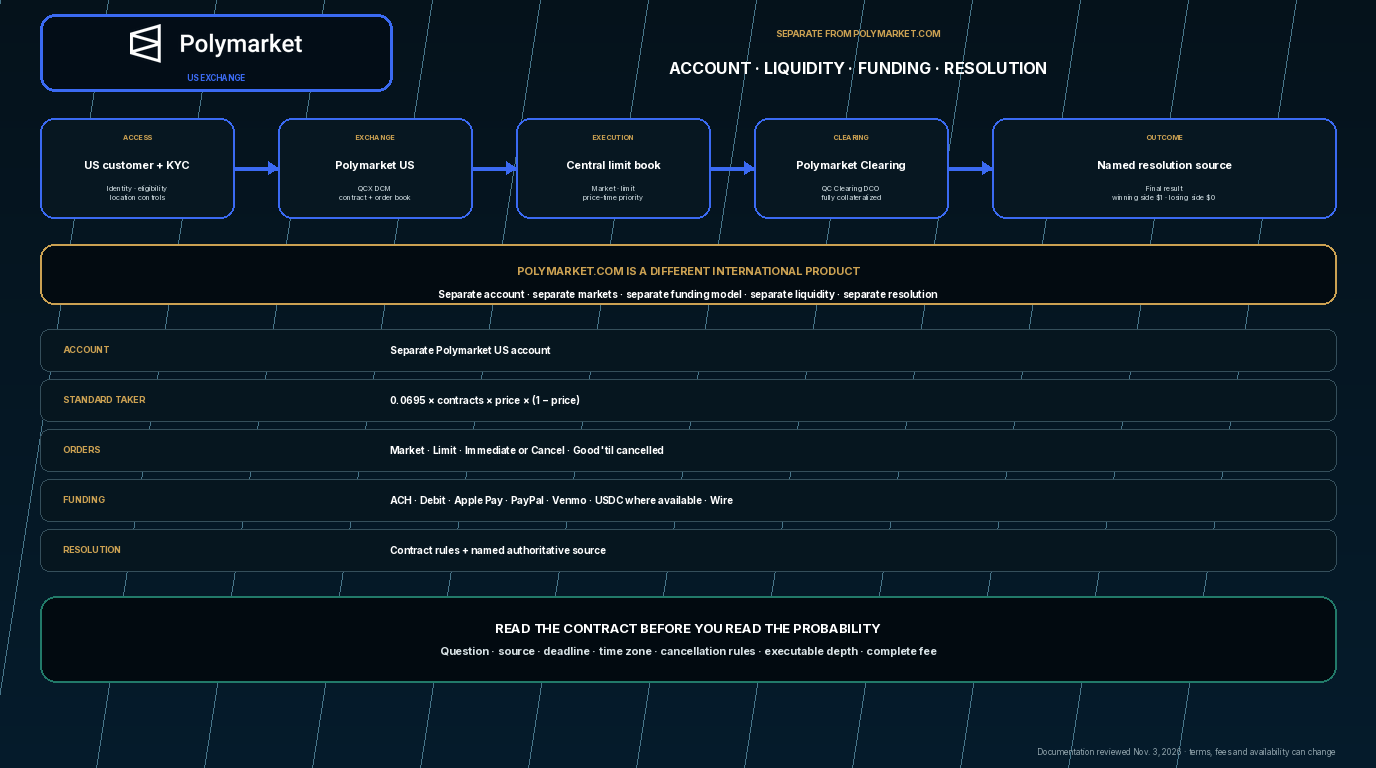
Polymarket US owns the contract and exchange book; Polymarket Clearing handles the clearing and settlement layer. Neither should be replaced with evidence from Polymarket.com.
Polymarket US is not Polymarket.com
This is the most important fact in the review. Polymarket's official product-separation guide says Polymarket.com serves eligible international users, while US residents use the separate Polymarket US product. Accounts and support teams are not connected.
Do not use Polymarket.com data to claim any of the following about Polymarket US:
- total trading volume or liquidity;
- USDC-only funding or a non-custodial wallet model;
- international category fee rates;
- UMA Optimistic Oracle resolution;
- access to the same markets, positions or API credentials.
Our broader Polymarket review explains both products. This page deliberately reviews only the US exchange.
How Yes and No contracts work
A binary market asks whether a defined outcome will occur. A contract price between $0.01 and $0.99 reflects the amount paid for that outcome position, not a guaranteed probability estimate. The winning side normally settles at $1 and the losing side at $0 after final resolution.
An order matches another order on the CLOB. Polymarket US says trades are matched between users rather than against the house. A market order seeks immediate execution within price protection; a limit order specifies the worst acceptable price and can rest on the book.
The headline is not the contract. Before trading, record the exact proposition, official source, observation window, time zone, cancellation language, alternative settlement terms and trading close. A similar question on Kalshi, ForecastEx or Polymarket.com is a separate contract with separate liquidity.
Polymarket US Fees, Rebates and Complete Trading Cost
Fee update checked November 7, 2026: the official Polymarket US fee schedule specifies volume-based standard taker coefficients from November 6 at 1:00 PM Eastern Time. Its older fixed-coefficient examples remain farther down the same documentation page; they should not be read as a universal current retail rate. This update is based on published terms, not a funded execution test.
Standard taker fee = Θ × contracts × price × (1 − price). Price is expressed in dollars. Θ is a coefficient, not a flat percentage of the amount invested or of profit. For a fixed quantity and coefficient, the dollar fee peaks at a $0.50 contract price.
Standard taker fee tiers and a worked example
The ordinary tier uses taker volume from the preceding 30 completed Eastern Time calendar days, excluding today. Consider one hypothetical fill of 100 contracts at $0.50: the contract premium is $50 and the price-and-quantity factor is 25. No rebates, spread, slippage, funding cost or later exit is included.
| 30-day volume | Θ | Fee |
|---|---|---|
| Under $10k | 0.095 | $2.38 |
| $10k–<$50k | 0.085 | $2.12 |
| $50k–<$250k | 0.075 | $1.88 |
| $250k+ | 0.0695 | $1.74 |
Adding the $50 premium gives entry totals of $52.38, $52.12, $51.88 and $51.74 across these rows, before other costs.
The lowest-volume row is not automatically every new user's rate. New-account and November transition rules can give an account a different coefficient. The schedule also places table tennis on this same standard ladder rather than its former 0.10 coefficient. Combo executions retain a separate fee curve.
New-account and November transition rules
Days 1–7 use Θ = 0.0695 regardless of volume for taker fees. Day 1 is the Eastern Time calendar date of the first filled order, including a maker fill; it is not a rolling 24-hour period. During days 8–30, the tier uses the higher of first-seven-day volume multiplied by 30/7 and trailing-30-day volume. Maker and taker volumes are evaluated separately for the corresponding fee or rebate tier. From day 31, the respective trailing window applies.
Accounts first filled in the six days before launch retain the remaining days of that window. During November, existing accounts receive the better tier calculated from October volume or the trailing window. Manual overrides take precedence. The coefficient is fixed when an order is inserted, so an older resting order can retain an earlier coefficient when it fills later. Check the account's actual order preview.
Volume and rounding change the calculation
Qualifying volume measures the position received, not the contract's face value: a buy contributes contracts × price; a sell contributes contracts × (1 − price). Buying 100 contracts at $0.50 therefore adds $50, not $100, to the applicable volume tally. Maker and taker fills count in their respective categories; combo fills count toward both, and voided fills are excluded.
Fees use nearest-cent half-to-even rounding. At Θ = 0.085, the example's exact $2.125 becomes $2.12, not $2.13. An aggressive order split across fills has an additional cumulative-fee adjustment, so do not blindly multiply a rounded one-contract fee by the order size. Maker rebates are calculated independently per fill.
Maker and taker rebates are volume-gated
A resting limit order only becomes a maker fill when someone executes against it. Below $10 million in qualifying maker volume there is no maker rebate; higher maker tiers use rebate coefficients of 0.0035, 0.0070 and 0.0104 in magnitude. Taker rebates begin at $250,000 in qualifying taker volume and range from 3% to 30% of eligible taker fees. These rebate tiers are separate from the four standard taker-fee tiers above.
From the November 6 cutover, rebate tiers use the preceding 30 completed Eastern Time calendar days and are set daily at midnight ET, subject to applicable onboarding and override rules. The rebate thresholds, coefficients and percentages were not changed by this window update. Taker rebates continue to be paid weekly. Count a rebate only when the actual account and fill qualify.
Combo fees use a different curve
Combo contracts use a separate taker formula. Effective October 28, 2026, the coefficient on the (1 − price)^4 term increased from 0.06 to 0.085:
combo taker fee = contracts × price × [0.0695 × (1 − price) + 0.085 × (1 − price)^4]
That curve should be calculated separately rather than estimated from the standard table. Combo fills carry no maker rebate, although qualifying taker rebates can still affect net cost under the current program.
The complete cost is larger than the platform fee
Use this framework:
all-in cost = entry fee − earned rebate + spread + slippage + exit fee + funding cost + withdrawal cost
The same fee formula can apply again when an early sale removes liquidity. A limit order can reduce price uncertainty, but it can remain unfilled. On a thin book, a one- or two-cent worse average execution can cost more than the explicit fee difference between platforms.
Use the prediction-market fee calculator to separate cost components, but verify that its selected model accepts the coefficient and account rules for this order. Compare the full executable book, not a headline percentage.
Funding, Withdrawals, Eligibility and Device Access
Polymarket US requires KYC before a customer can deposit or trade. The account guide says signup can use Google or Apple ID, followed by date of birth, phone, legal name, residential address and Social Security number. Additional review can require government identification and a selfie.
The exchange rulebook says an individual participant must be at least 18 and have reached the age of majority in the relevant state or country of residence. Passing the age threshold does not guarantee that every contract or category is available in every location.
Deposit methods and limits
The current funding guide lists:
- debit card;
- bank transfer through ACH;
- Apple Pay on iPhone;
- PayPal;
- Venmo;
- USDC on iPhone where available; and
- wire transfer.
It lists a $50,000 daily limit for debit and ACH, with three to four business days of processing. Wires have a $5,000 minimum, no stated maximum and an estimated one-business-day processing time. Non-wire deposits may receive instant buying power while processing, but withdrawals remain unavailable until the deposit fully clears.
Instant buying power is credit for trading, not proof that the money can immediately leave the account. A failed or reversed payment can create restrictions. Deposits must come from accounts in the customer's own name and can be reviewed.
Consumer device access
The official product-separation guide currently identifies the Polymarket US iOS app as the US consumer product and says Android is coming soon. The broader documentation also describes web and API workflows for approved users and integrations. Do not assume that institutional or developer access means every retail customer has the same interface or permission set.
Withdrawals and cash availability
The usable cash path is:
payment rail → cleared Polymarket US balance → trade → sale or settlement → available balance → withdrawal rail
Account review, deposit clearance, unresolved positions and provider checks can affect timing. Test the entire path with a small amount before relying on it for a time-sensitive obligation. Never fund event contracts with money needed for rent, taxes or emergency expenses.
Markets, Orders, APIs and Liquidity
Polymarket US can list sports, politics, economics, crypto, commodities, weather, technology, culture and other event categories, subject to exchange rules and current availability. Breadth is useful for discovery, but one popular contract does not prove that a niche market will be deep.
Market and limit orders
The official order-type guide documents two core instructions:
- Market order: seeks immediate execution against the best available orders within quote-based price protection. Any remainder does not rest on the book.
- Limit order: executes at the stated price or better. A partial fill can leave the remainder open until it fills, is cancelled or expires, unless Immediate or Cancel is selected.
Limit expiries include Good 'til cancelled, a specified daily cutoff, start of game for eligible sports contracts and Immediate or Cancel. Orders follow standard price-time priority.
| Capability | Current Polymarket US evidence | Practical implication |
|---|---|---|
| Order book | Central limit order book | Users trade against available orders, not house odds |
| Market orders | Immediate execution with price protection | Fast but exposed to spread and depth |
| Limit orders | Price control, partial fills and configurable expiry | Better control but no fill guarantee |
| Fractional contracts | Documented in the US product | Position size can be more granular |
| Early exit | Sell against available liquidity | Exit value is not guaranteed |
| Market data | REST, WebSockets and depth documentation | Useful for research and monitoring |
| Trading integration | SDKs, API credentials and institutional routes | Approval, permissions and limits apply |
| Hours | Generally 24/7 with scheduled maintenance | A listed market can still pause or close |
APIs and developer tools
Polymarket US publishes documentation for API references, WebSockets, SDKs, market data, partner integration and institutional connectivity. That is a material advantage for builders and professional users.
Public documentation is not the same as unrestricted automated trading. Confirm which endpoints are read-only, whether the account can create trading credentials, rate limits, order permissions and compliance obligations. An integration should preserve the exchange, instrument identifier, price scale, quantity scale and current contract rules.
Liquidity must be measured by size
A displayed price is only one point on the book. Before entering, inspect:
- best bid and best ask;
- spread in cents and percentage terms;
- quantity at the best level;
- average fill price for the intended order;
- depth available for a possible early exit; and
- whether another venue's similar contract actually has identical rules.
Polymarket US liquidity cannot be added to Polymarket.com, Kalshi or ForecastEx liquidity. The Polymarket US vs Crypto.com Predict Pro comparison demonstrates why two similar questions can maintain independent books and prices.
Is Polymarket US Legit and Safe?
Polymarket US is a legitimate regulated exchange. The CFTC lists QCX as a designated contract market and Polymarket Clearing as a registered DCO. The exchange is also a self-regulatory organization with surveillance, compliance and disciplinary responsibilities under its rulebook.
Registration is not a promise of profit, liquidity, uninterrupted access or instant withdrawals. It does not prevent a fully collateralized position from losing its purchase price.
Resolution and settlement
The US resolution guide says the exchange determines outcomes from the criteria and authoritative sources named in each market's rules. Sources can include government agencies, governing sports organizations, specified financial benchmarks and named news outlets.
After final resolution, Polymarket Clearing processes settlement. Winning contracts normally settle at $1 and losing contracts at $0. Some markets can define alternative settlement terms, which is another reason to save and read the complete rule set before trading.
The international UMA process does not control a Polymarket US contract.
Material risks
- Market loss: the losing side can become worthless.
- Liquidity risk: a position may not be sellable near the displayed probability.
- Spread and slippage: larger orders can execute across several price levels.
- Resolution risk: ambiguous wording or delayed authoritative data can slow the result.
- Operational risk: maintenance, payment holds or account review can interrupt access.
- Restriction risk: eligibility or contract availability can change.
- Information risk: an app headline or AI summary can omit controlling rule language.
- Conduct risk: the trading-restrictions policy prohibits activity involving certain confidential information, influence over an outcome or contract-specific restricted persons.
Use unique credentials, protect the connected email and phone, verify every payment destination and access the service only through official applications and domains.
Polymarket US Alternatives and Where Macro Markets Fits
No alternative is best for every customer. Compare legal role, exact contract, executable depth, total cost, funding and exit mechanics.
| Alternative | Best fit | Main difference from Polymarket US |
|---|---|---|
| Kalshi | Dedicated US exchange users comparing broad catalogs and native APIs | Separate exchange, clearinghouse, fee schedule and liquidity |
| ForecastEx | Macro and economic-event traders using eligible FCM access | Buy-only Yes/No design and broker-centered workflow |
| CME Prediction Markets | Users integrating event exposure with traditional derivatives | More traditional exchange and clearing context |
| Robinhood | Existing brokerage customers prioritizing one mobile account | Intermediary routing; the listing exchange varies by contract |
| Crypto.com Predict Pro | Active Crypto.com Exchange users wanting professional order controls | Separate CDNA venue, funding workflow and fee lifecycle |
| Polymarket.com | Eligible international users comfortable with crypto infrastructure | Separate non-US product, accounts, funding and resolution process |
| Macro Markets | Eligible users deliberately seeking crypto-native funding and global discovery | Different jurisdiction, custody, network and regulatory profile |
The direct Kalshi vs Polymarket US comparison is the closest exchange-versus-exchange decision. Our Polymarket US vs Robinhood comparison explains the different choice between a direct QCX exchange account and an FCM interface routing to several other venues. ForecastEx vs Polymarket US is better for macro specialists, while CME vs Polymarket US contrasts a consumer prediction experience with a traditional derivatives route.
Macro Markets as a disclosed crypto-native alternative
Macro Markets can suit eligible users who intentionally prefer crypto funding and global prediction-market discovery. That crypto-native approach can connect event contracts with a wallet-oriented workflow, but it also introduces different questions about jurisdiction, custody, supported networks, conversion, withdrawal and resolution.
Macro Markets is not presented as a CFTC-designated US exchange or a regulatory equivalent to Polymarket US. Because Macro Markets publishes this review, this section is first-party positioning rather than an independent endorsement. Verify eligibility, platform fees, network costs, custody, liquidity and dispute rules independently. See how Macro Markets works after completing those checks.
For a US-specific shortlist, compare the best Polymarket US alternatives. For international and crypto-native replacements, use the broader best Polymarket alternatives. Our prediction-market comparison methodology explains how we score both groups without mixing their legal and liquidity structures.
Our Polymarket US vs Gemini Predictions comparison examines fees, maker incentives, funding and the separate exchange order books.
Our Polymarket US vs Interactive Brokers comparison examines brokerage access, venue-specific charges, funding and exit mechanics.
For another US event-contract workflow, our Polymarket US vs DraftKings Predictions comparison explains the differences in listing venues, current fees, funding and early exits.
For a consumer-app alternative, our Polymarket US vs FanDuel Predicts comparison explains the current fee denominator, order controls, separate funding workflows and early-exit proceeds.
Our Polymarket US vs Fanatics Markets comparison compares current trading fees, order controls, funding, location restrictions and the difference between cash trading results and FanCash rewards.
Frequently Asked Questions and Final Verdict
Is Polymarket US legal and regulated?
Polymarket US is operated by QCX LLC, which the CFTC lists as a designated contract market. Its affiliated Polymarket Clearing entity is a registered DCO. Customer eligibility and contract availability still depend on current rules and location.
Is Polymarket US the same as Polymarket.com?
No. They are separate products with separate accounts, funding, support, market liquidity and resolution structures. US residents use Polymarket US rather than the international website.
What fees does Polymarket US charge?
The standard taker formula is Θ × contracts × price × (1 − price). Since November 6, 2026, the ordinary volume tiers use coefficients from 0.095 to 0.0695. New-account, November transition and order-insertion rules can change the applicable coefficient. Rebates have separate eligibility requirements, and combos use their own curve. Verify the current schedule and final order preview.
Can I sell before a market resolves?
Yes, when sufficient buy-side liquidity exists. A sale can receive a partial fill or execute below the displayed probability. The early exit can also generate a taker fee when it removes liquidity.
Does Polymarket US have an API?
Polymarket US publishes API, WebSocket, SDK, market-data and institutional documentation. Actual trading access depends on credentials, permissions, rate limits and the account relationship.
Can Polymarket US users fund with crypto?
The current funding guide lists USDC on iPhone where available, alongside fiat rails. That does not turn the US product into Polymarket.com or connect the two account balances.
Is Polymarket US safe?
It has identifiable federal exchange and clearing registrations, but event trading remains risky. A losing contract can settle at $0, liquidity can disappear, and funding or account reviews can delay access. “Regulated” does not mean capital-protected.
Is Macro Markets better than Polymarket US?
Not universally. Polymarket US can be a better fit for an eligible US customer seeking a CFTC-designated exchange and USD account. Macro Markets can be relevant to an eligible user who deliberately wants crypto-native funding and global discovery. The legal, custody, network and liquidity profiles are different.
Final verdict: Is Polymarket US worth using?
Polymarket US is worth evaluating when you want a dedicated regulated prediction exchange and can verify the exact contract, fee and liquidity. Its legal structure, order controls, funding options and developer documentation are meaningful strengths. The product is less compelling when Android access is essential, a competing venue has a tighter book, or the fee and withdrawal path do not fit the intended trade.
If you already use a crypto account, our Polymarket US vs Coinbase prediction-markets comparison explains why QCX and Coinbase's current Kalshi route remain separate exchange books.
The decisive unit is not the brand. It is one contract on one exchange at one executable price. Read the rules, calculate the full cost, size for a total loss and confirm the path back to cash before placing the order.