Polymarket US vs Gemini Predictions: Fees, Markets and Best Fit (2026)
Polymarket US fee update — November 7, 2026: From November 6 at 1:00 PM ET, the official standard taker schedule uses Θ of 0.095 below $10,000, 0.085 from $10,000 to below $50,000, 0.075 from $50,000 to below $250,000, and 0.0695 at $250,000 or more in qualifying trailing-30-day taker volume. The fee is Θ × contracts × price × (1 − price). For one fill of 100 contracts at $0.50, those fees are $2.38, $2.12, $1.88 and $1.74, respectively, before rebates and other costs. Θ is not a flat percentage of the investment.
New accounts use 0.0695 for their first seven ET calendar days from their first fill. Days 8–30 use the higher of first-seven-day volume × 30/7 and trailing volume; transition accounts and November's October-volume protection can also receive better tiers. Overrides and the coefficient fixed when an order is inserted matter. Table tennis now uses the standard ladder; combos remain separate. Rebate windows also moved to daily trailing-30-day measurement. The updated Polymarket US review explains volume, rounding and exceptions.
Scope of the comparisons below: Every Polymarket US $1.74 midpoint, $0.63 at $0.10/$0.90, and $51.74 total example assumes Θ = 0.0695 and one fill, without rebates. These remain valid conditional examples, not a universal current rate or a live quote. At Θ = 0.095, the midpoint fee is $2.38 and the entry debit is $52.38; comparisons with a $2.00 competing fee reverse at that coefficient. Other brands' facts retain their original review date.
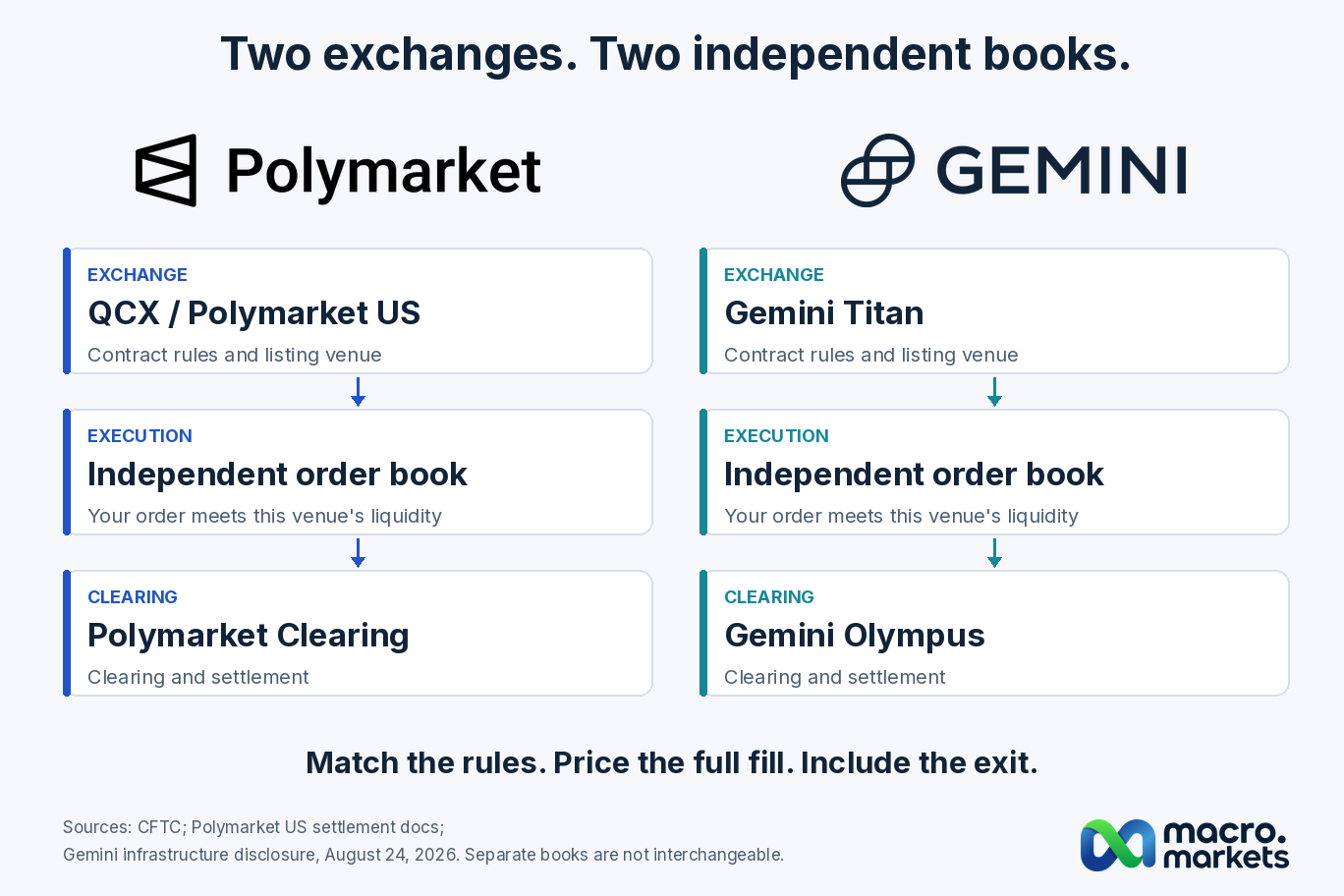
The Polymarket US vs Gemini Predictions decision comes down to the contract, executable price and account you want to use. Polymarket US offers a dedicated event-contract exchange through QCX. Gemini Predictions puts a separate exchange, Gemini Titan, inside the broader Gemini account experience. Their order books are independent, even when the event headlines look alike.
Our verdict: Polymarket US is the more natural starting point for someone seeking a dedicated prediction-market product and several direct deposit options. Gemini deserves a close look from existing Gemini customers and traders evaluating its prediction-specific APIs and current maker incentives. Neither wins every trade on fees or liquidity.
At a 50-cent price, 100 Polymarket US contracts cost $1.74 in taker fees at Θ = 0.0695, or $2.38 at Θ = 0.095, versus $1.75 under the Gemini schedule reviewed here. The applicable tier can change the fee ranking; executable price still matters. Maker orders require a different comparison: Gemini currently waives eligible maker fees, while Polymarket US separates maker rebates into volume tiers.
Last reviewed and fact-checked: November 4, 2026.
Editorial disclosure: Macro Markets publishes this comparison and operates a competing prediction-market platform. We include Macro Markets as a disclosed crypto-native alternative and do not present it as a CFTC-designated US exchange. We reviewed public documentation rather than placing synchronized funded trades on both platforms. Event contracts can settle at $0, and an early sale requires available liquidity. This article is educational, not financial, legal or tax advice.
Polymarket US vs Gemini: Quick Comparison
Start with the product relationship. Polymarket US is built around event-contract trading. Gemini combines predictions with a larger financial account, but the prediction contracts still belong to a specific exchange and its rules.
| Decision factor | Polymarket US | Gemini Predictions |
|---|---|---|
| Listing exchange | QCX LLC d/b/a Polymarket US | Gemini Titan, LLC |
| Trading balance | USD account; supported deposit methods vary | USD in the Gemini account |
| Standard taker coefficient | 0.0695–0.095, with account-specific rules | 0.07 for contracts covered by the current schedule |
| Standard maker treatment | Volume-based rebate tiers; lowest tier has no rebate | Listed maker coefficient 0.0175; current eligible maker waiver |
| Public order documentation | Market and limit orders | Prediction-specific limit and stop-limit API orders |
| Developer access | Public US documentation and integration tools | Prediction-specific REST and WebSocket documentation |
| Liquidity | QCX contract book | Separate Gemini Titan contract book |
| Best starting point | Dedicated prediction-market workflow | Existing Gemini relationship and documented prediction tools |
Which Fits Each Type of Trader?
- You want a standalone event-contract product: start with Polymarket US.
- You already keep usable USD on Gemini: compare the Gemini route before moving money elsewhere.
- You submit orders that execute immediately: compare the complete fill, not just the fee coefficient.
- You post resting orders: check Gemini's current waiver and rebates alongside your actual Polymarket US tier.
- You automate trading: both publish relevant documentation; compare permissions, order behavior and recovery workflows.
- You need reliable early exits: choose the contract with sufficient bids for your intended size.
These are starting points, not permanent rankings. Read our Polymarket US review, Gemini Predictions review and platform comparison methodology for the supporting framework.
Two Exchanges, Not a Shared Market
The CFTC identifies QCX LLC d/b/a Polymarket US and Gemini Titan as separate designated contract markets. A designated contract market is a regulated exchange that lists contracts and operates under an exchange rulebook.
Polymarket's US product overview distinguishes the USD-based US platform from the international blockchain product. This article compares Gemini with Polymarket US, not Polymarket.com. International wallet mechanics, fee schedules and reported volumes should not be imported into the US comparison.
For clearing, Polymarket's settlement documentation identifies Polymarket Clearing. Gemini's infrastructure announcement describes bringing Titan's clearing and settlement in-house through Gemini Olympus. The CFTC separately registers Olympus as a derivatives clearing organization.
Why the Exchange Identity Matters
You are buying a contract on a specific book. Another exchange can ask a similar question while using a different observation time, benchmark, cancellation condition or result source.
A position on QCX does not become a position on Gemini Titan because the headline matches. Nor does the same customer opening both apps combine their resting orders into one pool. Treat funding, positions and exits as separate until the written rules establish otherwise.
That distinction also changes how you read prices. A difference can reflect different terms or thin depth rather than a simple disagreement about the event. A valid comparison starts with contract identity and continues with the price available for your full quantity.
Fees: The Applicable Tier Can Change the Comparison
The conditional Polymarket US examples here use Θ = 0.0695; the current coefficient can be as high as 0.095 under the volume ladder described above. The Gemini Predictions schedule uses 0.07 for takers and 0.0175 for makers on contracts listed from March 18, 2026. Earlier Gemini listings have a separate schedule.
For an ordinary single contract, the calculation has this shape:
fee = rate coefficient × contract quantity × price × (1 − price)
Here, price is expressed in dollars. A 50-cent contract uses 0.50, not 50. Polymarket US rounds to the nearest cent using half-to-even rounding. Gemini rounds trading fees upward to the next cent.
A Matched 100-Contract Example
These are calculated examples using the published standard schedules, not live quotes. They assume one execution at the stated price, no earned rewards and no market-specific fee exception.
| Price per contract | Contract debit | Polymarket US taker fee | Gemini taker fee |
|---|---|---|---|
| $0.10 | $10.00 | $0.63 | $0.63 |
| $0.50 | $50.00 | $1.74 | $1.75 |
| $0.90 | $90.00 | $0.63 | $0.63 |
At the midpoint, the difference is one cent. If the average purchase price is two cents worse across 100 contracts, the contract debit rises by $2. That is 200 times the one-cent fee gap in this example.
The lesson is practical: inspect the average executable price for the complete order. A cheap-looking fee does not compensate for buying into a thin book several price levels above the best offer.
Compare the Entry and the Exit
Write down the contract debit, execution charge, spread, slippage, any eligible reward and the expected cost of selling before resolution. A later sale is another execution; do not compare a round trip on one platform with a single purchase on the other.
Partial fills can also complicate a fee estimate. An order may execute across several prices, and its final statement may differ from a simplified one-fill illustration. The actual confirmation and account record control.
Polymarket US table tennis now follows the same standard tier ladder. Combo pricing uses a separate curve and is outside the table above. Use our prediction-market fee calculator to examine scenarios, then verify the current platform schedule and order ticket.
Maker Fees, Rebates and the November 6 Change
A maker order waits on the book until another order executes against it. A taker order executes against interest already available. A limit order can still be a taker if its price crosses the book immediately.
Gemini's maker fee-free promotion currently covers qualifying executed maker trades from September 2 through December 31, 2026. The stated waiver requires no enrollment or minimum volume, but eligibility and exchange rules still apply. Gemini can amend or end the program.
This is different from saying every Gemini trade is free. The waiver applies to qualifying maker executions. Orders that take liquidity still need their own fee calculation.
Compare Your Actual Maker Treatment
Polymarket US's published maker tiers begin with no rebate below $10 million of qualifying maker volume under the daily trailing-30-day window and applicable account rules. Higher tiers can earn rebates. Do not assign a high-volume rebate to a new retail account.
Gemini separately documents a maker rebate program, including price-band and contract eligibility conditions. A rebate is not the same as a fee waiver, and an advertised reward is not guaranteed earnings. Resting orders can fill just before an unfavorable price move.
For a trader posting liquidity, compare four things: whether the order actually rests, the fee or waiver that applies, the rebate the execution qualifies for and the price movement after the fill. Gross reward alone cannot establish the better venue.
Liquidity Rewards Are Scheduled to Pause
Gemini's separate Liquidity Rewards Program announces a pause beginning November 6, 2026, with a relaunch date to be announced. That program rewards qualifying resting liquidity and has different mechanics from executed-trade maker rebates.
As of this article's November 4 review, the scheduled liquidity-program pause should not be described as the cancellation of the maker fee waiver. These are separate published programs. Recheck each program before relying on future incentives, and model the trade without discretionary rewards as well.
Funding, USD Balances and Eligibility
Polymarket US's funding guide lists ACH, debit card, wire transfer, Apple Pay, PayPal, Venmo and USDC where available. The precise menu depends on device and account availability. Its documentation distinguishes possible instant buying power from the clearance required before withdrawals.
Gemini's product launch announcement identifies USD in the Gemini Exchange account as the trading balance and documents web, iOS and Android access. That can reduce account friction for an existing customer, but it does not mean every crypto asset in the account is immediately usable for a prediction contract.
Crypto Ownership Is Not the Same as Available USD
If your money is held in BTC or another token, check whether a sale or conversion is needed before trading predictions. Include any conversion cost and clearance delay. Likewise, depositing through a supported USDC route does not turn a Polymarket US contract into the international blockchain product.
For either platform, check these account facts before transferring funds:
- Your identity and location qualify for the product and the exact contract.
- Your funding method is accepted in your own name.
- Your available trading balance excludes funds still subject to a hold.
- Your withdrawal route and timing fit your needs.
- Any conversion or intermediary charge is included in the comparison.
Federal exchange registration does not establish that every contract is available to every customer in every state. We do not claim universal state availability. Check current onboarding disclosures and the order ticket; our US prediction-market legal guide explains the distinction between exchange oversight and product access.
Orders, APIs and Trading Controls
Both platforms publish prediction-specific trading documentation. It would be misleading to give Polymarket US an automatic API win while treating Gemini as only a simple crypto app.
Polymarket US documents market and limit orders. A market order seeks available execution within quote-based protection; a resting limit order can remain after a partial fill, depending on the selected duration.
Gemini's prediction order endpoint documents limit and stop-limit orders, time-in-force choices and maker-only behavior. Its developer guidance prefers WebSocket order placement for active trading. These API controls should not be assumed to appear identically in every consumer screen.
| Trading question | What to verify |
|---|---|
| Must the order execute immediately? | Available depth, permitted price and remaining-quantity behavior |
| Must it provide liquidity? | Maker-only or post-only protection and whether crossing cancels the order |
| Can it fill partly? | Filled quantity, remaining quantity and fee treatment for each execution |
| Does a stop guarantee an exit? | No; a triggered stop-limit order still needs a match within its price limit |
| Can software place orders? | Prediction-specific credentials, permissions, terms acceptance and rate limits |
Which Has the Better API?
There is no defensible blanket winner from the existence of an API alone. Compare the endpoints you need, supported order types, authentication, test environment and the way your integration recovers after a connection drops.
Gemini's order lifecycle guide emphasizes reconciling orders, fills, positions and settlement rather than treating an accepted order as a completed trade. That principle applies to any venue: an acknowledgment is not a fill, a cancellation can leave an existing position, and a disconnected feed is not proof that nothing changed.
For a nontechnical user, the simpler question is whether the available screen makes price, quantity, fee and maximum loss clear before confirmation. Extra API capabilities do not automatically make an everyday trading workflow better.
Liquidity, Contract Rules and Settlement
The useful liquidity comparison is the quantity available at prices you can accept. It is not the number of market categories, the size of the company's crypto business or the volume shown for an unrelated international product.
Gemini's market-maker overview lists categories including sports, crypto, politics, economics and weather, while explaining that specific contracts can change. A broad category list does not establish deep bids in the contract you want.
Before comparing two apparently similar markets, match the event, observation time, reference source, close time, cancellation treatment and payout terms. Then inspect the bids and offers for your full intended quantity.
A Hypothetical Depth Check
Suppose one book offers only 10 contracts at 50 cents and the remaining 90 at 53 cents. Buying 100 costs $52.70 before fees. Another book offering all 100 at 51 cents costs $51.00 before fees. The lower headline offer was the more expensive complete purchase.
This is an illustrative arithmetic example, not observed market data. It shows why a one-cent standard fee difference should not dominate the decision. Our bid-ask spread guide explains the same issue for early exits.
Who Decides the Result?
Polymarket US's resolution guide ties the result to the written contract and named sources. Gemini's member agreement likewise makes contract-specific rules central to the trading relationship.
The exchange's settlement process is separate from your interpretation of a headline. A news report that seems decisive may not satisfy a contract requiring a named benchmark, an official release or a particular observation window.
Gemini also discloses that systems can fail and a contract can stop trading when bids or offers disappear. Regulation does not guarantee that an early exit will be available, that a deposit clears immediately or that the contract will resolve as you expected.
Alternatives, Including Macro Markets
If neither exchange has the contract, terms or usable depth you need, compare another route before funding. A broader choice is not always a better one: it should solve a specific missing requirement.
| Alternative | Reason to investigate |
|---|---|
| Kalshi | Compare another dedicated event exchange and its specific contract book |
| Robinhood Prediction Markets | Evaluate a brokerage-based route and the actual listing venue |
| Coinbase Prediction Markets | Evaluate the documented account and exchange-access relationship |
| Macro Markets | Consider a crypto-native prediction-market workflow, subject to your eligibility |
Where Macro Markets Fits
Macro Markets is our own prediction-market platform and a competing alternative included with that conflict disclosed. Its crypto-native positioning is relevant when a user is comparing digital-asset funding and event-market discovery beyond the two US products discussed here.
That is a different evaluation, not a claim that Macro Markets inherits the regulatory status or customer relationship of QCX or Gemini Titan. Check the terms, eligible locations, supported funding network, contract rules, displayed fees and available exit before using it.
If your requirement is specifically a CFTC-designated US exchange, evaluate the appropriate regulated venue for that requirement. If you are eligible and seeking a crypto-native workflow, Macro Markets belongs on the comparison list with its own mechanics assessed directly.
You can also explore our Polymarket US alternatives, Gemini Predictions alternatives and best prediction-market apps to compare different account and exchange models.
Frequently Asked Questions
Is Polymarket US Cheaper Than Gemini?
It depends on the applicable Polymarket US tier. At 100 contracts priced at 50 cents, the one-fill Polymarket fee ranges from $1.74 to $2.38 across the standard ladder, versus the $1.75 Gemini example reviewed here. The executable price, market-specific schedule and any applicable incentives can matter more.
Are Gemini Maker Trades Free?
Qualifying maker executions currently fall under a published fee waiver scheduled through December 31, 2026. That does not make taker trades free or guarantee a fill. Check the current promotion and order behavior before trading.
Does the November 6 Pause End All Gemini Rewards?
The published notice concerns the Liquidity Rewards Program. The maker fee waiver and maker rebate documentation are separate. Do not treat one program's notice as a rule for the others.
Do Polymarket US and Gemini Share an Order Book?
No. QCX and Gemini Titan are separate listing exchanges. Similar event names do not make their contracts, resting orders or positions interchangeable.
Is Polymarket US the Same as Polymarket.com?
No. The US product is a separate USD-based regulated platform. International accounts, contracts, fees and blockchain assumptions should not be transferred into this comparison.
Can I Trade Predictions With Bitcoin on Gemini?
Gemini's cited consumer documentation identifies USD as the prediction trading balance. Holding Bitcoin in the broader account does not by itself establish usable prediction buying power; check conversion requirements and the available balance.
Can I Sell Before the Event Ends?
An early sale depends on the venue's rules, trading status and executable bids. A position can remain open if nobody is prepared to buy at an acceptable price. Price controls protect the requested limit, not the certainty of an exit.
Final Verdict: Choose the Contract Before the Brand
Polymarket US fits a dedicated prediction-market workflow; Gemini fits an existing Gemini relationship and deserves consideration for its documented prediction tools and current maker programs. Both are credible candidates for a contract-level comparison, not automatic winners for every user.
For immediate execution, the standard fee difference in our midpoint example is only a penny. Concentrate on the full fill price, sufficient quantity, funding access and the likely cost of selling. For resting orders, verify the current waiver, rebate eligibility and the risk of being filled as the market moves against you.
The final check is simple: identify the exchange, read the complete contract, confirm usable funds, compare entry and exit depth and review all charges. If those facts do not support the trade, choosing neither platform is a reasonable result. A familiar logo and an attractive promotion cannot replace a contract you understand.