


Gemini Prediction Markets Review 2026: Fees, Safety and Alternatives

Gemini prediction markets combine a regulated US event exchange with the same broader Gemini account many customers use for crypto. Unlike an app that only routes orders to somebody else's venue, Gemini owns the exchange operator, Gemini Titan, and now uses affiliated clearing organization Gemini Olympus. That integrated structure is the product's clearest advantage.
The trade-off is cost and complexity. Gemini uses different probability-weighted fees for maker and taker orders. A marketable order can cost four times the standard rate coefficient of a resting maker order. Funding from a crypto balance can also trigger an automatic sale into USD, which may create a taxable event and can leave the customer with USD if the prediction order fails after the sale.
Our verdict: Gemini Predictions is a strong choice for an eligible customer who wants a CFTC-designated exchange inside a crypto-focused account, values web and mobile access, or needs API tools. It is less compelling for someone who only compares headline fees, expects every market to be liquid, or wants a simple fixed-cost order ticket.
Last reviewed and fact-checked: October 27, 2026.
Editorial disclosure: Macro Markets publishes this review and operates a prediction-market platform. We include Macro Markets as an alternative, apply the same criteria to it and do not present it as a CFTC-designated US exchange. This is a documentation-based review; we did not open and fund a Gemini Titan account for this article. Event contracts are speculative, can lose the full amount committed and are not suitable for everyone. This page is educational, not financial, tax or legal advice.
Gemini Prediction Markets Review: Quick Verdict
Gemini earns a positive but qualified verdict. The platform has a clear regulatory identity, publishes a detailed fee formula and supports a broad event catalog. Existing Gemini customers can manage predictions alongside other account activity, while developers get public market data, authenticated trading endpoints and WebSocket streams.
The current Gemini Predictions landing page emphasizes simple Yes or No markets, predefined settlement criteria and a shared Gemini balance. The CFTC registration record identifies Gemini Titan as a designated contract market, or DCM, effective December 10, 2025.
| Review factor | Finding | What it means |
|---|---|---|
| Exchange | Gemini Titan is a CFTC-designated contract market | Gemini operates the venue rather than only routing to a third-party exchange |
| Clearing | Gemini Olympus is a CFTC-registered derivatives clearing organization | The affiliated clearing layer handles fully collateralized products under its rules |
| Eligibility | Requires an approved account and eligible location | Gemini warns that availability varies; the current onboarding screen controls |
| Access | Web, iOS and Android, plus developer APIs | Suitable for both ordinary customers and technical traders |
| Markets | Sports, crypto, politics, economics, commodities, tech, business, weather and culture | The catalog is broad, but individual contracts and depth change |
| Fees | Probability-weighted maker and taker formulas | Resting and immediately matched orders can have materially different costs |
| Funding | Gemini balance, with supported fiat and crypto pathways | A crypto-funded prediction may require an automatic asset sale into USD |
| Settlement | Exchange rules and contract specifications control | News, AI summaries or a customer's preferred source do not override the written terms |
Gemini Predictions pros and cons
Pros
- CFTC-designated exchange operated within the Gemini group.
- Affiliated registered clearing organization.
- Published maker and taker fee formula with worked examples.
- Web and mobile access.
- Broad market categories, especially crypto-price events.
- Public REST and WebSocket developer tools.
- Existing Gemini balance can support an integrated account experience.
Cons
- Standard taker coefficient is four times the standard maker coefficient.
- Availability depends on location, account approval and the individual contract.
- Crypto funding can involve an asset sale and possible tax consequences.
- Marketable orders can incur spread, slippage and the taker fee at once.
- Thin markets may show no reliable exit quote.
- Promotions and rebates can make the current cost harder to compare over time.
- The legal and account structure is more complex than the consumer interface suggests.
Gemini should not be judged only by its strongest category or a temporary promotion. The useful test is whether the exact contract has clear rules, enough depth and an executable all-in price that beats the available alternatives. Readers comparing an integrated crypto account with a broker-led derivatives route can use our CME vs Gemini Prediction Markets comparison.
How Gemini Predictions Work
A Gemini prediction contract ties a payout to a defined real-world outcome. A standard binary market offers Yes and No positions. Prices usually range from $0.01 to $0.99 and can be read as market-implied probabilities. A winning standard contract is worth $1 at settlement; a losing position is worth $0, subject to the contract terms and applicable fees.
The structure is easier to understand in four layers:
- Gemini consumer account: holds the customer's supported fiat and digital-asset balances and provides the web or mobile entry point.
- Gemini Titan DCM: lists contracts, operates the matching venue, supervises trading and applies exchange rules.
- Gemini Olympus DCO: clears eligible contracts and manages the clearing framework under its registered rules.
- Contract specifications: define the outcome, source, observation time, settlement value and treatment of unusual events.
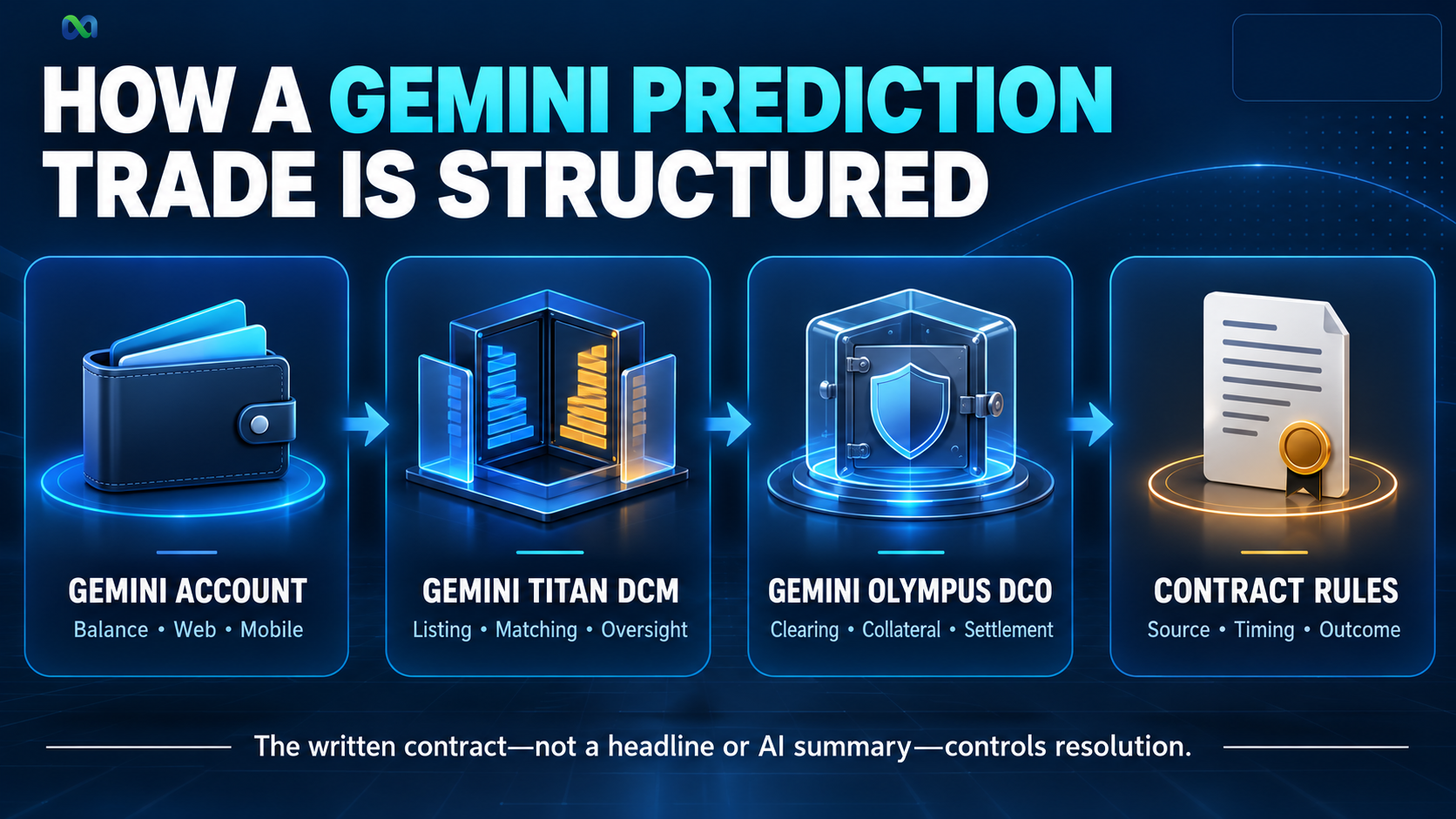
This distinction matters because regulation attaches to specific legal entities and functions. The Gemini brand is the umbrella, but the exchange function belongs to Gemini Titan. The CFTC's Gemini Olympus record lists Olympus as a registered derivatives clearing organization permitted to clear fully collateralized futures, options on futures and swaps.
The basic customer flow is familiar. An eligible user selects a market, reads the outcome terms, chooses Yes or No, sets an order and reviews the maximum risk. The order then meets available liquidity on Gemini Titan. Funds stay committed while an eligible resting order remains open or a position remains held.
Suppose a customer buys 100 Yes contracts at $0.40. The contract value is $40 before fees. If the contract settles at $1, the gross settlement value is $100. If it settles at $0, the $40 contract cost is lost. Selling before settlement replaces that binary outcome with the executable bid available at the time.
The visible percentage is not a promise. A displayed 60% can be a rounded representation of recent market pricing. The next executable price can differ because the best bid and offer are separate. Our guide to the bid-ask spread in prediction markets explains how that gap affects both entry and exit.
Gemini Titan's self-clearing member agreement adds an important warning. Electronic systems can fail, orders can become unavailable and a contract may stop trading when bids or offers disappear. An exchange designation does not guarantee continuous liquidity.
Gemini also markets a “Situation Room” information experience. Its member agreement says AI features may aggregate third-party information, can contain errors and play no role in contract resolution. Treat any summary as research context only. The rulebook and contract specifications remain authoritative.
New readers should use our beginner guide to trading prediction markets. The core habit is simple: read the contract before interpreting its price.
Is Gemini Predictions Legit and Safe?
Yes, Gemini Predictions is a legitimate regulated event-contract platform. Gemini Titan appears as a designated contract market in the CFTC's public filing database. Gemini Olympus appears as a registered derivatives clearing organization. Those records establish the exchange and clearing structure more directly than a marketing claim.
Legitimacy is not the same as safety from loss. A properly listed contract can settle at zero. A regulated order book can be thin. A platform can experience maintenance or outages. A customer can also misunderstand a threshold, observation time or source even when the rules are available.
Evaluate safety across four separate questions:
- Regulatory identity: Are the exchange and clearing organizations identifiable? For Gemini, yes.
- Account security: Has the customer protected login credentials and multifactor authentication?
- Contract risk: Can the customer tolerate losing the full amount committed?
- Execution risk: Is there enough depth to enter or exit near the displayed price?
Gemini Titan's rulebook says trading is normally available outside announced maintenance windows, but the exchange can adjust hours or suspend markets in unusual conditions. The self-clearing agreement also states that a lack of bids or offers can stop trading in a contract.
Do not treat DCM or DCO registration as investment insurance. Registration defines oversight, rules, clearing obligations and customer-fund requirements. It does not reimburse a position that loses because the selected outcome is wrong.
SIPC language requires similar care. Gemini Galactic Markets is a separate broker-dealer used for Gemini's stock product. Its SIPC membership should not be projected onto a Gemini Titan event-contract position. Prediction customers are governed by the Titan agreements, clearing rules and applicable commodities regulation.
Before trading, verify:
- the exact legal entity and account agreement;
- current location eligibility;
- the official settlement source;
- the observation window and time zone;
- cancellation, delay and ambiguous-outcome rules;
- the live bid, ask and available quantity;
- the maximum loss and total fee.
Eligibility is deliberately not reduced to a static list in this review. Gemini says availability varies by location, and its rulebook requires trading privileges plus the age of majority in the customer's state for a natural person. Product access can change faster than an evergreen article. The signed-in onboarding decision and current agreements control.
Our guide to whether prediction markets are legal in the US explains why federal exchange registration does not eliminate every state, contract-category or customer-specific restriction.
Markets, Orders, API and Trading Experience
Gemini's current catalog spans sports, crypto, politics, economics, commodities, technology, business, weather and culture. Its market-maker page lists the same broad categories while noting that the contracts inside them can change.
Crypto markets are a natural differentiator. Gemini can list threshold, directional or time-specific questions tied to digital assets, subject to filed specifications. Sports and political events broaden the audience, while economics and commodities serve customers who want macro exposure.
Breadth does not guarantee quality. Check the bid, ask, recent activity and available size for the exact contract. A popular category can still contain an illiquid market. Gemini's developer documentation even notes that position market value and unrealized profit fields may be absent when the held outcome has no live sell quote.
Gemini's transaction terms describe several order behaviors across its platforms:
- Limit order: rests at a specified price until filled or cancelled.
- Market order: trades against the best available resting orders and accepts price-movement risk.
- Fill-or-kill: fills the entire requested quantity immediately at the limit or cancels.
- Immediate-or-cancel: attempts an immediate execution under the stated constraints and cancels when it cannot execute as required.
- Maker-or-cancel: rests only when it can add liquidity; it cancels if any part would immediately match.
Feature availability can differ by interface and contract. The order ticket is the final check. A maker-or-cancel order can help control whether the standard maker schedule applies, but it does not guarantee a fill.
API and advanced access
Gemini offers one of the stronger public developer surfaces in this category. The official Prediction Markets API provides endpoints for events, market data, orders, positions, settled positions, volume, terms, combos and rewards. WebSocket streams expose live prices, depth, order events and position updates.
That makes Gemini relevant to analysts, market makers and developers building monitoring or execution tools. It also raises responsibility. Automated orders still need rate-limit handling, contract-term checks, position controls and reconciliation after disconnects. Undocumented fields are explicitly not stable.
Gemini supports structured GEMI- ticker formats for programmatically resolved crypto, sports, commodities and weather markets. Other categories can use unique identifiers. Developers should map every contract to its parent event rather than infer settlement from a ticker alone.
Combo RFQ tools are also available for eligible workflows. A requested quote can expire or fail to attract a maker. As with any multi-leg position, the combined payout can look attractive because all required conditions are harder to satisfy.
For ordinary customers, web and mobile access are the primary benefit. For technical users, the API is a meaningful advantage, but it does not improve the underlying probability estimate or remove liquidity risk.
Gemini Prediction Market Fees, Funding and Settlement
Gemini publishes a clear Predictions fee schedule. Standard trading fees use the same probability-weighted shape for makers and takers but different rate coefficients:
Fee = Rate × C × P × (1 − P)
In the formula, C is the number of contracts and P is the contract price in dollars. The standard maker rate is 0.0175; the standard taker rate is 0.07. Fees round up to the next cent.
For 100 contracts priced at $0.50:
- Maker:
0.0175 × 100 × 0.50 × 0.50 = $0.4375, rounded to $0.44. - Taker:
0.07 × 100 × 0.50 × 0.50 = $1.75.
The taker fee is therefore four times the maker fee at the same price and quantity under the standard rate coefficients. The dollar fee is highest near $0.50 and lower near the extremes because P × (1 − P) peaks in the middle.
A partially matched order can incur both rates: the immediately executed portion is taker volume, while a remainder that rests and later fills is maker volume. Gemini says cancelling an unfilled maker order has no fee. The standard schedule lists no settlement or membership fee.
Temporary programs complicate comparisons. As of this review date, Gemini's developer changelog describes a qualifying maker-fee waiver through December 31, 2026, plus separate maker, liquidity and taker incentives. Promotions can have price bands, caps and eligibility rules. We exclude temporary rewards from the long-term verdict and recommend checking the live order confirmation.
The fee is only one part of cost. A taker crosses the spread and can experience slippage while also paying the higher coefficient. A maker may pay less but never fill. Compare expected execution, not just the nominal formula.
Funding and crypto conversion risk
Gemini Predictions uses USD-denominated event contracts. Customers can use an eligible fiat balance. Gemini's transaction terms also say that selecting a crypto balance authorizes Gemini to sell enough digital assets to obtain the USD needed for the prediction order.
That convenience has two important consequences. First, selling crypto may be a taxable event. Second, the crypto sale can succeed while the subsequent prediction purchase fails. In that case, the customer may be left holding USD and exposed to price movement between the attempted steps.
ACH, card or wallet-based funding can carry settlement holds, restrictions or fees under the applicable Gemini terms. Do not assume “available to trade” means immediately withdrawable. Confirm the funding method, final collection status and withdrawal rules before an event deadline.
Settlement follows the contract specifications. Gemini Titan determines the exchange-side settlement price under its rules, and the clearing organization processes eligible cleared positions. A public headline, AI summary or price on another platform does not replace the named source.
A six-point order check
Before every Gemini Predictions trade, record:
- Eligibility: Is the account and location approved for this contract?
- Rules: What source, threshold and time determine settlement?
- Order type: Will the order add liquidity or take it?
- Cost: What fee, spread and slippage appear likely?
- Funding: Will Gemini sell crypto to obtain USD?
- Exit: Is there a live bid and enough size to close early?
This checklist is more useful than calling Gemini universally cheap or expensive.
Gemini vs Kalshi, Interactive Brokers, Coinbase, Robinhood, Polymarket US and Macro Markets
Gemini's biggest structural difference is vertical integration. Gemini Titan operates the exchange, Gemini Olympus provides affiliated clearing and the consumer Gemini account supplies the interface. Coinbase and Robinhood currently play different intermediary roles in their prediction products.
| Platform | Structure | Best fit | Funding model | Main trade-off |
|---|---|---|---|---|
| Gemini Predictions | Gemini Titan DCM with Gemini Olympus DCO | Crypto-oriented users wanting a regulated exchange, APIs and web/mobile access | Eligible Gemini fiat balance; supported crypto can be sold into USD | Taker fees exceed maker fees; location and liquidity vary |
| Kalshi | CFTC-designated contract market and clearing organization | Users wanting a dedicated event-contract exchange and broad catalog | Supported fiat funding | Separate account and contract-level access restrictions |
| Interactive Brokers | Broker/FCM routing to ForecastEx, Kalshi and CME | Experienced traders wanting desktop tools, multi-venue routing and consolidated reporting | Eligible brokerage cash | More complex workflow; venue, fees and rules vary by contract |
| Coinbase | CFM intermediary; current markets operated by Kalshi | Existing Coinbase customers wanting USD or USDC access | Settled USD or USDC | Current liquidity comes from Kalshi rather than an independent Coinbase venue |
| Crypto.com Predict Pro | Professional Exchange interface connected to the CDNA/NADEX venue stack | Eligible US users wanting depth and maker/taker controls in a crypto-oriented account | USD transferred from Spot to Derivatives | Separate Derivatives activation, second fee event and contract-specific liquidity |
| Robinhood | CFTC-registered FCM routing to partner exchanges | Existing brokerage customers prioritizing a mobile workflow | Eligible settled cash through derivatives flow | Trading execution is mobile-only; venue varies by contract |
| Polymarket US | Separate CFTC-designated US exchange and clearing structure | Users comparing another regulated US venue | US-product funding rules | Must not be confused with international polymarket.com |
| Macro Markets | Crypto-native prediction-market platform; not presented as a CFTC-designated US exchange | Eligible users seeking crypto funding and global market discovery | Supported crypto and network transactions | Different jurisdiction, custody, funding and regulatory risk profile |
Choose Gemini when exchange ownership, a crypto-centered account and API access matter. Use a resting order when price control is more important than immediate execution, but do not assume a fill.
Choose Kalshi when you want a mature dedicated event-exchange workflow and a broad US contract catalog. Our Kalshi review explains its fees and risks, while Kalshi vs Gemini Predictions compares their fees, funding, APIs and independent order books directly.
Choose Interactive Brokers when professional desktop software, consolidated reporting and access to ForecastEx, Kalshi and CME matter more than Gemini's single-exchange model. Our Gemini vs Interactive Brokers Prediction Markets comparison compares venue routing, fees, liquidity, funding and APIs directly; the Interactive Brokers prediction markets review covers the broader product.
Choose ForecastEx specifically when macro event contracts, a flat per-contract exchange fee and the variable collateral coupon matter more than Gemini's broader catalog and integrated crypto balance. The direct ForecastEx vs Gemini Predictions comparison compares the exchanges, orders, funding, APIs and matched 100-contract fee examples.
Choose Coinbase when you already use its account and prefer settled USD or USDC. Coinbase Financial Markets currently routes to Kalshi, so it is an access layer rather than an independent liquidity pool. Our Coinbase vs Gemini Prediction Markets comparison compares the separate books, fees, funding and APIs directly; the Coinbase prediction markets review covers that product in depth.
Choose Crypto.com Predict Pro when full order-book depth, Post-Only execution and a shared crypto-exchange derivatives environment matter more than Gemini's account route. The Crypto.com Predict Pro review explains the product, while our direct Gemini Predictions vs Crypto.com Predict Pro comparison matches fees, settlement, funding and APIs.
Choose Robinhood when a familiar brokerage app matters more than desktop execution. Its intermediary can route contracts to several partner exchanges. Our Gemini vs Robinhood Prediction Markets comparison explains exchange ownership, venue routing, fees, APIs and independent books directly; the Robinhood prediction markets review covers that product in depth.
Choose Polymarket US when you want another US-regulated exchange product. Keep it separate from the international crypto platform. Our Polymarket review explains the distinction.
Consider Macro Markets when you are eligible to use a crypto-native platform and value crypto funding plus global market discovery. Because Macro Markets publishes this article, treat its inclusion as a disclosed first-party claim. Verify its current eligibility, wallet flow, fees, liquidity and resolution rules yourself. Macro Markets has a different legal and custody profile and is not represented here as a CFTC-designated US exchange.
Use the same criteria for every platform: regulation, eligibility, fees, liquidity, funding, settlement and usability. Our prediction-market comparison methodology explains the scoring framework. For a Gemini-specific shortlist, compare the best Gemini prediction markets alternatives. For a wider view, see the best prediction market apps and platforms and our guide to Kalshi alternatives.
Our Polymarket US vs Gemini Predictions comparison examines fees, maker incentives, funding and the separate exchange order books.
Frequently Asked Questions and Final Verdict
Are Gemini prediction markets legit?
Yes. Gemini Titan is a CFTC-designated contract market, and Gemini Olympus is a registered derivatives clearing organization. Regulation does not guarantee profit, liquidity, continuous access or eligibility in every location.
Is Gemini itself the prediction-market exchange?
Gemini Titan, a Gemini affiliate, is the exchange operator. Gemini Olympus is the affiliated clearing organization. The consumer Gemini interface provides account access, while each contract specification defines the settlement terms.
What are Gemini prediction market fees?
Gemini's standard formula is Rate × Contracts × Price × (1 − Price). The published standard maker rate is 0.0175 and taker rate is 0.07. For 100 contracts at $0.50, the listed examples produce $0.44 maker or $1.75 taker. Promotions can temporarily change the effective cost.
Can I fund Gemini Predictions with crypto?
Gemini's transaction terms say selecting a crypto balance authorizes a sale into the USD needed for the prediction order. That sale may be taxable. It can also succeed even if the following event-contract order fails, leaving the customer with USD.
Can I trade Gemini Predictions on a computer?
Yes. Gemini supports web, iOS and Android access. It also publishes REST and WebSocket APIs for eligible technical users.
Does Gemini offer limit orders?
Gemini documents limit, market, fill-or-kill, immediate-or-cancel and maker-or-cancel behavior across its platform. Availability can vary by interface or contract. A limit order controls price but does not guarantee execution.
Does Gemini's Situation Room decide settlement?
No. Gemini's agreement says AI features can contain errors and have no role in contract resolution. The rulebook and contract specifications control.
Are Gemini event contracts SIPC insured?
Do not assume so. SIPC membership associated with Gemini's separate stock broker-dealer should not be projected onto Gemini Titan event contracts. DCM and DCO registration establish a commodities regulatory framework, not protection from a losing trade.
What is the best alternative to Gemini Predictions?
Kalshi is a direct alternative for a dedicated US event exchange. Coinbase and Robinhood offer integrated account experiences through intermediary structures, while Polymarket US provides another regulated US venue. Macro Markets can suit eligible crypto-native users, but it has a different legal and custody profile and is not a CFTC-designated US exchange.
Final verdict
Gemini prediction markets are worth considering for eligible customers who want a regulated exchange inside a crypto-oriented account. Gemini Titan's DCM designation, Gemini Olympus clearing, public fee schedule and developer platform give the product a credible foundation.
The main discipline is execution. Maker and taker costs differ sharply. A crypto-funded order can create a separate asset sale. Market depth varies, and AI context does not determine settlement. Read the contract, choose the order type deliberately and verify the funding path before confirming.
If the source, total cost, liquidity or maximum loss is unclear, do not trade the contract.
