Kalshi Review 2026: Is It Legit and Worth Using?

Kalshi is a strong choice for people who want a regulated event-contract exchange with a broad range of sports, politics, economics, weather and culture markets. Its clearest advantages are CFTC oversight, simple Yes/No contracts, multiple funding methods and a large consumer app. Its main drawbacks are variable fees, uneven liquidity outside popular markets, identity verification, deposit or withdrawal holds, and contract rules that demand careful reading.
Our verdict: Kalshi is legitimate and can be worth using when the exact market has clear resolution terms, enough depth and an acceptable all-in cost. It is not automatically the best venue for every event, and CFTC designation does not remove trading risk or guarantee that every contract is available in every location.
Last reviewed and fact-checked: October 27, 2026.
Editorial disclosure: Macro Markets publishes this review and operates a prediction-market platform that may compete for some of the same users. We disclose that conflict, apply the same evaluation criteria to both products and do not claim that Macro Markets is a CFTC-designated exchange. This review is based on public product documentation, regulator records and public app-store information. We did not open, fund or trade through a Kalshi account for this review. Event contracts can settle at $0, and you can lose the full amount committed plus fees. This page is educational, not financial, legal or tax advice.
Kalshi Review at a Glance
| Question | Short answer |
|---|---|
| Is Kalshi legitimate? | Yes. The CFTC lists KalshiEX LLC as a designated contract market. |
| What can you trade? | Event contracts across sports, politics, economics, financial indicators, weather, culture and other topics. |
| How do contracts pay? | A correct contract generally settles at $1; the losing side settles at $0, subject to the market's rules. |
| How are prices set? | Participants submit orders to an order book. The exchange matches people taking opposite sides. |
| Does Kalshi charge fees? | Yes. Trading fees can depend on price, quantity, order type and market. Some markets use different schedules. |
| Can you withdraw? | Yes, using eligible methods. Timing and temporary holds depend on funding method, bank, payment processor and account review. |
| Who is it best for? | Eligible users who want a regulated exchange and will compare rules, spread, depth and total cost before each trade. |
| Who should avoid it? | Anyone who cannot afford a full loss, wants guaranteed liquidity, will not complete KYC or treats a displayed probability as a promise. |
The short version is favorable, but the details decide whether a particular trade is good. A regulated venue can still have a wide spread, a thin order book or a resolution rule that does not match the question you thought you were trading. Readers choosing between a direct specialist account and an established derivatives-exchange route can use our Kalshi vs CME Prediction Markets comparison, including matched broker fees and API differences.
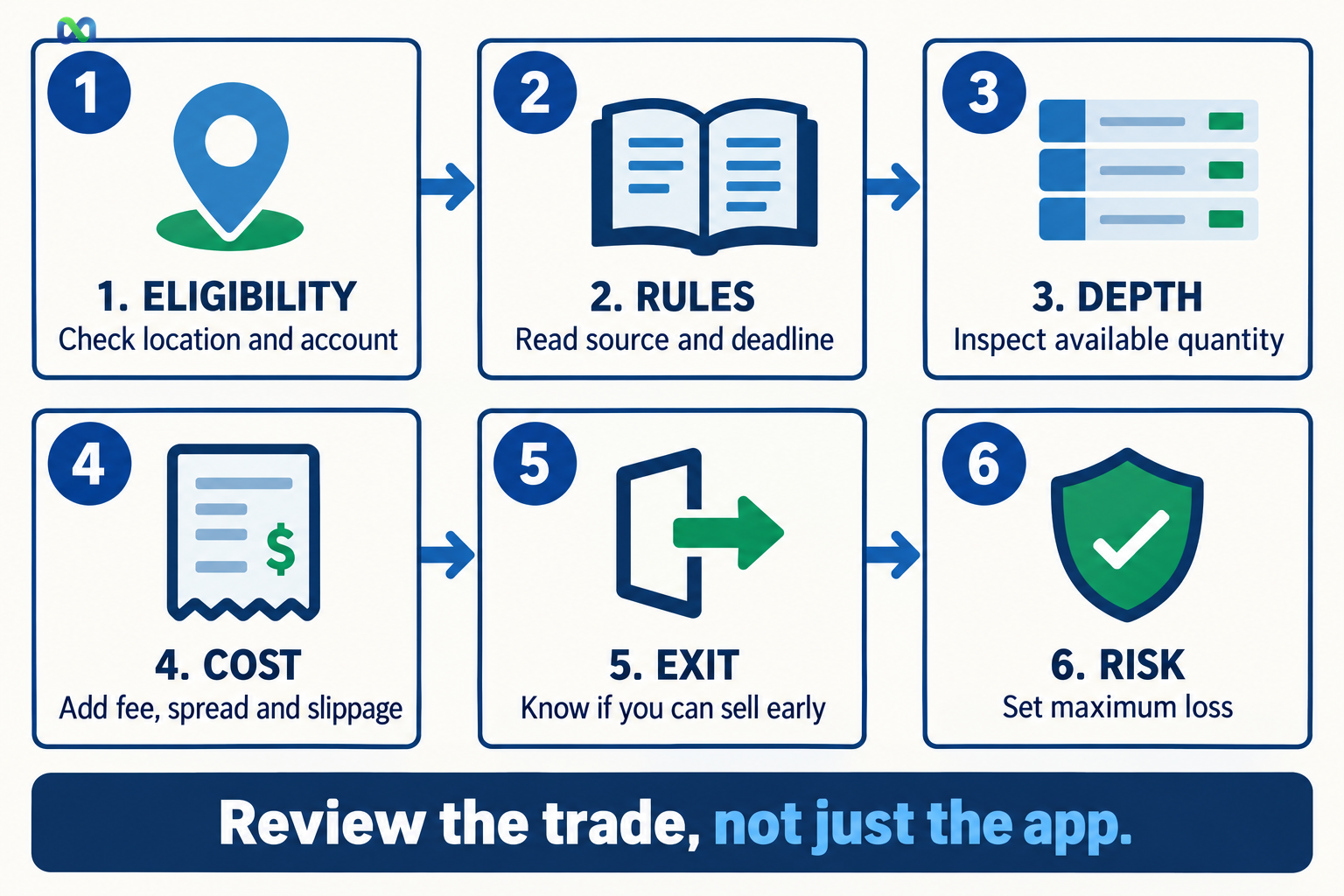
!Six checks before trading an event contract: eligibility, rules, depth, cost, exit and risk
What Is Kalshi?
Kalshi is an event-contract exchange. Instead of buying a share of a company, you buy a contract tied to whether a defined event will happen. A Yes contract and a No contract represent opposite outcomes. If the contract you hold resolves in your favor, it generally pays $1; otherwise it pays $0.
If you are researching ownership in the company rather than an event contract, read our guide to Kalshi stock, including private-share access through Hiive and Forge. Trading on Kalshi does not make the customer a Kalshi shareholder.
The CFTC's official filing page lists Kalshi as a designated contract market, with an original designation date of November 3, 2020. That regulatory status is material: Kalshi is an exchange subject to US commodities oversight, not an unregistered website simply using prediction-market language.
Regulation does not make a trade safe or profitable. Kalshi's own help center warns that members can lose the cost of entering a transaction, including fees. Our separate guide to whether Kalshi is legitimate examines the regulatory and trust questions in more depth.
How a Kalshi Contract Works
Suppose a Yes contract costs $0.62. If the event resolves Yes, the contract pays $1 and the gross difference is $0.38 before fees. If the event resolves No, that $0.62 position falls to $0. The quoted price is often read as roughly a 62% market-implied probability, but it is not a scientific forecast or a guarantee.
Kalshi says participants trade against other members rather than against the exchange. Orders meet in an order book, so the price and available quantity depend on what other participants are willing to buy or sell. For a mechanics-first walkthrough, read how Kalshi works.
Who Kalshi Is Best For
Kalshi fits people who:
- want a CFTC-designated event-contract exchange;
- value a wide menu of event categories;
- understand binary payouts and order books;
- are willing to complete identity checks;
- compare the live fee, spread and available depth before placing an order; and
- read the source, deadline and edge cases in every contract's resolution rules.
It is a weaker fit for people who want anonymous access, guaranteed instant withdrawals, uniformly deep markets or a passive investment whose value is tied to company earnings or productive assets. A Kalshi contract is a short-lived contingent claim, not ownership in Kalshi and not a diversified investment.
Kalshi Product Review
Market Selection: Broad, but Not Every Market Is Equally Tradable
Kalshi's breadth is one of its strongest features. Its public materials describe contracts tied to sports, elections, economic releases, financial indicators, weather, science and culture. That variety makes the app useful for people who follow more than one news category.
Breadth should not be confused with liquidity. The most visible event can have active bids and offers while a niche contract has little size near the displayed price. Kalshi's portfolio documentation warns that the displayed value of a position is not a guaranteed cash-out amount. When liquidity is limited, only part of a position may be sellable at the estimate shown.
Before trading, inspect:
- the best bid and offer;
- the quantity available at those prices;
- how much the price changes for your full order size;
- whether you can tolerate holding to settlement; and
- the exact source and time used to resolve the market.
Our guide to slippage in Kalshi explains why the last displayed price can be less important than the executable order-book depth.
Fees: Transparent at Order Time, but Not One Flat Rate
Kalshi charges transaction fees based on expected earnings, and some markets use different fee schedules. The official Kalshi fee guide also notes that maker fees can apply in some markets. The live order ticket and the current fee schedule are therefore more reliable than a single percentage copied into a review.
This is a meaningful drawback for quick comparisons: the cost depends on the contract price, quantity, order type and market. A resting limit order may receive different treatment from an order that executes immediately. Special events can also use distinct schedules.
The explicit fee is only one part of the cost:
all-in cost = trading fee + spread + slippage + funding cost + exit cost
A nominally low fee does not rescue a trade with a wide spread. Use our prediction market fee calculator to model formula-based fees, then confirm the result in the live order preview.
Account Opening and Verification: Normal for a Regulated Exchange, but Still Friction
Kalshi requires users to be at least 18 and may require document verification. Its current signup guidance says the platform is accessible internationally, although some jurisdictions remain restricted and every user is responsible for confirming lawful access.
The document-verification guide says a user may need a current passport or driver's license and, in some cases, a live selfie or phone verification. It also says account functions can remain restricted until verification succeeds.
That process is not unusual for a regulated financial platform, but it can be a real source of delay. Names and addresses should match the identification documents exactly. A user who needs immediate, anonymous access will not find that here.
Deposits and Withdrawals: Many Options, with Method-Specific Timing
Kalshi's transfer documentation lists bank transfer, debit card, PayPal, Venmo, Cash App deposits, crypto and wire transfers, with availability varying between US and international accounts. Bank transfers are limited to US users, while international accounts can use certain card, crypto and wire methods.
For US bank deposits, Kalshi states a $10 minimum and says full settlement typically takes up to five business days. It may make part of a deposit available earlier, but that early trading credit does not mean the funds are immediately withdrawable.
For withdrawals, the practical answer is yes, Kalshi pays settled and eligible balances through supported methods, but timing varies. The official documentation says:
- debit-card withdrawals often arrive within hours, subject to issuer and processor review;
- US bank withdrawals usually arrive within a few business days;
- recent deposits can have temporary security holds;
- money committed to open positions cannot be withdrawn; and
- compliance reviews or a rejected payment route can delay a transfer.
Those conditions explain why a real user can experience a delay without the exchange having refused a valid payout. They also mean that someone who needs cash on a fixed date should not assume instant access.
Resolution: Clear Rules Matter More Than the Headline
Every contract has its own resolution terms. Kalshi's market-outcomes documentation says the contract specifies the determining source and that final determination can take from about one hour to more than 12 hours after market closure, depending on when the source data arrives.
This is where careful readers have an advantage. Two questions that look identical in an app feed can resolve differently because of:
- a different deadline or time zone;
- preliminary versus revised data;
- a named government agency or media source;
- postponement and cancellation rules; or
- a threshold that uses strict “greater than” wording rather than “at least.”
Never trade from the headline alone. Save the rules that existed when you placed the order, especially for a close or potentially disputed result.
App and Usability: Strong Consumer Reach, but Ratings Are Not a Trading Audit
Kalshi has a mature consumer app. Apple's US listing showed a 4.8 rating across more than 600,000 ratings when this review was checked. That is a meaningful adoption signal, but not proof that every user has a smooth verification, settlement or support experience.
Public reviews tend to mix product quality, trading losses, account-review complaints and payment-processor issues. Those are not interchangeable. A useful review separates four questions:
- Did the app function correctly?
- Did the contract resolve according to its written rules?
- Did the user misunderstand an order, spread or security hold?
- Was support effective when a genuine account issue occurred?
We treat the aggregate rating as evidence of broad consumer use, not as a substitute for regulator records or the contract rulebook.
Kalshi Pros and Cons
| Pros | Cons |
|---|---|
| CFTC-designated exchange | A correct regulatory status does not eliminate the risk of losing the full trade amount |
| Broad event categories | Liquidity and spread can vary sharply by contract |
| Simple $1-or-$0 settlement concept | Fee math and special schedules require checking each order |
| Limit orders and an order book | Limit orders may not fill; marketable orders can experience slippage |
| Multiple deposit and withdrawal methods | KYC, security holds and processor reviews create friction |
| Public contract rules and named resolution sources | Small wording details can determine settlement |
| Large mobile-app footprint | A high app rating does not guarantee fast support in every case |
Kalshi Trust, Safety and Payouts
Is Kalshi Legit and Safe?
Kalshi is legitimate in the narrow, verifiable sense that the CFTC lists KalshiEX as a designated contract market. That is stronger evidence than a social-media endorsement or an app-store score.
“Safe” needs a more careful answer. Regulatory oversight and identity controls reduce some platform risks; they do not prevent a bad trade, a full contract loss, slippage, an unfilled exit or a temporary transfer hold. Security also depends on protecting your own login and using accurate account information.
For the full legal and state-level context, see are prediction markets legal in the US?. Federal designation should not be read as a promise that every event-contract category will remain available in every state. Product access and legal disputes can change.
Does Kalshi Really Pay?
Yes, Kalshi provides documented withdrawal routes for settled, eligible funds. A winning contract generally settles to $1 under its rules, after which available cash can be withdrawn through an eligible method.
That answer needs four caveats:
- A winning-looking position is not withdrawable cash until the market resolves or the position is sold.
- A displayed portfolio value is not a guaranteed exit price.
- Recent deposits can be subject to security holds.
- Bank, card, payment-processor or compliance reviews can affect transfer timing.
If a withdrawal is delayed, check the transfer-status screen, the deposit's hold period and whether the destination method is supported before assuming the underlying contract was not paid.
Kalshi vs Other Platforms and Our Review Method
Kalshi should be compared by product type, access, market rules and all-in execution cost—not by brand recognition alone.
| Platform | Best fit | Important distinction |
|---|---|---|
| Kalshi | Users who want a CFTC-designated event-contract exchange | Order-book liquidity, fee and contract access vary by market |
| Macro Markets | Eligible users seeking broad crypto-native market discovery | Published by us; not a CFTC-designated US exchange; crypto, network and jurisdiction risks apply |
| Polymarket US | Users comparing another dedicated US exchange | The US product is separate from the international polymarket.com platform |
| Robinhood | Existing brokerage users who value one app | A broker interface may route to partner exchanges rather than create independent liquidity |
| Interactive Brokers / ForecastEx | Macro and financial-event traders | Brokerage-oriented workflow and a more focused event catalog |
| Manifold | People who want free practice | Uses play money rather than redeemable cash positions |
Publisher disclosure: Macro Markets is included because it is a genuine alternative for some crypto-native users, not because it owns this article. We do not rank it above Kalshi on regulation. Macro Markets' help center says users should review maximum gain or loss, platform fees, blockchain-network details, liquidity and resolution rules before confirming. Its terms require jurisdictional compliance and identity checks where requested.
Choose Macro Markets only if it is legal where you are located and you accept crypto and network risks. Choose Kalshi when CFTC exchange status and its particular contract catalog are central to your decision. Our ForecastEx vs Kalshi comparison explains the two regulated exchanges' contract mechanics, fee routes, macro coverage and early exits. The Kalshi vs Interactive Brokers Prediction Markets comparison explains when a direct account and the IBKR broker route reach the same Kalshi book and how their funding, fees, APIs and reporting differ. Compare Coinbase's customer layer in Kalshi vs Coinbase Prediction Markets, compare the two regulated exchanges in Kalshi vs Gemini Predictions, compare its account and fee lifecycle in Kalshi vs Crypto.com Predict Pro, or read Kalshi vs Macro Markets for the crypto-native route. For more options, see our full list of Kalshi alternatives and the direct Kalshi vs Polymarket comparison.
How We Reviewed Kalshi
We evaluated six dimensions using public information available on October 27, 2026:
- Regulatory status: CFTC registry and public exchange documents.
- Product mechanics: order-book, contract and settlement documentation.
- Costs: official fee guidance and the need to include spread and slippage.
- Access: signup, identity and jurisdiction disclosures.
- Transfers: supported funding routes, stated timing and security holds.
- Usability evidence: official product documentation and public app-store data.
We did not assign a star score. A single number creates false precision because the best venue depends on the exact contract, jurisdiction and order size. We also did not claim hands-on experience that we did not perform. Our prediction-market comparison methodology explains the same standard across platform pages.
Frequently Asked Questions
Is Kalshi a scam?
No. KalshiEX is listed by the CFTC as a designated contract market. That does not mean every user will profit or that every account review is instant. It means the exchange has a verifiable regulatory status that distinguishes it from an anonymous or unregistered operator.
Is Kalshi legal in the United States?
Kalshi operates a federally designated contract market under CFTC oversight. However, access to particular contracts can still be affected by state disputes, court decisions, exchange controls and account eligibility. Check the live product and current notices in your location.
Does Kalshi really pay winners?
Kalshi documents settlement and several withdrawal methods. A contract that resolves in your favor generally pays $1, after which eligible settled cash can be withdrawn. Holds, open positions, account reviews and payment processors can affect timing.
How much does Kalshi charge?
There is no reliable universal percentage for every order. Fees depend on factors including contract price, quantity, order type and market, and special schedules can apply. Check the fee shown in the order preview and add spread and slippage to estimate the total cost.
Can you lose all your money on Kalshi?
You can lose the full amount committed to a contract that settles against you, plus applicable fees. Cash not committed to a position is different from money spent on a losing contract. Use a fixed risk budget and never trade money needed for expenses.
Is Kalshi available outside the US?
Kalshi's current signup documentation says it is accessible internationally, with some jurisdictions restricted. Funding methods also differ: ACH, PayPal, Venmo and Cash App are US-specific, while some international accounts can use debit card, crypto or wire options. Confirm eligibility directly before depositing.
Is Macro Markets better than Kalshi?
Not universally. Macro Markets may suit eligible users who want a crypto-native workflow and broad market discovery. Kalshi has the stronger claim for users who specifically want a CFTC-designated exchange. Macro Markets publishes this review, is not a CFTC-designated US exchange and carries crypto, network, liquidity and jurisdiction risks.
What is the best alternative to Kalshi?
The closest dedicated US exchange alternative is Polymarket US. Robinhood can suit existing brokerage users, ForecastEx through Interactive Brokers can suit macro traders, and Macro Markets can suit eligible crypto-native users. Compare the exact contract rather than choosing only by platform name.
Final Verdict: Is Kalshi Worth It?
This Kalshi review finds that the exchange is worth considering for an eligible user who wants a regulated event-contract venue, finds a well-written market with adequate liquidity and understands the complete cost before trading. Its regulatory status, category breadth and mature consumer app are real strengths.
The right answer is still contract-specific. Skip a trade when the rules are ambiguous, the spread is wide, the order book cannot absorb your size or the funding timeline does not fit your needs. Compare other venues—including Macro Markets where lawful and appropriate—without treating any platform as universally best.
If you are new to the category, start with how to trade on prediction markets before funding an account. Understanding limit orders, resolution rules and maximum loss matters more than picking a winner from a review table.