


Kalshi Stock: Can You Invest Before the IPO?
Kalshi stock is not publicly traded. Kalshi has no public ticker on Nasdaq or the New York Stock Exchange, and buying a Kalshi event contract does not make you a shareholder. The company is privately held.
Eligible investors may still find opportunities to buy or sell private Kalshi shares through secondary marketplaces such as Hiive and Forge. Both maintain Kalshi-specific pages. Access is conditional: a visible company page or indicative price does not guarantee that shares are available, that an order will match or that Kalshi will approve the transfer.
Quick answer: Most retail investors cannot buy Kalshi stock in an ordinary brokerage account today. Accredited investors may be able to pursue pre-IPO shares through Hiive or Forge, subject to verification, live supply, share class, transfer restrictions, company rights and final settlement.
Last reviewed and fact-checked: October 31, 2026.
Editorial disclosure: Macro Markets publishes this article and operates a prediction-market platform. Macro Markets does not sell Kalshi equity and is not a private-share marketplace. We include it only when explaining the difference between owning company stock and trading event outcomes. We did not open, fund or complete a private-share transaction on Hiive or Forge for this article. This page is educational and is not investment, legal or tax advice.
Kalshi Stock: The Essential Facts
| Question | Answer |
|---|---|
| Is Kalshi publicly traded? | No. Kalshi is privately held. |
| Does Kalshi have a stock ticker? | No public ticker exists. |
| Can you buy Kalshi stock in a normal brokerage account? | Not as a listed public stock. |
| Can accredited investors buy private Kalshi shares? | Potentially, through a secondary marketplace such as Hiive or Forge, subject to eligibility, availability and transfer completion. |
| Does trading on Kalshi give you company shares? | No. Event contracts are not equity in Kalshi. |
| Is a funding-round valuation the stock price? | No. A company valuation is not a continuously tradable public quote. |
| Has Kalshi announced an IPO date? | No specific public IPO date was identified in the sources checked for this review. |
The most important distinction is simple: Kalshi the company, Kalshi private shares and Kalshi event contracts are three different things.
- Kalshi the company operates financial-market infrastructure.
- A private Kalshi share represents an ownership interest, subject to the rights of its share class and the transaction documents.
- A Kalshi event contract pays according to a defined future outcome. It creates no ownership in the company.
Our Kalshi review covers the exchange product. This page is about the separate question of investing in the company itself.
Is Kalshi a Public Company?
No. Kalshi does not currently trade as a listed public company. That means there is no official public ticker, consolidated exchange order book or continuously available market price that every investor can access through a standard brokerage account.
Kalshi's latest first-party funding announcement says the company raised a $1 billion Series G at a $40 billion post-money valuation on October 29, 2026. Wellington and Sequoia co-led the round, with other institutional investors participating.
That $40 billion figure is useful context, but it is not the same as a public market capitalization or a guaranteed transaction value for every outstanding share. A private company's headline valuation can refer to a particular financing round and security class. Common shares, preferred shares, options, direct shares and interests held through a special-purpose vehicle can have different rights and economics.
Why there is no single Kalshi stock price
A public stock price comes from transactions on a public exchange with standardized disclosure and a visible market. Private shares trade less often and under negotiated conditions. The apparent price can depend on:
- the share class;
- liquidation preferences and other rights;
- whether the seller owns shares or options;
- the size of the block;
- whether the investment is direct or through an SPV;
- platform and transaction fees;
- company transfer restrictions;
- a right of first refusal, or ROFR;
- buyer and seller eligibility; and
- the time elapsed since the last real transaction.
This is why a funding-round valuation, a marketplace model price, a bid, an ask and a completed trade should never be treated as interchangeable numbers.
Can You Buy Kalshi Stock Before an IPO?
Potentially—but not through the same route used to buy a listed stock. Existing employees, early investors or other shareholders may seek liquidity before an IPO by selling private shares to another eligible investor. Platforms that help buyers and sellers find each other are called private secondary marketplaces.
The SEC explains that private-company securities are often restricted and are not freely tradable like public shares. A resale must comply with an available federal exemption, applicable state rules and the issuer's contractual restrictions. Even after buyer and seller agree on economics, the transaction can still require legal review, documentation and company action.
Two marketplaces are especially relevant for this search because each has a dedicated Kalshi page: Hiive and Forge.
Buying Kalshi Stock Through Hiive
Hiive's Kalshi stock page lets eligible users explore private-market activity related to Kalshi. Hiive describes a marketplace where buyers can review available opportunities and submit offers, while existing shareholders can confidentially list shares and negotiate with eligible investors.
Hiive also publishes a model-derived Hiive Price. That figure is an indicative estimate based on activity on its marketplace. It is not a Nasdaq-style last price and should not be assumed to be the price at which a reader can buy or sell a particular block.
Before treating a Hiive opportunity as actionable, verify:
- whether a live order or offering is actually available to your account;
- whether the security is a direct share, an SPV interest or another structure;
- the exact share class and rights;
- the minimum transaction size;
- buyer fees and any other costs;
- the company's transfer restrictions and approval rights;
- whether a ROFR applies; and
- the expected closing and settlement process.
Hiive states that purchasing private-company securities generally requires accredited-investor status. It also notes that the decision to approve a transfer may rest with the company. A listing can therefore attract a buyer and still fail to become a completed share transfer.
Buying Kalshi Stock Through Forge
Forge's Kalshi stock page also offers a route for eligible investors and shareholders to examine private-market interest. Forge describes a workflow that includes accreditation and identity verification, viewing marketplace opportunities, submitting or negotiating a bid and completing paperwork and approvals if a match occurs. The public page is available at forgeglobal.com/kalshi_stock/; Forge currently blocks this site's automated link checker, so we reviewed it separately rather than presenting the blocked URL as a broken clickable link.
Forge publishes a proprietary Forge Price for some private companies. Its methodology can incorporate primary financing information, secondary transactions and indications of interest. That makes it a data point—not a promise of liquidity, a firm quote for every share class or a substitute for the final transaction documents.
Forge explicitly warns that completion can depend on company policy, demand, approvals and transfer restrictions. The company or existing investors may have a ROFR. Settlement also takes much longer than a public brokerage trade because the parties must complete compliance, documentation and transfer steps.
Before pursuing Kalshi shares on Forge, inspect:
- active bids and asks rather than only the derived price;
- the date and source of each pricing signal;
- direct versus SPV ownership;
- common versus preferred shares;
- minimum size and total transaction value;
- commissions, placement charges and administrative costs;
- company approvals and ROFR timing; and
- the final legal entity and security you will own.
Hiive vs Forge for Kalshi Private Shares
Neither platform is automatically the better place to buy Kalshi stock. The better route is the one with a real opportunity for which you qualify, clear documentation, an acceptable security structure and a transaction that can actually close.
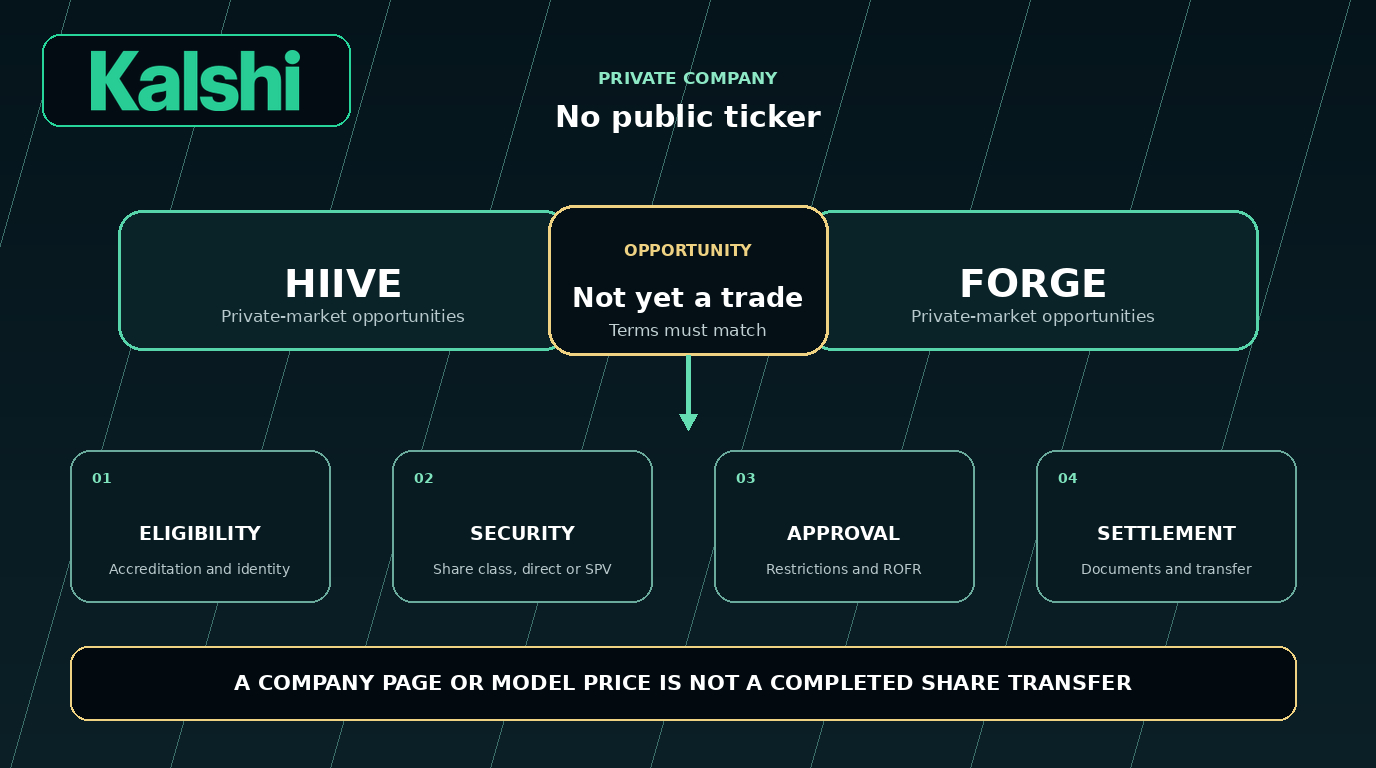
Hiive and Forge can surface private-market opportunities, but eligibility, share structure, transfer restrictions, ROFR and settlement still determine whether ownership actually changes hands.
| Decision factor | Hiive | Forge | What matters |
|---|---|---|---|
| Kalshi-specific page | Yes | Yes | A company page does not guarantee live supply |
| Buyer eligibility | Generally accredited investors for private securities | Accredited-investor verification for private opportunities | Confirm current account-specific requirements |
| Price signal | Hiive Price and marketplace activity | Forge Price and marketplace activity | Neither is a public exchange quote |
| Buyer action | Explore opportunities and submit offers | Browse opportunities and submit or negotiate bids | A submitted offer is not a completed trade |
| Seller action | Confidential listing and negotiation | Submit an indication or ask and seek a match | Demand and issuer policy control completion |
| Security format | Can vary by opportunity | Can vary by opportunity | Verify direct share, SPV, fund interest and share class |
| Transfer approval | Company restrictions can apply | Company restrictions and ROFR can apply | Approval can delay or prevent closing |
| Liquidity | Not guaranteed | Not guaranteed | Plan for a multiyear, illiquid holding |
Do not compare the two platforms using only a model price shown on the same day. Differences may reflect timing, methodology, security type, share class, sparse activity or data available only after account verification.
How a Private Secondary Transaction Works
A typical transaction is slower and more conditional than buying a public stock:
- Account and eligibility review. The platform verifies identity and determines whether the buyer qualifies for the opportunity.
- Opportunity review. The buyer examines the issuer, security, structure, documents, price and minimum size.
- Offer or negotiation. Buyer and seller seek agreement on price, quantity and other terms.
- Proof of ownership and diligence. The platform and counterparties verify that the seller owns the security and that the proposed structure is valid.
- Transfer review. Kalshi or another relevant party may review the transfer, exercise a ROFR or apply contractual restrictions.
- Documents and funding. The parties sign transaction documents and the buyer funds under the agreed process.
- Settlement. Ownership records or the applicable SPV interest are transferred after the conditions are satisfied.
Any step can stop the transaction. A buyer should not treat an agreed headline price as final exposure until the documents are signed, conditions are met and settlement is complete.
What to Check Before Buying Kalshi Pre-IPO Shares
1. What exactly will you own?
Ask for the legal name of the issuer and security. Direct common shares, preferred shares, an SPV interest and a fund interest are not the same asset. An SPV can add management fees, administrative costs and another layer between the investor and Kalshi.
2. Which share class is being valued?
The latest financing valuation may be based on preferred shares with negotiated rights. A secondary common-share block may deserve a discount or different analysis. Do not divide a headline valuation by an unverified share count and call the result a fair price.
3. Is the quote executable?
Identify whether the number is a confirmed transaction, pending transaction, live bid, live ask, midpoint, indication of interest or model-derived estimate. Only a completed transaction proves that a buyer and seller closed at that value—and even then, the terms may not match your opportunity.
4. What can block the transfer?
Review holding periods, securities-law restrictions, company consent, ROFR provisions, co-sale rights and any prohibition on particular buyers or structures. The SEC's private secondary-market guidance explains why restricted securities are not freely tradable.
5. How will you exit?
An IPO is not guaranteed. An acquisition is not guaranteed. Another secondary buyer may not exist when you want to sell. Assume you may need to hold the investment for years and that the eventual exit price could be lower than the purchase price.
6. What information is missing?
Private companies generally provide less continuous public disclosure than listed companies. Ask what financial, capitalization and legal information is available and whether it is current. The absence of a public quarterly filing changes the diligence burden; it does not make a marketplace estimate equivalent to audited company reporting.
Risks of Investing in Kalshi Stock Before an IPO
Illiquidity
There may be no buyer when you need cash. A marketplace can show interest without providing continuous liquidity.
Valuation risk
Kalshi's October 2026 funding valuation reflects a negotiated private round. Future financing, business performance, regulatory disputes or market conditions can move the value sharply. A high-growth company can still produce a poor investment if the entry price assumes too much future success.
Dilution
New financing, employee equity and convertible securities can increase the fully diluted share count. The economic effect depends on the security and protections attached to it.
Transfer and structure risk
ROFR, company consent, holding restrictions or SPV terms can delay, change or block a transaction. Owning an SPV interest can also create different voting, information and exit rights from direct ownership.
Limited disclosure
Private investors may receive less information and fewer standardized updates than public shareholders. The investor must decide whether the available materials are enough to evaluate the business and price.
No guaranteed IPO
A private company can stay private, sell itself, restructure or raise more private capital. Even if an IPO eventually happens, lockups and other restrictions may delay liquidity.
Kalshi Stock Is Not a Kalshi Event Contract
Buying a Kalshi event contract means taking a position on a defined event. It does not provide shares, voting rights, dividends or a claim on company earnings.
The reverse is also true: owning private Kalshi stock would expose an investor to the value of the company, not produce the fixed $1-or-$0 settlement of a particular event contract.
If your goal is to trade event outcomes rather than own Kalshi equity, compare the Kalshi review, Kalshi alternatives and Kalshi vs Macro Markets. Macro Markets offers a crypto-native prediction-market workflow for eligible users; it is not a route to invest in Kalshi stock.
Publicly traded companies such as brokers or crypto platforms may also participate in the prediction-market ecosystem. Buying their shares still does not create ownership in Kalshi, and their broader businesses can dominate the investment outcome.
Is Kalshi Planning an IPO?
No specific IPO date or public ticker was identified in the sources checked for this article. The latest verified first-party announcement was a private Series G financing, not an IPO registration or listing announcement.
Treat any proposed date, ticker or IPO price on social media as unverified unless it appears in an issuer announcement and the relevant SEC filing. A responsible watchlist should track:
- Kalshi's official newsroom;
- SEC EDGAR filings;
- formal exchange-listing announcements;
- changes to Hiive and Forge marketplace activity; and
- the terms of any actual opportunity available to the investor.
Do not invest solely because an IPO is rumored. The holding period, future dilution, listing price and post-listing performance are unknown.
A Practical Decision Checklist
Before pursuing Kalshi stock on Hiive, Forge or another private-market route, answer all of these questions:
- Am I legally and financially eligible for this offering?
- Is there a live opportunity, not merely a company information page?
- What exact security and share class will I own?
- Is ownership direct or through an SPV or fund?
- Which rights, preferences and restrictions apply?
- Is the displayed number a trade, bid, ask, midpoint or model estimate?
- What is the full cost, including platform, legal and SPV fees?
- Can Kalshi or another holder exercise a ROFR?
- What approvals are required before settlement?
- Can I hold the investment for years without liquidity?
- What information have I received about financials and capitalization?
- What happens if no IPO occurs?
If any answer remains unclear, the opportunity is not ready for a decision.
Frequently Asked Questions
What is the Kalshi stock symbol?
Kalshi has no public stock symbol because it is privately held. Be cautious of websites or social accounts claiming that an unofficial ticker already represents Kalshi equity.
Can I buy Kalshi stock on Robinhood, Coinbase or Interactive Brokers?
Not as a listed public stock. Those companies may offer event contracts or participate in the prediction-market ecosystem, but a normal brokerage search does not provide publicly listed Kalshi shares.
Can I buy Kalshi stock on Hiive?
Hiive maintains a Kalshi-specific private-stock page. Eligible investors may be able to view opportunities and submit offers, subject to live availability, accreditation, security structure, transfer restrictions and company approval. A page or indicative Hiive Price is not a guaranteed executable order.
Can I buy Kalshi stock on Forge?
Forge maintains a Kalshi-specific private-stock page. Accredited investors may be able to review market interest and pursue an opportunity, subject to availability, verification, negotiation, documentation, transfer restrictions, ROFR and final approval. Forge Price is a proprietary derived data point, not a public quote.
Is Hiive or Forge better for Kalshi stock?
Neither wins universally. Compare the actual security, share class, structure, live supply, total fees, transfer process and documents available to your account. A lower indicative model price does not prove that an executable opportunity is cheaper.
What is Kalshi's stock price?
There is no official public Kalshi stock price. Hiive and Forge publish their own marketplace data or model-derived indicators, but those figures can differ and do not guarantee the price of a completed transaction.
What is Kalshi's latest valuation?
Kalshi announced a $1 billion Series G at a $40 billion post-money valuation on October 29, 2026. That financing valuation is not the same as a continuously traded public market capitalization or a guaranteed value for every private share.
Do I need to be an accredited investor?
Private secondary opportunities are commonly limited to accredited investors, and both the platform and transaction structure can impose additional criteria. Check the current Investor.gov accredited-investor guidance and complete the marketplace's verification process.
Can Kalshi reject a private-share transfer?
Potentially. Company governing documents, securities laws, transfer restrictions and ROFR provisions can affect whether a transaction closes. The exact documents control.
Will Kalshi go public?
It may consider a future public listing, but this article does not assume an IPO will occur. No specific public IPO date was identified in the verified sources checked. Invest only on the economics and risks of the current private security, not on a promised exit.
Is buying a Kalshi event contract the same as investing in Kalshi?
No. An event contract is a position on a defined outcome. It does not provide equity, voting rights or ownership in Kalshi.
Primary Sources Checked
- Kalshi Series G announcement
- CFTC KalshiEX designated contract market record
- Hiive Kalshi stock page
- Hiive Regulation Best Interest disclosure
- Forge Kalshi stock page:
forgeglobal.com/kalshi_stock/(reviewed separately; automated requests are blocked) - Forge Kalshi IPO page:
forgeglobal.com/kalshi_ipo/(reviewed separately; automated requests are blocked) - SEC private secondary-market guidance
- Investor.gov accredited-investor definition
- Investor.gov private placements bulletin
Final Answer
Kalshi stock is not available on a public exchange. There is no public ticker or universal public price.
For eligible accredited investors, Hiive and Forge are two relevant private secondary-market routes because both maintain Kalshi-specific pages. Neither route guarantees that shares are available or that a negotiated transaction will close. Verify the live opportunity, security type, share class, ownership structure, fees, transfer restrictions, ROFR and approval process before committing capital.
For everyone else, the honest answer is to wait for a verified public offering rather than treating an indicative private-market price or IPO rumor as a tradable public stock.
