


Kalshi vs Coinbase Prediction Markets: Which Is Better in 2026?
Kalshi and Coinbase Predictions can show the same event contracts, but they are not two independent exchanges competing for the trade. Coinbase's current documentation says Coinbase Financial Markets provides the customer account while Kalshi operates the prediction markets and determines settlement under each contract's rules.
Our verdict: choose Kalshi when you want a direct relationship with the current exchange, its native market interface, public fee documentation and developer tools. Choose Coinbase when you already use Coinbase and value one familiar account, web and mobile access, and funding with settled USD or USDC. For a matched contract, the decision is often about the access layer rather than a different liquidity venue.
Last reviewed and fact-checked: November 1, 2026.
Editorial disclosure: Macro Markets publishes this comparison and operates a prediction-market platform. We include Macro Markets as a contextual crypto-native alternative, apply the same comparison criteria and do not present it as a CFTC-designated US exchange. This is a documentation-based comparison; we did not place simultaneous matched orders or complete a deposit-to-withdrawal test on both access paths. Event contracts are speculative and can lose the full amount committed. This page is educational, not financial, legal or tax advice.
Kalshi vs Coinbase: Quick Verdict
Choose Kalshi directly if you want to see the exchange relationship clearly. KalshiEX lists the current contracts, maintains the underlying market and applies the written settlement rules. A direct account also gives users access to Kalshi's native order controls, market pages and public developer documentation.
Choose Coinbase Predictions if integration is more valuable than a direct exchange account. Coinbase Financial Markets, or CFM, handles onboarding and the customer relationship. Existing Coinbase customers can use the broader Coinbase interface and fund the predictions balance with eligible settled USD or USDC.
Winner by use case
- Direct exchange account: Kalshi.
- Existing Coinbase account integration: Coinbase.
- Native exchange interface and public API: Kalshi.
- Funding with settled USDC inside a crypto-centered account: Coinbase.
- Published general fee formula: Kalshi.
- Simple customer-facing fee preview: Coinbase, but the applicable amount must be checked on each order.
- Different underlying liquidity: usually neither for current matched Coinbase contracts, because Coinbase says Kalshi operates them.
- Best executable trade: compare the final preview, quantity and order path rather than assuming one brand is cheaper.
Coinbase's current prediction-markets introduction says current markets are operated by Kalshi and that Coinbase cannot override Kalshi's resolution. The CFTC record for KalshiEX lists Kalshi as a designated contract market. CFM is the intermediary, not the exchange operator for the current consumer markets described by Coinbase.
For standalone assessments, read our Kalshi review and Coinbase Prediction Markets review. Our prediction-market comparison methodology explains the framework used here.
Kalshi vs Coinbase at a Glance
| Decision factor | Kalshi direct | Coinbase Predictions | Practical edge |
|---|---|---|---|
| Customer relationship | Direct Kalshi exchange account | Coinbase Financial Markets account connected to Coinbase | Depends on preferred account structure |
| Current exchange | KalshiEX | Coinbase says current markets are operated by Kalshi | Same underlying exchange for matched current contracts |
| Regulation | KalshiEX is a CFTC-designated contract market | CFM is a CFTC-registered FCM and NFA member | Different regulated roles |
| Eligibility | Account, location and contract restrictions apply | US residents only; current exclusions include Nevada and Michigan | Kalshi may support a wider direct footprint, subject to current rules |
| Funding | Eligible bank and supported transfer methods | Settled USD or USDC through the Coinbase relationship | Coinbase for integrated USDC funding |
| Fees | Public schedules and formulas; special series can differ | Applicable fee shown in the order confirmation | Kalshi for public formula detail; Coinbase for order-specific preview |
| Liquidity | Native Kalshi market and book | Current matched contracts reach the Kalshi market | Do not count Coinbase as a second independent book |
| Tools | Web, mobile, public API and exchange-native pages | Web and mobile customer interface | Kalshi for technical access; Coinbase for familiar account integration |
| Settlement | Kalshi applies the contract rules | Coinbase honors Kalshi's official result | Same rule source for current matched contracts |
Coinbase Financial Markets is not Coinbase Derivatives
The names can create confusion. Coinbase Financial Markets is the futures commission merchant that provides the customer access layer. Coinbase Derivatives LLC is a separately designated contract market listed by the CFTC. The existence of a Coinbase-owned DCM does not mean every prediction contract displayed in the Coinbase consumer product currently trades there.
The current help page is the controlling public description for the customer flow: it says the prediction markets are operated by Kalshi. Product architecture can change, so check the market detail page and current disclosure before every trade.
The Same Underlying Exchange Question
The central issue in a Kalshi vs Coinbase prediction markets comparison is whether a customer is choosing a different market or a different doorway to the same market.
Coinbase currently describes this chain:
- The customer uses a Coinbase.com relationship and applies for CFM predictions access.
- Settled USD or USDC is moved into the predictions balance.
- The customer selects an event and submits an order through Coinbase.
- Kalshi operates the current market and applies the contract rules.
- Settlement and proceeds return through the CFM and Coinbase balance flow.
With direct Kalshi access, the customer opens an account with Kalshi and interacts with the exchange interface without the Coinbase access layer.
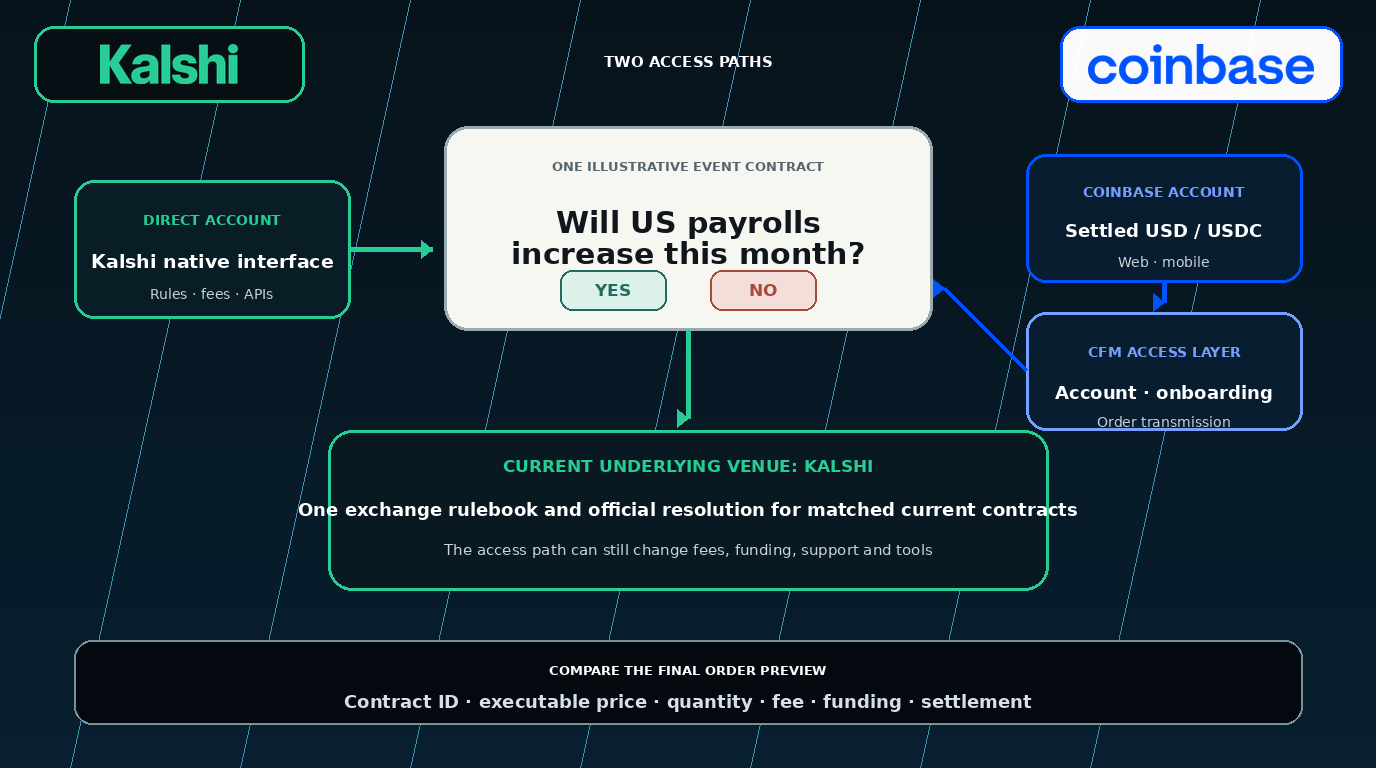
For the current Coinbase product described in official documentation, the key difference is the account and access path, not a second independent exchange book.
Similar screens do not create separate liquidity
If the same Kalshi contract appears on both interfaces, it should not be counted as two independent venues for arbitrage or diversification. The event question, market identifier, settlement source and underlying book need to be checked before comparing prices.
A quote can still look different because of timing, order presentation, rounding, quantity, customer-facing fees or a delay between screens. That difference does not prove there are two separate pools of liquidity.
Before treating two listings as equivalent, match:
- the exact event and outcome;
- the contract identifier or linked Kalshi page;
- the observation time and settlement source;
- the Yes or No side;
- the available quantity at the quoted price; and
- the complete customer-facing fee preview.
Coinbase's current payout documentation tells customers to use the corresponding Kalshi market page to verify the official result for applicable contracts. That is strong evidence that the exchange rulebook, not the Coinbase spot-price screen or a third-party chart, controls settlement.
Fees, Prices and Liquidity
Kalshi provides a public general fee formula for many immediately matched orders. The current Kalshi fee guidance explains that fees depend on contract price and quantity. Special series, maker schedules, intermediated access and promotions can differ.
Under the commonly published general probability-weighted formula:
fee = round up(0.07 × C × P × (1 − P))
At a 50-cent price, 100 contracts produce a $1.75 illustrative fee under that formula. At 20 cents, the same coefficient produces $1.12 before any special schedule. The lower nominal fee near a probability extreme does not make the trade safer.
Coinbase's current public overview does not publish one universal prediction-market fee formula. It says the applicable fee appears in the order confirmation. That means a direct Kalshi calculation cannot automatically be copied into the Coinbase column even when the underlying contract is the same.
Compare the complete order, not one fee line
Use this model:
all-in cost = contract debit + customer-facing fee + spread + slippage + funding friction
Suppose the direct Kalshi interface shows 100 contracts offered at $0.50, while Coinbase displays a total order preview for the corresponding contract. Record the final quantity, total debit and maximum payout on both paths at nearly the same time. Do not compare a Kalshi best ask with an old Coinbase last-traded price.
Liquidity is contract-specific. Because current matched Coinbase listings use Kalshi-operated markets, the broader Coinbase brand does not create a second independent order book. A highly liquid election contract also does not prove depth in a small weather or economic market.
Check:
- the best executable price for your side;
- quantity available at that price;
- depth beyond the first level;
- the fee shown for the complete order;
- whether the order can rest or must execute immediately; and
- the likely early-exit price.
Our prediction-market fee calculator helps compare matched scenarios. The bid-ask spread guide explains why a familiar interface can still produce a costly exit.
Funding, Access and Trading Tools
Coinbase has the clearest advantage for a customer already using its crypto-centered account. Its current buy-and-sell guide says prediction orders can use settled USD or USDC. Customers move eligible value into a predictions balance and can trade from mobile or a browser.
The word settled matters. A recent deposit can appear in the broader account but remain unavailable for prediction orders. Unrealized gains also do not become general spendable value. After a sale or settlement, transfers back to the primary balance follow Coinbase's documented processing windows rather than functioning as an instant on-chain withdrawal.
Kalshi provides a dedicated exchange account with eligible bank-transfer methods and supported crypto-transfer routes. That can require another account, but it keeps the exchange relationship and native market tools in one place.
Eligibility differs
Coinbase currently says its prediction markets are for US residents and exclude Nevada and Michigan. Approval requires the CFM account process and can include identity, financial and suitability information. If a customer no longer resides in the US, Coinbase says CFM may liquidate open contracts and close unfilled orders.
Kalshi applies its own identity, jurisdiction and contract-specific restrictions. Do not assume eligibility on one path proves eligibility on the other. The live onboarding screen and customer agreement control.
Kalshi has the API advantage
Kalshi publishes REST and WebSocket documentation for market data, order books, orders and portfolio workflows. That makes direct Kalshi access the clearer choice for a developer or systematic trader who needs exchange-native identifiers and programmatic order handling.
Coinbase's consumer predictions documentation focuses on web and mobile trading. General Coinbase crypto APIs should not be assumed to expose every CFM prediction-market function. Verify a supported prediction-specific endpoint before designing an integration.
Customer support follows the access path
A Coinbase customer begins with Coinbase support for account, balance and order-entry issues, while Kalshi remains responsible for the current exchange rules and official result. A direct Kalshi customer deals with Kalshi for the exchange account and contract.
This split matters in a dispute. Identify whether the issue concerns identity or funding, order transmission, exchange execution, or settlement. The correct evidence and responsible entity can differ at each layer.
How to Choose Safely
Use this decision sequence:
- Confirm eligibility on the chosen path. Check location, account approval and contract restrictions.
- Identify the exchange. Do not infer it from the app logo. Read the market disclosure.
- Match the contract. Confirm the identifier, source, deadline and exceptional-outcome rules.
- Compare the final preview. Use the same side, quantity and nearly the same time.
- Check the full money route. Include deposit availability, predictions balance, settlement and withdrawal timing.
- Plan the exit. Do not assume the displayed last price is executable for the whole position.
- Start small. Test the account, order and payout path before committing meaningful capital.
If neither access model fits, Macro Markets is a crypto-native alternative for eligible users who deliberately prefer wallet-oriented funding and global market discovery. Because Macro Markets publishes this article, treat that inclusion as a disclosed first-party statement. Verify its current jurisdiction, eligibility, network, fees, liquidity, custody and resolution rules independently. Macro Markets has a different legal profile and is not presented here as a CFTC-designated exchange.
For a broader shortlist, compare the best Coinbase prediction markets alternatives and Kalshi alternatives. Our guide to the best prediction market apps covers additional account models.
Frequently Asked Questions and Final Verdict
Is Coinbase Predictions the same as Kalshi?
No. Coinbase Financial Markets provides the Coinbase customer access layer. Coinbase's current help documentation says Kalshi operates the prediction markets and determines official outcomes. They are different companies and regulated entities, even when the customer reaches a Kalshi contract through Coinbase.
Does Coinbase have its own prediction-market exchange?
Coinbase Derivatives LLC is a CFTC-designated contract market, but it is distinct from Coinbase Financial Markets. The current consumer help page says the prediction markets offered through CFM are operated by Kalshi. Always check the venue disclosure for the specific contract because the architecture can change.
Are Coinbase and Kalshi prices the same?
They may refer to the same underlying contract, but screen values can differ because of timing, rounding, quantity or customer-facing fees. Compare the executable order preview and contract identifier, not screenshots captured at different times.
Is Coinbase cheaper than Kalshi?
There is no universal answer. Kalshi publishes general fee schedules, while Coinbase says its applicable prediction-market fee is shown in the order confirmation. Spread, slippage and quantity can outweigh a small fee difference.
Which is better for crypto users?
Coinbase can be more convenient for an existing customer who holds settled USDC and wants predictions inside the same broader account relationship. Kalshi also supports certain crypto-transfer routes, but the direct account remains centered on the event exchange. Macro Markets is a separate crypto-native alternative with a different legal and custody profile.
Who resolves a Coinbase prediction contract?
For the current markets described by Coinbase, Kalshi determines the official outcome from the source and conditions written into the contract. Coinbase says it cannot manually override that result.
Which is better for API trading?
Kalshi is the clearer choice because it publishes prediction-market REST and WebSocket documentation. Do not assume a general Coinbase crypto API supports CFM prediction orders unless Coinbase documents the exact function.
Final verdict
Kalshi is better for users who want direct exchange access, native market tools, public fee documentation and APIs. Coinbase is better for approved US customers who prioritize a familiar Coinbase account, web and mobile access, and settled USD or USDC funding.
For the current Coinbase product, this is usually not a contest between two independent order books. It is a choice between accessing a Kalshi-operated contract directly or through Coinbase Financial Markets. Verify the exchange, match the contract and compare the complete final preview before choosing.
For a comparison that does involve a separate exchange book, read Polymarket US vs Coinbase prediction markets.
Regulation does not guarantee profit or liquidity. A valid contract can settle at $0, and an early exit may be unavailable or expensive.
