


Coinbase Prediction Markets Review 2026: Fees, Safety and Alternatives
Coinbase prediction markets give eligible US customers a way to trade event contracts from the same broader Coinbase relationship they may already use for crypto. The product is legitimate and unusually convenient, but the name can hide how the trade actually works: Coinbase Financial Markets handles the customer account, while Kalshi currently operates the markets and determines settlement under the contract rules.
That separation matters. The Coinbase interface does not create a second pool of liquidity independent from Kalshi. Coinbase also does not promise one fixed prediction-market fee on its public help page; the order confirmation is where the applicable charge must be checked. A customer therefore needs to evaluate the account, exchange, contract and price, not only the Coinbase brand.
Our verdict: Coinbase is a strong fit for an approved US customer who already uses Coinbase, wants mobile and web access, and values funding with settled USD or USDC. It is less suitable for someone who wants a direct exchange relationship, lives in an excluded state, or expects Coinbase to control contract resolution.
Last reviewed and fact-checked: October 27, 2026.
Editorial disclosure: Macro Markets publishes this review and operates a prediction-market platform. We include Macro Markets as an alternative, apply the same criteria to it and do not present it as a CFTC-designated US exchange. This is a documentation-based review; we did not open and fund a Coinbase Financial Markets account for this article. Event contracts are risky, can settle at $0 and are not suitable for everyone. This page is educational, not financial, tax or legal advice.
Coinbase Prediction Markets Review: Quick Verdict
Coinbase earns a positive but qualified verdict. Existing Coinbase customers get a familiar login, a clear order path and access on both mobile and web. The current catalog can include sports, crypto prices, politics and elections, weather and economic events. Positions can be funded with settled USD or USDC, and a contract can normally be sold before resolution when a market is available.
The qualification is structural. Coinbase's official prediction-markets overview says the service is offered through Coinbase Financial Markets, or CFM. It also says the markets are operated by Kalshi, a CFTC-regulated exchange, and that Kalshi, not Coinbase, determines the final result using the source written into the contract.
| Review factor | Finding | What it means |
|---|---|---|
| Legal structure | CFM is a CFTC-registered futures commission merchant and NFA member | Coinbase provides the customer access layer; it is not the exchange operator for the current markets |
| Exchange | Current prediction markets are operated by Kalshi | Coinbase and direct Kalshi access may route to the same underlying market |
| Eligibility | Approved US residents, excluding Nevada and Michigan | Access is not nationwide and requires identity plus suitability information |
| Trading surfaces | Coinbase mobile app and browser | More flexible than a mobile-only product |
| Funding | Settled USD or USDC | Crypto users may find USDC convenient, but unsettled value is not available |
| Fees | Shown on the order confirmation | There is no defensible universal fee rate to quote from the current public overview |
| Settlement | Kalshi applies the contract's named source and rules | Coinbase cannot override a result because a customer disagrees with it |
| Risk | A losing standard contract pays $0 | The full amount committed to a losing outcome can be lost |
Coinbase prediction markets pros and cons
Pros
- Familiar account relationship for existing Coinbase users.
- Trading available on mobile and in a browser.
- Funding with settled USD or USDC.
- Broad event categories, including crypto-price contracts.
- Ability to sell many positions before resolution.
- Sports combos can combine two to ten legs when supported.
Cons
- Not available to residents of Nevada or Michigan.
- Account approval includes identity, financial and suitability questions.
- Current market flow comes from Kalshi rather than an independent Coinbase venue.
- Public documentation does not provide one fixed fee table for every prediction order.
- Payout sweeps follow a business-day schedule and are not continuous withdrawals to the primary balance.
- Thin markets, spreads and changing quotes can make an early exit costly or impossible.
Coinbase is therefore not automatically “better than Kalshi” merely because the trade appears in Coinbase. The strongest benefit is the access experience. The underlying market quality still depends on the Kalshi contract, its order book, its rules and the price available when the customer trades.
How Coinbase Prediction Markets Work
A standard prediction contract asks whether a defined event will occur. A Yes contract and a No contract normally settle so that the winning side pays $1 per contract and the losing side pays $0, minus applicable fees. A price of $0.62 can be interpreted as an implied probability near 62%, but it is a traded price, not a guarantee or a scientific forecast.
The easiest way to understand Coinbase prediction markets is to separate four layers.
- Coinbase.com balance: the customer's broader account can hold eligible settled USD or USDC.
- CFM predictions account: Coinbase Financial Markets conducts onboarding, maintains the prediction-market relationship and applies account or position limits.
- Kalshi exchange: Kalshi currently operates the market, supplies the trading venue and enforces its market rules.
- Contract terms: the written contract names the source, timing, threshold and exceptional circumstances that determine settlement.
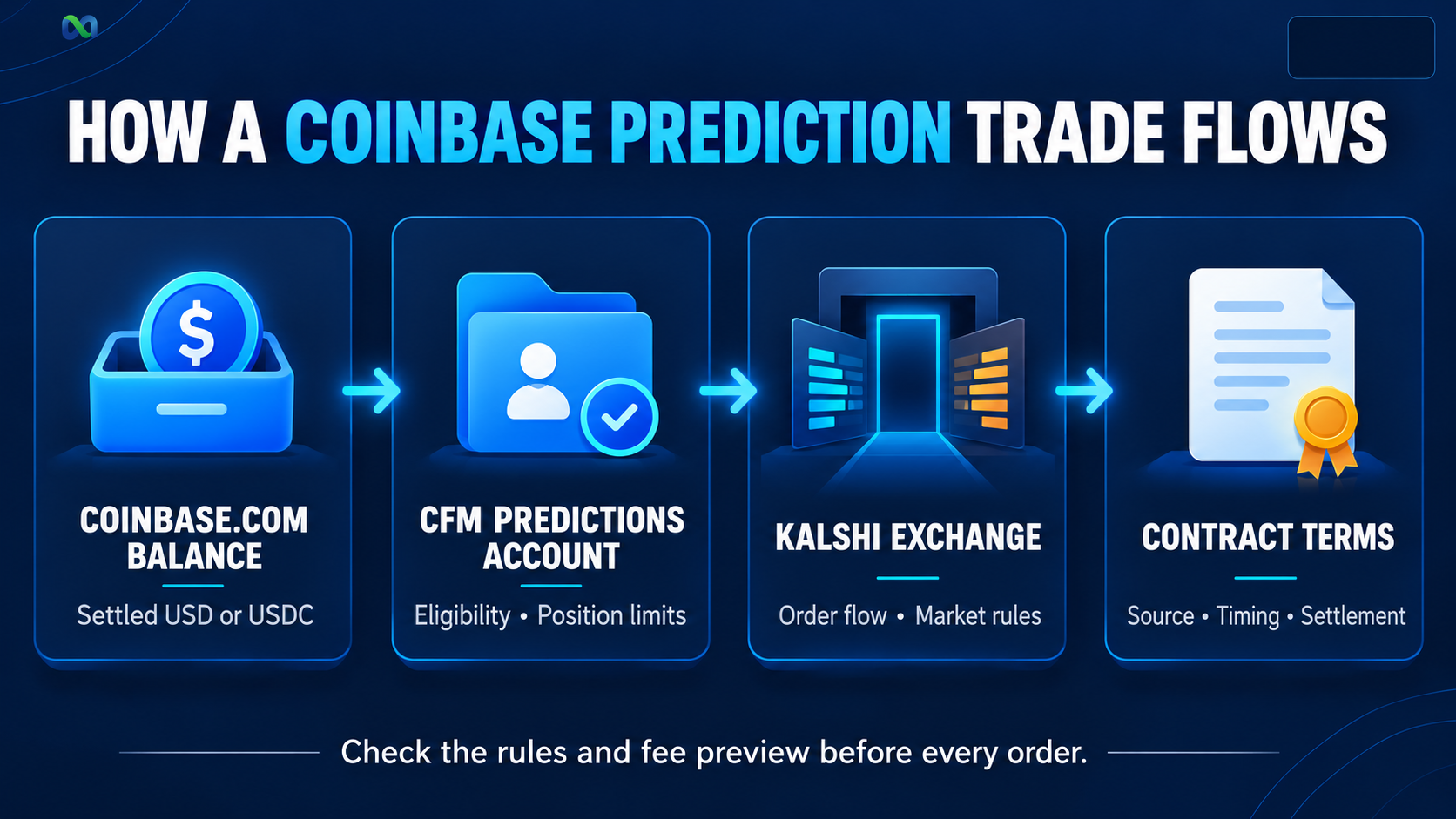
This model prevents three common mistakes. First, CFM is not the same entity as Coinbase's ordinary crypto platform. Second, Coinbase Financial Markets should not be confused with Coinbase Derivatives LLC, a separately listed derivatives exchange entity. Third, a Coinbase-branded screen does not mean Coinbase decides whether the real-world event happened.
The trading flow begins with an application. Coinbase's application guide says the customer needs a Coinbase.com account, a US address, a Social Security number or taxpayer identification number, and identity, employment and financial information. CFM uses those details for identity verification and a suitability assessment. Coinbase permits three application attempts in a day, followed by a seven-day wait if all three fail.
After approval, the customer opens Predictions on mobile or the web, chooses an event, selects an outcome and enters an order. The confirmation screen should show the price, quantity, fee and maximum potential payout. Position limits can depend on verified financial information and market conditions.
If you buy 100 Yes contracts at $0.40, the contract cost is $40 before fees. A $1 settlement would return $100 before fees, while a $0 settlement would lose the $40 cost. Selling early replaces the binary final payout with whatever executable market price is available at that moment.
The last displayed price is not necessarily the price you can obtain. Buyers submit bids and sellers submit offers; their difference is the spread. Our guide to the bid-ask spread in prediction markets explains why a contract can appear profitable on screen but still produce a poor exit after spread and slippage.
Coinbase says trading is generally available 24/7 except for a regular Thursday maintenance window from 3 a.m. to 5 a.m. Eastern Time and interruptions required by maintenance, market conditions or regulation. “24/7” should therefore be read as normal availability, not a guarantee that every contract can always be traded.
Readers who are new to the product should start with our guide to trading prediction markets. The most important habit is to read the rules before using the headline probability as a trading signal.
Is Coinbase Prediction Markets Legit and Safe?
Yes, Coinbase prediction markets are a legitimate regulated product for customers whom CFM approves. The CFTC's futures commission merchant data and the NFA's explanation of FCM registration describe the intermediary framework. Coinbase also states that CFM is registered with the CFTC and is an NFA member.
The markets currently run through Kalshi. The CFTC's list of designated contract markets identifies KalshiEX as a designated contract market. This is meaningful regulatory context, but it does not make an individual position safe from losing money, a thin order book liquid or a disputed contract outcome favorable to the customer.
The word “safe” needs to be split into three questions:
- Is the intermediary identifiable and regulated? Yes. CFM is a registered FCM and NFA member.
- Is the current exchange identifiable and regulated? Yes. Coinbase identifies Kalshi as the current market operator, and Kalshi is a CFTC-designated contract market.
- Is the investment protected from loss? No. A valid contract can settle at $0, and market prices can move sharply before resolution.
Account protection requires careful wording. Coinbase's insurance overview explains protections by product and account type: crypto is not FDIC or SIPC protected, certain USD balances may qualify for pass-through FDIC insurance under stated conditions, and securities held through Coinbase Capital Markets have separate SIPC treatment. It does not say that an event-contract loss is insured. Customers should not assume protections associated with another Coinbase balance or product automatically cover a CFM prediction position.
Operational security also matters. Use a unique password, enable strong multifactor authentication, verify that you are on the official Coinbase domain and avoid following unsolicited links to a “prediction” promotion. A regulated product does not prevent phishing or account takeover.
Contract risk is separate from account security. Before placing an order, identify:
- the exact question and outcome;
- the official settlement source;
- the observation window and time zone;
- the threshold and rounding method;
- the treatment of cancellation, delay or an ambiguous result;
- the fee, spread and available size;
- the amount that can be lost.
Crypto-price contracts provide a useful example. Coinbase says these markets can use the CF Benchmarks Bitcoin Real-Time Index, which represents a 60-second time-weighted average. A customer watching one exchange's last BTC trade could therefore expect one result while the contract correctly resolves from a different defined benchmark.
Location rules are equally important. Coinbase currently excludes Nevada and Michigan residents from the product, and other eligibility or contract restrictions may apply. If an approved customer moves outside the United States, Coinbase's buy-and-sell guide says CFM may liquidate open contracts and close pending orders. Our guide to whether prediction markets are legal in the US explains why federal registration, state access and contract category must be checked separately.
Markets, Trading Experience and Sports Combos
Coinbase lists five broad prediction categories in its current documentation: crypto, sports, weather, politics and elections, and economic events. The live catalog changes as contracts open, expire and settle. A category listed in a help article does not guarantee that a specific market is available at the time or in the customer's location.
The interface advantage is real. A customer can browse and trade from the Coinbase mobile app or a browser, use familiar USD values and see a preview before confirming. That makes Coinbase easier to access than a product restricted to mobile execution and less operationally demanding than a crypto-native platform that requires a separate wallet flow.
Convenience does not create liquidity. Because the current markets are operated by Kalshi, a Coinbase user and a direct Kalshi user may be reaching the same underlying contract and order book. Coinbase should not be counted as a separate venue when comparing the depth of that market. The visible quote, available size and spread at the moment of the order are the useful evidence.
Coinbase permits a customer to sell a position before settlement when trading remains available. An early sale can lock in a gain or reduce a loss, but it is not guaranteed. News can move a price before an order reaches the market, and a thin book may offer only a poor exit.
How sports combos work
Coinbase's sports-combo guide says a combo can contain two to ten legs. All legs normally need to win for the combo to pay the standard winning amount. The feature uses a request-for-quote process: Coinbase requests a price, the quote can change or expire, and the trade can be rejected if no valid quote is available.
That is different from simply buying several independent contracts. A combo bundles the selections into one all-or-nothing position. The attractive payout reflects the lower joint probability. If one standard leg loses, the combo normally loses even when every other prediction was correct.
Exceptional outcomes require another rule check. Coinbase says certain legs can settle at a fractional amount, which can proportionally adjust the combo payout. The displayed return is therefore not always the final return if a leg receives nonstandard treatment.
Use this checklist before accepting a combo quote:
- Confirm every leg and the event date.
- Read cancellation and postponement rules.
- Compare the quoted combined probability with your own estimate.
- Check whether the quote changed before confirmation.
- Assume the full amount can be lost if any ordinary leg fails.
- Do not rely on an early exit being available.
For single contracts and combos alike, the interface should be treated as an order-entry tool, not as research. Read primary event sources, distinguish fact from opinion and size the position for a total loss. Prediction prices can aggregate information efficiently, but they can also reflect poor liquidity, attention bias or participants trading for reasons other than a calibrated forecast.
Coinbase Prediction Market Fees, Funding and Payouts
Coinbase's current public prediction-market overview does not publish one fixed fee rate that applies to every order. It says the fee is disclosed in the order confirmation. That confirmation is the authoritative customer-facing number for the proposed trade, and this review will not invent a universal percentage.
The total economic cost can be larger than the displayed platform fee. It includes:
- the order fee shown before confirmation;
- the bid-ask spread;
- slippage when available size is insufficient at the displayed price;
- a second trading cost if the position is sold before resolution;
- the opportunity cost of value held until settlement and payout.
Suppose a Yes contract is offered at $0.48 and the best bid is $0.44. The four-cent spread represents $4 across 100 contracts before any disclosed fee. If the position must be closed immediately, that spread can matter more than a small headline commission. Compare the total debit, maximum payout and executable exit, not only the fee line.
Funding is comparatively simple. Coinbase says prediction orders use settled USD or USDC. The predictions balance is separate for trading purposes, but value from a settled position can be reused for another prediction. Unrealized gains are not available to spend or withdraw.
The word “settled” is important. A recent deposit or transfer may appear in the broader account while still being unavailable for predictions. Customers should fund before a time-sensitive event rather than assume every displayed dollar can immediately support an order.
Coinbase's payout guide says a winning standard contract pays $1, minus fees, and a losing contract pays $0. Winnings become available within the predictions experience after the market resolves.
Transfers back to the primary Coinbase balance follow an automatic sweep schedule. Coinbase currently says sweeps occur every two hours between 6 a.m. and 4 p.m. Eastern Time on business days, with no sweeps on weekends or holidays. The daily statement is the authoritative record. A Friday-night settlement may therefore remain in the predictions balance longer than someone expecting an instant weekend transfer anticipates.
Fees and timing should be checked again whenever the product changes. A screenshot from an old review, a Reddit comment or a direct Kalshi fee calculation does not necessarily establish the amount Coinbase will show on a new CFM order. The two access paths can have different customer-facing terms even when they reach the same underlying market.
Tax treatment depends on the instrument and the customer's circumstances. Coinbase's tax information center explains that forms and reporting vary by activity. Keep statements and transaction records, and consult a qualified US tax professional. The absence of a particular form does not by itself remove a reporting obligation.
A five-point order check
Before every Coinbase prediction order, record:
- Account: Is the available USD or USDC settled in the predictions flow?
- Contract: What source, threshold and deadline control settlement?
- Market: What are the executable bid, ask and available size?
- Cost: What fee and total debit appear on the final confirmation?
- Exit: Can the position be sold, and when would resolved funds sweep back?
This contract-level check is more reliable than labeling Coinbase universally cheap, liquid or fast.
Coinbase vs Gemini, Kalshi, Interactive Brokers, Robinhood, Polymarket US and Macro Markets
The best alternative depends on the customer's location, desired market, funding preference and need for direct exchange tools. Apply the same criteria to every option: legal structure, eligibility, funding, fees, liquidity, settlement and usability.
| Platform | Structure | Best fit | Funding model | Main trade-off |
|---|---|---|---|---|
| Coinbase | CFM intermediary; current markets operated by Kalshi | Existing Coinbase customers wanting mobile and web access | Settled USD or USDC | Not an independent liquidity venue from current Kalshi flow; NV and MI excluded |
| Gemini Predictions | Gemini Titan exchange with Gemini Olympus clearing | Crypto-oriented users wanting an independent exchange book and APIs | Eligible Gemini fiat balance; supported crypto can be sold into USD | Separate liquidity and rules; maker/taker costs and location vary |
| Kalshi | CFTC-designated contract market and clearing organization | US users wanting a direct event-exchange relationship | Supported fiat funding | Standalone exchange account; access varies by state and contract |
| Interactive Brokers | Broker/FCM routing to ForecastEx, Kalshi and CME | Experienced traders wanting desktop tools, multi-venue routing and consolidated reporting | Eligible brokerage cash | More complex workflow; a matching Kalshi contract may share Coinbase's underlying book |
| Robinhood | CFTC-registered FCM routing to partner exchanges | Existing Robinhood customers prioritizing a mobile brokerage workflow | Eligible settled cash through the derivatives flow | Trading execution is mobile-only; venue and rules vary by contract |
| Polymarket US | Separate CFTC-designated US exchange product | Users comparing another dedicated US venue | US-product funding rules | Must not be confused with international polymarket.com |
| Macro Markets | Crypto-native prediction-market platform; not presented as a CFTC-designated US exchange | Eligible users seeking crypto funding and global market discovery | Supported crypto and network transactions | Different jurisdiction, custody, funding and regulatory risk profile |
Choose Coinbase when you already trust its account workflow, want browser as well as mobile access and prefer settled USD or USDC. The benefit is integration, not a separate Coinbase-operated order book.
Choose Gemini when you want a Gemini-operated exchange book, explicit standard maker/taker formulas and prediction-specific APIs. The Coinbase vs Gemini Prediction Markets comparison explains why apparently similar contracts use separate liquidity, rules and settlement chains.
Choose Crypto.com Predict Pro when published maker/taker formulas, full depth and Post-Only execution matter more than Coinbase's consumer flow. It uses a separate CDNA/NADEX book rather than Coinbase's current Kalshi route. Our Coinbase vs Crypto.com Predict Pro comparison matches the funding paths, fees, orders, APIs and settlement authority.
Choose Kalshi when you want to use the current exchange directly and inspect its native market interface. Direct access can make the exchange relationship more obvious, although it does not guarantee better pricing for every trade. Our Kalshi vs Coinbase Prediction Markets comparison explains the two access paths, while the Kalshi review covers its fees, regulation and risks.
Choose Interactive Brokers when professional desktop software, consolidated reporting and supported access to ForecastEx, Kalshi and CME matter more than Coinbase's consumer workflow. Our Coinbase vs Interactive Brokers Prediction Markets comparison explains when both paths can reach the same Kalshi book and when IBKR provides an independent venue; the Interactive Brokers prediction markets review covers the broader product.
Choose ForecastEx when macro contracts, a published direct-client fee route, limit orders and APIs matter more than Coinbase's settled-USDC convenience. The ForecastEx vs Coinbase Prediction Markets comparison explains why current Coinbase orders reach a separate Kalshi book rather than ForecastEx liquidity.
Choose Robinhood when you want event contracts alongside a familiar brokerage relationship and are comfortable executing on mobile. Robinhood can route to multiple partner exchanges, so the venue must be checked contract by contract. Our Coinbase vs Robinhood Prediction Markets comparison explains when both interfaces can reach the same Kalshi book and when Robinhood creates a separate venue comparison; the Robinhood review covers its complete product.
Choose Polymarket US when you want to evaluate another regulated US exchange product. Keep the US platform separate from the international crypto product because their access, funding and legal structures differ. Our Polymarket review makes that distinction.
Consider Macro Markets when you are eligible to use a crypto-native platform and value crypto funding plus broad global market discovery. Because Macro Markets publishes this article, treat its inclusion as a disclosed first-party claim and verify current eligibility, wallet flow, fees, liquidity and resolution rules yourself. Macro Markets has a different legal and custody profile and is not represented here as a CFTC-designated US exchange.
No platform wins every category. A convenient interface can have a worse executable price; a direct exchange can require a separate account; and a crypto-native product can introduce wallet, network and jurisdiction risks. We publish the full framework in our prediction-market comparison methodology. For a Coinbase-specific shortlist, see the best Coinbase prediction markets alternatives. For US alternatives to Polymarket's regulated product, compare the best Polymarket US alternatives. For a wider view, compare the best prediction market apps and platforms and Kalshi alternatives.
Frequently Asked Questions and Final Verdict
Are Coinbase prediction markets legit?
Yes. Coinbase offers the product through Coinbase Financial Markets, a CFTC-registered futures commission merchant and NFA member. The current markets are operated by Kalshi, a CFTC-designated contract market. Regulation does not guarantee a profit, liquidity or access in every state.
Is Coinbase the exchange for its prediction markets?
Not for the current product described by Coinbase. CFM manages the customer relationship, while Kalshi operates the markets and applies the contract rules. Coinbase Derivatives LLC is a separate entity and should not be confused with the CFM prediction-market access layer.
How much does Coinbase charge for prediction markets?
Coinbase says the applicable fee appears in the order confirmation. Its current public overview does not state one universal fixed rate for every prediction order. Check the final fee, total debit, spread and maximum payout before submitting.
Can I use USDC for Coinbase predictions?
Yes. Coinbase says settled USD and USDC can fund prediction orders. Unsettled value and unrealized gains are not available in the same way, so verify the spendable predictions balance before a time-sensitive trade.
When do Coinbase prediction-market winnings pay out?
Winnings become available in the predictions balance after resolution. Coinbase says automatic sweeps to the primary account run every two hours from 6 a.m. to 4 p.m. ET on business days, excluding weekends and holidays. The daily statement is authoritative.
Can I trade Coinbase prediction markets on a computer?
Yes. Coinbase supports its prediction-markets experience on mobile and through a web browser. Actual availability still depends on account approval, location, maintenance and market conditions.
What states cannot use Coinbase prediction markets?
Coinbase currently says the product is unavailable to residents of Nevada and Michigan. Eligibility and contract restrictions can change, so the current application screen and product terms control.
Who decides whether a Coinbase prediction wins?
Kalshi determines the final result for the current markets using the source and rules written into each contract. Coinbase says it cannot override that decision. Read the official source, observation time and exceptional-outcome clauses before trading.
What is the best alternative to Coinbase prediction markets?
Kalshi is the most direct alternative for someone who wants the current underlying exchange relationship. Robinhood can suit brokerage-focused mobile users, while Polymarket US offers another US exchange product. Macro Markets can suit eligible crypto-native users, but it has a different legal, custody and funding profile and is not a CFTC-designated US exchange.
Final verdict
Coinbase prediction markets are worth considering for approved US customers who value a familiar account, web and mobile access, and the option to use settled USD or USDC. The product's convenience is its strongest advantage.
The correct mental model is not “Coinbase controls everything.” CFM handles the customer access layer, Kalshi currently operates the markets, and each contract's written terms control settlement. Fees must be checked in the order confirmation, liquidity must be checked in the live quote, and payouts follow the documented sweep schedule.
For a separate-book comparison, see Polymarket US vs Coinbase prediction markets, which contrasts the direct QCX exchange route with Coinbase Financial Markets access to Kalshi.
Read the contract, verify the source, inspect the total cost and size the position for a $0 outcome. If any of those facts are unclear, do not trade the contract.
Source note: Coinbase's official prediction-markets introduction, application, trading, sports-combo, payout, insurance and tax help pages were reviewed on October 27, 2026. Direct help-center links are omitted because the site returns HTTP 403 to automated availability checks. CFTC and NFA links above remain available for independent regulatory verification.
