Interactive Brokers Prediction Markets Review 2026: Fees, Safety and ForecastEx
Interactive Brokers Prediction Markets turns one brokerage account into a gateway to event contracts on ForecastEx, Kalshi and CME Group. That is its strongest feature. Eligible clients can search several venues, compare net prices and manage event positions beside stocks, options, futures, bonds and other assets without separately funding every exchange.
The structure also creates the product's biggest source of confusion. Interactive Brokers, or IBKR, is the broker and futures commission merchant. It is not the listing exchange for every contract shown in the interface. ForecastEx, Kalshi or a CME venue supplies the order book and rules for the specific market. Fees, liquidity, settlement and even the legal classification can therefore change with the destination.
Our verdict: IBKR is one of the strongest prediction-market access options for an eligible customer who already uses a full-service brokerage, wants to compare several regulated US venues from one account or needs desktop and API tools. It is less attractive for someone who wants a simple standalone app, assumes every displayed contract shares one pool of liquidity or does not want the additional complexity of venue-specific rules.
If the product is not a fit, our guide to the best Interactive Brokers prediction market alternatives compares direct exchanges, simpler brokerage apps, crypto-account integrations, and a disclosed crypto-native option.
Last reviewed and fact-checked: October 27, 2026.
Editorial disclosure: Macro Markets publishes this review and operates a prediction-market platform. We include Macro Markets as an alternative, apply the same criteria to it and do not present it as a CFTC-designated US exchange. This is a documentation-based review; we did not open, fund or place a test trade in an IBKR account for this article. Event contracts are speculative, can lose the full amount committed and are not suitable for everyone. This page is educational, not financial, tax or legal advice.
Interactive Brokers Prediction Markets Review: Quick Verdict
Interactive Brokers earns a positive, qualified verdict because it solves a real market-fragmentation problem. Its unified interface can surface related contracts from ForecastEx, Kalshi and CME Group, display venue liquidity and fees, and route an order to the most favorable available net price. Customers do not need separate funded accounts at all three venues.
IBKR's official Prediction Markets page describes access across the three exchanges and support through its broader trading environment. The current commission schedule publishes different charges for each venue, which is exactly why a net-price comparison matters.
| Review factor | Finding | What it means |
|---|---|---|
| Broker role | Interactive Brokers LLC is a CFTC-registered futures commission merchant | IBKR handles account access and execution services; it is not the exchange behind every contract |
| Venues | ForecastEx, Kalshi and CME Group products appear in one interface | One account can reach several order books, but those order books do not become one exchange |
| Regulation | The listing and clearing structure depends on the venue | ForecastEx is both a CFTC-designated contract market and registered DCO; other contracts follow their own venue structure |
| Eligibility | Varies by IBKR affiliate, residence, permissions, venue and contract | The signed-in account decision is more reliable than a static list in an article |
| Access | Prediction Markets web experience, Client Portal, Desktop, TWS, Mobile, GlobalTrader and APIs | Strong coverage for both ordinary and technical users |
| Fees | Venue-specific commission plus exchange fee | ForecastEx is currently the lowest published IBKR route, but the executable price and spread still matter |
| Funding | Fully collateralized event positions use eligible account cash | ForecastEx positions cannot be treated as collateral for margin borrowing |
| Settlement | The underlying exchange and contract terms control | IBKR's interface does not override the named source, deadline or review procedure |
Interactive Brokers Prediction Markets pros and cons
Pros
- Unified access to ForecastEx, Kalshi and CME Group through one funded brokerage account.
- Net-price comparison across connected exchanges for similar contracts.
- Event positions shown alongside a broader investment portfolio.
- Published, venue-specific commission schedule.
- Desktop, browser, mobile and API access.
- Limit-order support and advanced tools such as ScaleTrader for eligible products.
- ForecastEx positions can receive a variable incentive coupon based on daily market value.
Cons
- The broker, exchange and clearing roles are easy to confuse.
- Similar-looking contracts can have different wording, deadlines and resolution sources.
- Liquidity remains separate by venue and individual contract.
- Product availability varies by affiliate, residence and permissions.
- A favorable headline commission does not include spread or slippage.
- ForecastEx positions are fully collateralized and cannot support margin borrowing.
- Platform breadth can feel complex for a first-time prediction-market customer.
IBKR is most compelling when its routing and portfolio integration actually save work. A customer who only wants one venue or trades infrequently may prefer a direct, narrower interface. The correct choice depends on the total execution price, contract rules and account workflow—not the number of products in the navigation menu.
How Interactive Brokers Forecast Contracts Work
An event contract pays according to a defined future outcome. Many contracts shown through IBKR use Yes and No positions priced between about $0.01 and $0.99. A correct side commonly settles at $1 while the opposite side settles at $0. CME event contracts can use a different denomination and product structure, so the order ticket and specification always control.
The product is easiest to understand in four layers:
- IBKR customer account: holds eligible cash, permissions, positions and reporting.
- Interactive Brokers as broker/FCM: accepts the order, performs account and risk checks and routes it to an eligible destination.
- Underlying exchange and clearing structure: ForecastEx, Kalshi or CME supplies the market and the applicable clearing arrangement.
- Individual contract rules: define the question, source, observation window, expiration and settlement process.
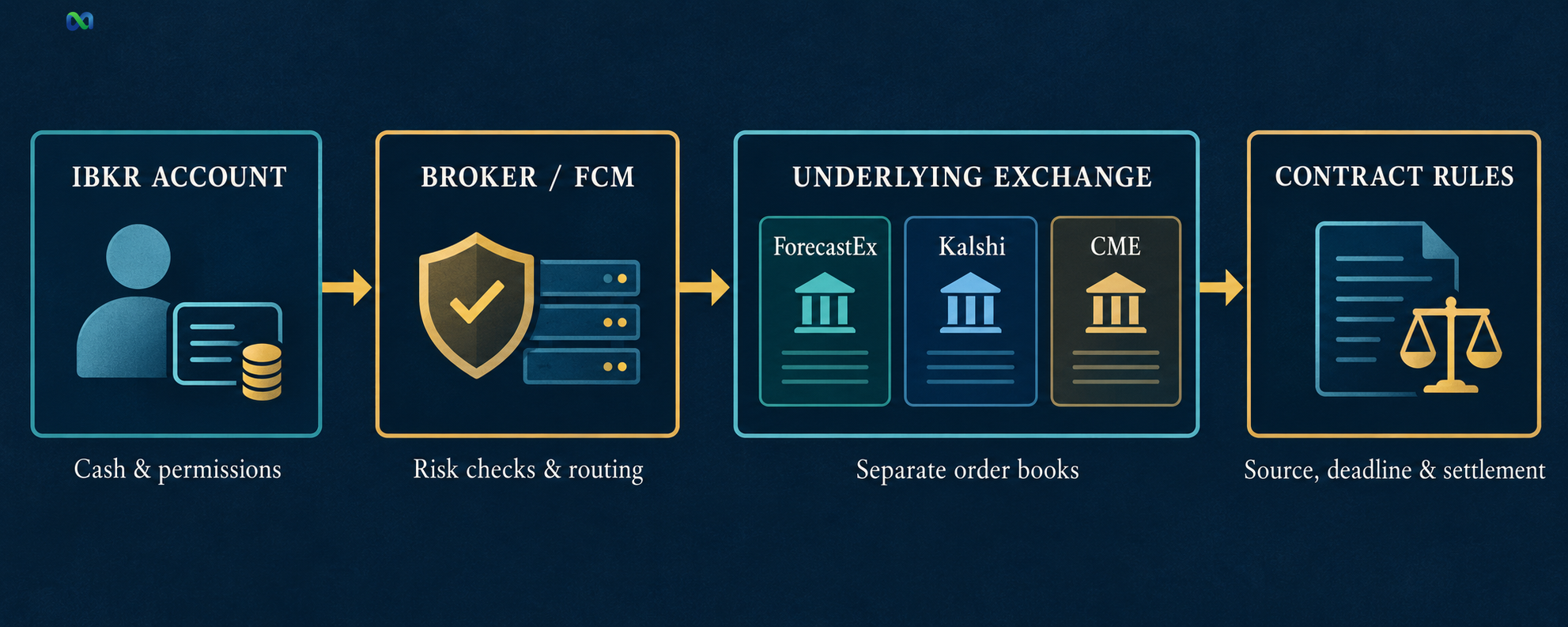
This map prevents several common errors. A contract discovered in IBKR is not automatically a ForecastEx contract. A Kalshi contract reached through IBKR still draws its price from the Kalshi order book. A CME contract can have different settlement value and regulatory classification. One customer account simplifies access; it does not erase venue identity.
IBKR announced its unified prediction-market interface in May 2026. The official launch announcement says the order interface compares similar contracts and can select the most favorable available destination inclusive of fees. Contracts from Kalshi and CME were being added on a rolling basis, so coverage should be checked in the live product rather than assumed from a press release.
What happens to a typical order?
Suppose the interface shows economically similar Yes contracts on two venues. Venue A offers at $0.46 with a $0.02 total per-contract charge. Venue B offers at $0.47 with a $0.01 charge. Their initial all-in cost is equal at $0.48 per contract, before any size-dependent price movement. IBKR's routing comparison is useful because the lowest displayed contract price is not always the lowest net price.
The contracts may still differ. One could close earlier, name a different source or treat a revision differently. Smart routing should never replace a rules comparison. Economically similar is not legally identical.
For a ForecastEx contract, Yes and No bids are paired under the exchange model. ForecastEx is the exchange and clearinghouse, while Interactive Brokers LLC is its affiliated FCM and clearing member. ForecastEx contracts are fully collateralized. The IBKR ForecastEx risk disclosure warns that a customer can lose all funds used to buy a contract.
Exiting a ForecastEx position is also different from selling a share. The disclosure explains that a customer offsets an existing position by acquiring the opposite side of the same event question. The resulting Yes/No pair is then settled under the exchange process. Available offsetting prices can be unattractive or absent in a thin market.
Prices are estimates expressed through actual orders, not forecasts guaranteed by IBKR. A Yes contract offered at $0.63 may be read as roughly a 63% market-implied probability, but the spread, fees, depth and contract structure can make that shorthand imperfect. Our guide to the bid-ask spread in prediction markets explains why the last price is not necessarily the next executable price.
Readers new to the workflow should start with our guide to trading prediction markets. The essential habit is to identify the venue and read the full specification before using the displayed percentage.
Is Interactive Brokers Prediction Markets Legit and Safe?
Yes, Interactive Brokers Prediction Markets is a legitimate broker-provided route to exchange-listed event contracts. Interactive Brokers LLC identifies itself as a CFTC-registered FCM. For ForecastEx products, the CFTC's public records identify ForecastEx as a designated contract market and a registered derivatives clearing organization, both effective June 24, 2024.
That answer needs three qualifications.
First, regulation follows the legal entity and function. IBKR is the broker/FCM access layer. ForecastEx is an affiliated exchange and clearing organization. Kalshi and CME contracts use their own exchange and clearing frameworks. Saying “IBKR is regulated” does not fully describe the contract a customer is trading.
Second, legitimate does not mean protected from loss. A correctly listed event contract can settle at zero. A regulated order book can be thin. A venue can halt trading, and a customer can misread the source or threshold. CFTC oversight does not insure a losing forecast.
Third, account protections do not all apply to every asset in the same way. Event contracts are derivatives, not shares of a company. Do not assume that protections associated with a securities brokerage position automatically reimburse an event-contract loss. Review the IBKR agreement, venue disclosure and applicable customer-fund rules for the specific product.
Evaluate safety through five checks:
- Entity check: Which IBKR affiliate holds the account, and which exchange lists the contract?
- Eligibility check: Is the customer, residence and account approved for that venue and category?
- Contract check: Which source, time zone and review process decide the outcome?
- Execution check: What are the live bid, ask, depth, fees and likely slippage?
- Loss check: Can the customer tolerate losing the entire amount committed?
The official IBKR product page says availability varies by affiliate and country of residence. US-election contracts are limited to eligible US residents. Other product pages also specify age and affiliate restrictions that can change. We therefore do not publish a fixed country or state list. The current permission screen and contract ticket are the controlling checks.
ForecastEx adds operational and liquidity risks. Its disclosure says trading can be halted, offsetting prices may not accurately reflect the event probability and the customer may be unable to exit when desired. The variable incentive coupon can also fall as benchmark rates change. None of those risks makes the product illegitimate; they make due diligence necessary.
Security at the account layer still matters. Use a unique password, multifactor authentication and device controls. Treat APIs as financial credentials, restrict permissions and rotate exposed secrets. A regulated venue cannot protect a customer from a compromised login or careless automation.
Our guide to whether prediction markets are legal in the US covers why federal exchange status does not answer every customer, contract-category or state-law question.
Markets, Orders and Trading Experience
IBKR's prediction-market catalog spans politics, economic indicators, climate and weather, finance and event contracts linked to traditional futures markets. The precise mix depends on what ForecastEx, Kalshi and CME list and what the customer's account can access.
This multi-venue view is the product's most important usability advantage. An existing IBKR customer can search an event without moving money among separate venue accounts. The platform can show related prices and liquidity in one place, while reporting the resulting position alongside the rest of the portfolio.
The product is available through a wide set of interfaces. IBKR documents access from its Prediction Markets web experience, Client Portal, IBKR Desktop, Trader Workstation, IBKR Mobile and GlobalTrader. The exact navigation and supported tool can differ, so an advanced function visible in TWS should not be assumed to exist in every mobile ticket.
Orders and routing
Limit orders are the basic control. A limit defines the worst price a customer is willing to accept, but it does not guarantee execution. A marketable limit can fill immediately against available offers; a passive limit can rest and wait for another participant.
IBKR also promotes ScaleTrader for event contracts. The algorithm can split a larger intended position into smaller orders across a price range. That can help stage an entry or exit, but it does not manufacture liquidity. A poorly chosen range can remain unfilled, and automated scaling can accumulate more exposure than a casual user expects.
The unified interface says it evaluates the best net price across connected venues. That is more useful than routing solely on the quoted contract price because commissions and exchange charges differ. Still, customers should inspect the actual venue selected before submitting. Settlement wording, closing time and the available size can outweigh a one-cent difference.
“Combined liquidity” should be interpreted carefully. IBKR can display and route to several venues, but it does not merge them into one central order book. A 500-contract offer on ForecastEx and a 500-contract offer on Kalshi remain separate venue liquidity. Contracts with different legal terms are not freely interchangeable after execution.
API access
Interactive Brokers supports event-contract discovery and trading through the Web API and TWS API. The official event-contract API documentation identifies FORECASTX, KALSHI and CME exchange values and models Yes and No sides through option-style fields.
That API surface is a meaningful advantage for analysts and automated traders. It can support monitoring, order placement and portfolio reconciliation within an existing IBKR stack. It also exposes complexity. A developer must preserve the exchange code, contract ID, expiration, strike and side rather than match instruments by question text alone.
API users should test manually first, enforce maximum size and price limits, reconcile partial fills and handle disconnects. Market-data permissions and account settings can affect what the API returns. An automated strategy does not change the authoritative settlement source or make a thin contract liquid.
For a human user, the broad interface choice is a strength. For a beginner, it can be a distraction. The order checklist should remain short: venue, rules, price, fee, size and maximum loss.
Interactive Brokers Prediction Market Fees, Funding and Settlement
IBKR publishes separate commissions and third-party exchange charges for each connected venue. As of this review date, the US direct-client schedule lists:
| Venue | IBKR commission per contract | Published third-party exchange fee | Listed total before spread or slippage |
|---|---|---|---|
| ForecastEx | $0.00 | $0.01 | $0.01 |
| Kalshi | $0.01 | $0.01 | $0.02 |
| CME event contracts | $0.01 | $0.01 | $0.02 |
These rates can change, and introduced or advisor-managed accounts may pay additional charges. Taxes can also apply in some jurisdictions. Check the live order preview rather than treating this table as a permanent quote.
The published fee is only part of total cost. Consider four components:
Total execution cost = contract price + commission + exchange fee + spread/slippage impact
Suppose a customer buys 100 ForecastEx Yes contracts at $0.48. The contract cost is $48. At the current listed third-party charge, the exchange-fee component is $1. A winning position would settle for $100, creating a $51 gross difference after that fee but before taxes or any other applicable charge. A losing position would lose the $48 premium plus the fee.
Now suppose a similar Kalshi contract offers at $0.47. The lower contract price saves $1 across 100 contracts, while the currently listed IBKR plus exchange charges total $2. The initial all-in outlay is therefore $49 on either route. Depth and settlement terms decide which is actually better. This is why net-price routing is valuable and why contract comparison remains necessary.
ForecastEx funding and incentive coupon
ForecastEx contracts are fully collateralized. IBKR's risk disclosure says sufficient funds must be deposited before the bid is accepted. A customer is not borrowing the purchase amount. The same disclosure says ForecastEx positions cannot be used as collateral for margin loans, which can reduce buying power elsewhere in a margin account.
ForecastEx also pays an “interest-like” incentive coupon. It accrues daily based on the contract's daily settlement value and is paid monthly. The rate tracks a benchmark and can change. IBKR displayed 3.38% APY on its product page when this review was checked, but that figure is time-sensitive and should never be treated as fixed.
The coupon can improve the return on a position held for time, but it does not offset a wrong outcome automatically. A contract that settles at zero can still produce a large net loss. Compare any coupon earned with the premium, fees and opportunity cost of fully collateralized cash.
Funding rules also depend on the IBKR account and affiliate. ForecastEx products are USD-denominated. A customer funding from another currency can face conversion costs and currency risk. Deposits can be subject to collection or withdrawal holds. Confirm settled cash and trading permission before an event deadline.
Settlement and early exits
Settlement belongs to the underlying contract, not to IBKR's editorial description of the market. Read the named source, observation time, revision policy, cancellation language and event-review procedure. Closely related contracts across venues can resolve differently because their written definitions differ.
ForecastEx's structure uses separate Yes and No positions. To exit before resolution, the customer acquires the offsetting side of the same event question. ForecastEx then processes the paired position under its rules. Kalshi and CME contracts can use different mechanics. Never generalize one venue's exit workflow to all three.
Our standalone CME Prediction Markets review covers that venue's fees, access and safety in depth. The direct ForecastEx vs CME Prediction Markets comparison explains how the two IBKR routes differ in product identity, fees and early-exit mechanics.
Before confirming an IBKR prediction-market order, record:
- Venue: ForecastEx, Kalshi or CME?
- Rules: What exact source, threshold and time determine settlement?
- Net price: What are the premium, commission, exchange fee, spread and likely slippage?
- Liquidity: Is enough size available for entry and an early exit?
- Funding: Is eligible settled cash available, and is currency conversion involved?
- Exposure: What is the maximum loss, and will the position reduce other account buying power?
That six-point check is more reliable than calling IBKR universally cheap. ForecastEx currently has the lowest published per-contract route, but a worse offer or thinner book can erase that advantage.
IBKR vs ForecastEx, Kalshi, Gemini, Coinbase and Macro Markets
Interactive Brokers is best compared as an access and routing platform, not as a single prediction exchange. ForecastEx is inside the IBKR group but remains the legal venue for its own contracts. Kalshi and CME are separate venues reached through the same broker interface.
| Platform | Structure | Best fit | Current cost model | Main trade-off |
|---|---|---|---|---|
| Interactive Brokers Prediction Markets | CFTC-registered FCM routing to ForecastEx, Kalshi and CME | Existing brokerage customers wanting multi-venue search, routing, reporting and APIs | Venue-specific commission and exchange fee | More legal and product complexity; eligibility varies |
| ForecastEx through IBKR | ForecastEx DCM and DCO accessed through affiliated FCM | Economic, climate and political contracts with fully collateralized positions and incentive coupon | $0 IBKR commission plus $0.01 listed exchange fee per contract | Cannot use positions as margin collateral; early exit uses an offsetting side |
| Kalshi direct | CFTC-designated exchange and clearing organization | Customers wanting a dedicated event-contract account and broad catalog | Probability-weighted direct fee schedule | Separate funding and interface; direct costs differ from the IBKR route |
| Gemini Predictions | Gemini Titan DCM with Gemini Olympus DCO | Crypto-oriented users wanting an integrated Gemini account and public APIs | Probability-weighted maker and taker fees | Taker rate is materially higher than maker rate; access varies |
| Coinbase | FCM intermediary currently connecting customers to Kalshi markets | Existing Coinbase users wanting settled USD or USDC workflow | Contract-level fee shown before confirmation | Liquidity comes from the partner venue rather than an independent Coinbase order book |
| Macro Markets | Crypto-native prediction-market platform; not presented as a CFTC-designated US exchange | Eligible users seeking crypto funding and global market discovery | Current platform, network and execution costs | Different jurisdiction, custody, funding and regulatory risk profile |
Choose IBKR Prediction Markets when one account, cross-venue comparison, desktop tools and consolidated reporting matter. It is especially attractive to an existing IBKR customer who understands brokerage permissions and wants to evaluate the all-in price across several regulated US venues.
Think of ForecastEx as a venue available through IBKR, not a separate substitute for the brokerage relationship. Its distinctive features are full collateralization, Yes/No pairing and the variable incentive coupon. ForecastEx is both DCM and DCO; IBKR is the FCM access layer. Our standalone ForecastEx review covers its fees, contract mechanics, coupon, liquidity and settlement risks.
Choose Kalshi direct when a focused prediction-market interface, native REST API and direct funding methods matter more than multi-asset portfolio integration. Our Kalshi vs Interactive Brokers Prediction Markets comparison explains when both routes reach the same Kalshi book and how their fees, account layers and tools differ; the Kalshi review covers the exchange in depth.
Choose Gemini when a crypto-centered account, its own US exchange structure and public prediction-market APIs are priorities. Gemini Titan operates the venue instead of aggregating three outside order books. Our Gemini vs Interactive Brokers Prediction Markets comparison compares the two architectures, fee models, liquidity, funding and tools directly; the Gemini prediction markets review covers that product in depth.
Choose Coinbase when settled USD or USDC and an existing Coinbase account are the main conveniences. Coinbase Financial Markets is an intermediary for current Kalshi contracts, so customers should not count Coinbase and Kalshi liquidity as two independent pools. Our Coinbase vs Interactive Brokers Prediction Markets comparison explains when both interfaces can reach the same Kalshi book and when IBKR provides a separate ForecastEx or CME route; the Coinbase prediction markets review covers that product in depth.
Choose Robinhood when a mobile-first retail workflow, dollar-based opening orders and supported sports combinations matter more than IBKR's desktop and API tools. Our Robinhood vs Interactive Brokers Prediction Markets comparison explains when both intermediaries can reach the same Kalshi or ForecastEx book and when their venue routes remain independent; the Robinhood prediction markets review covers that product in depth.
Choose Crypto.com Predict Pro when a focused professional prediction interface, market orders, Post-Only limits and probability-weighted maker/taker pricing matter more than a multi-asset brokerage account. Predict Pro uses the separate CDNA/NADEX venue rather than IBKR's ForecastEx, Kalshi or CME routes, so similar questions do not share liquidity. Our Interactive Brokers vs Crypto.com Predict Pro comparison matches their venues, fees, funding, APIs and settlement directly.
Consider Macro Markets when you are eligible to use a crypto-native platform and value crypto funding plus global market discovery. Because Macro Markets publishes this article, treat its inclusion as a disclosed first-party claim. Verify current eligibility, wallet flow, fees, liquidity and resolution rules yourself. Macro Markets has a different legal and custody profile and is not represented here as a CFTC-designated US exchange.
Use the same criteria for every platform: legal entity, customer eligibility, total cost, liquidity, funding, settlement and interface. Our prediction-market comparison methodology explains the framework. For a broader shortlist, see the best prediction market apps and platforms and our independent Polymarket review.
Our Polymarket US vs Interactive Brokers comparison examines brokerage access, venue-specific charges, funding and exit mechanics.
Frequently Asked Questions and Final Verdict
Is Interactive Brokers Prediction Markets legit?
Yes. Interactive Brokers LLC is a CFTC-registered futures commission merchant providing access to exchange-listed event contracts. The underlying venue varies. ForecastEx is a CFTC-designated contract market and registered derivatives clearing organization; Kalshi and CME contracts follow their respective venue structures.
Is Interactive Brokers the prediction-market exchange?
Not for every contract. IBKR is the broker/FCM and unified interface. ForecastEx, Kalshi or CME is the listing venue for the specific contract. The venue's order book and contract rules control execution and settlement.
What fees does IBKR charge for prediction markets?
The current US direct-client schedule lists ForecastEx at $0 IBKR commission plus a $0.01 exchange fee per contract. Kalshi and CME event contracts each list a $0.01 IBKR commission plus a $0.01 exchange fee. Spreads, slippage, taxes or account-specific charges can add to the total.
Can I trade ForecastEx, Kalshi and CME from one IBKR account?
Eligible clients can search and trade supported products from all three through one IBKR account without separately funding each venue. Availability depends on the account affiliate, residence, permission, venue and contract.
Does IBKR combine liquidity from the three exchanges?
IBKR can display several venues and route an order to the best available net price, but the venues retain separate order books and rules. Similar contracts are not necessarily identical or transferable between exchanges.
Can I exit a ForecastEx contract before settlement?
The ForecastEx disclosure says a customer offsets a position by acquiring the opposite side of the same event question. The paired Yes/No position is then settled under ForecastEx rules. An exit depends on available prices and can be difficult during a halt or in a thin market.
Does ForecastEx pay interest?
ForecastEx pays a variable incentive coupon derived from collateral earnings. It accrues daily based on the position's market value and is paid monthly. The rate can change and does not protect the customer from a losing contract.
Can I trade IBKR event contracts through an API?
Yes. IBKR documents support through its Web API and TWS API. Event contracts use venue identifiers such as FORECASTX, KALSHI and CME. Developers should verify permissions, contract IDs and exchange codes and add strict order controls.
Are Interactive Brokers event contracts available everywhere?
No. Availability varies by IBKR affiliate, country of residence, age, trading permission, venue and contract category. US-election markets have additional eligibility restrictions. Check the current signed-in account and order ticket.
What is the best Interactive Brokers prediction-market alternative?
Kalshi direct is a strong alternative for a dedicated US exchange account. Gemini offers its own exchange and clearing structure inside a crypto-oriented account. Coinbase and Robinhood offer other intermediary workflows. Macro Markets can suit eligible crypto-native users, but it has a different legal and custody profile and is not a CFTC-designated US exchange.
Final verdict
Interactive Brokers Prediction Markets is a strong choice for eligible customers who value multi-venue access, professional trading tools and a consolidated brokerage account. Its ability to compare ForecastEx, Kalshi and CME on net price is more useful than a single headline fee, and its desktop and API coverage is unusually broad.
The advantage only works when the customer respects venue differences. IBKR is the access layer. The exchange supplies liquidity and rules. The individual contract determines settlement. A cheap route can still be a poor trade when the spread is wide, the book is thin or the wording does not match the intended outcome.
Compare the complete order, not the logo: venue, terms, executable price, fees, depth, funding and maximum loss. Include direct exchanges, broker integrations and disclosed alternatives such as Macro Markets in that comparison under the same criteria. If any of those elements is unclear, do not submit the order.