


Polymarket Review 2026: Is It Legit and Worth Using?
Polymarket is worth considering if you want a prediction-first product with strong coverage of politics, sports, crypto, economics and breaking news. The biggest catch is that “Polymarket” now refers to two separate products. US residents use Polymarket US, while eligible users elsewhere use Polymarket.com. The accounts, funding methods, regulation, fees and resolution systems are not interchangeable.
Our verdict: Polymarket US is a credible choice for eligible US users who want a regulated event-contract app, while Polymarket.com is better suited to eligible international users who understand USDC, wallets and blockchain transfers. Neither product is automatically the cheapest or most liquid choice for every contract.
Risk warning: Event contracts are speculative. A position can lose its full purchase price plus fees. Regulation, a popular app or an on-chain record does not guarantee profit, liquidity, account access or an undisputed resolution.
Editorial disclosure: Macro Markets publishes this review and operates a prediction-market platform that may compete for some of the same users. We apply the same criteria to both products and do not claim that Macro Markets is a CFTC-designated US exchange. This is a documentation-based review using public sources checked on October 27, 2026. We did not open, fund or trade through a Polymarket account.
Polymarket Review at a Glance
| Question | Polymarket US | Polymarket.com |
|---|---|---|
| Who is it for? | Eligible US users | Eligible users outside restricted locations |
| Product access | Separate US app; official materials also reference web surfaces | Browser-based international platform |
| Legal structure | QCX LLC d/b/a Polymarket US is a CFTC-designated contract market | International crypto-native platform; availability depends on location |
| Funding | US dollars through supported app methods such as bank transfer or debit card | Crypto transfers converted for USDC-denominated trading |
| Account relationship | Separate from Polymarket.com | Separate from Polymarket US |
| Resolution | Exchange rules and the source named for the contract | Market rules plus the UMA Optimistic Oracle process |
| Main strength | Federally regulated US exchange with a consumer app | Broad, crypto-native market discovery and public blockchain infrastructure |
| Main limitation | Product and contract availability can still vary; the app is the primary experience | Wallet, network and jurisdiction friction; restricted in the US and other locations |
Best for: users who actively follow events and are willing to read contract rules before trading.
Skip it if: you need guaranteed liquidity, do not understand the funding method, cannot legally use the product in your location, or would struggle with a total loss.
Review score: We do not assign a numerical score because the two products serve different jurisdictions and a platform-wide number can hide major differences between individual markets.
For the broader category, see our comparison of the best prediction market apps in the US. For a focused assessment of the regulated American product, use the Polymarket US review, which covers the current fee formula, funding rails, order types, clearing and safety without importing evidence from Polymarket.com. If your shortlist includes a traditional derivatives route, the direct CME vs Polymarket US comparison separates the US app from polymarket.com and normalizes current fees. Traders choosing between two crypto-branded US account routes can use our Polymarket US vs Crypto.com Predict Pro comparison for the independent QCX and CDNA books, funding paths, orders and APIs.
What Is Polymarket?
Polymarket is a prediction-market brand built around event contracts. A Yes contract trades between zero and one dollar and normally settles at $1 if the defined outcome occurs or $0 if it does not. Traders can also sell before resolution when another participant is willing to take the other side.
Those outcome contracts are not company equity. If you are researching ownership in the business instead, read our guide to Polymarket stock, including conditional private-share access through Hiive and Forge. Trading on Polymarket does not make the customer a shareholder.
That simple description hides an important split.
Polymarket US
Polymarket US is the US exchange operated by QCX LLC. The CFTC register lists QCX LLC d/b/a Polymarket US as a designated contract market. Its trust materials say trades clear through Polymarket Clearing and that every account is subject to identity verification.
The US product is designed for dollar funding and exchange-listed event contracts. It is not simply the international website with a US login.
Polymarket.com
Polymarket.com is the international, crypto-native product. It runs on blockchain infrastructure, uses USDC-denominated trading and applies geographic restrictions. Its account, balance and support channel are separate from the US product.
Polymarket's own website-versus-app guide says US residents cannot deposit or trade on Polymarket.com and must use the US product. Do not use a VPN or another workaround to bypass a location restriction.
For a mechanics-only explanation, read how Polymarket trading contracts work. This review focuses on whether the overall product is useful and where its friction appears.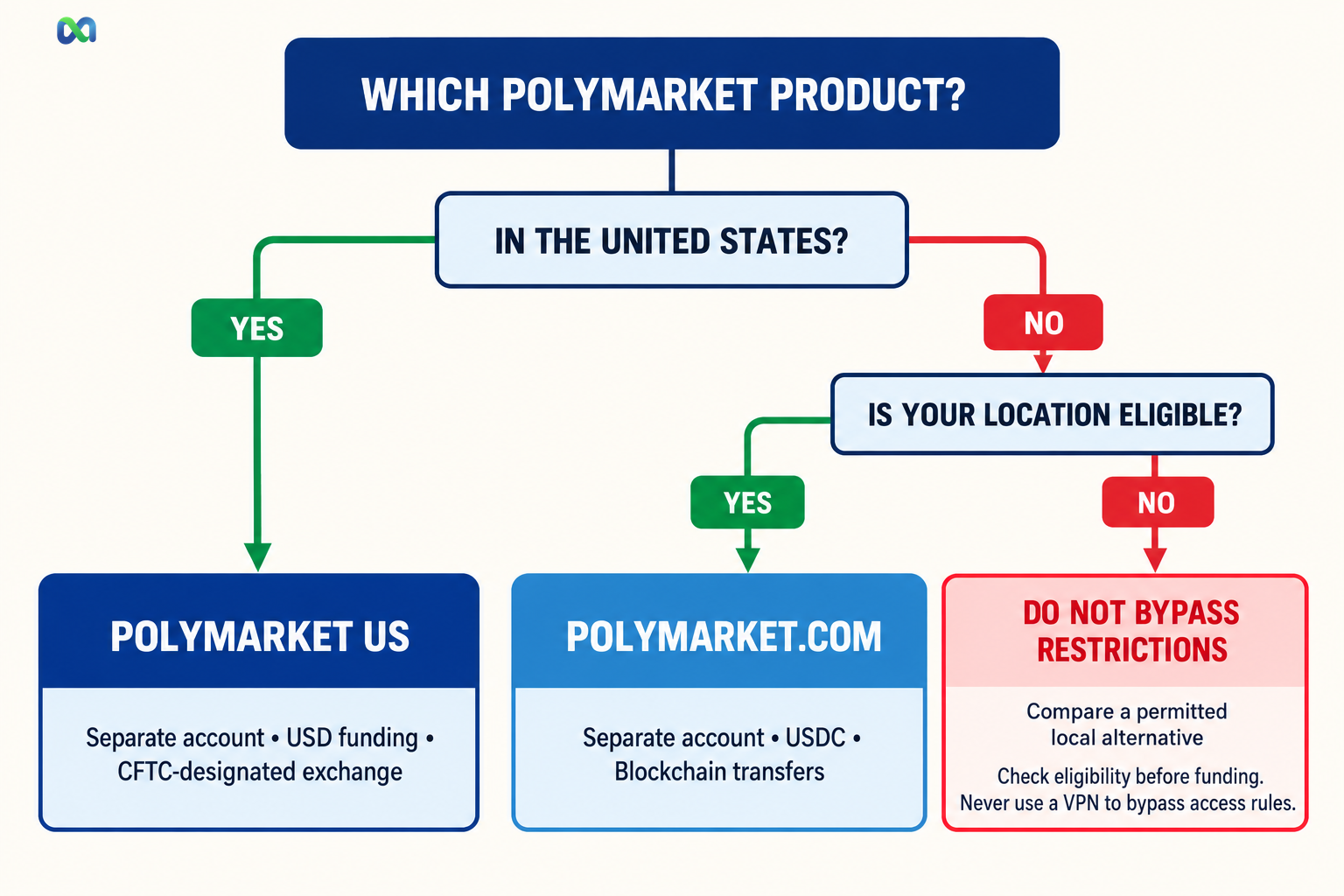
Start with location and eligibility. The US exchange and international platform use separate accounts and funding systems.
Polymarket Product Review
Markets and Liquidity: Broad Coverage, Uneven Execution
Polymarket's clearest advantage is event discovery. The brand is strongly associated with fast-moving politics, elections, sports, crypto, economics, technology, culture and breaking news. That breadth makes it useful as an information surface even for people who never trade.
Market count is not the same as tradable depth. A popular national election or major sports event may attract tight spreads and large resting orders, while a niche question can be expensive to enter or exit. A displayed probability can also be a last trade or midpoint rather than the price available for your desired quantity.
Before placing an order, inspect:
- the best executable price;
- the bid-ask spread;
- available quantity near that price;
- whether a limit order is supported;
- the likely exit price if you cannot wait for settlement.
This is why our verdict is contract-specific. Polymarket can be excellent for one event and unattractive for another on the same day.
Fees: Read the Product and the Order Ticket
The international help center's current trading-fee guide says makers are not charged trading fees and that takers pay a formula-based fee on certain categories. It lists geopolitics and world-events markets as fee-free and says Polymarket itself does not charge to deposit or withdraw USDC, although payment providers and networks may charge.
The published international formula is:
fee = contracts × fee rate × price × (1 − price)
That makes the dollar fee highest near a 50% contract price and lower near the extremes. Category rates can differ.
Do not automatically apply the international fee page to Polymarket US. The products are separate. For the US product, inspect the current exchange disclosure and final order ticket. For either product, the listed platform fee is only one cost. Spread, slippage, funding charges, network costs and price impact can matter more.
Use our prediction market fee calculator for hypothetical trades, or read the dedicated Polymarket and Kalshi fee comparison for the complete cost framework.
Eligibility and Verification: Location Comes First
Polymarket US says it verifies identity on every account. Eligibility and the contracts shown can depend on location and current exchange rules. Its trust page currently notes that trading is unavailable in Nevada, but users should check the product at signup because access can change.
Polymarket.com applies a different geographic policy. The official geographic restrictions page lists blocked and close-only locations and explicitly prohibits VPNs or similar tools used to bypass restrictions. As of this review, the blocked list includes the United States and Brazil, among other countries.
This is the most important onboarding check. A global brand does not mean a single product is globally available.
Deposits and Withdrawals: Simple in the US, More Technical Internationally
The US App Store listing says the US product supports dollar deposits through methods including bank transfer and debit card. The exact methods, holds and limits shown in an account can vary, so verify them before committing meaningful funds.
Polymarket.com requires more crypto awareness. Its deposit guide tells users to select a token and network, copy the deposit address and respect network-specific minimums. Sending an asset through the wrong network can delay or permanently prevent recovery. A small test transfer is sensible before a larger transfer.
The withdrawal guide requires a recipient address, token and network. Blockchain transfers are not the same as a reversible bank payment. Address custody, network selection and external provider fees become part of the product experience.
That difference creates a clear recommendation: use Polymarket.com only if you can independently verify wallet addresses, networks and tokens. Convenience is not worth a preventable transfer error.
Resolution: The Rules Matter More Than the Headline
A market title summarizes the question. The rules define the contract.
On Polymarket.com, the official resolution guide describes the UMA Optimistic Oracle process. A result is proposed with a bond, enters a challenge period and can move into a dispute process. Winning shares receive $1 after final resolution; losing shares become worthless.
That mechanism offers an inspectable process, but it does not make ambiguous wording disappear. Traders still need to read the named source, deadline, edge cases and clarification policy.
Polymarket US is an exchange product with its own rulebook and contract terms. Do not assume the international oracle process applies to the US app. Check the resolution source on the exact US contract.
For a deeper discussion of trust and legal structure, use our separate guide: Is Polymarket legit?.
App and Usability: Strong Discovery, but Two Products Add Friction
The consumer interface is built around rapid discovery. Categories, live probabilities and market pages make it easy to move from a headline to a contract. The ability to sell before resolution can also be useful when new information changes your view.
The main usability problem is conceptual rather than visual: a search result, social post or screenshot may refer to Polymarket.com even when a US user can only trade through Polymarket US. Liquidity, markets, fees and account features from one product should not be presented as evidence about the other.
The US iPhone app had a 4.5 out of 5 rating from about 61,000 ratings in the Apple App Store when we checked. That is a broad consumer signal, not proof that every withdrawal, market or support case works well.
Polymarket Pros and Cons
Pros
- Strong discovery across politics, sports, crypto and current events
- Separate CFTC-designated exchange for eligible US users
- Ability to sell positions before resolution when liquidity exists
- Public rules and named resolution processes
- Crypto-native, non-custodial structure on the international product
- Transparent fee formula for the international product
Cons
- “Polymarket” can mean two different products with separate accounts
- Jurisdiction and state-level access can change
- Liquidity and spreads vary significantly by contract
- Polymarket.com requires wallet, token and network competence
- Resolution disputes remain possible when contract wording is ambiguous
- The international product is unavailable in the US, Brazil and other restricted locations
Polymarket Trust, Safety and Payouts
Is Polymarket Legit and Safe?
Polymarket is a real operating brand, and its US exchange has an identifiable federal regulatory status. That supports rule transparency, surveillance and formal exchange obligations. It does not make trading safe in the sense of preserving your capital.
The products also carry different custody models. Polymarket US says customer funds are fully collateralized under its clearing framework and are not bank deposits or insured as bank deposits. Polymarket.com describes itself as non-custodial, which gives users control of wallet access but also makes key management and signing security the user's responsibility.
Relevant risks include:
- losing the entire amount paid for a losing contract;
- being unable to exit at the displayed probability;
- account restrictions or identity-review delays;
- wallet compromise, phishing or signing a malicious transaction;
- sending funds through the wrong network;
- contract clarification or resolution disputes;
- legal access changing by jurisdiction or contract category.
Does Polymarket Really Pay?
The normal contract design pays winning shares at $1 after final resolution and values losing shares at $0. A trader may also sell before the result when there is a counterparty.
That structure does not guarantee immediate access to cash. Resolution timing, withdrawal method, bank or blockchain processing, account review and available liquidity can all affect the path from a winning position to spendable funds. Test the full funding and withdrawal workflow with a small amount before using meaningful capital.
Polymarket vs Other Platforms and Our Review Method
| Platform | Best fit | Funding model | Main strength | Main caution |
|---|---|---|---|---|
| Polymarket US | Eligible US users who want a prediction-first app | USD methods supported in the app | CFTC-designated exchange and consumer-friendly event discovery | Separate from Polymarket.com; availability can vary |
| Polymarket.com | Eligible international users comfortable with crypto | Crypto transfers and USDC-denominated trading | Broad crypto-native discovery and on-chain infrastructure | Restricted locations, wallet risk and network friction |
| Kalshi | Users comparing a dedicated US exchange | Fiat-oriented account | Mature US event-contract workflow and public exchange documentation | Fees, depth and market availability vary |
| Macro Markets | Eligible users seeking crypto-native markets and another venue to compare | Crypto-native workflow | Additional market discovery and alternative contract selection | Not a CFTC-designated US exchange; jurisdiction, liquidity, network and resolution risks apply |
Because Macro Markets publishes this page, its inclusion is not an independent endorsement. Compare the same five factors for every platform: eligibility, contract rules, executable depth, total cost and exit path.
Read Kalshi vs Polymarket US when the decision is specifically between those two US exchanges. Eligible international wallet users can compare chain, fees and UMA versus Opinion AI in our direct Polymarket vs Opinion comparison. Read our Kalshi review for a product-level assessment of that competitor. For a broader framework, see how Macro Markets compares prediction market platforms.
How We Reviewed Polymarket
We reviewed the current Polymarket and Polymarket US help materials, CFTC registration, fee documentation, location rules, deposit and withdrawal guides, resolution documentation, trust disclosures and public app listing. We compared those findings using the same criteria applied to other platforms.
We did not assign points for bonuses, copy user-review anecdotes as verified facts or claim personal experience we do not have. We also did not treat activity on Polymarket.com as proof of liquidity on Polymarket US.
Frequently Asked Questions
Is Polymarket legit?
Yes, Polymarket is a real prediction-market brand. Its US exchange, QCX LLC d/b/a Polymarket US, is listed by the CFTC as a designated contract market. The international site has a different crypto-native structure and separate geographic restrictions.
Can US residents use Polymarket?
US residents must use Polymarket US rather than Polymarket.com. The accounts are separate. Users should verify current state and contract availability during signup and should not use a VPN to bypass restrictions.
Does Polymarket charge fees?
Polymarket.com publishes category-specific taker fees for some markets, while makers are listed as paying no trading fee. Some international categories are fee-free. Polymarket US is a separate product, so users should inspect its current disclosure and final order ticket instead of importing the international fee table.
Does Polymarket require KYC?
Polymarket US says every account receives identity verification. Requirements on the international product can depend on compliance, location and account activity. Never assume a platform will remain accessible without verification.
Is Polymarket safer than Kalshi?
There is no universal winner. Both Polymarket US and Kalshi have CFTC-designated exchange structures, but contract selection, liquidity, fees, funding methods and account experience differ. Polymarket.com is a separate international crypto product and should not be compared as if it were Polymarket US.
Can you lose all your money on Polymarket?
Yes. A fully funded Yes or No position can lose its full purchase price, and fees or transfer costs can increase the loss. Limit position size before trading.
Is Macro Markets better than Polymarket?
Not for every user. Macro Markets may be useful to eligible users who want a crypto-native alternative or additional market selection. Polymarket US may be more suitable for eligible US users seeking a CFTC-designated exchange, while Polymarket.com may have stronger activity on some global topics. Our direct Polymarket vs Macro Markets comparison covers custody, funding, execution, fees, APIs and resolution. Compare the exact contract and your legal access.
What is the best alternative to Polymarket?
For eligible US users, Kalshi is the closest dedicated regulated alternative. ForecastEx is the specialist option for macro contracts inside an eligible FCM account; our ForecastEx vs Polymarket US comparison covers their contract mechanics, fees, funding, APIs and separate books. Macro Markets is another option for eligible users seeking a crypto-native prediction-market experience, but it has a different legal and risk profile. Robinhood, Coinbase, Gemini, and Interactive Brokers may also fit users already active in those ecosystems. Compare their access, custody, fees, liquidity, and resolution in our guide to the best Polymarket alternatives.
Final Verdict: Is Polymarket Worth It?
Polymarket is worth evaluating, but only after identifying which Polymarket product you can actually use. Polymarket US offers a regulated US exchange and accessible consumer app. Polymarket.com offers broad crypto-native market discovery for eligible international users. The split is a strength because it creates jurisdiction-specific products, but it is also the brand's biggest source of confusion.
Choose Polymarket when it offers a clear contract, sufficient depth and a funding flow you understand. Choose another platform when the spread, rules, jurisdiction or withdrawal path is better elsewhere. If you cannot explain how the contract resolves and how you will exit, do not place the trade.
Sources and Fact-Check Record
- CFTC designation record for QCX LLC d/b/a Polymarket US
- Polymarket US Trust and Safety Hub
- Polymarket website versus US app
- Polymarket trading fees
- Polymarket geographic restrictions
- Polymarket deposits
- Polymarket withdrawals
- Polymarket resolution process
- Polymarket US App Store listing
Last fact-checked: October 27, 2026. Editorial method: official product documentation and regulator records; no funded-account execution test.
