


CME vs Polymarket US Prediction Markets: Which Is Better in 2026?
The CME vs Polymarket US prediction markets comparison covers two federally regulated event-contract ecosystems, but they are not interchangeable versions of the same product. CME lists prediction markets that customers reach through participating brokers. Polymarket US uses a separate US app, exchange and clearing route that must not be confused with the international polymarket.com website.
Our verdict: choose CME when you already use a participating broker, want event contracts beside a traditional derivatives workflow or find the stronger exact contract on CME. Choose Polymarket US when you want a prediction-first mobile experience, direct USD funding and the better live book in its US catalog. Neither wins every market because contract wording, fees, spreads and depth vary question by question.
Last reviewed and fact-checked: November 2, 2026.
Editorial disclosure: Macro Markets publishes this comparison and operates a prediction-market platform. We include Macro Markets as a disclosed crypto-native alternative, not as an independent recommendation or a CFTC-designated US exchange. This article uses official exchange, app-store, broker and regulator sources. We did not place simultaneous funded orders on both venues. Fees, products, device support and eligibility can change. This article is educational, not financial, legal or tax advice.
CME vs Polymarket US: Quick Verdict
The choice is mainly between broker-routed derivatives access and a prediction-first US app. CME supplies the listed product and exchange infrastructure, while your broker controls the retail account, interface, permissions and customer commission. Polymarket US combines a dedicated app with affiliated US exchange and clearing entities.
| Category | CME Prediction Markets | Polymarket US | Better fit |
|---|---|---|---|
| Customer route | Participating broker or futures commission merchant | Separate Polymarket US app and account | Depends on preferred workflow |
| Exchange | Applicable CME Group designated contract market | QCX LLC d/b/a Polymarket US, a DCM | Both regulated exchange structures |
| Clearing | CME clearing infrastructure for the listed product | QC Clearing LLC d/b/a Polymarket Clearing, a registered DCO | Both have identifiable clearing roles |
| Interface | Broker platform, web, mobile or API | Prediction-first US mobile app | Polymarket US for focused discovery |
| Current device route | Varies by participating broker | iPhone; official help says Android is coming soon | CME for broader route choice today |
| Funding | Eligible cash at the broker | US dollars; current app listing names bank transfer and debit card | Account-specific |
| Standard payoff | Binary contracts commonly settle at $1 or $0 | Fully collateralized contracts commonly settle at $1 or $0 | Tie on basic payoff |
| Published fee example | Current IBKR route: $0.02 per contract per execution | Current US exchange CLOB taker formula; maker rebate formula | Price, size and order behavior decide |
| Liquidity | Separate CME contract book | Separate Polymarket US contract book | Exact contract decides |
| Best for | Existing brokerage and derivatives workflow | Mobile-first event discovery and trading | Depends on user and contract |
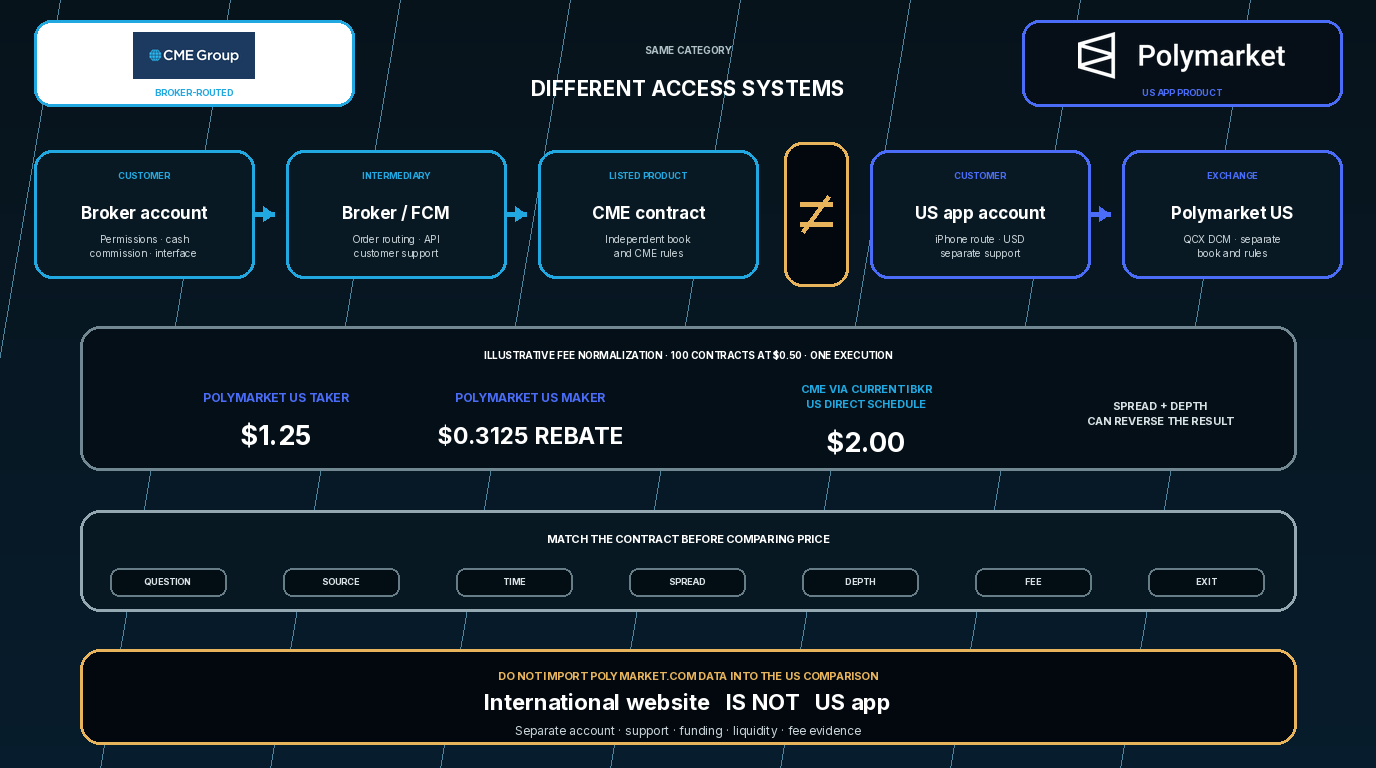
Using current published schedules, 100 contracts executed at $0.50 cost $2 through the listed Interactive Brokers CME route. The Polymarket US exchange formula produces a $1.25 gross taker fee at that price and quantity, while a qualifying maker execution produces a $0.3125 exchange rebate. Those numbers do not prove a universal winner. Broker arrangements, customer-facing charges, rebates, spread and price impact can change the complete cost.
Read the separate CME Prediction Markets review and Polymarket review before opening or funding either route.
The most important warning: Polymarket US is not polymarket.com
Polymarket's official help center says the products are separate. Polymarket.com is the international website; US residents must use the Polymarket US app. The accounts are not connected, and the products have separate support teams.
That boundary affects every comparison. Do not take a polymarket.com USDC deposit guide, wallet requirement, fee page, API behavior, account balance or liquidity figure and assume it applies to the US app. A chart or search result labeled only “Polymarket” may describe the international product. For this article, “Polymarket US” means the US app and its regulated US exchange route unless explicitly stated otherwise.
What CME and Polymarket US Actually Are
CME Prediction Markets is a product family inside CME Group's derivatives ecosystem. CME says customers must sign up with a broker offering the products. The broker or futures commission merchant carries the account, performs onboarding, supplies order entry and determines its customer-facing pricing.
Polymarket US has a different stack:
- The Polymarket US app and account provide the customer interface and USD funding route.
- QCX LLC d/b/a Polymarket US lists contracts and operates the designated contract market.
- QC Clearing LLC d/b/a Polymarket Clearing provides the affiliated registered derivatives-clearing function.
- The individual contract terms define the outcome, source, deadline and settlement treatment.
The CFTC's Polymarket US record shows QCX as a designated contract market from July 9, 2025. The regulator's Polymarket Clearing record shows QC Clearing registered as a DCO from December 16, 2024. Those are identifiable legal roles, not a statement that every customer or every contract is automatically suitable.
CME's structure adds an independent customer-account layer. Two people trading the same CME contract through different brokers may see different interfaces, market-data packages, permissions and commissions. The underlying listed contract can be the same, but the retail experience is not.
Regulation does not merge the products
Both ecosystems operate through CFTC-regulated entities. That does not make their positions fungible. A CME contract remains on its CME venue and clearing route. A Polymarket US contract remains on Polymarket US and its clearing route.
If both platforms ask whether the Federal Reserve will change a target rate at its next meeting, the contracts may still differ by:
- The exact rate or range being measured.
- The named source and publication.
- The observation date, time and time zone.
- Treatment of an emergency meeting or revised release.
- The final trading deadline.
- Cancellation, postponement and dispute rules.
- Settlement timing and customer charges.
Do not compare the headline alone. Match the complete proposition and rule document before treating two prices as competing forecasts. Our prediction-market comparison methodology uses the written contract, not the brand or topic, as the comparison unit.
Polymarket US access is app-specific
Polymarket's official product-separation guide says the US app is available on iPhone and describes Android as coming soon as of June 25, 2026. The current US App Store listing names sports, politics, financial and economic events, weather, culture, crypto and other topics. It also states that trading has eligibility restrictions and is not available in every jurisdiction.
Device support is therefore a practical differentiator, not a footnote. A desktop-first or Android-only customer may find a participating CME broker easier today. Recheck the official app listing because this limitation can change quickly.
Compare Contracts, Markets and Liquidity
CME's current Prediction Markets page names sports, economic indicators, cryptocurrencies and more. Its surrounding futures ecosystem can be useful to customers already following interest rates, equity indexes, energy, metals, agriculture or crypto benchmarks through the same broker.
Polymarket US is designed around event discovery. Its US app listing presents live sports, elections and politics, economic indicators, weather, culture, technology and crypto topics. That can make the catalog feel broader or easier to browse even when the comparison is only between two exact contracts.
Catalog count is a weak permanent ranking. Markets expire. New events appear. Some contracts are unavailable in particular jurisdictions, and a large catalog can contain many closely related outcomes for one event. Compare whether the platform lists the question you actually want with rules you understand.
How event-contract prices work
Binary contracts commonly trade between $0.01 and $0.99 and settle at $1 if the defined outcome occurs or $0 if it does not. A Yes contract bought at $0.43 has $0.57 of gross upside if it resolves Yes and can lose the $0.43 purchase price if it resolves No, before fees.
The displayed price is not a guaranteed probability. It is a market price influenced by beliefs, available capital, fees and liquidity. Polymarket's broader help center explains that a displayed figure can use the order-book midpoint when the spread is narrow and the last traded price when it is wide. Even when a platform presents a single percentage, your executable purchase price is the current offer for your size.
Limit orders control the worst acceptable price but may never fill. Marketable orders prioritize execution and may consume several levels. Selling early is another execution that can cross another spread and incur another fee. The bid-ask spread guide explains why a one- or two-cent difference can matter more than a small commission.
Which platform has more markets?
Polymarket US may feel more prediction-native because its app is organized around event categories and live discovery. CME may be more relevant when an event connects to a benchmark or economic workflow already used in a futures account. Neither observation establishes a permanent leader.
Use this process instead of counting tiles:
- Search the exact event on both routes.
- Open the contract specification and named settlement source.
- Confirm jurisdiction and account eligibility.
- Match the outcome, observation window and deadline.
- Record the bid, offer and available size.
- Add entry fees, expected exit fees and funding friction.
- Choose the stronger complete contract, not the larger homepage.
If neither has the right question, the CME alternatives guide and Polymarket alternatives guide cover a wider shortlist.
Which platform has better liquidity?
Liquidity belongs to the individual contract. CME Group's scale in futures does not guarantee a deep book in every new event market. Polymarket's international brand recognition and reported international volume do not establish liquidity in the separate US app.
Polymarket US filed a liquidity-provider program effective March 17, 2026 that pays approved firms for continuous two-sided quotes in assigned instruments. That can support baseline quoting, but it does not guarantee a tight spread or enough depth for every order.
Measure three things at the time you trade:
| Measurement | What it shows | What it misses |
|---|---|---|
| Best bid and offer | Immediate prices to sell or buy | Size beyond the top quote |
| Quantity at each level | Likely price impact for your order | Future exit conditions |
| Recent matched volume | Historical activity | A currently executable counterparty |
A one-cent spread with only ten contracts available can be worse for a 500-contract order than a two-cent spread backed by deeper size. Preview the full order and use limits when appropriate. Never assume you can close a CME position with Polymarket US liquidity or move the contract between venues.
CME vs Polymarket US Fees, Access and Tools
Fee comparisons must preserve the route. CME's retail cost is broker-dependent. Polymarket US publishes an exchange schedule, but the current app preview and customer agreements control the charge a specific customer sees. Promotions, intermediary charges and rebates can alter effective cost.
The current Polymarket US central-limit-order-book filing uses:
Fee = theta × contracts × price × (1 − price)
For takers, theta is +0.05. For makers, the filing shows theta −0.0125, an immediate rebate equal to 25% of the gross taker fee. A maker adds liquidity by resting an order before execution; a taker removes available liquidity. The same filing describes volume-based taker rebates for qualifying participants.
Interactive Brokers currently lists CME prediction-market pricing for US direct clients as a $0.01 commission plus a $0.01 exchange fee per contract per execution. Other participating brokers, introduced accounts and institutional arrangements can differ.
Normalized fee example
For 100 contracts executed at $0.50:
| Route and execution | Calculation | Published-schedule result |
|---|---|---|
| Polymarket US CLOB taker | 0.05 × 100 × 0.50 × 0.50 | $1.25 gross fee |
| Polymarket US CLOB maker | −0.0125 × 100 × 0.50 × 0.50 | $0.3125 exchange rebate |
| CME through current IBKR US direct schedule | 100 × ($0.01 + $0.01) | $2.00 fee |
This example uses the current Polymarket US exchange filing and the current IBKR event-contract schedule. It excludes spread, slippage, funding cost, a later sale and any difference between the exchange schedule and a customer's final app or intermediary charge. Always inspect the signed-in order preview.
The Polymarket US fee is probability-weighted: at the same contract count, it peaks around $0.50 and declines toward the extremes. The CME example is per contract, so its arithmetic does not change with contract price. Quantity and execution style can therefore reverse the ranking.
Do not use the international polymarket.com fee page for this comparison. That page describes the international USDC product and category-specific protocol fees. It is not evidence of the US app's customer cost. Use the prediction-market fee calculator for normalized arithmetic, then confirm the actual preview on the product you can legally access.
Access and funding
CME requires a participating broker. That extra layer adds onboarding and product permissions, but it can be efficient for someone who already holds futures, options, stocks or cash at the same firm. Statements, tax documents, API access and support depend partly on the broker.
The current Polymarket US App Store listing describes a USD account funded by bank transfer or debit card. That is materially different from the international website's wallet-and-USDC workflow. Do not send crypto to an address from an international help article expecting it to fund the US app.
Compare the complete funding path:
- Deposit method and processing time.
- Holds before trading or withdrawal.
- Debit-card or bank charges.
- Available cash treatment.
- Withdrawal method and timing.
- Minimums, limits and jurisdiction rules.
- Consequences of a rejected or reversed deposit.
Eligibility can differ by state, age, account status and contract. A nationwide brand statement does not override the signed-in account decision or a market-specific restriction.
APIs, desktop access and research tools
CME's technical experience usually comes through the participating broker. A broker may offer desktop software, web and mobile apps, streaming data, order APIs, risk tools and consolidated reporting. Symbols and order behavior must be mapped to the CME specification and the broker's implementation.
Polymarket US is currently more app-centered. The US exchange has filed rules addressing electronic and API access, but developers should not assume the international polymarket.com CLOB API, wallet authentication or market identifiers are valid for the US product. Use only documentation and credentials explicitly issued for Polymarket US.
For automated trading, compare:
- Authentication and key permissions.
- Documented order types and time-in-force values.
- Streaming depth and execution events.
- Rate limits and disconnect recovery.
- Stable contract identifiers and rule links.
- Historical data and timestamp standards.
- Account limits and kill switches.
- Test or paper-trading support.
An API does not make a contract safer. Automation can cross a spread repeatedly or continue after a specification change. Use hard size limits and store the contract version used for every decision.
Regulation, Safety and Settlement
CME's exchanges and clearing infrastructure belong to a long-established derivatives group. Polymarket US is a designated contract market, and Polymarket Clearing is a registered derivatives clearing organization permitted to clear fully collateralized positions within its registration.
These roles matter, but “CFTC-regulated” is not loss protection. It does not insure a trader against a correct $0 outcome, a misunderstood rule, a wide spread or an unavailable exit. A fully collateralized binary purchase can still lose its entire purchase price plus applicable fees.
Our guide to whether prediction markets are legal explains why the legal entity, account route, location and exact product matter more than a generic brand label.
What determines settlement?
The exchange rulebook and contract specification determine settlement, not a news headline, social-media consensus, another platform's outcome or an AI answer. Before trading, identify:
- The exchange and clearing entity.
- The exact product or contract code.
- The named resolution source.
- The observation time and time zone.
- Revision and correction policies.
- Postponement or cancellation treatment.
- The market-halt and dispute process.
- Expected settlement timing.
Polymarket US has filed contract terms for event categories with specific payout criteria and source agencies. CME likewise publishes product specifications and rule chapters. Save the version available when you trade because event wording and operational notices can change.
Two platforms can reach different outcomes without either being inconsistent if the contracts use different sources or windows. Even when both settle the same way, the timing can differ. Price convergence is therefore not guaranteed before the result becomes final under both rulebooks.
Account and operational safety
Use multifactor authentication where available, unique credentials and narrowly scoped API keys. Verify the official app publisher before installing software. Do not enter credentials through a link in a social post or sponsored search result.
For CME, distinguish the exchange from the participating broker carrying the customer account. Broker support, customer-fund treatment and outage procedures are part of the route. For Polymarket US, distinguish the US app provider, QCX exchange and QC Clearing from the separate international website. Contact the US support channel for the US account.
Position size remains the primary risk control. Treat correlated markets as related exposures, not independent bets. If several contracts all depend on the same election, rate decision or crypto move, a single event can produce multiple losses.
Which Platform Should You Choose?
Choose CME Prediction Markets when most of these statements are true:
- You already use a participating broker that offers the contracts.
- You prefer desktop, Android or multi-asset broker access.
- You want event markets beside futures and options research.
- The exact CME contract has better rules, price or executable depth.
- Your broker's API, reporting and risk controls meet your needs.
Choose Polymarket US when most of these are true:
- You want a dedicated prediction-first iPhone experience.
- You prefer a separate USD event-trading account.
- The US app lists the exact question you want.
- Its live book is tighter or deeper for your order size.
- You understand maker versus taker execution and can verify the app's final charge.
Do not choose Polymarket US because you saw volume or liquidity attributed to polymarket.com. They are separate products. Do not choose CME because its parent group dominates other derivatives. Event-contract depth must be measured independently.
The direct Kalshi vs CME comparison offers another regulated specialist reference. Our Kalshi vs Polymarket comparison is useful when evaluating two prediction-first brands, while CME vs Gemini covers another integrated crypto-oriented ecosystem.
Where Macro Markets fits
Macro Markets is a different option for eligible users who intentionally want crypto-native funding and global prediction-market discovery. It is not presented as a CFTC-designated exchange or as a regulatory equivalent to CME or Polymarket US.
Its crypto-native approach can be relevant when wallet-based deposits and withdrawals are central to the workflow rather than an app funded in US dollars or a traditional broker account. That route introduces its own diligence: supported jurisdictions, networks, custody, conversion cost, withdrawal rules, market-making design, resolution sources and liquidity all require verification.
Because Macro Markets publishes this article, this section is a disclosed first-party description, not an independent endorsement. Explore how Macro Markets works only after comparing the exact contract and complete funding path.
Final decision checklist
Before choosing either platform, record:
- The account route and legal entities involved.
- The exact contract code and current rule document.
- The proposition, source, observation time and deadline.
- Best bid, best offer and depth for your full size.
- Entry fee, likely exit fee, spread and price impact.
- Deposit method, holds and withdrawal path.
- Device and API requirements.
- Maximum loss across correlated positions.
FAQ and Final Verdict
Is Polymarket US the same as polymarket.com?
No. Polymarket's official help center says polymarket.com is for eligible international users and the Polymarket US app is a separate US product. Accounts are not connected, support is separate, and US residents cannot use the international website to deposit or trade. Do not transfer international fees, liquidity, APIs or wallet instructions to the US product.
Is CME or Polymarket US cheaper?
It depends on price, quantity, execution style and customer route. At 100 contracts and $0.50, the current Polymarket US exchange formula gives a $1.25 gross taker fee or a $0.3125 maker rebate. The current IBKR CME route totals $2 per execution. That comparison excludes spreads, slippage, later exits, broker differences, customer-level charges and volume rebates.
Can I trade CME Prediction Markets without a broker?
CME tells customers to sign up with a participating broker. The broker carries the customer account and controls interface, permissions and commissions. CME operates the listing venue rather than a universal direct retail app.
Does Polymarket US use crypto or USDC?
The current US App Store listing describes US-dollar funding by bank transfer or debit card. The international website has a separate crypto and USDC workflow. Do not assume international wallet instructions apply to the Polymarket US app.
Which has better liquidity?
There is no reliable brand-wide winner. Compare the exact contract's bid, offer and depth for your intended size. CME's overall futures scale and polymarket.com's international activity do not guarantee liquidity in the specific CME or Polymarket US contract you can trade.
Can I buy on CME and sell the same position on Polymarket US?
No. The venues have separate contracts, order books and clearing routes. Even when the questions look identical, positions are not automatically transferable or offsettable. Any cross-venue strategy requires independently funded positions and matched contract terms.
Is Polymarket US available on Android and desktop?
As of the official June 25, 2026 help article, the US product is an iPhone app and Android is described as coming soon. The international website is not a substitute for US residents. Recheck the current US app listing because device availability can change.
Is Macro Markets an alternative to both?
It can be a crypto-native alternative for eligible users, but it is not a CFTC-designated US exchange and should not be treated as a regulatory equivalent. Compare jurisdiction, custody, funding networks, rules and liquidity separately.
Final verdict
CME is the stronger fit for customers who already have an eligible broker, want event contracts inside a broader derivatives workflow or need the broker's desktop and API tools. Polymarket US is the stronger fit for customers who want a dedicated mobile prediction-market experience and find the better exact contract in its separate US app.
The decisive comparison is not CME versus the global Polymarket brand. It is one CME-listed contract through your chosen broker versus one Polymarket US contract through the US app. Match the wording, measure the executable book, calculate the complete cost and verify the settlement source before risking capital.
