Kalshi vs CME Prediction Markets: Which Is Better in 2026?
Kalshi and CME both offer regulated event contracts, but they solve different access problems. Kalshi is a specialist prediction exchange with a direct customer account and native exchange API. CME Group lists prediction markets inside a much broader derivatives ecosystem and distributes them through participating brokers.
Our verdict: choose Kalshi when you want direct prediction-market onboarding, consumer-first discovery and a native event-contract API. Choose CME when you already use a participating broker, value the CME derivatives ecosystem or find the better executable market on an exact CME contract. Through Interactive Brokers, the current published US direct-client fee is the same for either venue: $0.02 per contract per execution before spread and price impact. That tie does not apply to every route.
Last reviewed and fact-checked: November 2, 2026.
Editorial disclosure: Macro Markets publishes this comparison and operates a prediction-market platform. We include Macro Markets as a disclosed crypto-native alternative, not as an independent recommendation or a CFTC-designated US exchange. This comparison uses official exchange, broker and regulator sources. We did not place simultaneous funded orders in every contract and account route. Markets, fees, eligibility and liquidity change. This article is educational, not financial, legal or tax advice.
Kalshi vs CME Prediction Markets: Quick Verdict
The shortest useful answer is that Kalshi usually provides the simpler dedicated prediction-market experience, while CME is the stronger fit for someone who wants event contracts delivered through an established futures and derivatives relationship. Neither brand wins every contract. Price, depth, fees, resolution wording and broker availability must be checked on the exact market.
| Category | Kalshi | CME Prediction Markets | Better fit |
|---|---|---|---|
| Customer access | Direct Kalshi account or supported intermediaries | Participating broker required | Kalshi for direct access |
| Product identity | Specialist prediction exchange | Event contracts inside a global derivatives group | Depends on workflow |
| Current categories | Politics, economics, weather, sports, crypto, culture and more, subject to listings | Sports, economic indicators, cryptocurrencies and more | Check the live catalog |
| Contract payoff | Usually $1 if correct and $0 if incorrect | $1 if correct and $0 if incorrect | Tie on basic binary payoff |
| Price range | Generally $0.01 to $0.99 | $0.01 to $0.99 | Tie |
| Direct fees | Expected-earnings formula; market-specific and maker fees can apply | No universal direct retail fee because access is through brokers | Route-specific |
| Current IBKR US direct-client fee | $0.01 commission + $0.01 exchange fee | $0.01 commission + $0.01 exchange fee | Tie at $0.02 per execution |
| Developer access | Native REST, WebSocket and FIX exchange APIs | Broker API and CME product/market-data infrastructure | Kalshi for a direct exchange API |
| Regulation | CFTC-designated contract market | CME Group's exchanges are CFTC-designated contract markets | Both regulated exchange structures |
| Best for | Dedicated prediction-market account and discovery | Broker-led derivatives workflow | Depends on account and contract |
Do not interpret the displayed price as a guaranteed probability or a guaranteed execution. A $0.62 offer means a buyer can currently pay about 62 cents for that contract if sufficient size is available. The eventual result still depends on the written rules and named settlement source.
Start with our Kalshi review and CME Prediction Markets review if you need a platform-by-platform explanation before this direct comparison.
What Kalshi and CME Actually Are
Kalshi is a prediction-market exchange built around event contracts. An eligible customer can open a Kalshi account, fund it, discover events and submit orders in the same product environment. Kalshi also supports intermediated access, but its direct exchange experience is the central distinction in this comparison.
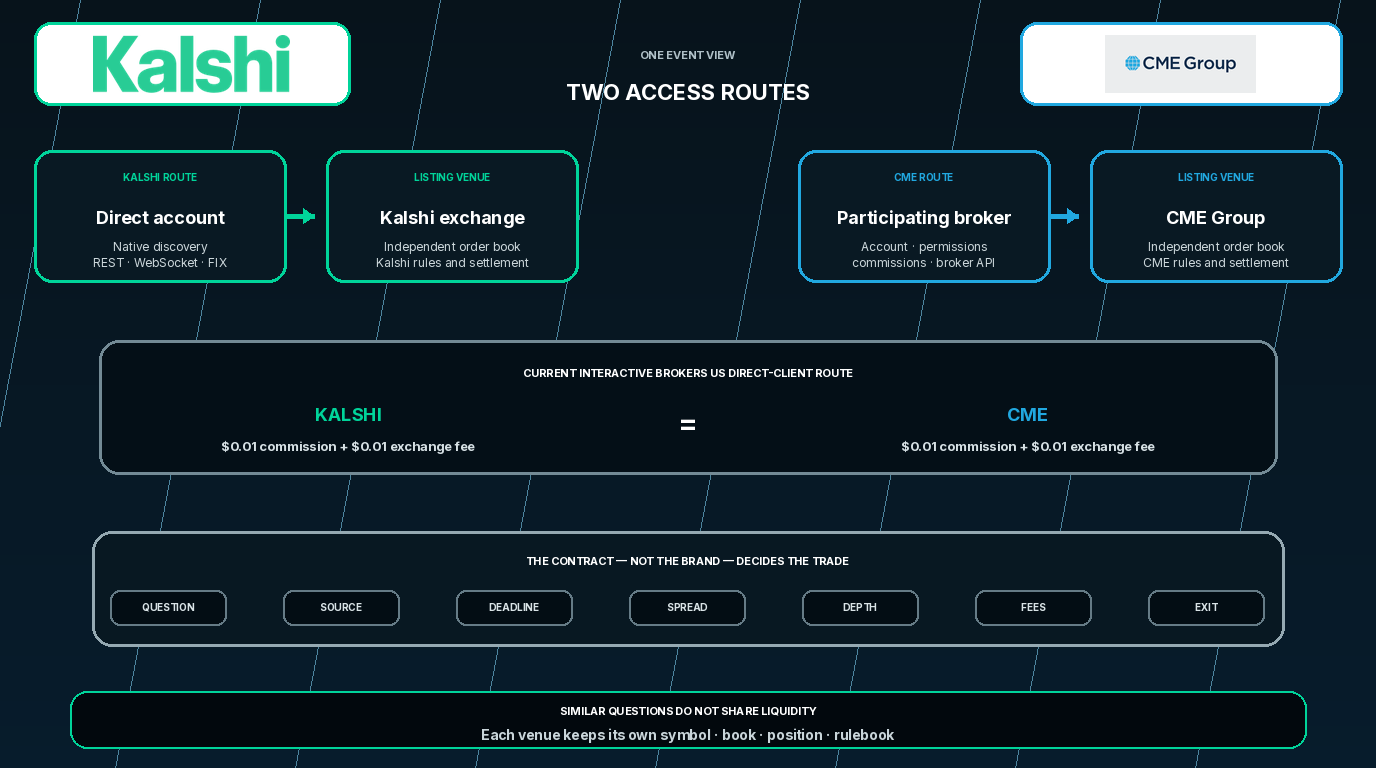
CME Group is a global derivatives marketplace comprising multiple designated contract markets. Its Prediction Markets product uses familiar event questions and binary payoffs, but CME explicitly tells customers to sign up with a participating broker. CME is the listing exchange; the broker carries the customer relationship, provides the trading interface and sets its own commissions or account requirements.
That creates two different stacks:
- Kalshi direct: customer → Kalshi account and interface → Kalshi order book → Kalshi rules and settlement.
- CME route: customer → participating broker or FCM → CME-listed contract → CME rules and clearing infrastructure.
Interactive Brokers can place both venues in one account. That convenience does not merge them. A Kalshi contract and CME contract asking a similar question still have different symbols, books, counterparties, rules and settlement processes.
Both are regulated, but registration is not a performance score
The CFTC designated contract market register lists Kalshi as a DCM. CME Group states that CME, CBOT, NYMEX and COMEX are designated contract markets. That matters because exchange rules, surveillance and regulatory obligations apply.
Registration does not mean every contract is approved for every person, that prices are accurate forecasts or that liquidity is deep. It also does not eliminate the possibility of loss. A contract bought for $0.73 can still settle at $0, leaving the buyer with the purchase cost and fees as a loss.
The product label also deserves care. "Prediction market" describes the user experience, not always one universal legal instrument. Broker disclosures can classify some event contracts as swaps and certain CME products as premium-style options on futures. The exact product code, exchange rule chapter and broker disclosure control. Our guide to whether prediction markets are legal explains why venue, jurisdiction and account type matter more than a generic category name.
Similar questions are not interchangeable positions
Suppose Kalshi and CME each list a contract about a Federal Reserve rate decision. Before comparing the prices, match at least these fields:
- The exact proposition and threshold.
- The observation date, time and time zone.
- The named data or resolution source.
- The policy for revisions, delays and cancellations.
- The final trading deadline.
- The payout and settlement timeline.
- The fees, spread and available size at your intended order.
A wording difference such as "target range at the scheduled meeting" versus "effective federal funds rate on a date" can create two economically different contracts. A trader cannot buy one venue and automatically close on the other. Our prediction-market comparison methodology uses the contract, rather than the brand, as the comparison unit.
Compare Contracts, Markets and Liquidity
Kalshi's product design is prediction-first. Its interface groups markets around events and topics, which can make discovery easier for a customer who is not starting from a futures symbol. The catalog has included politics, economics, weather, sports, crypto and culture, subject to current listings and eligibility.
CME's current Prediction Markets page names sports, economic indicators, cryptocurrencies and more. Its broader advantage is context: CME already operates major futures and options markets for rates, equity indexes, energy, metals, agriculture and crypto benchmarks. An event contract can therefore sit near instruments a derivatives trader already follows, even though it remains a separate contract with its own book.
Contract mechanics and early exit
Both platforms commonly use prices between $0.01 and $0.99 and an eventual $1-or-$0 payoff. A buyer's maximum contract loss is generally the price paid plus applicable fees, assuming no separate funding or account complication. A purchase at $0.37 produces $0.63 of gross profit if the contract settles at $1 and loses the $0.37 purchase price if it settles at $0.
CME says positions can be traded before an event completes. Kalshi also supports buying and selling event contracts where the market is open. Early exit is not guaranteed at the last displayed price. It requires another executable order, and a wide bid-ask spread can materially change the result.
Market orders deserve particular caution in thin books. The best displayed quote may cover only a small number of contracts. A larger order can consume several price levels, raising the average entry price. Limit orders control the worst price but may remain unfilled.
Which has more markets?
A raw count is a poor long-term answer because listings open, expire and settle continuously. Kalshi often feels broader to a retail reader because discovery is its core interface. CME can be more compelling for a particular economic, crypto or sports event and can benefit from distribution through established brokers.
Use this decision process instead:
- Search the exact event on both venues.
- Open the rules, not just the market title.
- Confirm eligibility and the broker route.
- Compare the same outcome and deadline.
- Record the best bid, best offer and available quantity.
- Add all opening and expected closing fees.
- Prefer the contract with the better complete trade, not the larger brand.
Our best prediction market apps guide covers broader platform selection. The Kalshi alternatives and CME alternatives guides are better when neither side of this comparison fits.
Which has better liquidity?
There is no honest platform-wide liquidity winner. Liquidity belongs to an exact contract, price and moment. A headline political market on Kalshi can be deeper than a niche CME listing, while a CME contract distributed through a large broker network can show the better executable book for another event.
Compare three measurements:
| Liquidity measure | What it tells you | Common mistake |
|---|---|---|
| Bid-ask spread | Immediate round-trip friction near the top of book | Looking only at the last trade |
| Depth by price level | How much size is executable before price moves | Assuming the best quote covers the full order |
| Recent matched volume | Whether participants have actually traded | Treating historical volume as current depth |
An apparent two-cent fee advantage cannot compensate for paying a five-cent worse offer. Conversely, a resting limit order can reduce spread cost but introduces execution risk. The appropriate venue can change between entry and exit, yet positions remain venue-specific.
Compare Fees, Access and Tools
Fee comparisons become misleading when one side uses Kalshi direct and the other uses a broker. The cleanest public comparison is to hold the route constant. Interactive Brokers currently supports Kalshi and CME event contracts, so its published US direct-client schedule gives a like-for-like account comparison.
| Venue through IBKR | IBKR commission | Exchange fee | Current listed total per execution |
|---|---|---|---|
| Kalshi | $0.01 | $0.01 | $0.02 per contract |
| CME | $0.01 | $0.01 | $0.02 per contract |
The current tie applies to this specified IBKR pricing route, not every customer or intermediary. Introduced, managed and institutional arrangements can differ. A purchase and later sale are two executions. Ten contracts bought and ten later sold would therefore create 20 charged contract executions before considering the spread.
The Interactive Brokers event-contract page currently describes access to CME, Kalshi and ForecastEx. Our IBKR Prediction Markets review explains why the broker is an account layer rather than a fourth merged exchange.
Kalshi direct fees versus CME broker fees
Kalshi's official fee explanation says the exchange charges transaction fees based on expected earnings. Some markets have different schedules, and maker fees can apply to resting orders when they execute. The signed-in order preview and current fee schedule are the authoritative cost for an exact Kalshi trade.
CME does not provide one universal direct retail commission because customers trade through participating brokers. The final CME cost can include broker commission, exchange fee, spread, market-data cost and any funding or currency cost attached to the account.
Use one equation for both:
Effective trade cost = execution price + commission + exchange fee + spread/price impact + funding or currency cost
For a complete position, calculate both expected entry and exit. Our prediction-market fee calculator helps normalize the arithmetic, but it cannot predict future depth or a changing fee schedule.
Account access and funding
Kalshi is the simpler route when the reader wants a dedicated exchange account. The customer can onboard directly, subject to location, identity checks and current eligibility. A supported intermediary may still be useful for consolidated reporting or a multi-asset portfolio.
CME requires a participating broker. That adds another selection decision, but it can be a feature for a customer who already has approved futures permissions, cash and reporting in that account. Broker availability, trading hours, order types, API support and product permissions can differ even when the underlying CME contract is the same.
Neither route should be assumed available globally. Verify the current jurisdiction, state restrictions, age requirements, tax treatment and account agreement. Do not use a VPN or false information to bypass eligibility controls.
APIs and market data
Kalshi has the cleaner direct developer story. Its official API documentation covers real-time market data and trade execution through REST, WebSocket and FIX. It also provides a demo environment, API keys, specifications and rate-limit documentation.
CME provides institutional market-data and product infrastructure, but a retail customer's trading API normally depends on the participating broker. Interactive Brokers, for example, documents event-contract identifiers and order routing through its own APIs. A developer choosing CME should therefore evaluate both the exchange contract specification and the broker's API limits, permissions and uptime.
For automation, compare:
- Authentication and key security.
- REST, streaming and FIX availability.
- Market-definition and rule-document access.
- Order types, cancellation behavior and idempotency.
- Rate limits and recovery after disconnects.
- Historical data, timestamps and symbol changes.
- Sandbox or paper-trading support.
- Broker and exchange fees for automated turnover.
A native API does not remove execution risk. Automated systems can repeatedly cross a spread, exceed intended exposure or trade after a market-definition change. Start with strict position limits and human-readable contract checks.
Regulation, Safety and Settlement Risk
Kalshi and CME operate within CFTC-regulated exchange structures, but "regulated" should not be read as "insured against trading loss." The CFTC's prediction-market education page emphasizes understanding how event contracts work and checking registration.
The most important safety questions are operational:
- Who is the exchange and who is the broker or FCM?
- Where is customer collateral held?
- Which rulebook governs the exact contract?
- What source resolves the outcome?
- What happens after a data revision, postponement or cancellation?
- How can a customer challenge a settlement?
- When can trading be paused or a contract voided?
Read the rules before entering, especially for weather measurements, economic releases and multistage political events. A market title is a summary, not the contract. CME provides event-contract specifications and rulebook links; Kalshi provides market rules and settlement criteria on its event pages.
Probability, price and maximum loss
Both products make the economics easy to visualize, but price is only the market's current clearing level. It is affected by available capital, trader beliefs, hedging demand, fees and liquidity. It is not an audited probability forecast.
The binary payoff caps the contract's terminal value at $1 or $0. It does not guarantee that a customer can exit early, receive the desired price or avoid account-level problems. Keep enough cash for fees, avoid concentrating on correlated outcomes and size the position based on a complete loss of the entry cost.
Security also includes account practices. Use unique credentials, multifactor authentication where offered, API keys with the minimum permissions and allowlists when available. Monitor broker and exchange notices rather than relying on social-media screenshots.
Which Should You Choose?
Choose Kalshi if most of these statements are true:
- You want one direct specialist prediction-market account.
- Consumer event discovery matters more than a traditional derivatives workstation.
- You need a native exchange API for data and execution.
- Your preferred contract has competitive depth after fees.
- The direct fee preview and rules are clear for your intended order.
Choose CME Prediction Markets if most of these are true:
- You already use a participating broker and want event contracts in that account.
- CME's exact contract has the better wording, price or executable depth.
- You value connection to a broader futures and options research workflow.
- Your broker's API, reporting and risk controls meet your requirements.
- You are comfortable separating broker costs from exchange contract rules.
Choose both through one broker only when multi-venue comparison justifies the added complexity. Interactive Brokers can make that practical, but each position remains on its original venue. A strategy that depends on cross-venue price differences must account for nonidentical rules, fees, transfer timing and the inability to net one contract directly against the other.
Where Macro Markets fits
Macro Markets is a different answer for an eligible reader who prioritizes crypto-native funding, global market discovery and a prediction-first experience outside the conventional US broker workflow. It is not presented here as a CFTC-designated exchange or as a regulatory equivalent to Kalshi or CME.
Consider Macro Markets when crypto deposits and withdrawals are an intentional part of the workflow. Then verify supported jurisdictions, custody, networks, conversion costs, withdrawal rules, market-making design, dispute procedures and executable liquidity. Crypto funding can introduce network, asset-price and custody risks that do not exist in the same form in a cash broker account.
Because Macro Markets publishes this article, this section is a first-party disclosure rather than an independent recommendation. Explore how Macro Markets works only after comparing the exact contract, full cost and eligibility with the regulated US routes above.
A practical final decision checklist
Before funding either route, write down:
- Your preferred account model: direct exchange or participating broker.
- The exact market URL and product code.
- The complete resolution wording and source.
- Best bid, best offer and depth for your order size.
- Entry fee, likely exit fee and funding cost.
- Maximum loss if the position settles at $0.
- API or manual order controls required.
- The reason this contract is better than the alternative venue's contract.
If item eight has no concrete answer, do not trade merely because one brand feels more familiar.
Frequently Asked Questions and Final Verdict
Is Kalshi better than CME Prediction Markets?
Kalshi is generally better for direct prediction-market onboarding, native discovery and a direct exchange API. CME can be better for a customer already using a participating broker or when the exact CME contract has superior rules, price or depth. There is no universal winner.
Is Kalshi cheaper than CME?
Not in every route. Through Interactive Brokers, the current published US direct-client total is $0.02 per contract per execution for both Kalshi and CME. Kalshi direct uses an expected-earnings formula, and CME broker fees vary. Compare the complete order preview and spread.
Can I trade CME Prediction Markets without a broker?
CME's current product page directs customers to sign up with a broker offering Prediction Markets. The broker provides the account and trading route; CME lists the contract.
Are Kalshi and CME both regulated by the CFTC?
Kalshi appears on the CFTC's designated contract market register. CME Group says its four exchanges are designated contract markets. Registration does not guarantee liquidity, availability, forecast accuracy or profit.
Do Kalshi and CME share liquidity?
No. Even when two contracts ask similar questions, their order books, rules and positions are separate. Using one broker to view both venues does not merge their liquidity.
Which has the better API?
Kalshi offers a native exchange API using REST, WebSocket and FIX, making it the clearer direct option. CME trading access for a retail customer generally depends on the participating broker's API, while CME supplies exchange specifications and market-data infrastructure.
Can I hedge a Kalshi position with a CME contract?
You can take economically opposing positions if both markets are available, but it is not a perfect hedge unless proposition, deadline, source and settlement rules align. The positions do not offset operationally, and both sides incur their own fees and liquidity risk.
What is the final verdict?
Kalshi wins the dedicated prediction-market experience. CME wins when broker integration and the wider derivatives ecosystem are more important. In the final Kalshi vs CME prediction markets decision, compare the contract rules and executable book before the brand. If both are offered through IBKR at the current published schedule, fees begin tied; wording, spread, depth and workflow decide the better venue.