


Are Prediction Markets Legal in the US? State and Federal Guide
Yes, some prediction markets are legal in the United States—but legality depends on the platform, the contract, and where the customer is located. A contract offered on a Commodity Futures Trading Commission-regulated exchange may fall within federal derivatives law. That does not mean every event contract is lawful, that every prediction-market website may serve US customers, or that every state accepts sports-related contracts.
The legal line is especially unsettled for sports event contracts. Federal regulators, state gaming authorities, courts, tribes, and exchange operators have taken competing positions. In 2026, federal appellate decisions strengthened the ability of states and tribes to challenge sports contracts in some circumstances.
This guide explains the current framework, how to check a platform, and why “available in the app” is not the same as “legal for this contract in this location.”
Last reviewed and fact-checked: October 24, 2026.
Disclaimer: This article provides general educational information and is not legal advice. Rules, court orders, product listings, and geographic restrictions can change quickly. Check current regulator and platform notices before trading.
Are Prediction Markets Legal Under Federal Law?
Prediction markets are not categorically legal or illegal under one federal rule. When people ask “Are prediction markets legal under federal law?”, the answer begins with the instrument and the venue.
The CFTC’s prediction-market guide explains that event contracts are often structured as swaps or futures. A venue offering those products to the general public generally must operate within the federal commodities framework, usually as a designated contract market, or DCM. The CFTC describes DCMs as exchanges operating under Section 5 of the Commodity Exchange Act and Part 38 of the agency’s regulations.
Federal registration matters because DCMs must follow core principles covering market integrity, monitoring, recordkeeping, participant protection, and other obligations. The CFTC also supervises the market and can review or challenge product listings.
But DCM status is not a blanket approval of every contract an exchange might list. A platform can be registered while a particular product remains disputed, restricted, reviewed, or prohibited.
That distinction answers a common question: Are prediction markets legal simply because the operator is CFTC-regulated? No. Registration is a necessary legal and consumer-protection signal for many retail event-contract products, but product-specific law still matters.
What the Commodity Exchange Act Says About Event Contracts
The Commodity Exchange Act lets registered entities submit or self-certify new contracts. The CFTC may stay, review, approve, or disapprove a product under the applicable process.
The statute’s special rule for event contracts is central. 7 U.S.C. § 7a-2(c)(5)(C) identifies contracts involving terrorism, assassination, war, gaming, or activity unlawful under federal or state law. The Commission may determine that covered contracts are contrary to the public interest, in which case they cannot be listed or made available for trading through a registered entity.
CFTC Regulation 40.11 addresses contracts based on certain excluded commodities and provides a 90-day review process for contracts that may involve the listed activities. The wording and operation of that rule have become part of the legal fight over sports and other event markets.
The regulatory framework was still developing when this guide was reviewed:
- In February 2026, the CFTC withdrew its 2024 event-contract proposal and a 2025 sports-contract staff advisory.
- In March 2026, CFTC staff issued a new prediction-markets advisory emphasizing exchange surveillance, product submissions, and compliance with core principles.
- In June 2026, the Commission proposed a new framework for evaluating contracts involving the activities named in the statute. A proposal is not a final rule.
- In September 2026, staff issued a separate advisory on “mention markets”, warning that contracts based on a person’s words, appearance, or conduct can create heightened manipulation risk.
Therefore, an old article that treats a withdrawn proposal as current law—or a proposed 2026 rule as final—can give the wrong answer.
Why State Law Still Matters, Especially for Sports Contracts
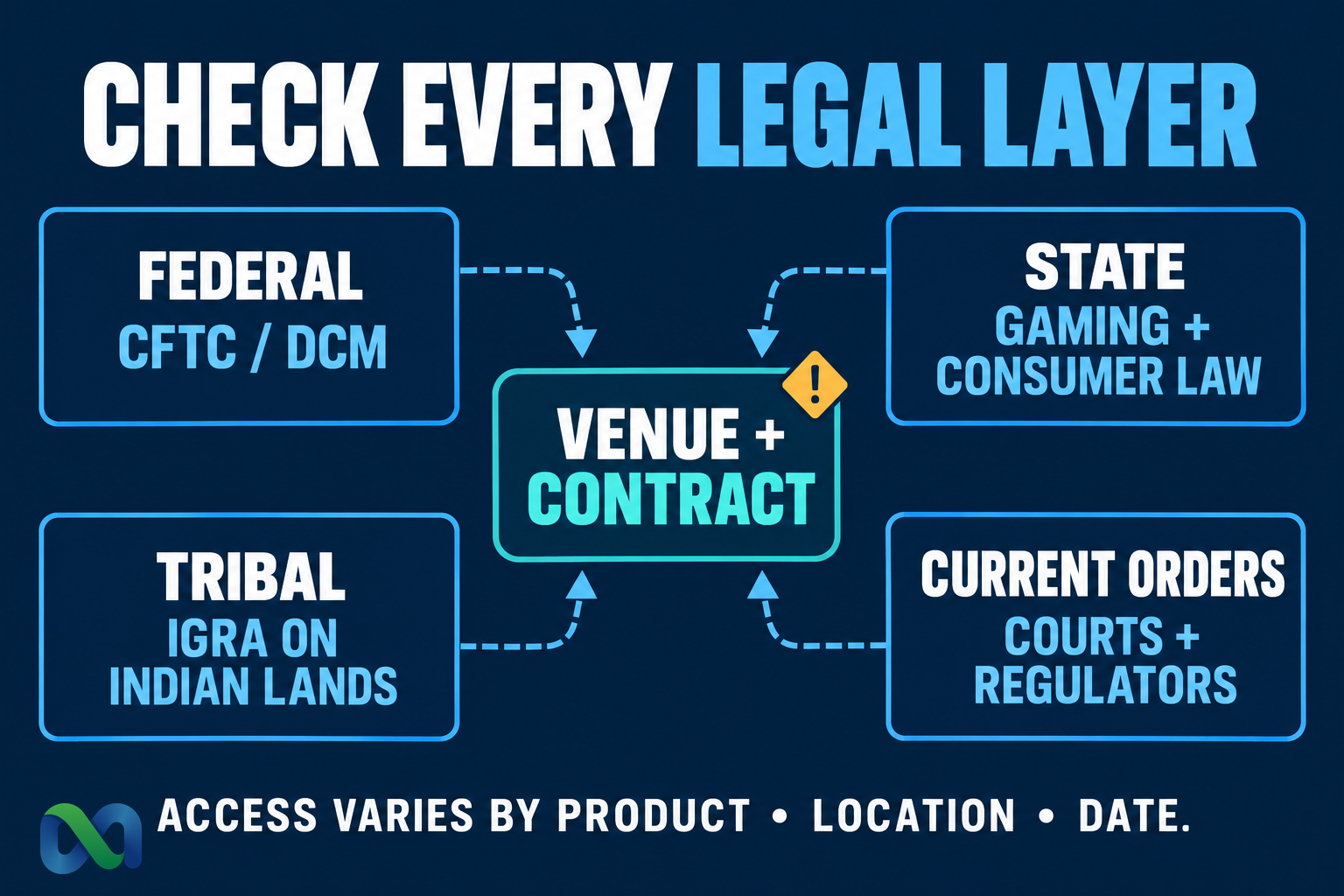
Federal law gives the CFTC broad authority over commodity derivatives markets. States, however, license and enforce gambling and sports-wagering laws. This overlap explains why people asking “Are prediction markets legal?” can receive different answers. A platform may call a sports event contract a federally regulated derivative while a state calls the same product an unlicensed wager.
The most important 2026 appellate decision for this issue is KalshiEX LLC v. Assad. In its August 28, 2026 opinion, the US Court of Appeals for the Ninth Circuit reviewed Nevada’s attempt to regulate Kalshi’s sports contracts. It held that Kalshi had not shown a likelihood that federal commodities law preempted Nevada gaming law. The court affirmed the dissolution of a preliminary injunction that had protected Kalshi from Nevada enforcement and remanded issues involving election contracts.
That ruling did not decide every prediction-market question nationwide. It was an appellate ruling about preliminary relief and Nevada’s enforcement. Still, it makes a sweeping “sports prediction markets are legal in all 50 states” statement unsafe.
Tribal law adds another layer. The Ninth Circuit decided Blue Lake Rancheria v. Kalshi on September 16, 2026. It held that the tribes were likely to succeed on claims that sports event contracts entered from tribal lands were class III gaming under the Indian Gaming Regulatory Act. The court also found a likely violation of the applicable tribal gaming rules and remanded for further consideration of preliminary-injunction factors.
The practical result is a location-sensitive framework:
- Federal commodities law governs registered derivatives venues and their contracts.
- State gaming authorities may assert jurisdiction over sports or gambling-like products.
- Courts decide preemption and statutory questions in specific cases.
- Tribal gaming law can apply when activity occurs on Indian lands.
- A platform may restrict a category in one location while continuing other markets elsewhere.
State Enforcement Examples as of October 24, 2026
The following examples show why “Are prediction markets legal?” cannot be answered with a static 50-state yes/no chart. They are not a complete list of states, operators, or pending cases.
| Jurisdiction | Current public action relevant to sports contracts | What a customer should infer |
|---|---|---|
| Nevada | The Nevada Gaming Control Board’s timeline records cease-and-desist actions, state-court injunctions, and the 2026 Ninth Circuit litigation. | Do not assume that federal exchange registration makes sports contracts available in Nevada. Check the platform’s current restrictions and state notices. |
| Massachusetts | A January 20, 2026 court order allowed a preliminary injunction blocking Kalshi from taking Massachusetts sports wagers without state licensure. | Sports-contract access can be blocked even while other event categories or federal issues remain separate. |
| Connecticut | Connecticut announced enforcement actions in September 2026 against multiple services offering sports event contracts, after a federal judge rejected Kalshi’s request for preliminary protection. | Verify the exact operator and product category; a general account login does not establish lawful sports access. |
| New York | The New York Attorney General announced a lawsuit against Kalshi on July 31, 2026, alleging illegal unlicensed gambling. | Treat sports and gambling-like offerings as actively contested and follow current court and regulator orders. |
These examples also show why state sportsbook legalization does not automatically legalize a prediction-market sports product. A state may authorize sports wagering only through licensed operators, with specific age, geolocation, responsible-gaming, tax, and consumer-protection requirements.
Conversely, a dispute about sports contracts does not automatically make economic, weather, financial, election, or other event contracts illegal. Each category and contract must be assessed under its own rules and current restrictions.
Election, Economic, Weather, and Other Markets
Not all prediction-market categories present the same legal issue. Anyone asking “Are prediction markets legal for elections or economic releases?” must check the category rather than reuse the answer for sports.
Election and political contracts
Election markets have their own federal litigation and product-submission history. Some political contracts have traded on CFTC-regulated exchanges, while others have been challenged or reviewed. The Ninth Circuit’s Nevada opinion remanded issues involving election contracts rather than treating its sports analysis as the final answer for those products.
Customers should check whether the exact election contract appears in the CFTC’s product filings, whether a current order affects it, and whether the platform permits trading from their location.
Economic and financial contracts
Contracts tied to inflation releases, interest-rate decisions, employment reports, or prices fit more naturally within traditional derivatives regulation. That does not remove every legal or trading risk. The venue, contract filing, manipulation controls, and customer eligibility still matter.
Weather, climate, culture, and technology contracts
These categories may be offered on registered venues, but the label alone does not determine legality. A weather contract designed to hedge a commercial risk differs from a contract involving an activity named in the event-contract special rule. A culture or technology contract can also raise manipulation concerns when a person controls or knows the result.
The CFTC’s 2026 mention-market advisory is a useful example: a market that seems like entertainment may still be problematic if settlement turns on conduct that a participant can influence.
How to Check Whether a Prediction Market Is Legal for You
Use this seven-part check before depositing or trading. It turns “Are prediction markets legal for me?” into a set of facts you can verify.
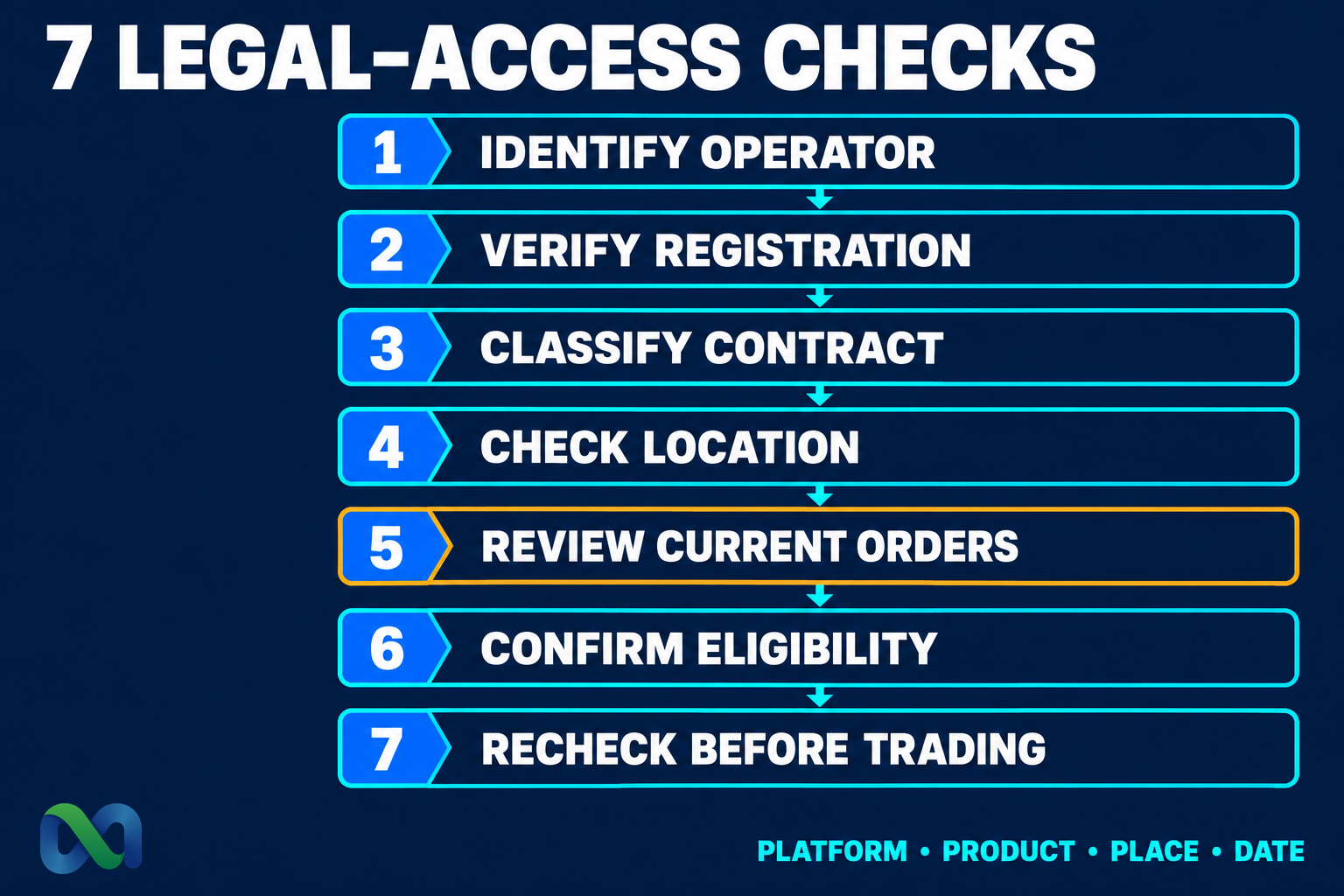
1. Identify the legal operator
Find the company name in the terms of service, not only the app brand. A familiar brand may route customers through a separate exchange, broker, clearing organization, or affiliate.
2. Verify federal registration
Search the CFTC’s DCM registry and filings. Confirm that the domain and app belong to the registered operator. An app-store listing, social account, or “regulated” badge is not enough.
Our review of prediction market apps in the US compares platform structure and access. Our Is Kalshi legit? guide explains what DCM oversight does and does not mean for customers.
3. Check the exact contract category
Do not stop at the platform’s registration. Determine whether the product is sports, elections, economics, weather, culture, or another category. Search the CFTC’s product filings and read any order associated with the contract.
4. Check your physical location
Use the platform’s current location and eligibility notices. State restrictions can apply to the place from which you trade, not just the address on the account. Tribal land can create additional legal issues.
Never use a VPN, false address, or other workaround to evade geolocation or eligibility controls.
5. Look for current court and regulator orders
Prioritize primary sources: CFTC notices, federal and state court opinions, state gaming regulators, and attorneys general. Check the date and procedural stage. A complaint contains allegations; a temporary restraining order is not a final judgment; a proposed rule is not a final rule.
6. Review age and customer requirements
Minimum age, identity checks, sanctions screening, funding methods, and account eligibility can differ from state sportsbook rules. Being old enough for one product does not prove eligibility for another.
7. Recheck immediately before trading
Legal access can change after a court order, regulatory notice, platform update, or product delisting. Save the contract rules and the current eligibility notice if the position is material.
Regulated Does Not Mean Risk-Free
A legal, federally regulated contract can still produce a total loss. Regulation does not guarantee that the market price is accurate, that a contract will remain liquid, or that your interpretation of the rules is correct.
The CFTC tells customers to use risk capital, understand fees and contract terms, monitor positions, and trade only through registered entities. It also warns that customers may have little or no protection when using unregistered offshore services.
Legal status and platform safety are related but different questions:
- Legal status: May this operator offer this product to this customer in this location?
- Regulatory status: Which agency supervises the venue and product?
- Market risk: Can the position lose value or settle at zero?
- Operational risk: Can funding, withdrawal, outage, or settlement problems occur?
- Fraud risk: Is the website or app authentic, and are the claims accurate?
Our explanation of whether Kalshi is gambling covers the legal and structural difference between event contracts and conventional sportsbook wagers.
Frequently Asked Questions
Are prediction markets legal in all 50 states?
Do not assume so. CFTC-regulated exchanges operate under federal law, but product-specific state, tribal, and court disputes can affect access. Sports event contracts have faced injunctions and enforcement in multiple states. Check the exact contract and current location restrictions.
Is Kalshi legal in the United States?
KalshiEX is a CFTC-designated contract market. That federal status is real, but it does not make every Kalshi contract available in every location. Sports contracts have been the subject of state enforcement and significant 2026 court decisions.
Is Polymarket legal for US users?
Users must distinguish the global polymarket.com service from any separately structured US-regulated offering. Verify the legal entity, domain, CFTC registration, and current customer terms rather than relying on the shared brand name.
Are political prediction markets legal?
Some election contracts have traded on registered US exchanges, but legality and availability are contract-specific. Review the venue’s filing, current CFTC actions, applicable court orders, and location rules.
Are sports prediction markets the same as legal sportsbooks?
No. A sportsbook operates under state gaming licenses. A prediction exchange may claim federal derivatives status. Courts and states have disputed whether sports event contracts are nevertheless wagers subject to state or tribal gaming law.
Does CFTC registration protect my money?
It creates oversight and conduct obligations, but it does not insure a trade or guarantee profits. Confirm how customer funds are held, which intermediary serves the account, what fees apply, and how withdrawals work.
Can I use a VPN if my state is blocked?
No. Circumventing geolocation or providing false information can violate platform terms and applicable law. It may lead to account closure, frozen transactions, or other consequences.
Are Prediction Markets Legal? The Bottom Line
Are prediction markets legal in the United States? Some are, under specific federal and state conditions. Start with the operator’s registration, then verify the exact contract, your location, and current court or regulator orders.
A CFTC-regulated venue is not a universal legal pass. A state dispute over sports contracts is not a universal ban on every prediction market either. The product, venue, jurisdiction, and date all matter.
For practical due diligence, use the same sequence every time. Identify the operator and verify registration. Then classify the contract, check location restrictions, read current legal notices, confirm eligibility, and recheck before placing an order.
In short, are prediction markets legal? Sometimes—but only after the platform, product, place, and current rules all check out.
