


CME Prediction Markets Review 2026: Fees, Safety and Markets
CME Group has moved prediction markets into the same broad derivatives ecosystem used for interest rates, equity indexes, energy, metals, agriculture and cryptocurrencies. Its event contracts let eligible customers express a defined view on economic releases, sports, crypto benchmarks and other outcomes with a maximum $1-or-$0 settlement.
Our verdict: CME Prediction Markets is a credible, regulated choice for customers who want event contracts connected to traditional futures markets and accessed through a participating broker. Its strengths are institutional market infrastructure, clear contract specifications, broker distribution and products linked to recognized benchmarks. Its limitations are broker-dependent access, product-code complexity, venue-specific fees and liquidity that must be evaluated contract by contract.
Last reviewed and fact-checked: November 2, 2026.
Editorial disclosure: Macro Markets publishes this review and operates a prediction-market platform. We include Macro Markets later as a disclosed crypto-native alternative and do not present it as a CFTC-designated US exchange. This review is based on current official exchange, broker and regulatory material. We did not place funded synchronized orders across every CME broker or contract. Event contracts can settle at $0, and regulation does not reimburse a correctly settled losing position. This article is educational, not financial, legal or tax advice.
CME Prediction Markets Review: Quick Verdict
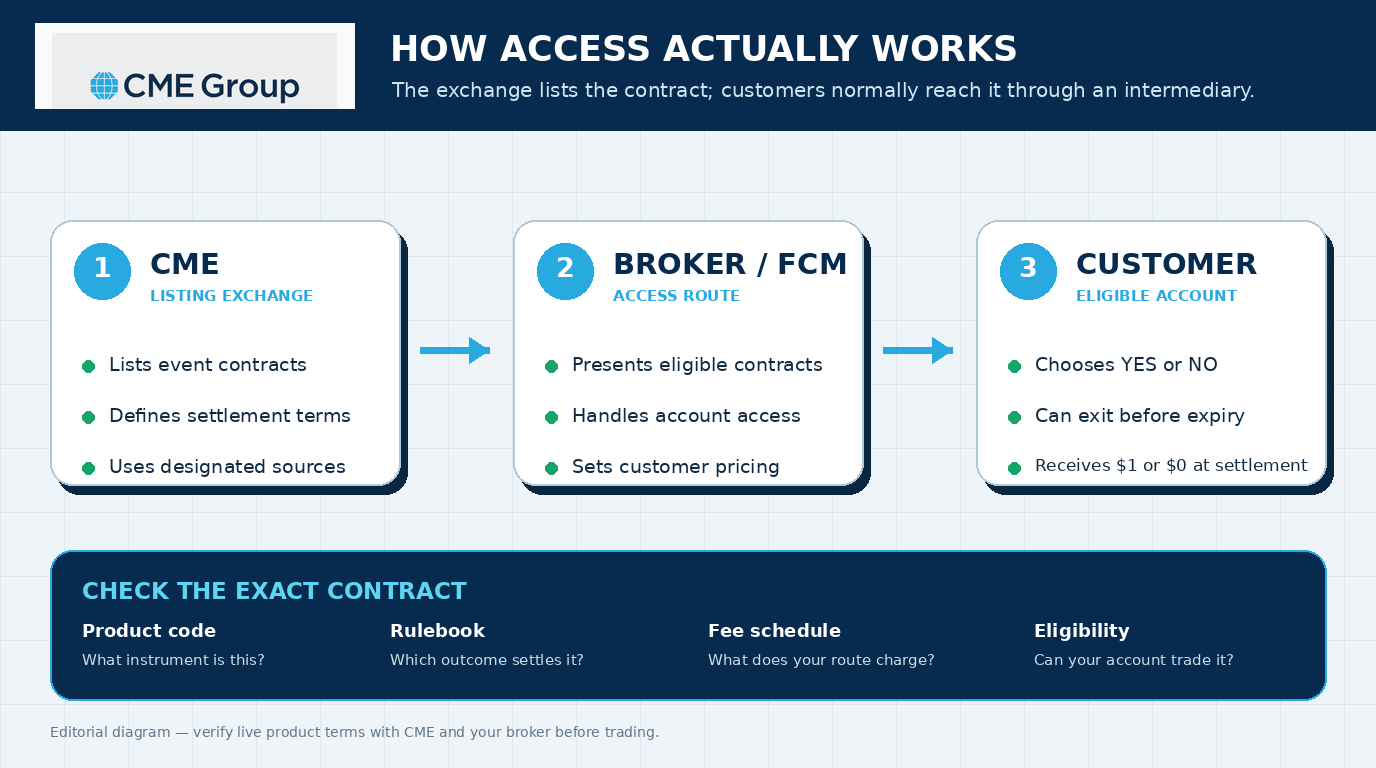
CME Prediction Markets is best understood as an exchange product family, not one direct consumer account. CME lists the contracts. A participating broker or futures commission merchant handles customer onboarding, cash, permissions, order entry, statements and support.
That distinction explains why two customers can trade CME event contracts through different interfaces or fee schedules while remaining connected to the same listing venue.
| Review factor | Finding | What it means |
|---|---|---|
| Exchange role | Chicago Mercantile Exchange is a CFTC-designated contract market | CME lists regulated derivatives; the broker carries the customer relationship |
| Current categories | Sports, economic indicators, cryptocurrencies and more | Broader than a macro-only forecast exchange |
| Pricing | Generally $0.01 to $0.99 | Price can be read as approximate market-implied probability, not certainty |
| Settlement | Correct prediction pays $1; incorrect prediction pays $0 | Maximum loss is generally the amount paid plus applicable fees |
| Early exit | Supported positions can be traded before event completion | A sale still needs executable bids and sufficient depth |
| Product type | Event swaps plus certain premium-style options on futures | Product code and rule chapter must be checked |
| Retail access | Participating brokers and FCMs, including supported IBKR and FanDuel Predicts routes | Fees, eligibility and tools depend on the account layer |
| Current IBKR fee example | $0.01 commission plus $0.01 exchange fee per contract | $0.02 per execution before spread or slippage for current US direct clients |
| Data and tools | Time and Sales, daily bulletins, specifications, CSV listings and broker APIs | Strong research workflow, but not one unified native retail API |
| Main risk | Binary loss plus liquidity, settlement and broker-access risk | CME's reputation does not guarantee a profitable or liquid contract |
CME Prediction Markets pros
- Regulated exchange structure with established derivatives infrastructure.
- Economic, crypto, sports and other event categories.
- Binary prices and maximum payout are easy to understand.
- Positions can be traded before the event completes when liquidity exists.
- Official specifications, rulebook chapters, bulletins and time-and-sales resources.
- Access can sit beside stocks, options, futures and bonds through a broker such as Interactive Brokers.
- Certain products connect naturally to futures benchmarks already monitored by active traders.
CME Prediction Markets cons
- Customers need a participating broker rather than a universal direct CME retail account.
- Fees, eligibility, funding and interfaces vary by broker.
- “Event contract” can refer to a swap or certain options-on-futures structures.
- Liquidity is contract-specific and can be thin despite CME's scale in other derivatives.
- Similar contracts on ForecastEx, Kalshi or another venue are not automatically fungible.
- A $1-or-$0 payoff can produce a complete loss of the purchase amount.
The direct ForecastEx vs CME Prediction Markets comparison covers the closest macro-focused specialist alternative. For direct exchange accounts, use Kalshi vs CME Prediction Markets, the mobile-focused CME vs Polymarket US comparison, the broker-versus-app guide to CME vs Robinhood Prediction Markets, the professional crypto-exchange comparison of CME vs Crypto.com Predict Pro or the integrated-account CME vs Gemini Prediction Markets comparison. The standalone Crypto.com Predict Pro review covers that product's fees, order types, funding and risks. This page focuses on CME as a product family.
What Is CME Prediction Markets, and Is It Legit?
CME Prediction Markets is CME Group's umbrella for contracts tied to defined event outcomes. CME's official Prediction Markets page says customers use insights and opinions to trade the result of events in sports, economic indicators, cryptocurrencies and other categories.
Chicago Mercantile Exchange appears on the CFTC's official list of designated contract markets. A DCM operates under the Commodity Exchange Act and CFTC rules. CME Group also maintains exchange rulebooks, product filings, surveillance processes and clearing arrangements.
That makes CME Prediction Markets legitimate regulated derivatives, but the statement needs boundaries:
- CME is the listing exchange, not necessarily the company holding the retail customer's front-end account.
- The broker or FCM controls onboarding, permissions, cash movement and customer service.
- The individual product code determines whether a contract is an event swap or another structure.
- Exchange regulation does not guarantee liquidity, forecast accuracy or protection from a losing outcome.
- Availability can vary by residence, state, account entity and event category.
The CFTC's prediction-market education page explains that event contracts are often structured as swaps, can be used for hedging or speculation and commonly use Yes/No outcomes with fixed payouts. It also recommends verifying official exchanges, intermediaries and apps.
CME is not one direct retail app
CME tells customers to sign up with a broker offering Prediction Markets. Interactive Brokers currently exposes supported CME contracts beside ForecastEx and Kalshi in one professional account. FanDuel Predicts provides a separate retail route through its registered FCM structure and clears supported CME products through its disclosed arrangement.
The broker choice affects:
- who is eligible to open the account;
- which CME contracts are displayed;
- deposit, withdrawal and settled-cash rules;
- commission and exchange-fee presentation;
- mobile, desktop and API tools; and
- statements, tax records and support.
Always identify both legal entities: the exchange listing the contract and the broker carrying the customer account. Our Interactive Brokers Prediction Markets review explains the multi-venue broker model.
How CME Event Contracts Work
CME presents prediction contracts on a $0.01-to-$0.99 scale. A contract offered at $0.32 can be read as the market assigning roughly a 32% probability to the specified result, subject to spread, fees and market design. It is a tradable price, not a scientific confidence interval.
If the predicted result occurs, a correct position pays $1. If it does not occur, the position pays $0. No intermediate payout applies to the ordinary binary example unless the specific product rules define a different cancellation or special-settlement procedure.
Suppose a customer buys 100 Yes contracts at $0.38:
- contract cost: $38;
- winning gross settlement: $100;
- gross difference before fees: $62; and
- losing settlement: $0, producing a $38 contract loss before fees.
Fees increase the loss and reduce the gain. A position purchased at $0.90 can be more likely to win according to the market and still offer only $0.10 gross upside per contract before fees.
Buying, selling and early exit
CME says a position can be traded multiple times before the event completes. A customer can increase exposure or close out before the final outcome. Through Interactive Brokers' documented workflow, supported CME event positions can be bought and sold. Short selling is not permitted in the compared event-contract route.
A sell button is not guaranteed cash. A 500-contract position might have a bid for only 40 contracts at the displayed best price. The remainder can fill at worse prices or remain open. Limit orders control the minimum accepted price but do not guarantee execution.
The bid-ask spread guide explains why the midpoint or last trade may differ materially from the next executable price.
Settlement rules are more important than the title
An economic contract should name the data series, source agency, observation period, release version, threshold, last trading time and payout procedure. A sports contract should identify the governing result, treatment of postponements, ties, cancellations and official corrections. A crypto contract should identify the exact benchmark, time and calculation method.
Before ordering, record:
- CME product code and listing exchange;
- exact question and threshold;
- named source or benchmark;
- measured period and time zone;
- last trading, resolution and payout times;
- correction, cancellation and dispute rules; and
- maximum loss including fees.
Two contracts saying “Bitcoin above $100,000” can settle differently if one uses a futures settlement and another uses an index observation at a different time.
Swap or futures option?
“CME event contract” is an economic description, not one universal legal classification. Interactive Brokers' current disclosure says most event contracts are swaps, while certain CME products are cash-settled, European-style, premium-style options on CME-listed futures.
The customer experience can look similar: pay a premium, hold a binary position and receive $1 or $0. The legal rules, product discovery, disclosures and tax treatment can differ. Check the product code rather than assuming every contract follows the same chapter.
Markets, Data and Liquidity
CME's current categories include sports, economic indicators, cryptocurrencies and more. Product listings can change quickly because contracts expire, seasons end, new events are certified and brokers may add coverage on different schedules.
Economic indicators
Economic contracts can express a view on releases such as GDP or other measurable data. These products suit readers who already follow macro calendars and want defined binary exposure instead of a leveraged directional futures position.
The trade still requires a probability estimate. Being directionally correct is not enough if the purchase price already assumes an even more likely result.
Cryptocurrencies and futures-linked events
CME is especially relevant when a prediction question connects to its futures benchmarks. Interactive Brokers documentation describes event contracts tied to whether key futures markets finish above or below a level. The specified underlier and settlement reference must be verified.
This can be attractive to customers already monitoring Bitcoin, Ether, gold, crude oil or equity-index futures. It does not make the event contract interchangeable with the underlying future. The payout, maximum loss, expiration and liquidity are different.
Sports and other events
CME has expanded sports event products through participating retail routes. Sports availability can depend on state, customer location and account provider. A product listed by CME is not automatically accessible in every brokerage account or jurisdiction.
Read the contract rather than importing assumptions from a sportsbook. An exchange-listed event contract has its own order book, rule chapter, fees and settlement method.
Research and market data
CME provides direct access to Time and Sales, daily bulletins, contract specifications, rulebook summaries and downloadable event-contract listing data. Those resources are valuable for verifying symbols and historical executions without relying only on a broker's marketing description.
Broker tools can add watchlists, order books, portfolio reporting and APIs. Interactive Brokers' event-contract API documentation uses CME exchange and trading-class fields to distinguish contracts from conventional futures options.
Is CME liquidity always better?
No. CME's overall derivatives franchise is large, but that fact cannot be transferred to every prediction-market order book. A newly listed niche event contract can have a wide spread or limited size even while the related futures market is highly liquid.
Evaluate:
- executable bid and offer;
- available size at several price levels;
- recent trade frequency;
- likely early-exit depth;
- time remaining until resolution; and
- expected news catalysts.
Do not rank liquidity using displayed volume alone. Volume definitions can differ, and historical activity does not guarantee a future exit. Our comparison methodology keeps liquidity at the exact-contract level.
CME Prediction Markets Fees and Access
CME does not publish one universal retail all-in price because the customer reaches the exchange through a broker or FCM. The useful calculation includes the broker commission, CME exchange fee, spread, price impact and any funding or currency cost.
Interactive Brokers' current prediction-market commission schedule provides a transparent US direct-client example:
| Cost component | CME event contract through IBKR |
|---|---|
| IBKR commission | $0.01 per contract |
| Third-party CME exchange fee | $0.01 per contract |
| Listed total per execution | $0.02 per contract |
Buying 100 contracts therefore creates $2 in listed execution charges before spread or price impact. Selling the 100-contract position before settlement creates another execution and another $2 under the same schedule.
Introduced, advisor-managed or other account arrangements can differ. Taxes and currency conversion can also apply. Another broker, including a mobile consumer route, can use a different fee formula or promotion. The signed-in order confirmation is the final check.
Use this formula:
Effective cost = contract price + broker commission + exchange fee + spread + price impact + funding cost
A one-cent cheaper contract can still be more expensive if the order book is shallow. Use the prediction-market fee calculator for scenarios, then confirm the live ticket.
Eligibility and funding
Eligibility depends on the broker, account entity, residence, age, permissions and contract category. Do not infer access from CME's global brand or from seeing a market in a public catalog. The signed-in broker application and order ticket control.
Funding rules are likewise account-layer rules. Interactive Brokers uses eligible brokerage cash. FanDuel Predicts has its own customer agreement, banking workflow and geographic controls. Neither should be generalized to every future CME broker.
APIs and professional tools
Interactive Brokers supports CME event-contract discovery and trading through Web and Trader Workstation APIs. CME also publishes specifications and market-data resources. This is useful for analysts who want contract metadata, historical activity, controlled orders and portfolio reconciliation.
Automation needs strict controls:
- store exchange, product code, contract ID, expiration, threshold and side;
- begin with read-only discovery;
- verify newly encountered products manually;
- enforce maximum price, quantity and daily loss;
- handle partial fills and canceled orders; and
- reconcile executions and settlement against broker records.
Never match contracts only by headline text. A similar question can refer to a different source, deadline or product type.
Regulation, Safety and Risk
CME Prediction Markets operates within the US regulated derivatives framework. CME's DCM status, product filings, rulebooks, surveillance and clearing arrangements create meaningful institutional controls. CME also publishes event-contract risk disclosures stating that futures, options on futures and cleared swaps involve significant risk and are not appropriate for everyone.
“Regulated” does not mean:
- the forecast is accurate;
- the contract cannot settle at $0;
- an early exit will be available;
- the broker app cannot have an outage;
- a source agency cannot delay or revise data; or
- the customer is insured against trading loss.
Main risks
Binary loss: a losing contract can forfeit the purchase amount plus fees.
Liquidity risk: wide spreads and thin bids can make early exit expensive or impossible.
Settlement risk: ambiguous wording, corrections, postponements and source delays can affect timing or interpretation.
Broker risk: permissions, cash availability, transfers, outages and support belong partly to the account provider.
Product-classification risk: treating an event swap and an option on futures as identical can cause legal, tax or operational mistakes.
Automation risk: an incorrect symbol or venue field can send an order to the wrong product.
Use multifactor authentication, verify the broker's legal entity, read the exchange rules, calculate maximum loss and avoid committing money needed for near-term obligations. Our guide to prediction-market legality in the US explains the difference between venue registration, customer eligibility and contract availability.
CME Alternatives and Who Should Use It
CME is strongest for customers who already think in terms of futures benchmarks, economic releases and broker-routed derivatives. It is not the automatic best choice for a reader seeking a simple standalone prediction app.
| Alternative | Better when | Main trade-off |
|---|---|---|
| ForecastEx | Specialist macro and climate contracts, simple IBKR fee and variable coupon matter | Separate buy-only Yes/No structure and opposite-contract exit |
| Kalshi direct | Direct account, broad consumer discovery and native REST API matter | Different fee model and separate account |
| Gemini Predictions | An eligible user wants predictions integrated with a Gemini crypto account | Independent catalog, eligibility and liquidity |
| Polymarket US | A prediction-first US venue and separate discovery experience matter | Must be distinguished from global Polymarket |
| Interactive Brokers | One account should compare CME, ForecastEx and Kalshi | It is the broker layer, not one independent order book |
| Macro Markets | Crypto-native funding and global discovery are deliberate priorities | Different jurisdiction, custody and regulatory profile |
Compare the full shortlist in Best CME Prediction Market Alternatives. The Kalshi review, ForecastEx alternatives and best prediction-market apps provide additional context.
Choose CME if
- you want event contracts linked to a traditional derivatives workflow;
- economic, crypto, sports or futures-linked questions fit the strategy;
- your participating broker offers the exact product;
- official specifications and exchange data are valuable; and
- you are comfortable checking the product code and rule chapter.
Choose another venue if
- direct exchange onboarding is more important than broker integration;
- the exact CME contract has poor depth or a wide spread;
- the broker's fee or eligibility rules do not fit;
- you need an exchange-native consumer API; or
- crypto-native funding is an explicit requirement.
Macro Markets as a disclosed crypto-native alternative
Macro Markets is designed for eligible users seeking crypto funding and global prediction-market discovery rather than a US broker/FCM workflow. It can be relevant when wallet-native access and crypto context are intentional requirements.
That convenience introduces different questions about jurisdiction, custody, supported assets and networks, withdrawals, fees, liquidity and dispute rules. Because Macro Markets publishes this review, this inclusion is a first-party disclosure, not an independent endorsement.
Macro Markets is not represented here as a CFTC-designated US exchange and should not be assumed to offer the same account, exchange or clearing protections as CME. Open Macro Markets only after confirming current eligibility and contract rules.
Frequently asked questions
Is CME Prediction Markets legitimate?
Yes. Chicago Mercantile Exchange is a CFTC-designated contract market, and CME event products operate within the regulated US derivatives framework. Legitimacy does not guarantee profit, liquidity or reimbursement of a losing contract.
How do I access CME Prediction Markets?
Customers use a participating broker or FCM rather than opening a universal direct CME retail account. Current routes include supported Interactive Brokers products and FanDuel Predicts. Availability and fees depend on the account provider and jurisdiction.
What fees does CME Prediction Markets charge?
Fees depend on the broker route. The current IBKR US direct-client schedule lists a $0.01 broker commission plus a $0.01 CME exchange fee per contract, or $0.02 per execution before spread and price impact. Other brokers can differ.
Can I sell a CME event contract before settlement?
CME says positions can be traded before event completion. Through IBKR's documented route, supported CME positions can be bought and sold. A sell order requires executable bids and may fill partly or not at all.
Are CME event contracts swaps or futures options?
Both descriptions can apply to different products. Current broker disclosures say most event contracts are swaps, while certain CME products are cash-settled European-style premium-style options on futures. Check the product code.
What markets are available on CME?
CME currently highlights sports, economic indicators, cryptocurrencies and additional event categories. Listings expire and broker availability changes, so use the live catalog and exact specification.
Is CME safer than Kalshi or ForecastEx?
It is not useful to name a universal safety winner. CME, Kalshi and ForecastEx have different exchange, clearing, broker and product structures. Compare regulation, account security, contract loss, liquidity, settlement and operational risk separately.
Does CME Prediction Markets have an API?
CME publishes market-data and specification resources, while brokers can provide trading APIs. Interactive Brokers supports CME event-contract discovery and orders through its Web and TWS APIs, subject to permissions.
Final verdict
CME Prediction Markets earns a positive, qualified review. It brings binary event trading into a mature derivatives ecosystem and provides strong official specifications, benchmark connections and broker distribution. It is particularly compelling for an eligible customer already using a professional brokerage account or following CME futures markets.
The product is less simple than a direct prediction app. The customer must identify the broker, exchange, product code, classification, rule chapter and complete fee. Liquidity must be checked in the exact event contract rather than inferred from CME's broader futures franchise.
Choose CME when the exact contract is clear, the participating broker fits, the spread and depth are acceptable and the event exposure belongs inside a derivatives workflow. Otherwise, compare ForecastEx, Kalshi or a disclosed crypto-native option without forcing a trade.
