


CME vs Crypto.com Predict Pro: Which Is Better in 2026?

The CME vs Crypto.com Predict Pro comparison is not simply an old exchange against a crypto app. CME Group lists prediction-market products that customers reach through participating brokers. Predict Pro is a professional event-contract interface inside Crypto.com Exchange technology, connected through regulated intermediary and exchange entities in the OG.com and Crypto.com group structure.
Our verdict: choose CME when you want a CME-listed contract, already use a participating derivatives broker or need the broker's broader portfolio, desktop and API workflow. Choose Crypto.com Predict Pro when you want an exchange-style prediction interface with visible depth, maker/taker pricing, advanced order controls and a derivatives balance connected to a crypto-oriented account. The better route still depends on the exact contract, written rules, executable price and total cost.
Last reviewed and fact-checked: November 2, 2026.
Editorial disclosure: Macro Markets publishes this comparison and operates a prediction-market platform. We include Macro Markets as a disclosed crypto-native alternative, not as an independent recommendation or a CFTC-designated US exchange. This article uses official exchange, broker and regulator sources. We did not place simultaneous funded orders through both routes. Predict Pro launched recently, and fees, features, entities, contracts and eligibility can change. This article is educational, not financial, legal or tax advice.
CME vs Crypto.com Predict Pro: Quick Verdict
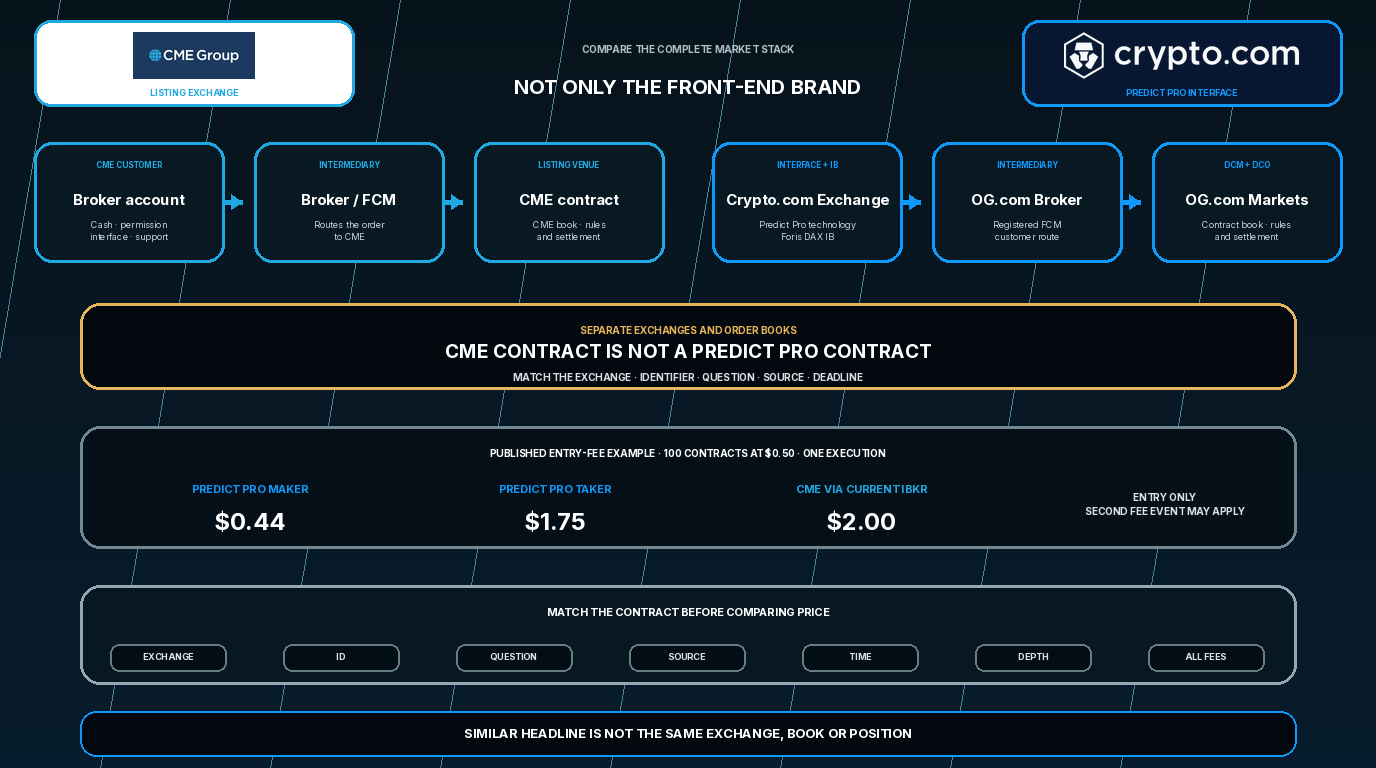
The practical choice is between a CME-listed product reached through a participating broker and a Crypto.com Exchange interface connected to the OG.com/CDNA market stack. Both can provide regulated US event contracts, but they do not share an order book, contract specification or settlement decision.
| Category | CME Prediction Markets | Crypto.com Predict Pro | Better fit |
|---|---|---|---|
| Main customer route | Participating broker or FCM → CME | Crypto.com Exchange technology/IB → OG.com Broker FCM → OG.com Markets | Different stacks |
| Listing venue | Applicable CME Group exchange | North American Derivatives Exchange entity, branded through OG.com/Crypto.com | Separate regulated venues |
| Customer interface | Depends on broker | Professional Crypto.com Exchange interface | Predict Pro for a consistent native interface |
| Current categories | Sports, economic indicators, cryptocurrencies and more | Sports, crypto, commodities, forex, indices, economics, politics, culture and climate | Check live catalogs |
| Standard outcome | Commonly $1 if correct and $0 if incorrect | $1 if correct and $0 if incorrect | Tie on basic payoff |
| Order controls | Broker-dependent; limit and professional tools may be available | Market, limit, post-only and launch-documented stop controls | Predict Pro for native event controls |
| Retail fee model | Broker-specific; current IBKR route totals $0.02 per contract per execution | Probability-weighted maker and taker formulas; another fee can apply at settlement or early close | Order-specific |
| Funding | Eligible cash and permissions at the broker | USD moved from Spot to a shared Derivatives balance | Depends on existing account |
| API and connectivity | Broker API plus CME data/specifications | Public prediction data plus institutional FIX; customer trading interfaces depend on access | Workflow-specific |
| Liquidity | CME contract book | OG.com Markets/CDNA contract book | Exact contract decides |
| Best for | CME products and multi-asset broker workflows | Professional prediction tools in a crypto-oriented exchange account | Depends on contract and workflow |
For an entry execution of 100 contracts at $0.50, the current Predict Pro formula produces a $0.44 maker fee after cent rounding or a $1.75 taker fee. The current Interactive Brokers schedule totals $2.00 for 100 CME contracts. That opening comparison is incomplete by itself: Predict Pro says fees apply again at settlement or early close, while a CME early exit is another broker execution. Spread and price impact can cost more than either published commission.
Read our separate CME Prediction Markets review before choosing a broker route. The standalone Crypto.com Predict Pro review examines its second fee event, order controls, Spot-to-Derivatives funding and liquidity risk without the CME comparison. The Crypto.com Predict Pro alternatives guide ranks seven exchange, broker and crypto-native routes, while the CME alternatives guide starts from the other side of the decision.
What CME and Predict Pro Actually Are
CME Prediction Markets is a product family within CME Group's derivatives ecosystem. CME's current Prediction Markets page tells customers to sign up with a broker offering the products. CME lists the contract and operates the applicable market infrastructure. The broker handles customer onboarding, permissions, funding, order entry, statements and its customer-facing fee schedule.
The typical CME customer route is:
- Open or use an eligible account with a participating broker or FCM.
- Obtain the product permissions required by that broker.
- Select a CME-listed prediction contract.
- Send the order through the broker to the CME book.
- Apply the CME contract specification and rulebook at settlement.
Predict Pro is newer and structurally different. Crypto.com's October 15, 2026 Predict Pro launch announcement describes a professional prediction-market feature inside Crypto.com Exchange technology. Its disclosure names several distinct roles:
- Crypto.com Exchange technology supplies the professional customer interface.
- Foris DAX, Inc. offers the feature as an NFA-registered introducing broker.
- Foris DAX FCM LLC, doing business as OG.com Broker, provides the registered FCM path.
- North American Derivatives Exchange, Inc., doing business as OG.com Markets, operates the designated contract market and derivatives clearing organization behind the listed products.
Crypto.com's Predict Pro overview uses the related Nadex and Crypto.com Derivatives North America names for the exchange entity. These brand names can make the stack look simpler than it is. The legal entity, live ticket and applicable agreement control.
Predict Pro is not CME access
Predict Pro does not turn a similar question into a CME contract. The platform connects to its own named exchange route. CME contracts remain on the applicable CME book and require a broker that offers them.
Suppose both ecosystems list a contract about the next Federal Reserve decision. Before comparing prices, match:
- The exchange and contract identifier.
- The exact target rate or range.
- The meeting date and observation time.
- The named source and revision policy.
- The Yes and No definitions.
- The final trading deadline.
- Cancellation, postponement and dispute rules.
A price difference can reflect two different instruments rather than an arbitrage opportunity. Our prediction-market comparison methodology treats the written exchange contract as the unit of comparison.
Predict Pro vs Crypto.com App Prediction Trading
Crypto.com now has more than one prediction-market surface. That distinction matters because a reader searching for Crypto.com fees or availability can land on documentation for the App rather than Predict Pro.
Predict Pro is positioned inside the Crypto.com Exchange for advanced users. It emphasizes full bid/ask depth, probability charts, professional order entry, a shared Derivatives balance and an exchange-style trading layout.
Prediction Trading in the Crypto.com App uses a consumer mobile flow. It has its own help documentation, funding explanation, slippage settings and category-specific fee table. Some legal entities overlap, but the user interface and customer disclosures are not interchangeable.
Before relying on a fee or feature claim, confirm all four items:
- Product name shown in the signed-in interface.
- Account agreement and customer intermediary.
- Listing exchange named on the contract.
- Fee schedule linked from that exact order ticket.
Do not apply the Predict Pro maker rate to an App order merely because both products carry the Crypto.com name. Do not assume an App feature, such as a particular crypto-funding shortcut, exists in the same form on the Exchange.
Compare Contracts, Catalogs, Tools and Liquidity
CME's current product page names sports, economic indicators, cryptocurrencies and more. The broader CME environment can be valuable to customers already monitoring interest rates, equity indexes, energy, metals, agriculture or crypto benchmarks through a derivatives broker.
Predict Pro's current overview lists sports, crypto, commodities, foreign exchange, stock indexes, economics, politics, culture and climate. The launch announcement also emphasizes election, Fed, sports and cultural contracts. Listings change continuously, so a category list cannot establish a permanent winner.
Professional order controls
Predict Pro's strongest differentiator is its trading interface. Its current market and order-type guide documents market orders, good-till-canceled limit orders and post-only instructions. Post-only is useful when a trader wants the order to rest instead of crossing immediately and paying the taker rate.
The launch announcement also describes stop-market and stop-limit controls, real-time depth and probability charts. Those tools can improve execution planning, but they do not guarantee a fill or prevent a loss. A stop order can activate into a thin book, and a limit order can remain unfilled.
CME tools depend on the selected broker. Interactive Brokers and other professional routes can provide desktop, web, mobile, reporting and API tools. This flexibility is an advantage when the customer already has a mature derivatives workflow. It is also a source of variation: another broker can offer a different interface, order behavior, data package and fee schedule.
The CME vs Gemini comparison covers another crypto-oriented exchange account. Our CME vs Robinhood comparison explains the opposite design choice: a guided consumer app routing to several partner venues.
Which platform has more markets?
Neither platform has a durable catalog advantage across every category. Use a contract-level process:
- Search the exact event on both routes.
- Confirm the listing exchange and product code.
- Open the full written terms.
- Match the proposition, source, deadline and special cases.
- Confirm account and state eligibility.
- Record the executable bid, offer and depth.
- Add entry, likely exit and settlement costs.
Predict Pro can be attractive for sports and crypto discovery inside one professional interface. CME can be attractive when a market connects to a benchmark or macro workflow already followed through a futures broker. Catalog fit is more useful than raw market count.
Which route has better liquidity?
Liquidity belongs to the exact contract. CME Group's size in traditional derivatives does not guarantee depth in each prediction market. Crypto.com's large global user base does not guarantee depth in each OG.com Markets contract.
Compare:
| Measurement | What it shows | What it misses |
|---|---|---|
| Best bid and offer | Immediate selling and buying prices | Quantity beyond the first level |
| Depth by price | Expected average fill for your size | Future exit conditions |
| Recent matched volume | Historical activity | A currently available counterparty |
| Open resting orders | Visible interest in the book | Hidden intent and later cancellations |
Predict Pro's visible depth can make this analysis easier. The same principle still applies to a broker showing CME data: inspect the full size, not only the headline price. Our bid-ask spread guide explains why a one-cent fee advantage can disappear inside a worse fill.
CME vs Predict Pro Fees, Funding and APIs
CME does not publish one universal retail charge for every customer route. The selected broker sets the customer commission and passes through applicable exchange charges. Interactive Brokers currently lists a $0.01 commission plus a $0.01 exchange fee per CME event contract per execution for US direct clients.
Predict Pro's current fee page uses probability-weighted rates:
Taker fee = 0.07 × contracts × price × (1 − price)
Maker fee = 0.0175 × contracts × price × (1 − price)
The order form displays the fee before confirmation. The same page says a fee applies when the position opens and again at settlement or when it closes early. Fees are not refunded unless the event is canceled.
Normalized entry-fee examples
For 100 contracts at a price of $0.50:
| Route and order | Calculation | Published entry-execution fee |
|---|---|---|
| Predict Pro maker | 0.0175 × 100 × 0.50 × 0.50 | $0.44 after cent rounding |
| Predict Pro taker | 0.07 × 100 × 0.50 × 0.50 | $1.75 |
| CME through current IBKR US direct schedule | 100 × ($0.01 + $0.01) | $2.00 |
The maker advantage requires an order that rests and later fills. A marketable limit can become a taker. A post-only order avoids crossing but can be canceled or remain unfilled. For one contract at $0.50, cent rounding also changes the comparison: the raw Predict Pro maker amount is below one cent, while the actual displayed fee follows the platform's rounding and order preview.
Do not treat $0.44, $1.75 and $2.00 as lifetime position costs. Predict Pro documents another fee at settlement or early close. Closing a CME position creates another execution under the broker schedule. Both routes also include spread and possible price impact. Use the prediction-market fee calculator for normalized arithmetic, then verify the live ticket.
Funding and account structure
Predict Pro requires a US derivatives account. Its getting-started guide says positions are funded from the Derivatives balance. Deposits and withdrawals move through the Spot account, so a user transfers USD from Spot to Derivatives before trading and back to Spot before withdrawing.
Predictions, futures and perpetuals share that Derivatives balance. This can be convenient for an active Crypto.com Exchange customer. It also makes balance management important. Collateral reserved for another derivatives position can reduce the amount available for event contracts.
CME funding follows the participating broker's account model. A multi-asset broker can place eligible event contracts beside stocks, options, futures and cash management. Permissions, settled cash, withdrawal timing and customer-fund disclosures remain broker-specific.
Crypto branding does not mean a Predict Pro contract settles in a token. Current product documentation describes USD funding and $1-or-$0 contract outcomes. Moving value from crypto into the required balance can create conversion cost, market exposure and tax consequences before the prediction trade begins.
API and professional connectivity
CME access can use the selected broker's API, symbology, permissions and market-data subscriptions. Interactive Brokers, for example, documents CME event contracts in its professional trading API. Other brokers can offer different interfaces.
Crypto.com's current Exchange API page presents public prediction-market data and institutional connectivity. It lists REST access for prediction data, WebSocket as coming soon and FIX connectivity for DCM and FCM prediction workflows. That marketing page is not proof that every retail Predict Pro customer has automated order entry. Confirm account eligibility, protocol access, documentation and permission before designing a trading system.
Regulation, Settlement and Customer Risk
The CFTC's DCM record for North American Derivatives Exchange identifies the exchange as designated and notes that it also does business as Crypto.com. The CFTC's DCO registry identifies NADEX doing business as Crypto.com Derivatives North America as a registered clearing organization.
CME's applicable exchanges and clearing infrastructure have their own registered roles. Registration establishes legal functions and oversight. It does not guarantee profit, a tight spread, an available exit or a particular outcome.
The guide to prediction-market legality in the US explains why exchange registration, intermediary registration, location and contract availability are separate questions.
Who determines settlement?
For a CME contract, the CME specification and rulebook control. For Predict Pro, the OG.com Markets/CDNA contract terms, named source and exchange process control. Crypto.com Exchange technology presents the position, but the interface does not replace the listing exchange as settlement authority.
Predict Pro's launch announcement says each contract displays its resolution source, settlement timeline and dispute window and that contracts typically settle within one hour after the outcome is resolved. “Typically” is not a guarantee. A disputed source, correction, delayed official publication or nonstandard outcome can extend the process.
Before trading, record:
- Legal exchange and contract identifier.
- Resolution source and observation time.
- Time zone and final trading deadline.
- Revision and correction treatment.
- Cancellation, tie and postponement rules.
- Dispute window and expected settlement timing.
- Customer support path for the account.
Another platform's result, an AI answer, a news headline or a social-media post cannot override the written contract.
Loss and operational boundaries
Fully funded $1 event contracts commonly limit position loss to the purchase cost plus fees. That still permits a complete loss of the amount committed. Combos can concentrate risk because every required leg must satisfy its terms for the position to pay as designed.
Use multifactor authentication and official domains. Restrict API credentials, verify transfer destinations and separate trading funds from long-term crypto holdings. Size several contracts tied to the same Fed decision, election or crypto price as one correlated risk group.
Which Platform Should You Choose?
Choose a CME Prediction Markets route when most of these statements are true:
- You want a specific CME-listed contract.
- You already use a participating broker offering CME products.
- You need the broker's desktop, portfolio or API workflow.
- You want event contracts beside a broader traditional derivatives portfolio.
- The CME contract has the better rules, price or executable depth.
Choose Crypto.com Predict Pro when most of these are true:
- You are an eligible US customer comfortable activating the required derivatives account.
- Full depth, maker/taker treatment and post-only controls matter.
- You want sports, crypto and macro events inside one professional prediction interface.
- A shared Spot-to-Derivatives account flow fits your funding process.
- The OG.com Markets contract has the better complete terms and book.
Do not choose CME only because CME is large in futures. Measure the event contract. Do not choose Predict Pro only because the interface looks professional or the maker rate is lower. Confirm that the order actually receives maker treatment and include the second fee event described by the schedule.
For other direct comparisons, see Kalshi vs CME and CME vs Polymarket US.
Where Macro Markets fits
Macro Markets is a separate crypto-native option for eligible users who intentionally want wallet-oriented funding and global prediction-market discovery. It is not presented as a CFTC-designated exchange or as a regulatory equivalent to CME, OG.com Markets, Crypto.com Derivatives North America or the intermediaries behind Predict Pro.
Macro's crypto-native design can matter when wallet deposits and withdrawals are more important than a US broker or FCM workflow. It requires separate diligence on jurisdiction, custody, supported networks, conversion cost, market-making design, withdrawal rules, resolution sources and executable liquidity.
Because Macro Markets publishes this article, this section is a disclosed first-party description rather than an independent endorsement. Explore how Macro Markets works only after comparing the exact contract and complete funding path.
FAQ and Final Verdict
Is Crypto.com Predict Pro the same as Crypto.com Prediction Trading?
No. Predict Pro is an advanced product inside Crypto.com Exchange technology with its own account route, professional controls and fee documentation. Prediction Trading in the Crypto.com App uses a consumer interface and separate product documentation. Always follow the agreement and fee page linked from the exact surface you use.
Does Predict Pro use CME contracts?
No. Current Predict Pro disclosures connect the product to OG.com Markets, the North American Derivatives Exchange legal entity. CME contracts trade on the applicable CME book through participating brokers. Similar event titles do not make the positions interchangeable.
Is CME or Predict Pro cheaper?
There is no universal winner. At 100 contracts priced at $0.50, the published Predict Pro entry formula gives $0.44 for a maker fill or $1.75 for a taker fill, while the current IBKR CME example totals $2.00 per execution. Predict Pro documents another fee at settlement or early close, and CME broker fees vary.
What is the difference between a Predict Pro maker and taker order?
A maker order rests on the book before matching and uses the lower published rate. A taker order executes against existing liquidity and uses the higher rate. Post-only can prevent an order from crossing immediately, but it does not guarantee a later fill.
Can Predict Pro be funded directly with crypto?
Predict Pro's current getting-started guide describes USD funding through the Derivatives balance, with deposits and withdrawals moving through the Spot account. Any crypto conversion happens before the prediction position and can add cost and tax considerations.
Which route has better professional tools?
Predict Pro provides a consistent native interface with depth, probability charts and advanced order controls. CME can be equally or more powerful through a professional broker, but the exact capabilities depend on that broker, data package and API.
Who settles Predict Pro contracts?
The listing exchange applies the written contract and named resolution source. Current disclosures identify the North American Derivatives Exchange entity operating under OG.com and Crypto.com brands as the market and clearing layer.
Is Macro Markets an alternative to both?
It can be a crypto-native alternative for eligible users, but it has a different jurisdiction, custody and funding model and is not a CFTC-designated US exchange. Compare its protections and rules separately.
Final verdict
CME is the stronger fit for customers seeking a CME-listed contract inside an established broker and derivatives workflow. Crypto.com Predict Pro is the stronger fit for eligible US customers who want a professional prediction-first interface, visible depth, maker/taker pricing and crypto-exchange account integration.
The decisive comparison is not CME blue against Crypto.com navy. It is one CME contract through a named broker versus one OG.com Markets/CDNA contract through the Predict Pro stack. Match the written terms, calculate every fee event and inspect executable depth before taking a position.
