


CME vs Gemini Prediction Markets: Which Is Better in 2026?

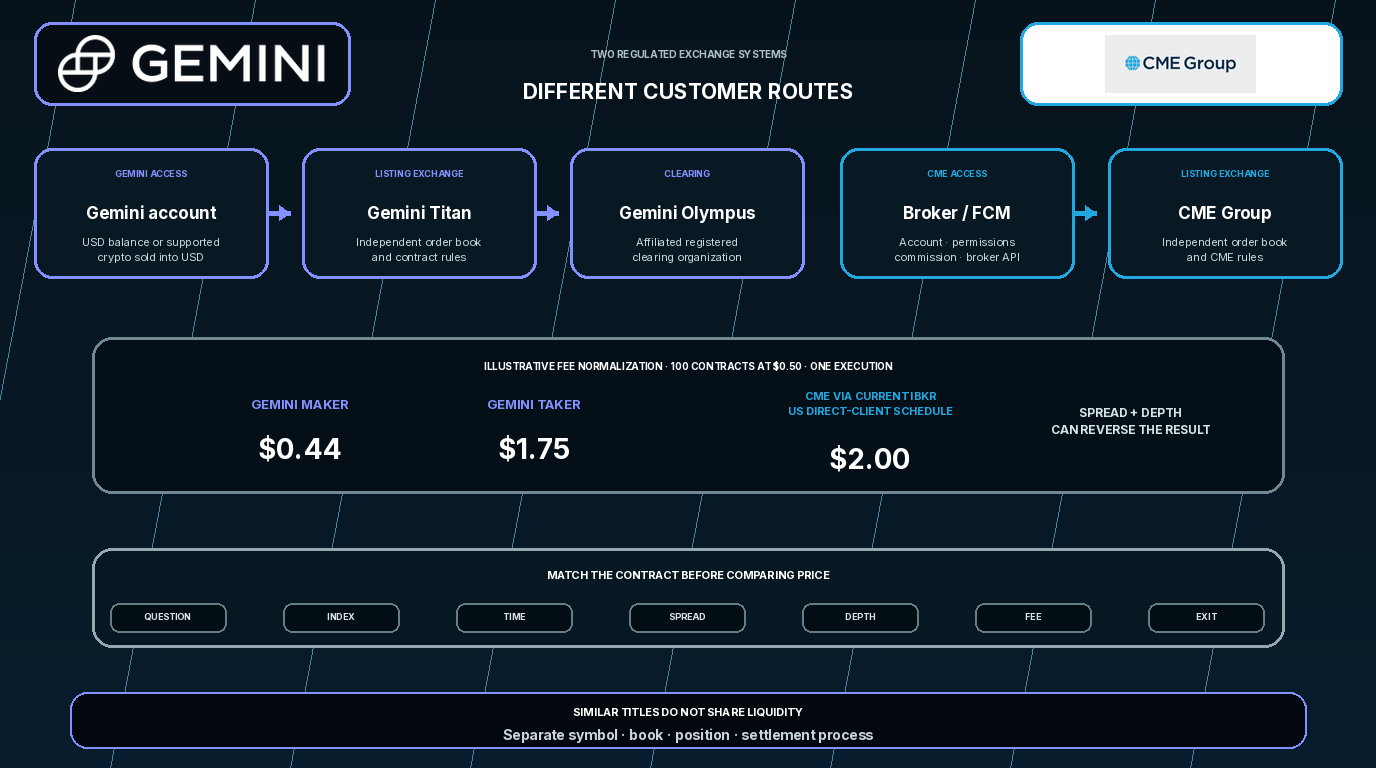
CME and Gemini both operate regulated event-contract ecosystems, but their customer routes are fundamentally different. CME Group lists Prediction Markets through participating brokers. Gemini Predictions is integrated into the Gemini account, while affiliated Gemini Titan operates the exchange and Gemini Olympus provides the clearing layer.
Our verdict: choose CME when you already use a participating broker, want event contracts inside a traditional derivatives workflow or find the better exact contract on CME. Choose Gemini when you want a direct crypto-oriented account, native prediction-market APIs and one interface for your Gemini balance and event positions. Neither platform wins every market because rules, spreads and executable depth remain contract-specific.
Last reviewed and fact-checked: November 2, 2026.
Editorial disclosure: Macro Markets publishes this comparison and operates a prediction-market platform. We include Macro Markets as a disclosed crypto-native alternative, not as an independent recommendation or a CFTC-designated US exchange. This article uses official exchange, broker and regulator sources. We did not place simultaneous funded orders on both venues. Fees, contracts, liquidity and eligibility can change. This article is educational, not financial, legal or tax advice.
CME vs Gemini Prediction Markets: Quick Verdict
The practical choice is between broker-routed derivatives access and an integrated crypto-oriented exchange account. CME supplies the listed contract and exchange infrastructure, but the participating broker controls onboarding, permissions, interface and customer commission. Gemini combines its consumer account with an affiliated exchange and clearing organization.
| Category | CME Prediction Markets | Gemini Predictions | Better fit |
|---|---|---|---|
| Customer route | Participating broker or futures commission merchant | Integrated Gemini account; third-party FCM access may also exist | Gemini for direct integrated access |
| Listing venue | A CME Group designated contract market | Gemini Titan DCM | Both regulated exchange structures |
| Clearing | CME clearing infrastructure for the listed product | Gemini Olympus for eligible affiliated clearing | Contract-specific |
| Current categories | Sports, economic indicators, cryptocurrencies and more | Sports, crypto, politics, economics, commodities, technology and more | Check live catalogs |
| Standard payoff | $1 if correct, $0 if incorrect | Standard binary contracts settle at $1 or $0 | Tie on basic payoff |
| Retail fee model | Broker-specific; current IBKR route totals $0.02 per contract per execution | Probability-weighted maker and taker formulas | Depends on order size, price and route |
| Funding | Eligible cash in the broker account | Gemini balance; supported crypto can be sold into USD | Gemini for crypto-account integration |
| API | Usually the participating broker's trading API plus CME specifications/data | Native Prediction Markets REST and WebSocket APIs | Gemini for direct product integration |
| Liquidity | Separate CME contract book | Separate Gemini Titan contract book | Exact market decides |
| Best for | Existing broker and derivatives workflow | Existing Gemini customer, crypto context and developers | Depends on account and contract |
At a current published fee example, 100 contracts at $0.50 would cost $2 per execution through the listed Interactive Brokers CME route. Under Gemini's standard formula, the same price and quantity produce $0.44 for a maker execution or $1.75 for a taker execution after rounding. That is not a universal cheapest-platform ranking: the routes, order behavior, spread and available contracts differ.
Read our CME Prediction Markets review and Gemini Predictions review for separate platform assessments.
What CME and Gemini Actually Are
CME Prediction Markets is an exchange product family inside CME Group's broad derivatives ecosystem. CME states that customers must sign up with a broker offering the products. The broker or futures commission merchant carries the customer account, applies permissions, supplies order entry and determines its customer-facing fee schedule.
Gemini Predictions uses a vertically integrated structure:
- The Gemini consumer account provides balances and the web or mobile interface.
- Gemini Titan lists contracts and operates the matching venue as a designated contract market.
- Gemini Olympus clears eligible products as an affiliated derivatives clearing organization.
- The contract specification defines the exact outcome, source, deadline and settlement treatment.
This is different from an app that only routes to another company's exchange. Gemini owns the relevant exchange affiliate and offers its own order book. It is also different from CME's standard retail route, where the broker is an independent decision layer between the customer and the exchange.
Regulation does not merge the products
The CFTC filing for Gemini Titan records its designated contract market status from December 10, 2025. CME Group states that its four exchanges are designated contract markets. A DCM is an exchange operating under CFTC oversight and the requirements applicable to its registered role.
Regulation does not mean CME and Gemini share liquidity, customer protection terms or settlement decisions. A Gemini contract stays on Gemini Titan. A CME contract stays on the applicable CME Group exchange. Even if both ask whether Bitcoin will finish above a threshold, the positions are not automatically interchangeable.
The product classification can also vary. "Prediction market" describes a user experience, while the exact instrument may be an event-contract swap or, for certain CME products, an options-on-futures structure. The exchange code, product specification, rule chapter and broker disclosure control. Our guide to prediction-market legality in the US explains why the venue and contract matter more than the marketing category.
Match the exact question before comparing price
Before treating two prices as competing probabilities, match:
- The precise proposition and threshold.
- The observation date, time and time zone.
- The named index, publication or settlement source.
- The policy for revisions, postponements and cancellations.
- The final trading deadline.
- The payout and settlement timeline.
- The bid, offer and size for your intended order.
A Gemini crypto contract can use a named index-provider value at a specific observation time, while a CME contract can reference a different benchmark or window. A two-cent apparent price gap may reflect different questions rather than an opportunity. Our prediction-market comparison methodology treats the written contract as the comparison unit.
Compare Contracts, Markets and Liquidity
CME's current Prediction Markets page names sports, economic indicators, cryptocurrencies and more. The wider CME ecosystem is relevant to customers already monitoring futures benchmarks for interest rates, equity indexes, energy, metals, agriculture or crypto.
Gemini's current Predictions page presents outcome contracts within the broader Gemini experience. Its catalog has included sports, crypto, politics, economics, commodities, technology, business, weather and culture, subject to current availability. Crypto events are a natural strength because customers can research the event beside other Gemini account activity.
How the contracts work
Standard binary event contracts on both platforms commonly trade between $0.01 and $0.99 and settle at $1 or $0. A Yes contract bought at $0.43 produces $0.57 of gross profit if the defined event resolves Yes and loses the $0.43 purchase cost if it resolves No, before fees.
The displayed price is not a promise that the event has that probability. It is a market price shaped by participant beliefs, available capital, fees and liquidity. The last trade can also differ from the current bid and offer.
Both platforms support trading before final settlement when the market is open and a counterparty is available. An early exit is an additional execution. It can add a second fee, cross another spread and create slippage when the order consumes several price levels.
Limit orders control the maximum purchase price or minimum sale price but may never fill. Marketable orders prioritize execution and can pay a worse average price than the headline quote. The bid-ask spread guide explains why this difference can cost more than the commission.
Which platform has more markets?
There is no durable answer based on a raw count. Listings expire and new events appear continuously. Gemini can feel broader to an existing crypto customer because the catalog is embedded in one account and its crypto contracts are prominent. CME can be more useful when a contract connects to a benchmark or economic event already followed through a derivatives broker.
Evaluate catalog quality rather than headline quantity:
- Search the exact event on both platforms.
- Open the contract rules and named source.
- Confirm eligibility and the customer route.
- Compare the same outcome and deadline.
- Record live bid, offer and size.
- Add entry, expected exit and funding costs.
- Prefer the better complete contract, not the larger catalog.
The CME alternatives guide and Gemini alternatives guide cover a wider shortlist when neither venue has the right market. For another crypto-oriented professional route, compare CME vs Crypto.com Predict Pro, including its separate introducing-broker, FCM and OG.com Markets layers.
Which platform has better liquidity?
Liquidity belongs to the contract, not the brand. CME Group's scale in traditional futures does not guarantee deep liquidity in every new event contract. Gemini's crypto customer base does not guarantee a tight book in every crypto or political market.
Use three measurements:
| Measurement | What it shows | What it does not show |
|---|---|---|
| Best bid and offer | Immediate price to sell or buy | Depth beyond the first quote |
| Quantity by price level | Expected price impact for your size | Future exit liquidity |
| Recent matched volume | Historical trading activity | A currently executable order |
An order book with a one-cent spread for five contracts may be worse for a 500-contract order than a book with a two-cent spread and greater depth. Compare the full size you intend to trade. Never assume a position on CME can be closed using Gemini liquidity or vice versa.
CME vs Gemini Fees, Access, Funding and APIs
For CME vs Gemini prediction markets, the fee comparison must preserve the account route. CME retail cost comes from the selected broker plus applicable exchange fees. Gemini publishes direct maker and taker formulas, while third-party FCM customers can face a different FCM schedule.
The current Gemini standard formula is:
Fee = Rate × Contracts × Price × (1 − Price)
The Gemini Predictions fee schedule lists a standard maker rate of 0.0175 and taker rate of 0.07. Fees round up to the next cent. A maker order rests before matching; a taker order matches immediately. A partially matched order can incur both treatments.
Interactive Brokers currently lists CME at a $0.01 commission plus $0.01 exchange fee per contract per execution for US direct clients. Introduced, managed or institutional arrangements can differ, and another participating broker can set another price.
Normalized fee example
For 100 contracts at $0.50:
| Route and order | Calculation | Published-schedule fee per execution |
|---|---|---|
| Gemini standard maker | 0.0175 × 100 × 0.50 × 0.50 | $0.44 after rounding |
| Gemini standard taker | 0.07 × 100 × 0.50 × 0.50 | $1.75 |
| CME through current IBKR US direct-client schedule | 100 × ($0.01 + $0.01) | $2.00 |
This example does not include spread, price impact, broker-account differences, funding cost or a later sale. Gemini promotions and rebate programs can change effective cost. CME fees can differ by broker. The signed-in order preview and current agreements control.
At one contract priced at $0.50, rounding produces a different comparison: the Gemini maker formula rounds to $0.01, Gemini taker rounds to $0.02 and the listed IBKR CME route is $0.02. Order quantity therefore matters. Use the prediction-market fee calculator for the arithmetic, then confirm the actual order book.
Access and funding
CME requires a participating broker. That adds an onboarding and permissions layer but can simplify life for someone who already holds futures, options, stocks or cash in the same brokerage account. Reporting, APIs, market data and support depend partly on that broker.
Gemini Predictions integrates with the broader Gemini account. Eligible customers can use an existing USD balance. Gemini's transaction terms also describe a workflow in which selecting a supported crypto balance authorizes the sale of enough crypto to obtain the USD needed for the prediction order.
Crypto conversion is convenient but not free of consequences. Selling an asset can create a taxable event. The crypto sale can also complete before a following event-contract order fails, leaving the customer with USD. Price movement, conversion fees, holds and withdrawal rules should be checked before using crypto as the funding source.
Neither platform should be assumed available in every jurisdiction or state. Account approval, age, location, product permissions and specific contracts can change. The current signed-in eligibility decision controls.
APIs and advanced tools
Gemini has the clearer native consumer-to-exchange API path. Its official Prediction Markets API supports public event discovery, authenticated orders and positions, plus WebSocket streams for prices, depth, order events and positions. Developers still need to check terms, rate limits and stable documented fields.
CME supplies product specifications and market-data infrastructure, but retail trading access normally depends on the broker. Interactive Brokers and other participating brokers can expose CME event contracts through their own APIs, permissions and symbols. A developer must therefore integrate both exchange definitions and broker behavior.
Compare these technical controls:
- Authentication and key permissions.
- REST, streaming and FIX availability.
- Contract definitions and rule-document access.
- Order types and cancellation semantics.
- Rate limits and disconnect recovery.
- Historical data and timestamp standards.
- Sandbox or paper-trading support.
- Position limits and account-level risk controls.
Automation does not improve a weak contract. A bot can repeatedly cross a spread or trade after a specification change faster than a human can intervene. Use strict size limits and map every symbol to the full contract terms.
Regulation, Clearing and Settlement Risk
Both ecosystems have identifiable regulated entities. The CFTC describes designated contract markets as exchanges subject to Part 38 requirements. Gemini Titan is a DCM; a CFTC staff letter identifies Gemini Olympus as a registered derivatives clearing organization. CME Group's exchanges and clearing infrastructure belong to a long-established derivatives group.
These facts establish regulatory roles. They do not insure a trader against a correct $0 settlement, a wide spread, an unavailable exit or a misunderstood rule. A regulated contract can still lose its entire purchase cost.
What determines settlement?
The exchange rulebook and contract specification determine settlement. Before trading, identify:
- The exchange and clearing entity.
- The exact product code.
- The named outcome source.
- The observation window and time zone.
- Revision and correction policies.
- Postponement or cancellation treatment.
- The dispute and market-halt process.
Gemini promotes an information experience called the Situation Room, but informational or AI-generated summaries do not replace contract rules. Public news, another exchange's result or an AI answer cannot override the stated source. CME likewise publishes product specifications and rule chapters that control its listed contracts.
Account and operational safety
Use multifactor authentication where available, unique credentials and narrowly scoped API keys. Monitor exchange and broker notices. Do not rely on a screenshot of a quote or rule shared on social media.
For Gemini, separate the event-contract entities from other Gemini affiliates. Protections associated with a separate stock broker-dealer or crypto product should not be projected automatically onto Gemini Titan positions. For CME, separate the exchange from the participating broker carrying the account. Broker solvency, customer-fund treatment and support processes are part of the route.
The maximum loss on a fully paid binary purchase is generally the amount paid plus applicable fees, but account-level currency conversion and funding costs can add friction. Size every position for a complete loss and avoid treating correlated event contracts as independent risk.
Which Platform Should You Choose?
Choose CME Prediction Markets when most of these statements are true:
- You already use a participating broker offering CME event contracts.
- You want predictions near a wider futures and options workflow.
- The exact CME contract has better rules, price or executable depth.
- Your broker's API, reporting and risk controls meet your needs.
- You prefer cash funding without an automatic crypto sale.
Choose Gemini Predictions when most of these are true:
- You already use Gemini and want one integrated account experience.
- Crypto events and crypto-oriented research matter.
- You need native REST and WebSocket prediction-market APIs.
- The Gemini Titan contract has the better exact book.
- You can choose deliberately between maker and taker execution.
Do not select Gemini only because a 100-contract fee example is lower than the current IBKR CME route. A worse spread or thinner book can erase that advantage. Do not select CME only because the parent group dominates other derivatives markets. Event-contract liquidity must be measured separately.
The direct Kalshi vs CME comparison provides another specialist-exchange reference. The Kalshi vs Gemini comparison is useful when direct exchange access matters more than broker integration.
Where Macro Markets fits
Macro Markets is a different option for eligible users who intentionally want crypto-native funding and global prediction-market discovery. It is not presented as a CFTC-designated exchange or as a regulatory equivalent to CME or Gemini Titan.
Macro Markets can be relevant when wallet-based deposits and withdrawals are central to the workflow rather than an automatic sale into USD. That difference introduces its own requirements: verify supported jurisdictions, custody, networks, conversion costs, withdrawal rules, market-making design, resolution process and liquidity.
Because Macro Markets publishes this article, this section is a disclosed first-party description, not an independent endorsement. Explore how Macro Markets works only after comparing the exact contract and full funding path.
Final decision checklist
Before choosing a platform, record:
- The account route and legal entities involved.
- The exact product code and market URL.
- The proposition, source and observation time.
- Best bid, best offer and depth for your size.
- Entry fee, likely exit fee and spread.
- Any crypto sale, tax or funding implication.
- API and order controls required.
- Maximum loss and settlement timeline.
If one platform cannot answer these questions for the desired contract, the other route is not automatically safe; it must pass the same test.
Frequently Asked Questions and Final Verdict
Is CME better than Gemini Predictions?
CME is better for customers who already use a participating broker and want event contracts within a traditional derivatives workflow. Gemini is better for an integrated Gemini account, crypto context and native prediction-market APIs. The exact contract determines the execution winner.
Is Gemini Predictions an independent exchange?
Gemini Titan, a Gemini affiliate, operates the designated contract market. Gemini Olympus is the affiliated registered clearing organization for eligible products. Gemini Predictions is therefore more than an interface routing all orders to an unrelated venue.
Can I trade CME Prediction Markets directly?
CME's current product page directs customers to a participating broker. The broker handles the retail account and order route, while CME lists the contract.
Which platform is cheaper?
It depends on price, size, order type and route. For 100 contracts at $0.50, Gemini's current standard formula produces $0.44 maker or $1.75 taker per execution. The current IBKR US direct-client CME schedule produces $2.00. Spread and price impact can reverse the result.
Do CME and Gemini share liquidity?
No. Similar questions remain independent contracts with separate symbols, rulebooks, books and positions. A customer cannot close a CME position using a Gemini order.
Which platform has the better API?
Gemini provides a native Prediction Markets API with REST and WebSocket tools. CME retail trading APIs depend on the participating broker, while CME provides the exchange product specifications and market-data environment.
Can I fund Gemini Predictions with crypto?
Gemini documentation describes using supported crypto balances through a sale into the USD needed for the event contract. That can create conversion cost and tax consequences, and the sale may complete even if the following prediction order does not.
Are CME and Gemini event contracts safe?
Both operate within regulated exchange structures, but neither protects customers from trading losses, illiquidity or misunderstanding a contract. Read the rules, confirm the source and size for a complete loss.
What is the final verdict?
CME wins for broker-led derivatives integration. Gemini wins for a direct crypto-oriented account and native API experience. In the final CME vs Gemini prediction markets decision, compare the exact proposition, complete route cost and executable depth. The better brand is not necessarily the better contract.
