


Kalshi vs Gemini Prediction Markets: Which Is Better in 2026?
Kalshi and Gemini Predictions are both US event exchanges, but they fit different users. Kalshi is the stronger default for someone who wants a dedicated prediction-market account, broad event discovery and a mature consumer exchange. Gemini Predictions is more compelling for an existing Gemini customer, an active maker or a developer who wants prediction markets connected to a crypto-centered account.
Neither platform wins every contract. They maintain separate order books, rules and fees. The better place for one trade depends on the exact contract, executable price, available size and whether your order adds or removes liquidity.
Last reviewed and fact-checked: November 1, 2026.
Editorial disclosure: Macro Markets publishes this comparison and operates a prediction-market platform. We include Macro Markets as a contextual crypto-native alternative, apply the same comparison criteria and do not present it as a CFTC-designated US exchange. This is a documentation-based comparison; we did not place simultaneous matched orders or complete a deposit-to-withdrawal test on both platforms. Event contracts are speculative and can lose the full amount committed. This page is educational, not financial, legal or tax advice.
Kalshi vs Gemini: Quick Verdict
Choose Kalshi if you want a focused event-trading product with broad category navigation, a direct exchange account and a long public operating record as a designated contract market. It is usually the more natural starting point for a consumer whose main goal is trading events rather than managing crypto and predictions in one account.
Choose Gemini Predictions if you already use Gemini, care about its explicit maker and taker pricing, or need its REST and WebSocket interfaces. Its integration with the wider Gemini account can make funding and account management convenient, especially for a crypto-oriented user. That convenience needs a careful check: using crypto to fund a prediction can involve an automatic sale into US dollars, with possible tax consequences.
Winner by use case
- Dedicated prediction-market experience: Kalshi.
- Existing crypto-account integration: Gemini.
- Published maker discount: Gemini.
- Broad consumer market discovery: Kalshi.
- Developer access: both; compare the exact endpoints and authentication your project needs.
- Cheapest marketable order: no universal winner; price, spread, quantity and contract probability change the result.
- Best liquidity: contract-specific, not platform-wide.
- US regulatory structure: tie at the exchange level; KalshiEX and Gemini Titan are separately designated contract markets.
The CFTC record for KalshiEX lists the venue as a designated contract market from November 3, 2020. The CFTC record for Gemini Titan records designation from December 10, 2025. These registrations establish regulatory status. They do not guarantee profit, liquidity, uptime or eligibility for every user and contract.
For standalone product assessments, read our Kalshi review and Gemini Prediction Markets review. Our prediction-market comparison methodology explains the criteria used here.
Kalshi vs Gemini at a Glance
| Decision factor | Kalshi | Gemini Predictions | Practical edge |
|---|---|---|---|
| Exchange operator | KalshiEX LLC | Gemini Titan LLC | Both are CFTC-designated contract markets |
| Product focus | Dedicated event exchange | Predictions within a broader Gemini account | Depends on preferred account model |
| Pricing model | Probability-weighted transaction fees; schedules can vary by series and order type | Published probability-weighted maker and taker rates | Gemini makes the maker/taker distinction especially explicit |
| Market access | Web, mobile and APIs | Web, mobile and APIs | Both support consumer and developer access |
| Funding | Eligible fiat methods and supported crypto-transfer routes | Gemini balance with fiat and supported crypto pathways | Gemini for an existing Gemini balance; Kalshi for a focused exchange account |
| Market catalog | Economics, politics, sports, weather, crypto, culture and more | Sports, crypto, politics, economics, commodities, technology, business, weather and culture | Compare the live contract, not category labels |
| Liquidity | Separate order book for each market | Separate order book for each market | No permanent platform-wide winner |
| Settlement | The market's written rules and named source control | The contract specification and exchange rules control | Read both before trading |
| Regulatory identity | US designated contract market | US designated contract market | Tie on DCM status, not on product history |
Similar titles do not mean identical contracts
Suppose both platforms list a contract about the next Federal Reserve rate decision. One may resolve from the upper bound of the target range at the scheduled announcement, while another may refer to a different threshold, observation time or source. Those positions are not interchangeable merely because their titles sound alike.
Before comparing prices, match:
- the exact event and outcome;
- the Yes or No side;
- the observation and close time;
- the official resolution source;
- cancellation, postponement and correction rules;
- the quantity available at the quoted price; and
- every fee and funding cost relevant to your route.
A Yes price of 52 cents on one exchange is not automatically cheaper than 55 cents on another. The cheaper quote can disappear before execution, cover less size or belong to a differently defined outcome.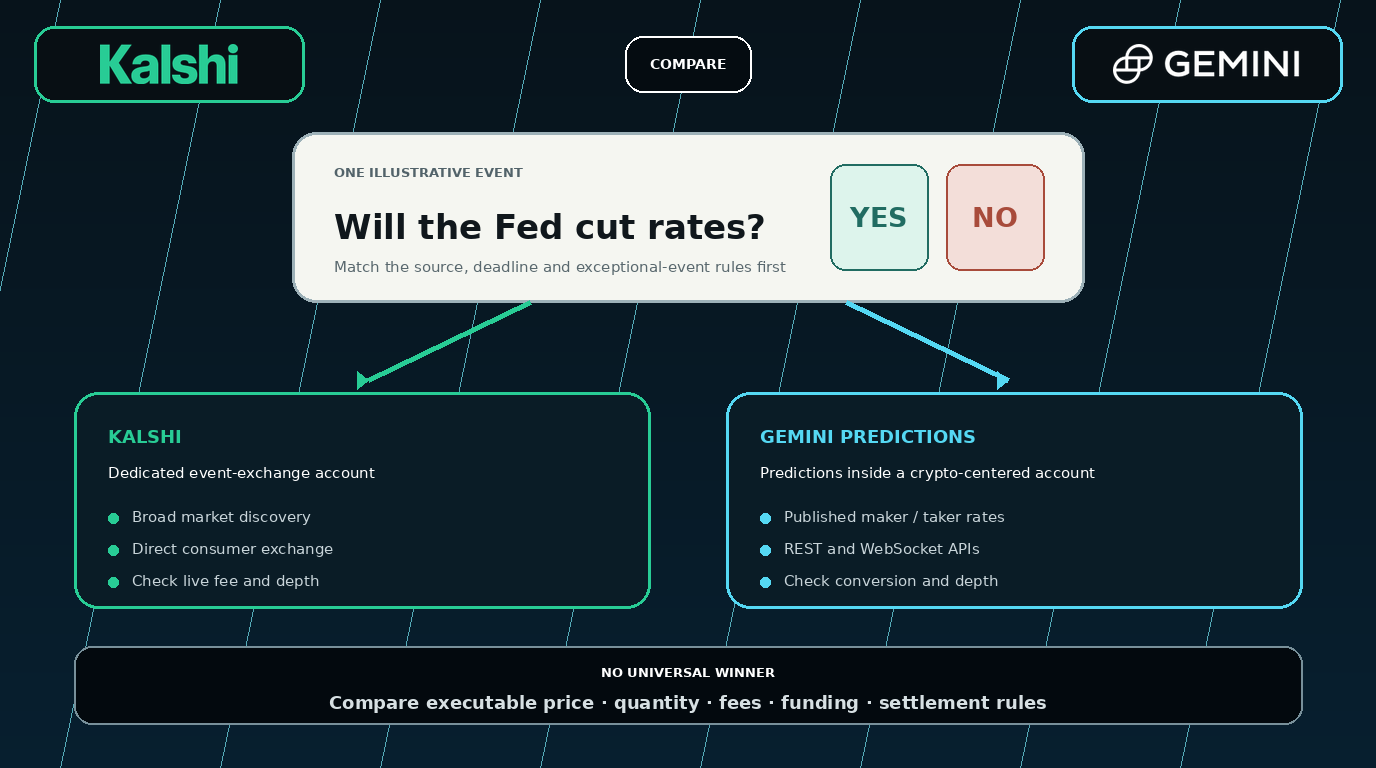
Kalshi and Gemini can list the same event while maintaining independent contracts, prices, depth and settlement rules.
Fees and Execution
Both platforms use probability-weighted transaction fees, so a single headline percentage can mislead. Fees change with contract price and quantity. Order behavior also matters, especially on Gemini, where standard maker and taker coefficients differ.
Gemini's current prediction-market fee schedule gives this standard formula:
fee = rate × C × P × (1 − P)
Here, C is contract quantity and P is the contract price from 0 to 1. The published standard rate is 0.0175 for a maker order and 0.07 for a taker order, with the result rounded up to the next cent. An order is generally a maker when it rests on the book and adds liquidity; it is a taker when it matches immediately and removes liquidity.
Kalshi's fee guidance describes a similar probability-weighted general fee for immediately matched orders. Its current schedule, special series, maker rules and promotions can alter the applicable charge, so the order preview and live schedule control.
Matched example: 100 contracts at 50 cents
Using the published standard formulas and ignoring spread or slippage:
| Order | Calculation | Illustrative fee |
|---|---|---|
| Gemini maker | 0.0175 × 100 × 0.50 × 0.50 |
$0.4375, rounded to $0.44 |
| Gemini taker | 0.07 × 100 × 0.50 × 0.50 |
$1.75 |
| Kalshi general immediately matched order | 0.07 × 100 × 0.50 × 0.50 |
$1.75 under the general formula |
This example teaches two things. First, Gemini's standard maker coefficient is one quarter of its taker coefficient. Second, Gemini does not automatically beat Kalshi on every completed order. A resting order may not fill, while an immediate order can pay both the taker fee and the bid-ask spread.
At 20 cents, the probability factor is 0.20 × 0.80 = 0.16, versus 0.25 at 50 cents. For 100 contracts, the same 0.07 coefficient produces a fee of $1.12 before any rounding difference. The fee is smaller, but the market's payoff, likelihood and available depth are also different. Lower nominal fees near the probability extremes do not make a position safer.
Use a complete execution model:
all-in cost = transaction fee + spread + slippage + funding/conversion cost + withdrawal cost
Our prediction-market fee calculator helps compare scenarios. Always enter the executable price and realistic quantity, not a last-traded price that may no longer be available.
Maker pricing has an opportunity cost
A maker order trades a lower fee for uncertainty. The market can move away before the order fills, partially fill the quantity, or fill precisely when new information makes the price less attractive. A taker order buys immediacy, not a better forecast.
This is why the honest fee winner is conditional:
- Gemini can have a clear fee advantage for an eligible order that genuinely rests and fills as maker.
- Standard immediately matched examples can produce the same probability-weighted charge on both venues.
- A narrower spread or better depth can outweigh a fee difference.
- Special series, rebates and promotions must be checked in the current schedule.
Markets, Liquidity, and Resolution
Kalshi and Gemini both cover broad event categories. The useful comparison is not how many category names appear in a menu. It is whether the exact market you want has clear rules and enough executable depth.
Kalshi's longer consumer operating history gives it an advantage in established event-market discovery. Users can browse a product centered entirely on contracts. Gemini's catalog sits inside a broader crypto and financial account, which can be more convenient for an existing customer but less focused for someone who only wants event markets.
Liquidity is local
Each order book is its own market. A highly active sports contract says little about depth in a small economic release on the same platform. Compare liquidity at the time and size you expect to trade:
- best bid and best ask;
- quantity available at each level;
- depth beyond the top quote;
- recent trading activity;
- likely price impact for the full order; and
- whether an early exit is available at an acceptable price.
Do not treat total platform volume as proof that a particular position can be closed. A contract can settle correctly and still be expensive or impossible to exit early.
Resolution starts with the rulebook
Read the contract before placing the order. Identify the named source, observation period, threshold, rounding method and treatment of corrections or postponements. A news headline, social-media post or AI answer does not override the exchange's written terms.
The two exchanges can settle apparently similar markets differently without either settlement being erroneous. That is another reason a screen-price gap is not necessarily an arbitrage. The contracts must be economically equivalent after every rule is matched.
Funding, APIs, and User Experience
Kalshi offers a direct exchange relationship and supports eligible funding methods that can include bank rails and supported crypto transfers. Gemini Predictions uses the broader Gemini account and balance. For an existing Gemini customer, that can reduce the number of accounts to manage.
Gemini's integration needs one important qualification. Its product documentation explains that a prediction order funded from a crypto balance can require the asset to be sold into USD. The sale can have tax consequences, and the user can be left holding USD if the prediction order does not complete after conversion. Review the confirmation screen rather than assuming the original asset remains untouched.
Compare the full route:
| Step | Kalshi question | Gemini question |
|---|---|---|
| Deposit | Which bank or crypto route is available to this account? | Will fiat be deposited, or will crypto be sold into USD? |
| Conversion | What provider, spread or network cost applies? | What sale price, fee and tax consequence can arise? |
| Trade | What are the executable price, fee and available size? | Is the order maker or taker, and what is the full preview? |
| Exit | What bid and depth exist for the full position? | What bid and depth exist for the full position? |
| Withdraw | Which method, hold and limit apply? | Which Gemini balance and withdrawal method apply? |
APIs
Kalshi documents market data, order books, trading, portfolio workflows, WebSocket streaming and software development kits. Gemini's Prediction Markets API specification documents REST and WebSocket access for market data, trading, positions, volume and related features.
Gemini has an attractive developer proposition for teams that want prediction-market access adjacent to a crypto platform. Kalshi has the advantage of a developer ecosystem built around a dedicated event exchange. Neither description replaces a technical evaluation. Test authentication, rate limits, market identifiers, order-state transitions, cancellation behavior and sandbox or demo support before committing to an integration.
API availability also does not create liquidity. Automation can make order handling faster, but it cannot guarantee a fill or turn a loosely matched contract into an arbitrage.
How to Choose Safely
Use this sequence for a real decision:
- Confirm eligibility. Check the current onboarding flow, location rules, age requirement and contract restrictions. Do not use location-masking tools to bypass controls.
- Match the contract. Compare the outcome, source, deadline and exceptional-event rules line by line.
- Measure the executable trade. Record the price and available quantity for your side and size.
- Preview the total cost. Include maker or taker status, spread, slippage, conversion and withdrawal costs.
- Plan settlement and exit. Know whether you intend to hold through resolution and what happens if the market becomes thin.
- Start small. A small first transaction can test the account, order behavior and withdrawal route without assuming that documentation covers every practical detail.
If neither account model fits, Macro Markets is a crypto-native alternative worth evaluating for eligible users who deliberately prefer crypto funding and global market discovery. Because Macro Markets publishes this article, treat that inclusion as a disclosed first-party statement. Verify its current jurisdiction, eligibility, wallet networks, fees, liquidity and resolution rules independently. Macro Markets has a different legal and custody profile and is not presented here as a CFTC-designated exchange.
For broader legal context, read are prediction markets legal?. For a wider platform shortlist, see our guide to the best prediction market apps.
Frequently Asked Questions and Final Verdict
Is Gemini Predictions the same type of exchange as Kalshi?
At the regulatory category level, both exchange operators are CFTC-designated contract markets. They are separate companies with separate accounts, order books, contract rules, fee schedules and operating histories. Their positions are not transferable or automatically interchangeable.
Is Gemini cheaper than Kalshi?
Gemini's standard published maker coefficient is lower than its taker coefficient and can create a fee advantage for a resting order that fills. Standard immediately matched examples can produce the same probability-weighted fee as Kalshi's general formula. The actual winner depends on price, quantity, order status, spread, depth and any special schedule.
Which has more prediction markets?
Both advertise broad catalogs, and the available list changes. Raw market count is less useful than finding an eligible, clearly defined contract with enough depth for your intended size. Check the live catalogs instead of relying on a fixed count.
Can I use crypto on either platform?
Both can involve crypto, but in different account flows. Gemini Predictions sits within a crypto-focused Gemini account and may sell crypto into USD for a prediction order. Kalshi supports certain crypto transfer routes through its funding system. Supported assets, networks, providers, locations and costs can change, so verify the live deposit screen.
Which is better for API trading?
Both publish developer tools. Gemini is compelling for a team already integrating with its ecosystem; Kalshi is compelling for a workflow focused on event markets. Compare the exact endpoint coverage, test environment, authentication and rate limits your system needs.
Final verdict
Kalshi is the better default for a user who wants a dedicated, mature event-exchange experience. Gemini Predictions is the better fit for an existing Gemini customer, a maker-sensitive trader or a developer who values crypto-account integration.
Do not select either platform from branding alone. Compare the exact rulebook, executable quote, available quantity and complete cost for the contract you intend to trade. Regulation establishes oversight, not certainty. A Yes contract can still expire at zero, and an early exit may not be available.
Ready to explore a crypto-native alternative? Open Macro Markets only after checking whether the platform, market and funding route are available and appropriate in your jurisdiction.
