CME vs Robinhood Prediction Markets: Which Is Better in 2026?

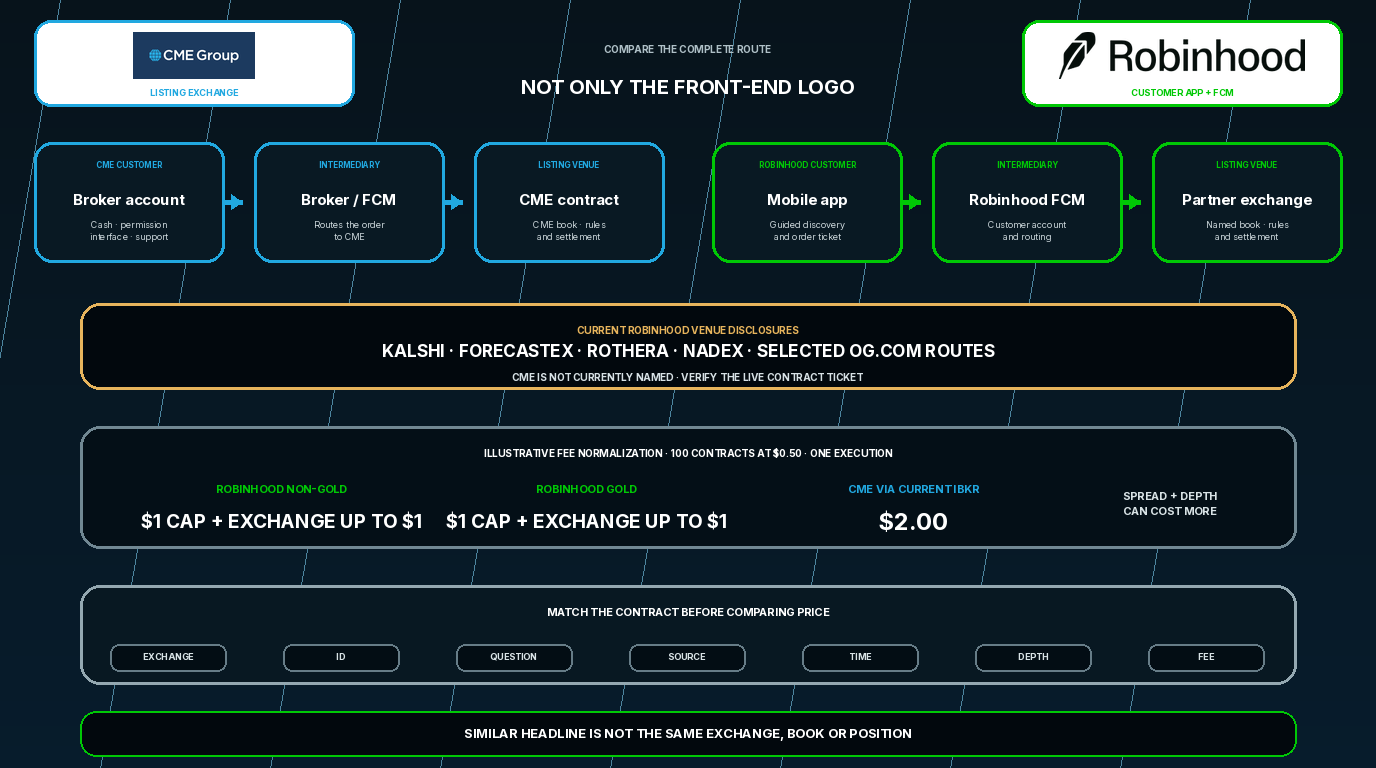
The CME vs Robinhood prediction markets comparison is not exchange versus exchange. CME Group lists prediction-market products that customers reach through participating brokers. Robinhood presents event contracts inside its app through Robinhood Derivatives, an FCM that routes each contract to a named partner exchange.
Our verdict: choose CME when you want a CME-listed contract, already use a participating broker or need professional desktop and API tools through that broker. Choose Robinhood when you value a simpler mobile experience, prediction-first discovery and one consumer app for stocks, cash and event contracts. The stronger route still depends on the exact exchange, contract rules, executable price and complete fee preview.
Last reviewed and fact-checked: November 2, 2026.
Editorial disclosure: Macro Markets publishes this comparison and operates a prediction-market platform. We include Macro Markets as a disclosed crypto-native alternative, not as an independent recommendation or a CFTC-designated US exchange. This article uses official exchange, broker, regulator and product documentation. We did not place simultaneous funded orders through CME and Robinhood. Fees, exchange routes, eligibility and contracts can change. This article is educational, not financial, legal or tax advice.
CME vs Robinhood Prediction Markets: Quick Verdict
The key distinction is listing venue versus customer intermediary. CME creates and lists its prediction contracts. A participating broker carries the customer relationship. Robinhood Derivatives carries the customer relationship but currently sends event orders to partner exchanges that list the actual contracts.
| Category | CME Prediction Markets | Robinhood Prediction Markets | Better fit |
|---|---|---|---|
| Main role | Exchange product family | Consumer app and futures commission merchant route | Different layers |
| Customer access | Participating broker or FCM | Robinhood app plus approved Robinhood Derivatives account | Robinhood for guided mobile onboarding |
| Current documented venues | CME-listed contracts | Kalshi, ForecastEx, Rothera, Nadex and selected Crypto.com/OG.com routes | Robinhood for multi-venue discovery |
| CME availability | The contract is listed by CME | Current Robinhood disclosures do not identify CME as a routed event venue | CME broker route |
| Trading surfaces | Depends on broker; can include web, desktop, mobile and APIs | Mobile execution; web viewing may be available | CME route for professional tools |
| Standard payoff | Binary contracts commonly settle at $1 or $0 | Binary contracts commonly settle at $1 or $0 | Tie on basic payoff |
| Customer fee | Broker-specific; current IBKR CME total is $0.02 per contract per execution | Probability-weighted Robinhood commission, capped at $0.01 per contract, plus exchange fee up to $0.01 | Order-specific |
| Liquidity | CME contract book | Book of the named Robinhood partner exchange | Exact contract decides |
| Settlement authority | CME rules and contract specification | Named partner exchange rules and contract specification | Read the contract |
| Best for | CME products and professional broker workflows | Existing Robinhood customers and mobile event discovery | Depends on workflow |
At 100 contracts priced at $0.50, the current Interactive Brokers CME schedule totals $2 per execution. Robinhood's raw probability-weighted formula reaches its $1 commission cap for both Gold and non-Gold customers at that price; a partner exchange can add up to another $1. Robinhood's displayed total can therefore also reach $2 before spread and slippage.
Read our standalone CME Prediction Markets review and Robinhood Prediction Markets review for deeper product assessments.
Can you trade CME Prediction Markets on Robinhood?
Not according to Robinhood's current public event-contract venue disclosures as of November 2, 2026. Robinhood's official help pages name KalshiEX, ForecastEx, Rothera Exchange and Clearing and North American Derivatives Exchange. A September 2026 Robinhood announcement also describes selected football contracts routed to Crypto.com's prediction-markets platform through the OG.com partnership.
Those current sources do not name CME as a Robinhood prediction-market venue. CME contracts are available through participating brokers that explicitly offer them. Exchange routes can change, so the signed-in contract ticket and current product disclosures control.
This answer also explains why the comparison matters. Robinhood can show a question similar to a CME market without providing the CME contract. The proposition, exchange, identifier, source, deadline and order book may all differ.
What CME and Robinhood Actually Are
CME Prediction Markets is a product family inside CME Group's derivatives ecosystem. CME's current Prediction Markets page tells customers to sign up with a broker offering the products. CME lists the contract; the broker supplies onboarding, account permissions, funding, order entry, statements and customer support.
The CME customer route is:
- The customer opens or uses an eligible account with a participating broker.
- The broker grants the required product permissions.
- The customer selects a CME-listed event contract.
- The order reaches the CME book.
- CME's rules and contract specification determine the outcome.
Robinhood uses a multi-venue intermediary model. Robinhood's event-contract overview says Robinhood Derivatives is a registered futures commission merchant and NFA member. It provides the customer account and app experience, while the selected partner exchange supplies the listed contract, book and settlement rules.
The Robinhood route is:
- The customer has an eligible individual Robinhood investing account.
- The customer applies for Robinhood Derivatives access.
- Robinhood displays an event contract from a named partner exchange.
- Robinhood Derivatives routes the order to that exchange.
- The exchange's contract terms determine settlement.
Robinhood's own market-structure guide uses CME, Kalshi and ForecastEx as examples of exchanges and Robinhood as an example of a broker or FCM. That distinction is more useful than comparing logos.
Robinhood is not one universal order book
A market displayed inside Robinhood can come from Kalshi, ForecastEx, Rothera, Nadex or another disclosed route. The app does not combine those independent contracts into one shared exchange book. The venue identified for the contract controls:
- The exact proposition and instrument identifier.
- Available bids, offers and depth.
- Exchange fees and position limits.
- Trading hours, halts and order behavior.
- Named resolution source and correction policy.
- Cancellation and nonstandard-outcome treatment.
Robinhood's September 2026 Crypto.com and OG.com announcement says selected football contracts can be routed across OG.com, Kalshi and Rothera based on availability and other factors. That may improve catalog coverage, but it makes the venue label more important, not less.
Similar headlines do not make the contracts identical
Suppose CME and Robinhood both display a question about the next Federal Reserve decision. Before comparing the two prices, match:
- The target rate or range being measured.
- The meeting date and observation time.
- The named source and revision treatment.
- The Yes and No definitions.
- The final trading deadline.
- The exchange and contract identifier.
- Cancellation, postponement and review rules.
A two-cent gap can reflect different questions rather than a pricing opportunity. Our prediction-market comparison methodology treats the written exchange contract as the unit of comparison.
Compare Contracts, Catalogs and Liquidity
CME's current product page names sports, economic indicators, cryptocurrencies and more. The surrounding CME ecosystem can be useful to customers already monitoring interest rates, equity indexes, energy, metals, agriculture or crypto benchmarks through a derivatives broker.
Robinhood emphasizes discovery across sports, politics, weather, commodities, entertainment and financial events. Its app can aggregate listings from multiple partner routes into one customer experience. Current product announcements also describe player contracts, combos, live sports presentation and company earnings contracts, subject to rollout and approval.
Robinhood can therefore feel broader or easier to browse. CME can be more relevant when the customer wants a particular CME specification or a contract connected to an established futures workflow. Neither observation creates a permanent catalog winner.
Compare exact contract availability
Use a simple sequence:
- Search the desired event on both routes.
- Identify the exchange behind the Robinhood listing.
- Open the official contract terms on each venue.
- Match the source, threshold, deadline and special cases.
- Confirm state and account eligibility.
- Record the executable bid, offer and size.
- Add the complete opening and likely closing costs.
If the Robinhood ticket does not identify CME, do not describe it as a CME position. It may ask a similar question while remaining a legally and economically separate instrument.
For broader shortlists, use the CME alternatives guide and Robinhood prediction-market alternatives. The CME vs Crypto.com Predict Pro comparison covers a professional exchange interface with maker/taker pricing instead of Robinhood's guided consumer route.
Which route has better liquidity?
Liquidity belongs to the exact exchange contract. CME Group's scale in traditional futures does not guarantee a deep book in every prediction market. Robinhood's large customer base and total event-contract volume do not guarantee depth in every partner listing.
Measure:
| Measurement | What it shows | What it misses |
|---|---|---|
| Best bid and offer | Immediate prices to sell or buy | Quantity beyond the first level |
| Depth for your size | Likely average execution price | Future exit conditions |
| Recent matched volume | Historical activity | A currently executable counterparty |
| Venue and identifier | Whether the quote is the same instrument | Customer fee and funding friction |
If a Robinhood contract is routed to an exchange other than CME, its order book is independent from CME. You cannot close a CME position against the Robinhood partner's liquidity. A cross-venue strategy requires separately funded positions and genuinely matched rules.
The bid-ask spread guide explains why a one-cent commission difference can disappear inside a worse fill.
CME vs Robinhood Fees, Funding and Tools
CME does not set one universal retail customer fee across every broker. The customer pays the schedule of the selected participating broker plus applicable exchange charges. For a transparent current example, Interactive Brokers lists a $0.01 commission plus a $0.01 exchange fee per CME event contract per execution for US direct clients.
Robinhood moved to a probability-weighted customer commission on June 1, 2026:
Commission = k × price × (1 − price) × contracts
The constant k is 10% without Robinhood Gold and 5% with Gold. Robinhood rounds up to the nearest cent and caps its commission at $0.01 per contract. A partner exchange can add a fee of up to $0.01 per contract. Opening and early-closing executions can each create charges.
Normalized fee examples
For 100 contracts at $0.50:
| Route | Calculation | Published-schedule result per execution |
|---|---|---|
| Robinhood without Gold | Raw: 0.10 × 0.50 × 0.50 × 100 = $2.50 | $1 commission after cap, plus exchange fee up to $1 |
| Robinhood with Gold | Raw: 0.05 × 0.50 × 0.50 × 100 = $1.25 | $1 commission after cap, plus exchange fee up to $1 |
| CME through current IBKR US direct schedule | 100 × ($0.01 + $0.01) | $2 total fee |
At this price and quantity, Gold does not reduce the capped Robinhood commission. At 100 contracts priced at $0.10, the raw Robinhood commission becomes $0.90 without Gold or $0.45 with Gold, before a possible exchange fee. CME through the current IBKR example remains $2 because its listed charge is per contract rather than probability-weighted.
This is not a universal cheapest-route ranking. Robinhood Gold currently has a separate subscription cost. The partner exchange fee can vary. Another CME broker can charge differently. Spread and slippage can exceed the visible fee.
Use the current Robinhood event-contract fee explanation and the current IBKR event-contract schedule, then confirm the signed-in order preview. Our prediction-market fee calculator helps normalize quantities and probabilities.
Funding and account access
CME funding depends on the broker. A multi-asset broker can let eligible customers use cash in the same relationship that holds stocks, options or futures, subject to settlement, permissions and account rules.
Robinhood requires an individual investing account plus approval for Robinhood Derivatives. Event-contract buying power is separate from ordinary brokerage and crypto displays even when the system performs internal sweeps. Instant deposits may not be eligible, so time-sensitive orders can require settled cash.
Compare:
- Deposit and settlement time.
- Eligible cash and automatic sweep behavior.
- Withdrawal timing after contract settlement.
- State, age and account restrictions.
- Account statements and tax documentation.
- Support route for a disputed or delayed order.
Do not assume cash visible in either app is immediately eligible for every event contract.
Mobile simplicity versus professional tools
Robinhood's advantage is the guided consumer mobile flow. It supports contract orders, opening dollar orders, some fractional execution and selected multi-leg combinations. These features can simplify discovery, especially for sports and entertainment markets.
Robinhood's limitations are equally clear. Prediction-market execution is currently mobile-centered, the exchange can differ by contract and no comparable public customer execution API is documented for the product.
CME tools depend on the broker. Interactive Brokers and other professional routes can provide web, desktop, mobile, market data, reporting and APIs. The trade-off is a more complex interface and the need to preserve the CME exchange, product code and contract specification in every workflow.
Our Robinhood vs Interactive Brokers comparison covers the consumer-app versus professional-broker decision in more detail.
Regulation, Protections and Settlement
CME's listed products operate through designated exchange and clearing infrastructure. Robinhood Derivatives is a CFTC-registered futures commission merchant and NFA member. Its partner venues have their own regulated exchange and clearing roles.
These facts establish legal functions. They do not insure a trader against a correctly settled $0 outcome, a misunderstood rule, a wide spread or an unavailable exit. Regulation does not make every prediction contract appropriate for every customer.
The guide to prediction-market legality in the US explains why exchange registration, intermediary registration, customer location and contract availability are separate questions.
Who determines settlement?
For CME Prediction Markets, the CME contract specification and rulebook control. For Robinhood, the partner exchange named on the contract controls. Robinhood provides access and account support but does not replace the exchange as the outcome authority.
Before trading, identify:
- Exchange and clearing route.
- Exact contract identifier.
- Resolution source.
- Observation time and time zone.
- Revision and correction policy.
- Cancellation or nonstandard-outcome treatment.
- Market-halt and review procedure.
- Expected settlement timing.
A news headline, sports app, social-media post, another exchange's settlement or AI summary cannot override the source named in the contract.
Customer protection boundaries
Do not project stock-account protections automatically onto event contracts. Robinhood's derivatives disclosures say Robinhood Derivatives is not SIPC protected or FDIC insured. CME customers must likewise distinguish the exchange from the broker carrying the account and understand the broker's customer-fund disclosures.
Fully collateralized event contracts generally limit position loss to the amount paid plus applicable fees. That still permits a complete contract loss. It does not remove operational, liquidity, settlement or jurisdiction risk.
Use multifactor authentication, verify the official app or broker domain and restrict API credentials where applicable. Size correlated contracts as one risk group. Several markets tied to the same election, rate decision or crypto price can all lose together.
Which Platform Should You Choose?
Choose a CME Prediction Markets route when most of these statements are true:
- You want a specific CME-listed contract.
- You already use a participating broker offering CME products.
- Desktop, professional order controls or API access matter.
- You want event contracts beside a broader derivatives portfolio.
- The exact CME book has better rules, price or depth.
Choose Robinhood Prediction Markets when most of these are true:
- You already use Robinhood and want a guided mobile experience.
- Sports, politics, entertainment or combo discovery matters.
- Opening a position by dollar amount is useful.
- You accept that the exchange can differ by contract.
- The named partner contract has the better complete order preview.
Do not choose CME only because CME dominates other derivatives categories. Measure the event book. Do not choose Robinhood only because the app shows high total platform volume. Identify the specific venue and contract first.
The Kalshi vs Robinhood comparison explains direct exchange access versus a consumer intermediary. The Kalshi vs CME comparison compares two listing venues, while CME vs Polymarket US covers a prediction-first US app with its own separate exchange identity.
Where Macro Markets fits
Macro Markets is a different option for eligible users who intentionally want crypto-native funding and global prediction-market discovery. It is not presented as a CFTC-designated exchange or as a regulatory equivalent to CME, Robinhood Derivatives or Robinhood's partner venues.
Its crypto-native model can be relevant when wallet-based deposits and withdrawals matter more than a US broker or consumer securities app. That route requires separate diligence: supported jurisdictions, custody, networks, conversion cost, withdrawal rules, market-making design, resolution sources and executable liquidity.
Because Macro Markets publishes this article, this section is a disclosed first-party description, not an independent endorsement. Explore how Macro Markets works only after comparing the exact contract and complete funding path.
Final decision checklist
Before choosing either route, record:
- Customer intermediary and listing exchange.
- Exact contract identifier and written rules.
- Proposition, source, observation time and deadline.
- Best bid, best offer and depth for your size.
- Customer commission, exchange fee, spread and price impact.
- Funding availability and withdrawal timing.
- Device, desktop and API requirements.
- Maximum loss across related positions.
FAQ and Final Verdict
Can I trade CME Prediction Markets on Robinhood?
Robinhood's current public event-contract disclosures do not identify CME as a routed venue as of November 2, 2026. They name Kalshi, ForecastEx, Rothera, Nadex and selected Crypto.com/OG.com routes. Use a participating broker that explicitly offers CME Prediction Markets and recheck Robinhood's current ticket because routes can change.
Is Robinhood an exchange for prediction markets?
Robinhood Derivatives is the customer-facing FCM. The named partner exchange lists the contract, operates the book and determines settlement. Rothera is an affiliated joint-venture route, but it remains an identifiable exchange and clearing entity rather than a universal Robinhood book.
Is CME or Robinhood cheaper?
There is no universal winner. The current IBKR CME route totals $0.02 per contract per execution. Robinhood uses a probability-weighted commission capped at $0.01 per contract, plus a partner exchange fee that can be up to $0.01. Price, quantity, Gold status, venue and spread determine the result.
Does Robinhood Gold always lower event-contract fees?
No. Gold halves the constant in Robinhood's formula, but the one-cent-per-contract cap can make Gold and non-Gold commissions equal around some prices and quantities. The subscription cost also matters. Check the order preview.
Which route has better liquidity?
Compare the exact exchange contract's bid, offer and depth. CME's overall derivatives scale and Robinhood's aggregate event volume do not guarantee liquidity in a particular market.
Who settles a Robinhood prediction contract?
The partner exchange identified for that contract applies its written rules and named outcome source. Robinhood displays the position and supports the customer account but cannot substitute another result for the exchange determination.
Which is better for desktop and APIs?
A CME route through a professional broker is generally stronger. Robinhood currently centers event-contract execution in its mobile app and does not document a comparable public customer trading API for prediction markets.
Is Macro Markets an alternative to both?
It can be a crypto-native alternative for eligible users, but it has a different jurisdiction, custody and funding model and is not a CFTC-designated US exchange. Compare its rules and protections separately.
Final verdict
CME is the stronger fit for customers seeking CME-listed products, professional broker tools and a traditional derivatives workflow. Robinhood is the stronger fit for existing customers who value mobile discovery, guided order entry and access to several partner-exchange catalogs through one app.
The decisive comparison is not the CME logo against the Robinhood logo. It is one CME contract through a named broker versus one Robinhood-displayed contract from a named exchange. Match the written terms, calculate the complete cost and inspect executable depth before taking a position.