


Robinhood Prediction Markets Review 2026: Fees, Safety and Alternatives

Robinhood prediction markets are a legitimate way for eligible US customers to trade event contracts inside a familiar investing app. The strongest reason to use them is convenience: stocks, cash and event contracts can live in one broader Robinhood relationship. The main limitation is structural. Robinhood is the intermediary, while a partner exchange lists the contract, supplies its rules and determines settlement.
That distinction affects almost everything in this review. Fees can include both a Robinhood commission and an exchange fee. Liquidity belongs to the underlying venue and contract, not simply to the Robinhood brand. State access can also vary by event category and exchange.
Our verdict: Robinhood is best for an existing US customer who values a polished mobile workflow and is willing to inspect the exchange, spread, fee and resolution terms on every order. A dedicated exchange may suit traders who want deeper market tools or a more direct view of the order book. A crypto-native platform may suit eligible users outside that account model.
Last reviewed and fact-checked: October 27, 2026.
Editorial disclosure: Macro Markets publishes this review and operates a prediction-market platform. We include Macro Markets as an alternative, apply the same criteria to it and do not present it as a CFTC-designated US exchange. This is a documentation-based review; we did not open and fund a Robinhood Derivatives account for this article. Event contracts are risky, can settle at $0 and are not suitable for everyone. This page is educational, not financial, tax or legal advice.
Robinhood Prediction Markets Review: Quick Verdict
Robinhood earns a positive but qualified verdict. The app reduces onboarding friction for people who already invest there, supports several useful order formats and gives customers access to contracts across sports, politics, weather, commodities and entertainment. Robinhood's official event-contract overview also explains the commission formula and current eligibility rules in one place.
However, the simplest interface does not remove contract-level complexity. Before trading, you still need to identify the partner exchange, read the settlement source, check the bid-ask spread and confirm the total fee in the order preview. Robinhood does not determine the settlement rules for contracts listed by its exchange partners.
| Review factor | Finding | What it means |
|---|---|---|
| Legal structure | Robinhood Derivatives is a CFTC-registered futures commission merchant and NFA member | The customer uses a regulated intermediary, but should identify the exchange behind each contract |
| Availability | US residents with an approved individual account; state and contract restrictions apply | Access is not universal, especially for some sports contracts |
| Trading surface | Mobile app for execution; web can display contracts | Desktop-only traders may find the workflow restrictive |
| Markets | Sports, politics, weather, commodities and entertainment | Breadth is useful, but the live catalog changes |
| Orders | IOC, GTD limit orders, dollar orders, some fractional contracts and supported combos | The interface is flexible, although not every order or feature is available on every market |
| Fees | Probability-weighted Robinhood commission plus a possible exchange fee | The displayed total, spread and slippage matter more than one advertised rate |
| Settlement | Partner exchange rules control the outcome; positions settle in cash | Read the source, threshold, timing and exceptional-outcome terms before buying |
| Account protection | Robinhood Derivatives is not FDIC insured or SIPC protected | Do not assume brokerage-account protections apply to event-contract positions |
Robinhood prediction markets pros and cons
Pros
- Familiar app for existing Robinhood users.
- Access to several partner exchanges through one interface.
- Limit orders, dollar orders and some fractional-contract support.
- Broad mix of sports and non-sports events.
- Clear order preview before submission.
Cons
- Trading is currently mobile-only.
- The underlying exchange and rules can differ between contracts.
- Robinhood and exchange fees can both apply when opening and closing.
- State restrictions and product eligibility are not uniform.
- The derivatives account does not have SIPC or FDIC protection.
- Thin contracts and combos may be difficult to exit at an attractive price.
The headline conclusion is not “Robinhood is always cheaper” or “Robinhood has the most liquidity.” Neither claim can be established across a changing catalog. The defensible conclusion is that Robinhood offers a convenient access layer whose quality must be checked at the individual-contract level.
How Robinhood Prediction Markets Work
Robinhood prediction markets use event contracts. A standard binary contract asks whether a defined outcome will happen. You buy Yes when you think it will occur or No when you think it will not. A winning contract generally settles at $1, while a losing contract generally settles at $0.
The price is often read as an implied probability. A Yes contract offered at $0.63 suggests a market estimate near 63%, but it is not a scientific forecast or a guarantee. The executable price may differ from the last displayed price because buyers and sellers quote different levels. Our guide to the bid-ask spread in prediction markets explains this gap.
Robinhood adds an important middle layer. Customers trade through Robinhood Derivatives, LLC. Robinhood says contracts may be offered through partner exchanges including KalshiEX, ForecastEx, Rothera Exchange and Clearing, and North American Derivatives Exchange. The exact list can change, so the contract disclosure is the authoritative source for a specific order.
That architecture creates three separate roles:
- Robinhood Derivatives handles the customer relationship and routes the order. It is a futures commission merchant, not the exchange for every listing.
- The partner exchange lists the contract. Its market rules, fee schedule and liquidity environment apply.
- The contract terms define settlement. They name the official source, threshold, deadline and treatment of unusual outcomes.
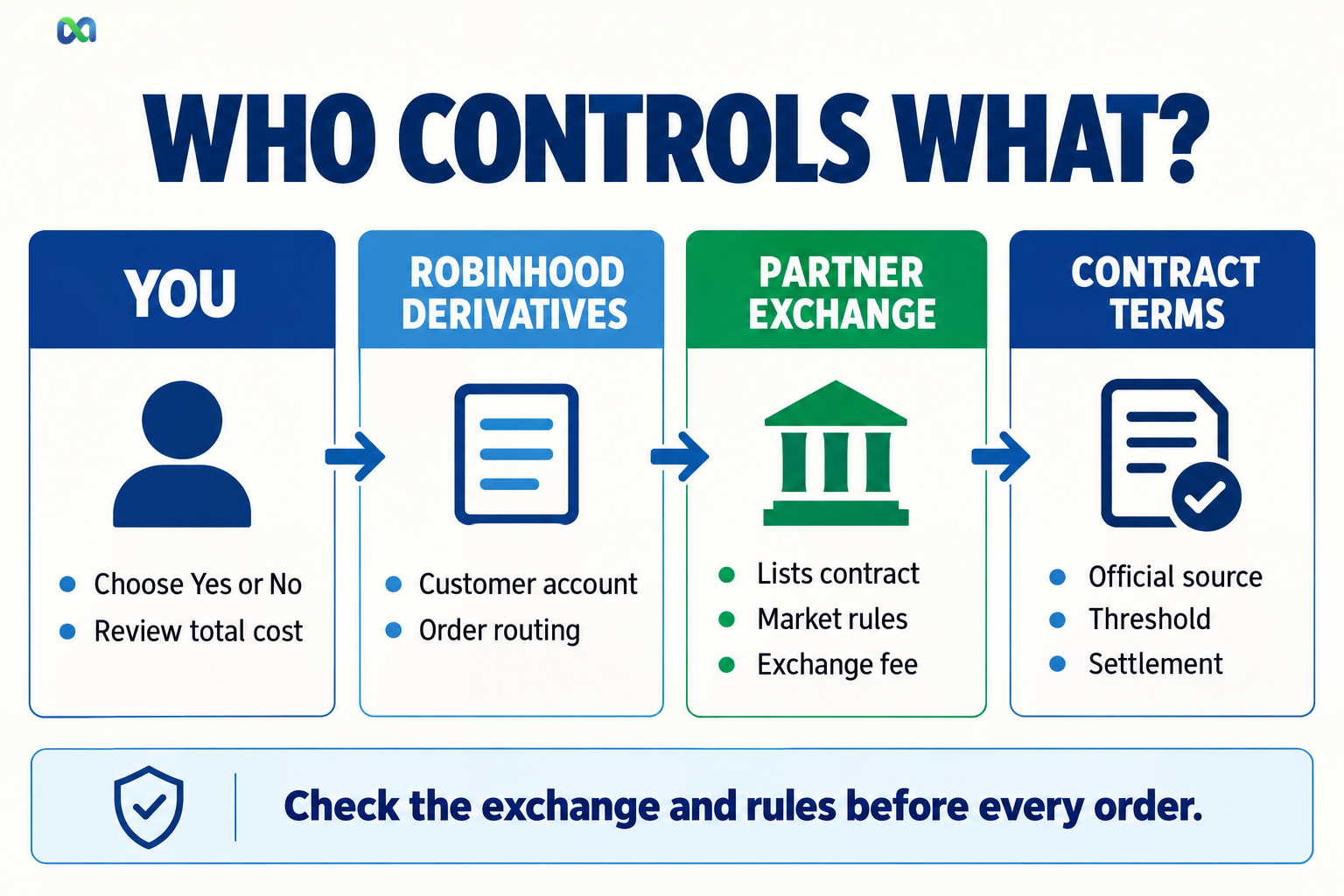
For example, a sports contract shown in Robinhood could be a Kalshi contract. Choosing the Robinhood interface would not necessarily provide an independent price pool from Kalshi. It may be another route to the same underlying venue. This is why a platform-level comparison must not double-count liquidity.
The basic trading flow is straightforward. Apply for a Robinhood Derivatives account, open the Prediction Markets area in the mobile app, select an event and then choose a contract. The order ticket shows the quantity, price, commission, exchange fee when applicable and maximum payout. Review those figures before submitting.
Robinhood's educational materials explain that contract price is the amount placed at risk, while $1 is the normal winning payout. If you buy 100 contracts at $0.40, the position costs $40 before fees. A $1 settlement returns $100, while a $0 settlement loses the $40 purchase cost. Closing early produces a gain or loss based on the available market price, less fees.
Readers new to these mechanics should use our beginner guide to trading prediction markets. The central habit is to read the contract before reacting to the headline or probability.
Is Robinhood Prediction Markets Legit and Safe?
Yes, Robinhood prediction markets are legitimate regulated derivatives products for approved customers. Robinhood Derivatives states that it is registered with the Commodity Futures Trading Commission as a futures commission merchant and is a member of the National Futures Association. The CFTC's published FCM financial data also lists Robinhood Derivatives as an FCM.
Legitimacy does not mean a position is safe from loss. It means the product operates inside a defined regulatory and contractual framework. A valid contract can still settle at $0. A regulated intermediary can still experience outages, restrictions, disputes or poor execution in a thin market.
The most important protection caveat is easy to miss. Robinhood's derivatives disclosure page says Robinhood Derivatives is not FDIC insured or SIPC protected. The protections associated with a bank deposit or a conventional securities brokerage account should not be assumed for an event-contract position.
Event contracts are fully collateralized, according to Robinhood's Event Contracts Risk Disclosure. They are not purchased on margin and do not create a maintenance margin call for an existing event position. That limits the position loss to the amount paid and applicable fees, but it does not protect the amount paid from going to zero.
Safety also depends on operational choices:
- Use a unique password and enable the strongest account security Robinhood offers.
- Fund early enough that cash is settled before a time-sensitive event.
- Confirm the partner exchange on the order ticket.
- Read the exact resolution source and deadline.
- Use a limit order when you need price control.
- Avoid treating a displayed percentage as certainty.
- Keep position size small enough that a $0 settlement is tolerable.
Location deserves its own check. Robinhood currently requires a US residence, age 18 or older, an individual brokerage account and approval for Robinhood Derivatives. Event contracts are not available in every state. Its overview specifically notes sports restrictions for Maryland and Nevada and warns that additional restrictions may apply. The app's current eligibility screen controls.
Federal registration is not a promise that every state accepts every contract category. The legal conflict around sports contracts remains especially fluid. Our guide to whether prediction markets are legal in the US explains why platform registration, contract type and customer location must be checked separately.
Markets, Orders and App Experience
Robinhood's main usability advantage is consolidation. Existing customers can discover event contracts without learning a separate crypto wallet or opening a standalone exchange interface. The design uses familiar dollar values, order previews and position history.
The catalog spans sports, politics, weather, commodities and entertainment. That breadth is meaningful, but categories do not prove that a desired contract will be present. Listings rotate with the calendar and depend on partner exchanges. Always search the live app rather than relying on an old review screenshot.
Execution currently happens only in Robinhood's mobile app. Contracts can be viewed on the web, but not traded there, and they are not available in Robinhood Legend. This is a significant drawback for users who analyze on a large screen or want an advanced desktop workflow.
Robinhood's trading guide describes the principal order formats:
- Immediate-or-cancel (IOC): fills immediately at available prices or cancels the unfilled amount.
- Good-til-date (GTD) limit order: stays open until filled or expires at 3 a.m. ET on the next calendar day.
- Dollar order: calculates quantity from a dollar amount and is always IOC.
- Fractional contracts: available for some dollar or closing orders, depending on the market.
- Preset or custom combos: combine several outcomes into one contract when supported.
Limit orders are valuable because they cap the price you agree to pay. They do not guarantee a fill. An IOC order can fill only part of the requested quantity, while a combo may cancel entirely if the exchange cannot provide a quote or find a counterparty.
Combos deserve extra caution. Every leg must resolve correctly for a standard $1 payout, and the entire position trades as a single contract. You cannot close only one leg. Robinhood notes that closing may be unavailable when no participant takes the other side. A large headline payout can hide a low probability and weak exit liquidity.
Sub-penny and fractional execution can also make mental math less reliable. Exchange-fee rounding may change the final cost. The order preview, not a rough per-contract estimate, should be the last check before submission.
We did not award Robinhood a universal liquidity score. Public documentation describes order behavior but cannot establish the depth available for every contract at every moment. Measure liquidity using the actual bid, ask, available size and likely price impact for your intended order.
Robinhood Prediction Market Fees, Funding and Settlement
As of June 1, 2026, Robinhood documents a probability-weighted commission for event contracts:
Commission = k × p × (1 − p) × c
In the formula, p is the contract price, c is the number of contracts and k is 10% without Robinhood Gold or 5% with Gold. Robinhood rounds the commission up to the nearest cent and caps it at $0.01 per contract. A partner exchange may charge an additional fee of up to $0.01 per contract.
The probability weighting makes the Robinhood commission highest near a 50-cent contract and lower near $0 or $1. The cap means 100 contracts can still incur a $1 Robinhood commission across much of the middle price range. An exchange fee can add another amount, and both commissions may apply again when you close before settlement.
Consider 100 contracts offered at $0.50. The position value is $50. The formula would reach the $0.01-per-contract cap, producing a $1 Robinhood commission. If the exchange also charges $0.01 per contract, total opening cost becomes $52. Closing later could produce another Robinhood commission and exchange fee.
This example excludes the bid-ask spread and slippage. Those costs can exceed the visible fee in a thin contract. Compare the total debit, maximum payout and price available to exit, not only the commission line.
Robinhood Gold lowers the k coefficient, but the subscription costs $5 monthly or $50 annually under the current Gold overview. The event-contract discount alone does not automatically justify subscribing. Estimate the actual saving across your expected trades and consider Gold's other benefits separately.
Funding is more restrictive than ordinary brokerage buying power may suggest. Robinhood's event-contract funding guide says buying power is separate from the brokerage and crypto accounts, although the system can sweep funds automatically. Instant Deposits may not be available. If they are unavailable, only settled cash can be used, and a standard bank transfer can take one to five business days.
Settlement timing depends on the exchange and event. Robinhood's settlement guide says the exchange partner defines the authoritative rules and official source. Sports results may finalize quickly, while elections can take longer. Payout proceeds are generally available for withdrawal within one business day after settlement, with weekends and holidays adding time.
The tax treatment is not simplified by the app. Robinhood's event-contract tax guide says activity appears in annual statements but Robinhood does not currently issue a 1099 for event-contract trades. It also says the IRS has not provided specific guidance and that customers remain responsible for reporting. Consult a qualified US tax professional instead of treating the absence of a 1099 as an absence of tax obligations.
A five-point order check
Before every Robinhood event-contract order, record:
- Exchange: Which partner exchange lists the contract?
- Rules: What source, threshold and deadline determine settlement?
- Price: What are the current bid, ask and available size?
- Cost: What Robinhood commission and exchange fee appear in the preview?
- Exit: Can the position be closed, and how would spread and liquidity affect that exit?
This checklist is more useful than a static “cheap” or “expensive” label.
Robinhood vs Gemini, Coinbase, Kalshi, Polymarket US and Macro Markets
Robinhood is not the only route into prediction markets. The right alternative depends on location, funding method, desired market, trading tools and tolerance for each product's legal and operational structure.
| Platform | Structure | Best fit | Funding model | Main trade-off |
|---|---|---|---|---|
| Robinhood | CFTC-registered FCM routing to partner exchanges | Existing Robinhood customers who want one mobile app | US brokerage cash and supported bank funding | Mobile-only execution; exchange and rules vary by contract |
| Gemini Predictions | Gemini Titan DCM with Gemini Olympus DCO | Crypto-oriented users wanting a Gemini-operated exchange, APIs and web/mobile access | Eligible Gemini fiat balance; supported crypto can be sold into USD | Taker fees exceed maker fees; location and liquidity vary |
| Coinbase | CFM intermediary; current markets operated by Kalshi | Existing Coinbase customers wanting browser and mobile execution | Settled USD or USDC | Simpler current venue chain; not independent from a matching Kalshi route |
| Kalshi | CFTC-designated contract market and clearing organization | US users who want a dedicated event-contract exchange | Fiat account funding | Standalone account; contract access can vary by state and category |
| Polymarket US | Separate CFTC-designated US exchange product | Users who want another dedicated US exchange | US product funding rules | Must not be confused with international polymarket.com |
| Macro Markets | Crypto-native prediction-market platform; not presented as a CFTC-designated US exchange | Eligible users seeking crypto funding and broad global market discovery | Supported crypto and network transactions | Different jurisdiction, custody, funding and regulatory risk profile |
| Interactive Brokers / ForecastEx | Broker access to a CFTC-designated exchange | Macro-focused traders and existing IBKR customers | Brokerage cash | More institutional workflow; eligibility and product access vary |
Choose Robinhood when interface convenience matters most and you already have an eligible account. Choose Kalshi when you want a direct relationship with a dedicated US event exchange and its native market tools. Our Kalshi review covers its fees, regulation and risks.
Choose Gemini when you prefer a Gemini-operated order book, browser execution, explicit maker/taker pricing or prediction-specific APIs. The Gemini vs Robinhood Prediction Markets comparison explains why Gemini's exchange-and-clearing stack differs from Robinhood's contract-specific partner routing.
Choose Coinbase when browser access and settled USD or USDC matter more than Robinhood's multi-exchange mobile workflow. The Coinbase vs Robinhood Prediction Markets comparison separates same-Kalshi liquidity overlap from genuinely independent exchange listings.
Choose Crypto.com Predict Pro when full depth, published maker/taker formulas, GTC Limit and Post-Only controls matter more than Robinhood's guided mobile flow. Because Robinhood can route some contracts to CDNA, the Robinhood vs Crypto.com Predict Pro comparison checks when the venue can overlap and when the two products use independent books.
Choose Polymarket US when you want to compare another dedicated regulated US venue. Do not use international Polymarket documentation to infer US account rules. Our Polymarket review separates the two products.
Consider Macro Markets when you are eligible to use a crypto-native platform and value crypto funding plus global market discovery. Because Macro Markets publishes this article, treat the inclusion as a disclosed first-party claim and verify its current eligibility, wallet flow, fees, liquidity and resolution rules yourself. Macro Markets has a different legal and custody profile and is not represented here as a CFTC-designated US exchange.
Interactive Brokers may suit customers focused on macroeconomic, climate and financial-event contracts who also need desktop software, APIs and multi-asset reporting. The Robinhood vs Interactive Brokers Prediction Markets comparison explains when both intermediaries can reach the same Kalshi or ForecastEx book, when their venue routes differ and how their fees and trading tools compare.
If ForecastEx is the intended listing venue, use the narrower ForecastEx vs Robinhood Prediction Markets comparison. It compares direct-IBKR pricing with Robinhood's current probability-weighted commission and shows why matching venue and contract IDs must come before any liquidity claim.
No platform wins every comparison. Apply the same six criteria, regulation, eligibility, fees, liquidity, resolution, and usability, to the exact market you want. We publish the complete scoring framework in our prediction-market comparison methodology. For a ranked replacement guide, compare the best Robinhood prediction markets alternatives. If Polymarket US is the benchmark, use the direct Polymarket US vs Robinhood comparison to compare QCX's own book with Robinhood's multi-venue FCM route, then use our best Polymarket US alternatives for a wider shortlist. If a CME-listed contract is the benchmark, use our CME vs Robinhood Prediction Markets comparison to distinguish exchange, intermediary and fee layers. For a broader shortlist, see the best prediction market apps and platforms and our guide to Kalshi alternatives.
Frequently Asked Questions and Final Verdict
Are Robinhood prediction markets legit?
Yes. Robinhood Derivatives is a CFTC-registered futures commission merchant and NFA member. Event contracts are offered through partner exchanges. Regulation does not prevent loss, guarantee liquidity or make every contract available in every state.
Is Robinhood itself the prediction-market exchange?
Not for every contract. Robinhood Derivatives handles the customer relationship and routes orders, while partner exchanges such as KalshiEX, ForecastEx, Rothera or North American Derivatives Exchange may list the contract. Check the disclosure on the specific order.
How much does Robinhood charge for prediction markets?
Robinhood currently documents a probability-weighted commission capped at $0.01 per contract, with a lower coefficient for Gold members. A partner exchange may add up to $0.01 per contract. Fees can apply when opening and closing, while spread and slippage create additional trading costs.
Can I trade Robinhood prediction markets on a computer?
You can view contracts on the web, but Robinhood says trading is currently available only in the mobile app. Prediction markets are not available in Robinhood Legend.
Are Robinhood event contracts SIPC protected?
No. Robinhood states that Robinhood Derivatives is not SIPC protected or FDIC insured. Do not assume protections from a conventional brokerage or bank account cover event-contract positions.
Can I lose more than I invest?
Robinhood's risk disclosure describes event contracts as fully collateralized and not purchased on margin. A losing position can still lose its full purchase cost plus fees, but it should not create a maintenance-margin obligation for that event position.
Why did my Robinhood event contract settle differently than expected?
The partner exchange applies the written contract terms, including the official data source, threshold, deadline and exceptional-outcome rules. A news report, sports app or unofficial result does not override those terms.
What is the best alternative to Robinhood prediction markets?
Kalshi or Polymarket US can be stronger fits for users who want a dedicated US exchange. Interactive Brokers with ForecastEx can suit macro-focused traders. Macro Markets can suit eligible crypto-native users, but it carries a different legal, custody and funding profile and is not a CFTC-designated US exchange.
Final verdict
Robinhood prediction markets are worth considering for approved US customers who prioritize a familiar mobile app and consolidated account experience. The product is legitimate, flexible and broad enough for many mainstream users.
The convenience comes with a recurring duty: identify the exchange and inspect the contract. Fees, state access, liquidity and settlement rules can change from one listing to the next. Robinhood should therefore be judged as an access layer, not as a promise that every market behind the interface is equally liquid, cheap or suitable.
Open the order ticket only after reading the terms. Confirm the exchange, total cost, spread, available size and settlement source. If any of those facts are unclear, the best trade is no trade.
