ForecastEx vs Robinhood Prediction Markets: Fees and Best Fit (2026)
ForecastEx and Robinhood Prediction Markets can appear to offer competing Yes-or-No trades, but they often occupy different layers of the same transaction. ForecastEx is a regulated exchange and clearinghouse. Robinhood Derivatives is a futures commission merchant, or FCM, that provides the customer account and routes supported contracts to partner exchanges - including ForecastEx.
That distinction changes the answer. If a Robinhood order ticket names ForecastEx, comparing “ForecastEx versus Robinhood” may mean comparing two access routes to the same underlying ForecastEx contract, rules and exchange book. If Robinhood names KalshiEX, Rothera or Crypto.com Derivatives North America instead, the contract belongs to a different venue and must be compared independently.
The short answer: choose a direct ForecastEx route, most prominently Interactive Brokers, when macro and public-data contracts, desktop tools, APIs and transparent one-cent exchange pricing are the priority. Choose Robinhood when you want a mobile-first consumer interface, automatic buying-power sweeps, multi-exchange discovery, dollar orders and combinations in one brokerage ecosystem. Before choosing either, identify the listing exchange on the exact ticket.
Last reviewed and fact-checked: November 3, 2026.
Editorial disclosure: Macro Markets publishes this comparison and operates a crypto-native prediction-market platform. We include Macro Markets later as a disclosed alternative, not as an independent recommendation or a CFTC-designated US exchange. This analysis uses current regulator, exchange and broker documentation. We did not place simultaneous funded orders through Interactive Brokers and Robinhood in the same ForecastEx contract. Fees, partner venues, eligibility and product features can change. Event contracts can lose the full amount committed. This page is educational, not financial, legal or tax advice.
ForecastEx vs Robinhood Prediction Markets: Quick Verdict
ForecastEx is the stronger specialist venue for traders who want economic releases, central-bank decisions, climate observations and financial thresholds inside a professional brokerage workflow. Through the current direct Interactive Brokers route, the published cost is a $0 IBKR commission plus a $0.01 ForecastEx exchange fee per contract.
Robinhood is the stronger convenience layer for an eligible US customer who already uses its mobile app. Robinhood Derivatives can expose contracts from several partner exchanges, automatically sweep buying power between the brokerage and event-contract accounts and support familiar dollar-based orders. It also offers preset and custom combinations for supported events.
| Decision factor | ForecastEx through direct IBKR access | Robinhood Prediction Markets | Practical edge |
|---|---|---|---|
| Legal role | ForecastEx is the listing exchange and clearing organization; IBKR is the FCM route | Robinhood Derivatives is the FCM and interface; a partner exchange lists the contract | Different layers |
| Possible venue | ForecastEx | ForecastEx, KalshiEX, Rothera or CDNA, depending on contract | Robinhood for venue breadth |
| Shared liquidity | Yes, when Robinhood identifies ForecastEx for the same contract | Same ForecastEx book in that case; otherwise a separate venue and book | Check the ticket |
| Market emphasis | Economics, central banks, government, climate and financial thresholds | Sports, politics, weather, commodities, entertainment and other categories across partner venues | Different strengths |
| 100 contracts at $0.50 | $1 current exchange fee | $1 Robinhood commission plus exchange fee of up to $1 | Direct route on explicit fees |
| Orders | Limit; Day, GTC and IOC | Limit; IOC and GTD; dollar orders are IOC; combos use FOK | Depends on workflow |
| Quantity | Whole contracts | Whole-contract opening limits; selected dollar and closing orders can be fractional | Robinhood for flexibility |
| Trading surface | IBKR web, desktop and mobile environment | Mobile trading; web view-only; unavailable on Legend | ForecastEx route for desktop/web |
| APIs | IBKR TWS and Web API | No public event-contract trading API documented | ForecastEx route |
| Funding | Eligible brokerage cash | Separate event buying power with automatic sweeps; settled funds may be required | Robinhood for existing customers |
| Early exit | Buy the matching opposite ForecastEx contract | Sell/close through the app; ForecastEx-listed positions still follow ForecastEx offset rules underneath | Contract dependent |
| Settlement authority | ForecastEx contract and rulebook | The partner exchange named on the contract | Identify the venue |
The most important row is not the app name. It is the listing venue. A Robinhood screen is an access interface, not proof of a separate exchange market.
Choose ForecastEx through IBKR when you want the clearest direct relationship with the specialist venue, broader trading surfaces and technical integration. Choose Robinhood when consumer discovery and brokerage convenience matter more than direct venue tooling.
Read our full ForecastEx review and Robinhood Prediction Markets review for product-level analysis. Our comparison methodology explains why contract identity comes before brand comparisons.
What ForecastEx and Robinhood Actually Are
ForecastEx LLC is both a designated contract market and a registered derivatives clearing organization. The CFTC's DCM record and DCO record identify the entity that lists, matches, clears and settles Forecast Contracts.
Retail access normally comes through an eligible FCM. Interactive Brokers is the prominent affiliated route, but the exchange role remains separate from the broker role. ForecastEx writes the contract terms and operates the market. The carrying FCM opens the customer account, handles collateral and provides the trading interface.
Robinhood Derivatives, LLC is a CFTC-registered FCM and NFA member. It does not become the exchange merely because the customer discovers and trades a contract in the Robinhood app. Current Robinhood disclosures say event contracts may be offered through KalshiEX, ForecastEx, Rothera Exchange and Clearing or Crypto.com Derivatives North America.
The two routing scenarios
The comparison has two materially different branches:
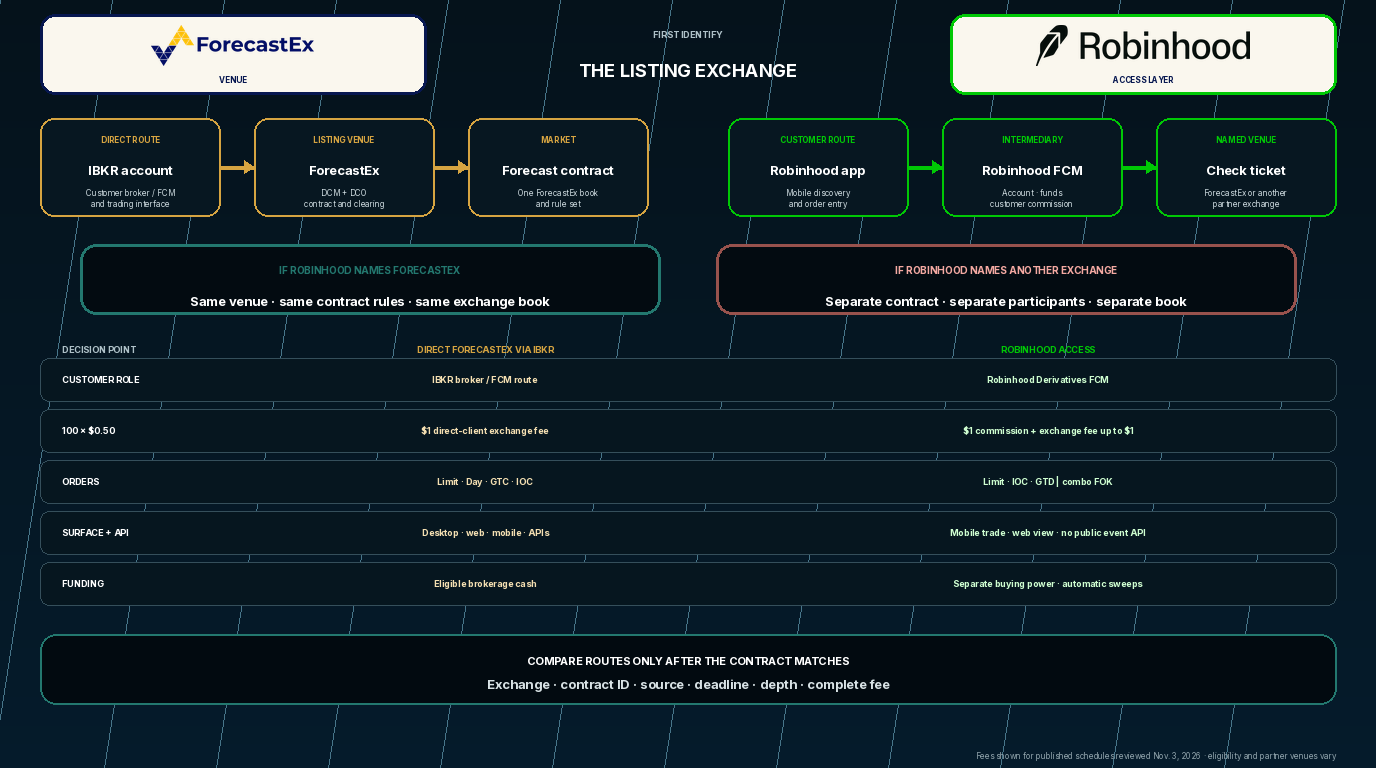
- Robinhood ticket names ForecastEx. The customer uses Robinhood Derivatives as the FCM, but the position reaches ForecastEx. The exchange question, rulebook, matching process, liquidity and settlement authority come from ForecastEx. The Robinhood and direct-IBKR experiences can still differ in commission, interface, order-entry controls, funding, support and reporting.
- Robinhood ticket names another exchange. The question may look similar, but it belongs to a different venue. It can have different wording, deadlines, official sources, price increments, fees, participants and settlement contingencies. The books are independent.
This is why a price shown in Robinhood cannot be compared with an IBKR ForecastEx quote until the venue and complete contract identifier match. If they match, a temporary display difference can reflect refresh timing, order size, fee presentation or interface behavior - not separate market consensus.
If they do not match, the apparent probability difference may be rational. One contract might use headline CPI while another uses core CPI. One may settle on the first release while another recognizes revisions. One threshold may count equality while another requires a strict greater-than result.
Same exchange does not mean identical customer experience
Using the same exchange does not erase the FCM. The FCM determines onboarding, eligibility checks, customer-facing fees, cash movement, interface, statements, support and available order controls. Robinhood can therefore be easier for a mobile brokerage customer even when both routes ultimately touch ForecastEx.
Conversely, direct IBKR access can be more useful to a trader who needs desktop workstations, web execution, APIs and consolidated multi-asset reporting. Neither interface changes ForecastEx's final authority over a ForecastEx-listed contract.
Fees, Gold and a Matched ForecastEx Example
Interactive Brokers' current prediction-market pricing lists a $0 commission for ForecastEx Forecast Contracts plus a $0.01 third-party exchange fee per contract for direct US clients. Introduced, advised, managed and non-US arrangements can differ.
Robinhood moved to probability-weighted event-contract commissions on June 1, 2026. Its current event-contract overview publishes this formula:
Robinhood commission = k × price × (1 − price) × contracts
The coefficient is 5% with a Robinhood Gold subscription and 10% without Gold. Robinhood rounds the order commission up to the nearest cent and caps it at $0.01 per contract. The partner exchange typically adds a separate charge that can be as high as $0.01 per contract. Fees can apply on both opening and closing executions.
| Illustration | ForecastEx through current direct-IBKR schedule | Robinhood with Gold | Robinhood without Gold |
|---|---|---|---|
| Open 100 contracts at $0.50 | $1.00 exchange fee | $1.00 capped commission, plus up to $1 exchange fee | $1.00 capped commission, plus up to $1 exchange fee |
| Open 100 contracts at $0.90 | $1.00 exchange fee | $0.45 commission, plus applicable exchange fee | $0.90 commission, plus applicable exchange fee |
| Close or offset before settlement | Another execution fee if the opposite contract is bought | Another commission and exchange fee can apply | Another commission and exchange fee can apply |
At the midpoint, Gold does not reduce the Robinhood commission in the 100-contract illustration because both calculations hit the one-cent-per-contract cap. At $0.90, Gold reduces the commission from $0.90 to $0.45. Gold itself has a subscription price, so a complete comparison should include the subscription only when the user would not otherwise pay for it.
Same ForecastEx book, different customer cost
Suppose Robinhood identifies ForecastEx and IBKR shows the exact same contract. The exchange-side liquidity can be the same, while the customer-facing expense differs. Under the published direct-IBKR schedule, 100 contracts cost $1 in exchange fees. Through Robinhood at $0.50, the Robinhood commission is $1 and the exchange fee can add up to another $1.
This does not guarantee that the IBKR route has the better final result. The executable price, available quantity and order behavior still matter. A one-cent price difference across 100 contracts is another $1 - enough to equal the direct route's entire explicit opening fee.
The correct calculation is:
all-in result = settlement or exit proceeds − entry cost − commission − exchange fees − spread − slippage − exit costs − optional subscription allocation
Use our prediction-market fee calculator to normalize the schedules, then replace every illustration with the live order confirmation. Never infer a ForecastEx fee from a Robinhood screen that names a different partner exchange.
ForecastEx coupon is separate from fees
ForecastEx can distribute a variable collateral-based incentive coupon under current member terms. The rate and treatment can change, and eligibility depends on the carrying member and account arrangement. It is not guaranteed yield and does not protect a losing contract.
Do not subtract an assumed coupon from an entry fee. Compare the actual amount credited over the actual holding period, after confirming that the route and account qualify.
Contracts, Orders, APIs and Early Exit
ForecastEx uses an unusual contract model. Yes and No are separate buy-only instruments. The documented IBKR route supports Limit orders with Day, Good-Till-Canceled and Immediate-Or-Cancel time in force. Orders use whole contracts, and ForecastEx positions cannot be sold in the conventional sense.
To exit a ForecastEx Yes position before resolution, the trader buys the corresponding No contract. To exit No, the trader buys Yes. ForecastEx then has an offsetting pair under its rules. This requires an acceptable offer in the opposite contract and another execution fee.
Robinhood presents a simpler consumer workflow: select Yes or No, enter contracts or dollars and review the order. Current Robinhood trading documentation says standard event contracts use limit orders. Contract orders can be IOC or GTD; GTD orders remain open until filled or 3 a.m. ET the next calendar day. Dollar orders are IOC.
| Capability | ForecastEx through IBKR | Robinhood Prediction Markets |
|---|---|---|
| Standard order type | Limit | Limit |
| Time in force | Day, GTC, IOC | IOC or GTD; GTD expires at 3 a.m. ET next calendar day |
| Opening quantity | Whole contracts | Whole contracts for opening limit orders; dollar orders calculate quantity |
| Fractional support | Not documented for ForecastEx route | Selected dollar and closing orders can use fractions up to two decimals |
| Custom combinations | Not a defining retail feature | Up to ten supported legs; FOK execution and exchange quote required |
| Early exit | Buy matching opposite contract | App shows a close flow; venue mechanics still control the underlying position |
| Desktop/web execution | Available through IBKR surfaces | Web is view-only; event trading is mobile-only and absent from Legend |
| API | IBKR TWS and Web API environment | No public Robinhood event-contract trading API documented |
Robinhood's interface cannot override ForecastEx mechanics
Robinhood says customers can sell or close contracts before expiration, but the legal mechanics depend on the listing venue. For a ForecastEx-listed contract, Robinhood's own Forecast Contract Risk Disclosure states that contracts cannot be sold or transferred to another exchange. An early exit is achieved by acquiring the matching opposite position.
That means the button can look familiar while the venue-level process remains ForecastEx-specific. For a contract from another exchange, the close mechanics can differ. Always read the terms linked from the exact event page.
Which route is better for technical users?
ForecastEx through IBKR is the clear choice for programmatic workflows. IBKR documents ForecastEx contracts in its TWS and Web API environments, including contract discovery, market data and order submission. Event contracts can sit inside systems that also track stocks, options, futures, bonds and currencies.
Robinhood's public developer API does not currently document event-contract order entry. Its event product is designed around the mobile app. That can be more approachable, but it is not a substitute for a documented trading API, desktop terminal or automated reconciliation flow.
Neither route guarantees an early exit. IOC orders can cancel, GTD or GTC limits can remain unfilled, and ForecastEx offsets require liquidity in the opposite contract. Our bid-ask spread guide explains why the displayed probability is not necessarily the price available for the complete intended size.
Funding, Markets and Liquidity
ForecastEx access follows the carrying FCM. Through Interactive Brokers, eligible customers use brokerage cash and permissions. Event contracts can be viewed beside a broad multi-asset portfolio, and the direct client does not need a separate consumer prediction app.
Robinhood creates a separate Robinhood Derivatives event-contract account. Its buying-power guide says event buying power is distinct from brokerage and crypto balances, but funds sweep automatically rather than through a manual transfer. Instant deposits may not be available, so fully settled cash can be required. Standard ACH transfers can take one to five business days; debit-card and wire funding may also be available under current terms.
That structure favors an existing Robinhood customer who values convenience. It does not make the balances legally identical or make event positions SIPC-protected. Robinhood Derivatives' disclosures state that the derivatives entity is not FDIC insured or SIPC protected.
Market breadth
ForecastEx specializes in objective, scheduled and measurable questions. Its strongest identity covers economic data, Federal Reserve decisions, government statistics, climate observations and financial thresholds. It suits traders who begin with an economic calendar and then select an exact strike or range.
Robinhood aggregates discovery across partner exchanges. Current materials show sports, politics, weather, commodities, entertainment and other categories. It can also offer preset or custom combinations where the exchange supplies a quote. That breadth is an interface advantage, not proof that every category comes from ForecastEx.
For a broader exchange-to-exchange comparison, read ForecastEx vs Polymarket US. For another access-layer comparison, Robinhood vs Interactive Brokers Prediction Markets evaluates the two FCM and brokerage experiences directly.
Which has better liquidity?
There is no defensible permanent winner. If Robinhood routes the same ForecastEx contract, liquidity comes from the same ForecastEx market rather than an independent Robinhood pool. If Robinhood routes another exchange, liquidity belongs to that other venue and contract.
Compare at the contract level:
- Confirm the exchange and complete contract identifier.
- Match the proposition, source, threshold, deadline and contingency language.
- Record the best executable price and quantity for the intended side.
- Inspect depth beyond the first displayed unit.
- Add commission, exchange fee, spread and likely exit cost.
- Repeat at the same time; stale screenshots are weak evidence.
Do not use Robinhood's total prediction-market volume, Interactive Brokers' company-wide volume or a popular sports contract as proof that a specific ForecastEx macro threshold is liquid.
Regulation, Settlement, Risk and the Macro Alternative
ForecastEx's DCM and DCO registrations identify the exchange and clearinghouse. Robinhood Derivatives' FCM registration identifies the intermediary carrying the customer relationship. Those roles create auditable rules and regulatory obligations, but they do not guarantee a favorable price, uninterrupted access, an early exit or a profitable forecast.
The exchange named on the ticket controls settlement. Robinhood's settlement guide explicitly says Robinhood does not determine the official settlement rules. The partner exchange defines the source, measurement, deadline and treatment of exceptional outcomes.
For every position, save the contract terms and verify:
- exact event question and outcome side;
- listing exchange and contract identifier;
- official source, release table or league record;
- observation date, deadline and time zone;
- strict or inclusive threshold;
- treatment of revisions, corrections, postponements and cancellations;
- maximum loss, explicit fees and likely spread; and
- expected settlement and withdrawal timing.
ForecastEx contracts are fully collateralized. A winning side generally receives $1 and a losing side expires at $0. Robinhood also describes event positions as defined-risk contracts, but a customer can still lose the full purchase amount plus fees. Fractional and nonstandard settlements can use special rounding or fallback values.
Availability can change by state and category
Robinhood requires an approved Robinhood Derivatives account, an individual brokerage account, US residency and age 18 or older. State and category restrictions apply. As of the review date, its current page lists sports restrictions in Maryland, Michigan, Nevada and Ohio, plus broader category restrictions in Utah. This list can change and should not be copied into a permanent eligibility assumption.
ForecastEx eligibility depends on the carrying FCM, customer location, account entity and permissions. A market appearing publicly does not guarantee that an individual customer can trade it.
Our guide to prediction-market legality explains why an entity's registration and a customer's eligibility are related but separate questions.
Macro Markets as a crypto-native alternative
Macro Markets is relevant when an eligible user prioritizes crypto funding, digital-asset custody workflows and global market discovery instead of a US brokerage or FCM relationship. It has a different jurisdictional, regulatory, custody and funding profile from ForecastEx and Robinhood.
Because Macro Markets publishes this article, treat this section as disclosed first-party information. Verify current eligibility, supported assets and networks, custody, fees, liquidity and resolution rules independently. Macro Markets is not presented as a CFTC-designated exchange, DCO or US FCM.
Which Platform Should You Choose?
Choose ForecastEx through a direct IBKR route when:
- economic, central-bank, government, climate or financial thresholds are the priority;
- desktop, web and API workflows matter;
- event contracts should sit beside a broader multi-asset portfolio;
- the current one-cent exchange fee is preferable to an added FCM commission; and
- you understand separate buy-only Yes and No instruments.
Choose Robinhood Prediction Markets when:
- you already use Robinhood and want one mobile discovery surface;
- automatic buying-power sweeps are valuable;
- multi-exchange selection is more important than a direct venue relationship;
- dollar orders, selected fractional support or combinations matter; and
- you will check the partner exchange on every contract.
Choose neither when the contract language is ambiguous, the market is unavailable in your location, the spread is too wide, the intended quantity cannot execute, or losing the full amount would affect essential finances.
For replacement shortlists, compare the best ForecastEx alternatives and best Robinhood Prediction Markets alternatives.
Frequently asked questions
Is Robinhood Prediction Markets an exchange?
No. Robinhood Derivatives is an FCM and customer interface. The partner exchange named on each contract - such as ForecastEx, KalshiEX, Rothera or CDNA - lists the contract and controls its settlement terms.
Does Robinhood use ForecastEx?
Yes, for supported contracts. Robinhood's current disclosures identify ForecastEx as one of several partner exchanges. Do not assume every Robinhood contract uses ForecastEx; check the event terms and exchange name.
Do Robinhood and ForecastEx share liquidity?
They can when Robinhood routes the exact same ForecastEx-listed contract. In that case, Robinhood is an access route to the ForecastEx venue, not a second independent book. A Robinhood contract listed by another exchange has separate venue liquidity.
Is ForecastEx cheaper than Robinhood?
Under current published schedules, direct IBKR access is cheaper in the matched 100-contract, $0.50 illustration: $1 in ForecastEx exchange fees versus a $1 Robinhood commission plus an exchange fee of up to $1. Executable price, spread, quantity and exit cost can outweigh that explicit-fee difference.
Does Robinhood Gold always lower prediction-market fees?
No. Gold halves the formula coefficient from 10% to 5%, but Robinhood caps commissions at one cent per contract. At prices near $0.50, both tiers can hit the same cap. Gold creates a larger difference near price extremes, and the subscription cost still matters.
Can I trade Robinhood prediction markets on desktop?
Not currently. Robinhood says event-contract trading is available only in its mobile app. Contracts can be viewed on web, and they are not available in Robinhood Legend.
Can I trade ForecastEx through an API?
Yes, through documented Interactive Brokers TWS and Web API workflows, subject to account permissions and technical requirements. Robinhood does not currently document public event-contract order entry in its developer API.
Can I sell a ForecastEx contract?
ForecastEx contracts cannot be sold in the conventional sense through the documented routes. To exit Yes early, acquire the matching No position; to exit No, acquire Yes. Liquidity and another execution fee apply.
Which is better for prediction markets?
ForecastEx through IBKR is better for macro specialization, professional trading surfaces and APIs. Robinhood is better for mobile brokerage convenience and multi-exchange discovery. If Robinhood names ForecastEx, compare the two access routes rather than pretending they are separate exchanges.
Final verdict
ForecastEx and Robinhood are not direct substitutes at the institutional level. ForecastEx creates, lists, matches, clears and settles Forecast Contracts. Robinhood Derivatives carries the customer account and can route orders to ForecastEx or another supported exchange.
That makes the venue label the decisive fact. For a ForecastEx-listed contract, the direct IBKR route currently offers lower explicit fees and stronger desktop/API tooling, while Robinhood offers a simpler mobile experience and automatic integration with an existing brokerage account. For a Robinhood contract listed elsewhere, start the comparison again from the written specification and independent book.
Our verdict favors ForecastEx through IBKR for specialist macro traders and technical workflows. Robinhood wins for eligible mobile customers who value convenience and venue breadth. Neither wins without an exact contract, live executable price, complete fee preview and settlement rule.
Primary sources reviewed
- CFTC ForecastEx designated contract market record
- CFTC ForecastEx derivatives clearing organization record
- Interactive Brokers prediction-market commissions
- Interactive Brokers event-contract order documentation
- Robinhood event contracts overview and fee formula
- Robinhood event-contract trading and order documentation
- Robinhood event-contract buying power
- Robinhood event-contract settlement
- Robinhood Forecast Contract Risk Disclosure