ForecastEx Review 2026: Fees, Safety, Markets and How It Works

ForecastEx is a regulated US prediction exchange with an unusual design. Customers buy separate Yes or No contracts through an eligible futures commission merchant, receive a variable incentive coupon and close early by buying the opposite contract rather than selling. This ForecastEx review examines whether that structure works after fees, liquidity and risk are considered.
Our verdict: ForecastEx is a legitimate and distinctive venue for economic, political, climate and financial event contracts. It is strongest for eligible Interactive Brokers customers who want macro markets inside an existing brokerage account. Its $0.01 exchange fee is simple, and the incentive coupon is a real differentiator. The trade-offs are indirect access, an unfamiliar buy-only structure and dependence on the opposite contract's depth when exiting early.
Last reviewed and fact-checked: November 1, 2026.
Editorial disclosure: Macro Markets publishes this review and operates a prediction-market platform. We include Macro Markets as a disclosed crypto-native alternative and do not present it as a Commodity Futures Trading Commission-designated US exchange. This is a documentation-based review; we did not place a synchronized funded test order through every ForecastEx member. Forecast Contracts can settle at $0, and regulation, full collateralization and incentive coupons do not protect a customer from trading losses. This article is educational, not financial, tax or legal advice.
ForecastEx Review: Quick Verdict and Scorecard
ForecastEx lists and clears Forecast Contracts but does not primarily operate as a direct consumer broker. An eligible customer normally reaches it through a qualified futures commission merchant (FCM), most visibly Interactive Brokers. The FCM controls the account, funding, permissions and reporting; ForecastEx controls the exchange rules, execution, clearing and settlement.
ForecastEx at a glance
| Review factor | Current assessment | What it means |
|---|---|---|
| Regulation | CFTC-designated contract market and registered derivatives clearing organization | Legitimate US exchange and clearing structure, not loss protection |
| Retail access | Through eligible FCM accounts | No ordinary direct-to-exchange consumer account |
| Contract structure | Separate buy-only Yes and No positions | Closing early requires acquiring the opposite side |
| Settlement | Correct side receives $1; incorrect side receives $0 | Maximum contract loss can equal the amount paid plus fees |
| Published exchange fee | $0.01 per contract at execution | Simple headline fee; spread and exit cost still matter |
| IBKR direct-client route | $0 IBKR commission plus $0.01 exchange fee | Account arrangements and taxes can differ |
| Incentive coupon | Variable, accrued daily and paid monthly | Adds collateral earnings but does not insure the outcome |
| Main market strengths | Economics, central banks, government, climate and financial benchmarks | Particularly relevant to macro-focused traders |
| Interfaces | Broker web, desktop, mobile and APIs | Experience depends heavily on the selected FCM |
| Main weakness | Opposite-side liquidity required for early close | Exiting can be costly or impossible in a thin or halted market |
Pros
- CFTC-designated exchange and registered clearing organization.
- Clear $1-or-$0 contract payoff.
- Simple published $0.01 exchange fee.
- Variable incentive coupon paid while eligible positions remain open.
- Strong coverage of scheduled macroeconomic and climate data.
- Integration with professional Interactive Brokers tools and APIs.
- Fully collateralized exchange structure.
Cons
- Indirect customer access through a broker or FCM.
- Separate Yes and No contracts are less intuitive than ordinary buying and selling.
- Early exits require sufficient depth in the opposite contract.
- USD denomination creates currency risk for customers funding in another currency.
- Forecast Contracts cannot be used as collateral for margin loans under the current IBKR disclosure.
- Availability depends on residence, broker affiliate, permissions and contract category.
- A regulated contract can still settle at zero or become difficult to exit.
What Is ForecastEx and How Does It Work?
ForecastEx LLC is a US event-contract exchange and clearinghouse within the Interactive Brokers Group. The CFTC lists it as a designated contract market and registered derivatives clearing organization. Both registrations took effect June 24, 2024. The DCO scope includes fully collateralized swap positions.
Customers do not normally send retail funds directly to ForecastEx. The venue's membership documentation says customers trade through qualified FCM members or other approved access arrangements. Interactive Brokers provides the most visible retail route and is affiliated with ForecastEx.
An order generally follows this path:
- The customer opens and funds an eligible FCM account.
- The broker approves prediction-market permissions for the customer and contract.
- The customer selects a ForecastEx event question and either the Yes or No contract.
- The FCM sends a fully collateralized bid to ForecastEx.
- ForecastEx matches the paired Yes and No interests and clears the resulting positions.
- The exchange applies the written settlement rules when the source publishes the result.
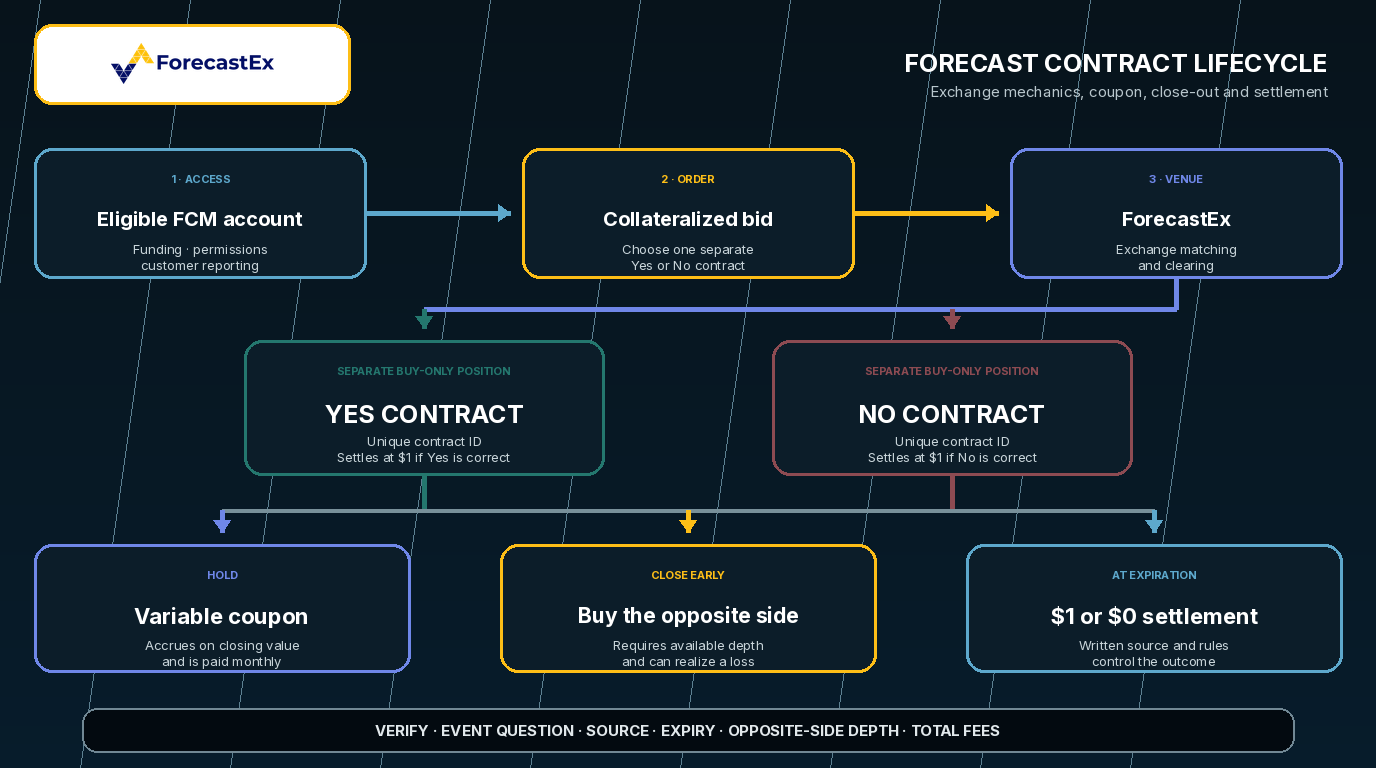
ForecastEx uses separate Yes and No contracts. A customer can hold, buy the opposite side to close early or continue to contract settlement.
Yes and No are separate contracts
ForecastEx does not describe the market as one participant selling a contract to another. Its contract guide says Yes and No are separate contracts with different identifiers. Participants bid to buy their selected side, and the two positions are paired through the exchange and clearinghouse.
Prices are generally quoted from $0.01 to $0.99 in one-cent increments. A correct contract receives $1 at settlement, while the incorrect contract receives $0. A customer who buys Yes for $0.43 has a maximum gross settlement difference of $0.57 if Yes is correct, before fees. If Yes is incorrect, the $0.43 contract cost is lost, plus the execution fee, before any coupon income.
How an early exit works
A Forecast Contract is not closed by selling the original position. The documented exit is to acquire the opposite contract for the same event question. A customer holding Yes buys No; a customer holding No buys Yes. The combined position then produces the fixed $1 settlement amount under ForecastEx rules.
This makes the exit cost easy to calculate:
Net close-out result = $1 settlement - original side cost - opposite side cost - both execution fees + eligible coupons
Suppose a customer bought Yes for $0.43 plus a $0.01 fee and later buys No for $0.40 plus another $0.01 fee. The paired position costs $0.85 and returns $1, leaving $0.15 before coupons and taxes. If No costs $0.80 instead, the total cost becomes $1.25 and the close-out realizes a $0.25 loss before coupons.
The important constraint is liquidity. The customer cannot manufacture the opposing contract at an attractive price, and trading can be halted. The current IBKR risk disclosure warns that insufficient volume or depth can prevent an offset.
ForecastEx Markets, Liquidity and Trading Experience
ForecastEx is strongest when an event has an objective, scheduled source. The venue's current markets catalog includes US initial jobless claims, unemployment, retail sales, building permits, payroll employment, inflation, Fed Funds, housing starts, real gross domestic product, corporate profits, national debt and global temperature. Its broader documentation also covers elections, government, capital markets and financial benchmarks.
That catalog gives ForecastEx a coherent identity. Macro traders can form positions around releases already used in rates, currency, equity and bond analysis. Each contract can also serve as one signal beside surveys and economist forecasts.
The resolution source matters more than the headline. Current ForecastEx examples reference agencies and institutions such as the Bureau of Labor Statistics, Census Bureau, Bureau of Economic Analysis, National Oceanic and Atmospheric Administration and University of Michigan. Before trading, record:
- the exact event question and threshold;
- the Yes or No contract identifier;
- the source agency and named data series;
- the observation date, release time and time zone;
- whether revisions affect settlement;
- the expiration and review procedure; and
- the live price, quantity and complete fee preview.
Closely related questions are not interchangeable. “CPI above 3% year over year” is not the same instrument as “monthly CPI above 0.3%.” A first release can also differ from a later revised value. The exchange rules, not an AI answer or news headline, control settlement.
Liquidity and price quality
ForecastEx regulation does not guarantee a liquid order book. Popular releases can attract interest, while distant thresholds or specialized contracts can be thin. A displayed price matters only when enough size can execute near it.
Evaluate four numbers rather than one probability:
- the best executable price for the selected side;
- the available quantity at that price;
- the price and depth of the opposite side for a possible exit; and
- the total fee for entry and any future offset.
A wide gap between the paired sides can make an early close expensive even when the original forecast was reasonable. The incentive coupon should not be used to excuse poor execution. Use limit orders and size the position for the possibility of holding through settlement.
Our guide to the bid-ask spread in prediction markets explains why a low published fee can coexist with a high effective trading cost. The prediction-market fee calculator can help compare contract cost, fees and payoff scenarios.
Web, mobile, desktop and API access
The retail experience is mainly the broker experience. Interactive Brokers documents ForecastEx access through its prediction-market web interface and broader brokerage platforms, with eligible positions managed beside stocks, options, futures and bonds. This is an advantage for an existing IBKR customer and extra complexity for someone seeking a simple standalone prediction app.
Developers can use IBKR's Web API or Trader Workstation API, subject to permissions. The official TWS event-contract documentation uses FORECASTX as the exchange value and represents Yes and No through option-style fields. Contract discovery must preserve the exchange, expiration, strike, side and persistent contract identifier.
API automation does not change the rules. Test manually, enforce maximum price and quantity, reconcile partial fills and preserve the exchange plus contract ID.
ForecastEx Fees, Incentive Coupon and Funding
ForecastEx publishes a $0.01 transaction fee per contract, charged when an execution occurs. Interactive Brokers' current prediction-market commission schedule lists ForecastEx at $0 IBKR commission plus the $0.01 third-party exchange fee for US direct clients.
That makes 100 executed contracts a $1 exchange-fee line item under the current schedule. Introduced customers, advisor-managed accounts and some tax jurisdictions can incur additional charges. Rates can change, so the signed-in order preview remains the controlling number.
The complete cost is:
Total cost = contract price + exchange fee + broker/account charges + spread or price impact + currency conversion
If 100 Yes contracts execute at $0.48, the contract cost is $48 and the current exchange fee is $1. A correct settlement pays $100, creating a $51 difference after that fee but before taxes, currency conversion or any exit transaction. An incorrect settlement loses the $48 contract cost plus the $1 fee, partly offset only by any coupon already received.
How the incentive coupon works
ForecastEx invests the fully secured cash held through its member structure and passes the earnings back to members. The allocation is based on each member's interest in invested collateral at the daily close. A member can then share that amount with customers as a monthly incentive coupon.
Interactive Brokers displayed a 3.38% annual percentage yield when this review was checked on November 1, 2026. Its event-contract page says the coupon accrues daily based on the closing market value of the position and is paid monthly. The disclosure also says the rate varies with benchmark rates.
Three qualifications are essential:
- The rate is variable. It can rise or fall and should not be projected as a guaranteed return.
- The base is position value. It is not necessarily the same as earning the quoted APY on the original cash cost every day.
- The outcome still dominates. A modest coupon cannot make a contract that settles at $0 profitable by itself.
The coupon adds collateral earnings outside the $1-or-$0 event payoff. Fees, poor execution and an incorrect outcome can still outweigh it.
Collateral and buying power
ForecastEx verifies that member bids can be fully collateralized. At the retail layer, the FCM determines available cash, collection periods, currency conversion and permissions. Forecast Contracts are USD-denominated.
The current IBKR risk disclosure says Forecast Contracts cannot be used as collateral for margin loans. Allocating cash to them can therefore reduce borrowing capacity elsewhere in a margin portfolio. Customers funding in another currency also face exchange-rate movements between entry, coupon payments and settlement.
Do not confuse account equity with usable ForecastEx buying power. Open orders, unsettled transfers, conversion, holds and permissions can all affect what is available.
Is ForecastEx Legit and Safe?
ForecastEx is legitimate, but “regulated” does not mean risk-free. The CFTC designation confirms that ForecastEx operates a registered exchange and clearing framework subject to applicable core principles and oversight. It does not validate a customer's prediction, guarantee an exit price or reimburse a contract that correctly settles at zero.
Full collateralization addresses the exchange's ability to support the paired obligations. It does not prevent market loss. The maximum loss on an unhedged position can be the complete amount paid plus fees, offset by any coupon received.
Review safety through six layers:
- Entity: Which FCM and affiliate hold the customer account?
- Eligibility: Is the customer, residence and account approved for this contract?
- Contract: Which source, threshold, time and correction policy control settlement?
- Execution: What quantity can actually trade at the displayed price?
- Exit: Is the opposite contract deep enough for a realistic close-out?
- Account security: Are multifactor authentication, device controls and API permissions configured correctly?
The official disclosure warns that prices may not represent true probabilities. Thin liquidity, an evident outcome or a halt can prevent an offset. Source-agency problems can delay settlement; currency movement and member operational failures add other risks.
Eligibility is account-specific. IBKR currently says event contracts are available to eligible customers age 21 or older through selected affiliates, and US-election contracts are limited to eligible US residents. Country, affiliate and product permission rules can change. Check the live application and order ticket rather than relying on a static country list.
Forecast Contracts are derivatives, not stock ownership or insured savings products. Do not assume that every protection associated with a securities brokerage position applies identically. Our guide to prediction-market legality in the US explains why exchange status does not answer every customer, jurisdiction or contract-category question.
ForecastEx vs Kalshi, CME and Other Alternatives
ForecastEx's main advantage is not that it is universally cheaper or safer. It is the combination of a regulated exchange, macro-focused contract design, a simple fee and the variable coupon. The best alternative depends on the desired catalog, account layer, funding method and legal structure.
| Platform | Structure | Strongest fit | Main trade-off |
|---|---|---|---|
| ForecastEx | CFTC DCM and DCO, generally reached through an FCM | Macro, climate and financial event contracts inside an IBKR workflow | Buy-only Yes/No structure and opposite-side exit dependency |
| Kalshi direct | CFTC DCM with separate clearing organization and direct customer account | Native prediction-market interface, direct account and broad event catalog | Different fee model and separate account workflow |
| CME event contracts | Established derivatives exchange and clearing structure | Event exposure connected to traditional futures benchmarks | More traditional derivatives context and product-specific mechanics |
| Interactive Brokers | Broker/FCM routing to ForecastEx, Kalshi and CME | Multi-venue search, professional tools, APIs and consolidated reporting | It is the access layer, not the listing exchange |
| Polymarket US | QCX DCM with Polymarket Clearing DCO | Direct prediction-first account, broad discovery and conventional buy/sell mechanics | Separate US product, order book, funding and fee schedule |
| Gemini Predictions | Gemini-operated US exchange and clearing entities | Crypto-oriented users wanting an integrated Gemini account | Separate fee, eligibility and liquidity profile |
| Coinbase | FCM/intermediary account layer for supported event contracts | Existing Coinbase customers using settled USD or USDC | Venue liquidity and rules still come from the underlying exchange |
| Robinhood | Mobile-first intermediary for supported event contracts | Retail users prioritizing a simple app experience | Supported venue, catalog and order behavior vary by contract |
| Macro Markets | Crypto-native prediction-market platform; not presented as a US DCM | Eligible users seeking crypto funding and global market discovery | Different jurisdiction, custody, funding and regulatory profile |
Choose ForecastEx when macro, climate or financial thresholds are the main interest, an eligible FCM account is available and holding until settlement is acceptable.
Choose Kalshi direct when a dedicated account, native REST API, direct funding and consumer-first discovery matter more. Read our ForecastEx vs Kalshi comparison for the exchange mechanics, fee routes and early-exit differences, then use the Kalshi review or Kalshi vs Interactive Brokers comparison for deeper platform detail.
Choose CME when the event position belongs inside a traditional futures and derivatives workflow. Our direct ForecastEx vs CME comparison covers product classification, buy-and-sell versus opposite-contract exits and the current IBKR fee routes.
Choose Polymarket US when a direct prediction-market account, broader consumer discovery, conventional long/short trading, fractional contracts and native APIs matter more than ForecastEx's specialist broker route. Our direct ForecastEx vs Polymarket US comparison matches the contract models, current fee examples, funding, APIs, settlement and independent books.
Choose Gemini Predictions when an integrated crypto account, a broader consumer catalog, native Predictions APIs and maker/taker execution matter more than ForecastEx's specialist macro design and variable coupon. Our direct ForecastEx vs Gemini Predictions comparison matches fees, funding, orders, incentives, APIs and the two independent order books.
Choose Crypto.com Predict Pro when a focused professional prediction interface, Market orders and explicit Post-Only maker control matter more than ForecastEx's macro specialization and incentive coupon. Predict Pro uses the separate CDNA/NADEX book rather than ForecastEx liquidity. Our ForecastEx vs Crypto.com Predict Pro comparison matches the current fees, orders, funding, APIs, early-exit mechanics and settlement structure directly.
Choose Robinhood when mobile brokerage convenience and multi-exchange discovery matter more than direct venue tooling. If its ticket names ForecastEx, both routes can reach the same underlying ForecastEx market while customer commissions, funding, order controls and interfaces differ. Our ForecastEx vs Robinhood Prediction Markets comparison separates that shared-venue case from contracts routed to another partner exchange.
Choose Coinbase when settled USD or USDC and a familiar crypto-account workflow matter more than ForecastEx's specialist tools. Coinbase currently routes Predictions to Kalshi, so the books are independent. Our ForecastEx vs Coinbase Prediction Markets comparison matches the legal roles, fees, funding, orders, APIs and settlement chains.
Choose DraftKings Predictions when sports-first discovery, combo markets and a consumer mobile flow matter more than ForecastEx's macro tools. DraftKings is the customer FCM layer for contracts that can come from DKeX, CDNA or CME, so verify the listing exchange and book on each ticket. The ForecastEx vs DraftKings Predictions comparison matches their legal roles, fees, orders, APIs, wallets and separate liquidity routes.
Choose FanDuel Predicts when sports-led discovery and a simple mobile Market-order flow matter more than ForecastEx's specialist macro tools. FanDuel carries the customer account as an FCM while CME Group exchanges currently list the contracts described in its product materials. The ForecastEx vs FanDuel Predicts comparison matches their legal roles, fees, wallets, orders, APIs and independent books.
Choose Fanatics Markets when sports discovery, FanCash and combo RFQs matter more than ForecastEx's macro specialization. Fanatics is the customer FCM or documented IB access layer, while CDNA maintains the separate listing venue and book. The ForecastEx vs Fanatics Markets comparison matches legal roles, fees, funding, orders, APIs and independent liquidity.
Choose Interactive Brokers as the account layer when multi-asset reporting, desktop software and cross-venue discovery matter. Our Interactive Brokers Prediction Markets review covers that broker in depth.
Consider Macro Markets when you are eligible to use a crypto-native platform and deliberately prefer crypto funding plus global market discovery. Because Macro Markets publishes this review, treat that inclusion as a disclosed first-party statement. Verify current jurisdiction, wallet network, custody, fees, liquidity and resolution rules independently. Macro Markets has a different legal profile and is not represented here as a CFTC-designated US exchange.
For direct replacements, use the best ForecastEx alternatives. Wider shortlists include the best prediction-market apps, Kalshi alternatives and Interactive Brokers prediction-market alternatives. Our comparison methodology explains why legal role, exact contract terms and executable depth should be compared before brand familiarity.
Frequently Asked Questions and Final Verdict
Is ForecastEx legit?
Yes. ForecastEx is listed by the CFTC as a designated contract market and registered derivatives clearing organization. It operates a regulated exchange and clears fully collateralized positions within its approved scope. That status does not guarantee profit, liquidity or an early exit.
Is ForecastEx the same as Interactive Brokers?
No. ForecastEx is an affiliated exchange and clearing organization. Interactive Brokers is the broker/FCM that provides eligible customers with account access, funding, interfaces and reporting. The ForecastEx contract rules control a ForecastEx settlement.
What fees does ForecastEx charge?
ForecastEx publishes a $0.01 transaction fee per executed contract. IBKR's current US direct-client schedule lists $0 commission plus that $0.01 exchange fee for ForecastEx. Other account arrangements, taxes, spreads, price impact and currency conversion can add cost.
Does ForecastEx pay interest?
ForecastEx distributes collateral earnings through a variable incentive coupon. Through IBKR, it accrues daily based on closing position value and is paid monthly. IBKR displayed 3.38% APY when checked on November 1, 2026, but the rate varies with benchmark rates and is not guaranteed.
Can I sell a ForecastEx contract?
Not in the conventional sense. Yes and No are separate buy-only contracts. To close before expiration, a customer acquires the opposite contract for the same event question. The exit depends on available opposing-side liquidity and can realize a loss.
Can I trade ForecastEx directly?
Retail customers generally access Forecast Contracts through a qualified FCM rather than opening a direct exchange account. Interactive Brokers is the most visible customer route. Eligibility depends on affiliate, country, age, permissions and contract type.
What markets are available on ForecastEx?
The venue focuses on economics, central banks, government, elections, climate and financial benchmarks. Current examples include CPI, payrolls, unemployment, Fed Funds, GDP, housing, national debt and global temperature contracts. Listings change over time.
Does ForecastEx have an API?
Eligible Interactive Brokers customers can use supported IBKR APIs for ForecastEx contract discovery, market data and trading. The TWS API uses FORECASTX as the exchange identifier. Developers must preserve contract IDs, side, expiration and strike and use strict order controls.
Is ForecastEx better than Kalshi?
ForecastEx can be better for an eligible IBKR customer focused on macro events, consolidated brokerage tools and the incentive coupon. Kalshi direct can be better for native market discovery, a dedicated account, direct funding options and its own API. Fees, liquidity and rules must be compared contract by contract.
Final verdict
ForecastEx is a credible specialist prediction exchange, not a universal replacement for Kalshi or a standalone retail broker. Its strengths are regulated exchange and clearing status, macro-oriented markets, a simple fee, full collateralization and the variable coupon.
Its unusual mechanics require discipline. Yes and No are separate contracts. An early exit means buying the opposite side. Thin depth, a halt or an evident outcome can make that offset expensive or impossible. Customers should size every order for the possibility of holding through $1-or-$0 settlement.
ForecastEx is therefore best for eligible customers who already understand Interactive Brokers, read contract specifications and value macroeconomic markets more than consumer-app simplicity. Beginners should compare the broker experience, exact fee, opposing-side depth and settlement source before committing funds.
Ready to evaluate a crypto-native alternative? Open Macro Markets only after confirming that the platform, market and funding route are available and appropriate in your jurisdiction.