Kalshi vs Interactive Brokers Prediction Markets: Which Is Better in 2026?
Kalshi and Interactive Brokers can give a customer access to the same Kalshi event contract, but they are not the same product. Kalshi is the exchange and offers a direct account, native market interface and REST API. Interactive Brokers is a broker and futures commission merchant that can route eligible customers to supported Kalshi contracts while also offering ForecastEx and CME.
That distinction is the key to a useful Kalshi vs Interactive Brokers prediction markets comparison. If the exchange and contract identifier match, both interfaces can reach the same Kalshi order book and settlement rules. IBKR does not create a second pool of Kalshi liquidity. The customer is choosing an account layer, fee path, funding method and toolset around the same exchange instrument.
Our verdict: choose Kalshi direct if you want the exchange's native catalog, direct account relationship, flexible funding options and native API. Choose Interactive Brokers if you want Kalshi positions inside a professional multi-asset portfolio with desktop software, consolidated reporting and access to ForecastEx and CME from the same funded account. Neither route is universally cheaper or better for every contract.
Last reviewed and fact-checked: November 1, 2026.
Editorial disclosure: Macro Markets publishes this comparison and operates a prediction-market platform. We include Macro Markets as a contextual crypto-native alternative, apply the same criteria and do not present it as a CFTC-designated US exchange. This is a documentation-based comparison; we did not place synchronized funded orders through direct Kalshi and IBKR. Event contracts can settle at $0 and lose the complete amount committed. This page is educational, not financial, tax or legal advice.
Kalshi vs Interactive Brokers Prediction Markets: Quick Verdict
Choose Kalshi direct if prediction markets are the primary product you want. A direct customer gets Kalshi's native market discovery, exchange account, funding methods and REST API. Kalshi now says eligible customers from many countries can apply, although country and contract restrictions remain.
Choose Interactive Brokers Prediction Markets if event contracts are one part of a larger investment workflow. Eligible customers can discover supported Kalshi, ForecastEx and CME products, use professional desktop and API tools and manage event positions alongside stocks, options, futures, bonds and other assets.
Winner by use case
- Native Kalshi catalog and interface: Kalshi direct.
- Direct exchange relationship: Kalshi direct.
- Broader direct funding methods: Kalshi direct.
- Native exchange REST API: Kalshi direct.
- Desktop workstation and professional order tools: Interactive Brokers.
- Multi-asset portfolio and reporting: Interactive Brokers.
- Access to ForecastEx and CME from the same account: Interactive Brokers.
- Best liquidity on an identical Kalshi contract: tie; it is the same exchange book.
- Universal fee winner: neither; use the exact contract and order preview.
For standalone assessments, read our Kalshi review and Interactive Brokers Prediction Markets review. Our comparison methodology explains why contract identity and executable depth matter more than the interface displaying the quote.
Kalshi vs Interactive Brokers at a Glance
| Decision factor | Kalshi direct | Interactive Brokers Prediction Markets | Practical edge |
|---|---|---|---|
| Legal role | KalshiEX is the exchange; Kalshi Klear is the clearing organization | IBKR is the broker/FCM; selected exchange lists the contract | Different functions |
| Kalshi liquidity | Native Kalshi book | Same book when the exact Kalshi contract matches | Tie |
| Other prediction venues | Kalshi only | ForecastEx and CME in addition to Kalshi | IBKR |
| Product catalog | Native Kalshi listings | Supported subset plus other venues | Depends on contract |
| Direct standard fee example | $1.75 for 100 contracts at $0.50 under July 2026 general table | $2 for 100 Kalshi contracts under listed direct-client route | Kalshi in this example only |
| Funding | ACH, card, wire, PayPal/Venmo, Cash App deposits and crypto, subject to region | Eligible brokerage cash | Kalshi for rail breadth; IBKR for portfolio integration |
| Trading surfaces | Native web, mobile and REST API | Web, Client Portal, Desktop, TWS, Mobile, GlobalTrader and APIs | IBKR for professional breadth |
| Account reporting | Dedicated prediction-market account | Consolidated multi-asset account | IBKR |
| Eligibility | Many countries, subject to Member Agreement and contract restrictions | Varies by affiliate, country, permission, venue and contract | Account-specific |
| Settlement | Kalshi rules | Kalshi rules for Kalshi contracts; other venue rules for ForecastEx/CME | Same for matching Kalshi contract |
Direct Exchange Access vs Broker Access
A direct Kalshi order generally follows this path:
- The customer opens and verifies a Kalshi account.
- Funds enter the Kalshi balance through an eligible transfer method.
- The customer selects a Kalshi contract through the native platform or API.
- The order reaches the KalshiEX order book.
- Kalshi Klear clears the resulting position, and Kalshi's contract rules control settlement.
An IBKR Kalshi order generally follows this path:
- The customer funds and permissions an eligible Interactive Brokers account.
- IBKR acts as the customer broker and futures commission merchant.
- The customer discovers a supported Kalshi contract through an IBKR interface or API.
- IBKR routes the order to Kalshi.
- The Kalshi order book and contract rules still control execution and settlement.
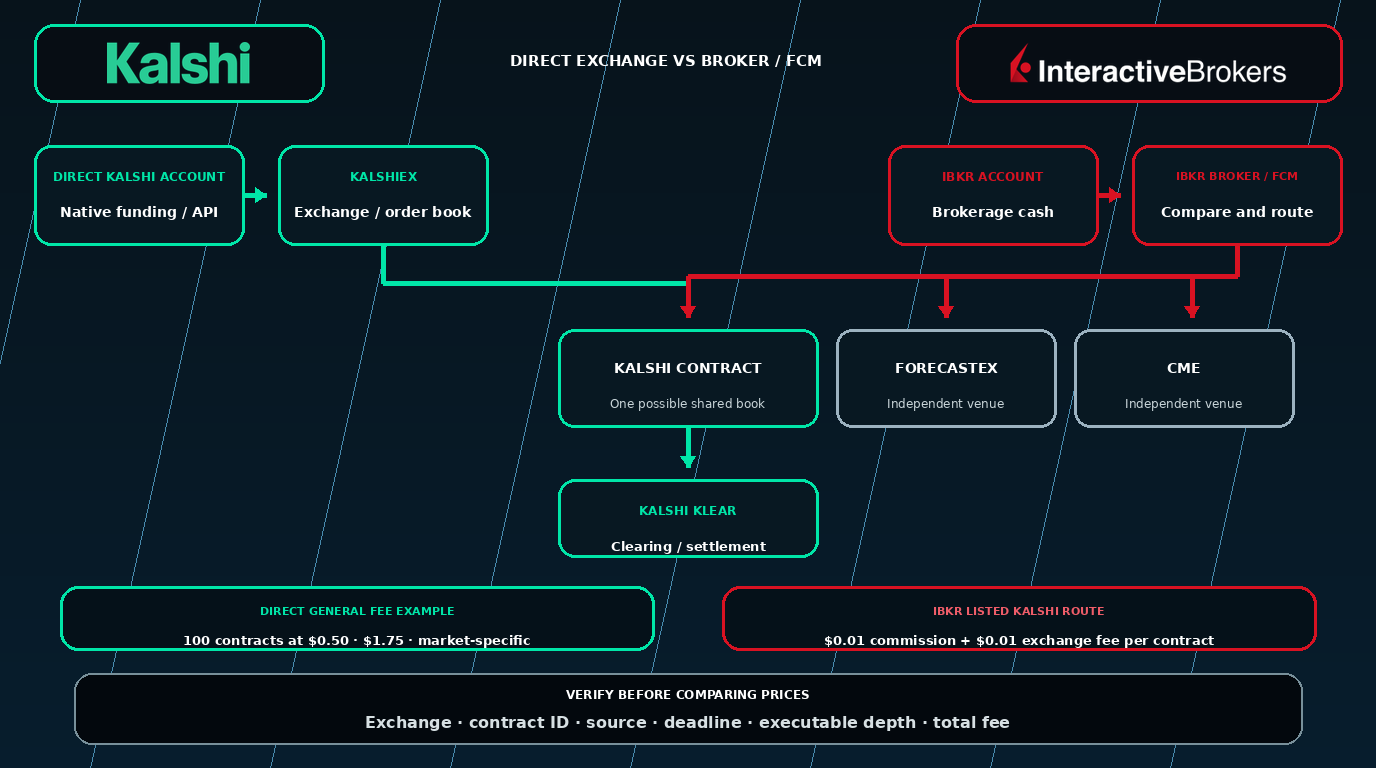
A matching Kalshi identifier reaches one exchange book; ForecastEx and CME contracts available through IBKR remain independent.
The Commodity Futures Trading Commission lists KalshiEX as a designated contract market and Kalshi Klear as a registered derivatives clearing organization. The CFTC amended Kalshi's designation in January 2025 to permit intermediated futures trading, which provides the regulatory basis for FCM customer routes.
IBKR's current event-contract page says eligible clients can search and trade contracts across Kalshi, ForecastEx and CME without separately funding each exchange. The account relationship is consolidated; the venues are not.
When both interfaces show the same Kalshi contract
If the exchange is Kalshi and the exact contract identifier matches, the reasonable inference is that direct Kalshi and IBKR are displaying the same underlying exchange market. Verify that inference in the live tickets before trading.
Record:
- exchange name and contract ID;
- event question and selected side;
- threshold and observation window;
- close and settlement times;
- official resolution source;
- executable price and available quantity; and
- complete customer and exchange charges.
Different screens can show different displayed prices because of refresh timing, rounding, cached data or fee presentation. A difference does not prove separate liquidity. When the identifier matches, compare the direct account and FCM account around the same book.
When IBKR shows ForecastEx or CME
An IBKR ForecastEx or CME contract is not a Kalshi contract. Similar question text can hide different thresholds, sources, deadlines, payout structures and review procedures. Liquidity remains on the named venue. Read our ForecastEx review for its separate Yes/No contracts, incentive coupon and opposite-side close-out model.
IBKR's cross-venue discovery can make comparison easier, but it cannot make contracts interchangeable. A lower price on another venue is not an arbitrage unless the legal and economic terms match and both orders are executable at the required size after fees.
Kalshi vs Interactive Brokers Fees
Kalshi direct uses a market-specific fee schedule. Its current fee help page says charges are based on expected contract earnings and that some markets use different fees. Resting orders can incur maker fees when they execute, and canceling an unfilled resting order does not itself create a trading fee.
The direct exchange's July 7, 2026 fee schedule states:
- no membership fee;
- no settlement fee;
- no Kalshi fee for ACH deposits or withdrawals;
- up to 2% for card deposits;
- processor fees can apply to crypto transfers; and
- market-specific trading multipliers can differ from the general table.
The general trading table lists these examples:
| Direct Kalshi order | Contract debit | Listed general trading fee |
|---|---|---|
| 100 contracts at $0.10 | $10 | $0.63 |
| 100 contracts at $0.25 | $25 | $1.32 |
| 100 contracts at $0.50 | $50 | $1.75 |
| 100 contracts at $0.75 | $75 | $1.32 |
| 100 contracts at $0.90 | $90 | $0.63 |
These are general schedule examples, not quotes for every market. The fee icon and current order ticket control.
IBKR publishes a simpler Kalshi route for direct US clients. Its current commission schedule lists:
| IBKR Kalshi component | Current listed charge |
|---|---|
| IBKR commission | $0.01 per contract |
| Third-party Kalshi exchange fee | $0.01 per contract |
| Listed total | $0.02 per contract |
Advisor, introducing-broker or other arrangements can differ. The listed schedule can also change.
Example: 100 contracts at 50 cents
For 100 contracts priced at $0.50:
- Contract debit: $50.
- Direct Kalshi general-table fee: $1.75.
- IBKR listed Kalshi route: $2.
- Difference in this example: $0.25 in favor of the direct general schedule.
That 25-cent difference does not establish a universal winner. A specific Kalshi market can use a non-standard multiplier or different maker treatment. A direct customer can also incur funding charges. An IBKR client can have account-specific pricing. Most importantly, one cent of worse execution across 100 contracts costs $1, four times the example fee difference.
Use the complete model:
all-in cost = contract debit + trading fees + funding fees + spread + slippage
Our prediction-market fee calculator can compare scenarios. Use the executable quote and quantity rather than the last trade.
Liquidity, Orders and Early Exits
For an identical Kalshi contract, liquidity is not a platform contest. Direct Kalshi and IBKR reach the Kalshi book. The available bid, ask and depth belong to that contract on the exchange.
Compare:
- top executable bid and ask;
- available quantity at each level;
- depth beyond the top quote;
- expected price impact for the complete order;
- order duration and cancellation behavior; and
- executable price for an early close.
Our guide to the bid-ask spread explains why a displayed probability or last trade is not a guaranteed execution price.
Kalshi direct gives customers the exchange-native workflow. A user can browse the complete native catalog, inspect the order book and manage orders without translating the instrument into a broker's product model. For customers focused exclusively on event markets, that narrower context can be easier to understand.
IBKR adds professional order and portfolio tools. Supported event contracts can be managed through its web experience, Client Portal, Desktop, Trader Workstation, Mobile, GlobalTrader and APIs. ScaleTrader can stage eligible orders over a price range. These tools can help with disciplined execution but do not create depth or guarantee fills.
When a Kalshi market is thin, both paths face the same exchange constraint. A resting order may remain unfilled. A marketable order can move through several price levels. A halt or close can prevent an early exit.
Native Kalshi API vs IBKR APIs
Kalshi provides a native REST API. Its official API overview says developers can access public market information, order books, account orders, trades, portfolio data and portfolio history. The native identifiers map directly to exchange markets.
IBKR provides TWS and Web APIs across a much broader brokerage environment. Its event-contract documentation uses KALSHI as one exchange value beside FORECASTX and CME. Yes and No positions use option-style fields in the TWS contract model.
Choose the native Kalshi API when:
- the strategy is centered on Kalshi markets;
- direct exchange identifiers and order books are preferable;
- a separate prediction-market account is acceptable; or
- the developer wants less brokerage abstraction.
Choose an IBKR API when:
- event contracts must coexist with other asset classes;
- consolidated positions and account reporting matter;
- the strategy compares supported venues; or
- an established IBKR integration already exists.
Neither API removes the need for controls. Enforce maximum quantity and price, handle partial fills, reconcile order status and preserve the exchange plus contract ID. Test a workflow manually before automation. An API error can submit the wrong side or size faster than a human interface.
Funding and Account Experience
Kalshi direct offers more visible funding rails. Its current transfer FAQ lists debit card, ACH, PayPal, Venmo, Cash App deposits, cryptocurrency and wire transfer. Availability depends on region. ACH, PayPal, Venmo and Cash App are limited to eligible US users, while international users can have debit-card, wire and crypto options.
Each rail has trade-offs:
- ACH has no Kalshi fee but can take several business days to settle.
- Card deposits can be faster but may cost up to 2%.
- Wire transfers have a $1,000 minimum under current documentation.
- Crypto transfers can include third-party processor charges and require correct asset and network handling.
- Withdrawal holds depend on the method and account status.
IBKR uses eligible brokerage cash. That is convenient when the customer already maintains a funded portfolio and wants one statement. It is less flexible for someone specifically seeking a direct card or crypto funding route for event contracts. Currency conversion can apply when the brokerage account is funded in another currency.
Do not confuse a displayed total portfolio value with available event-contract buying power. Open orders, settlement status, holds, permissions and currency can affect what is usable.
Eligibility and International Access
Kalshi says it is now accessible internationally. Eligible customers from many countries can apply, verify identity and trade subject to the Kalshi Member Agreement. Some jurisdictions and contract categories remain restricted. A customer is responsible for confirming that use is lawful where they live.
This is a material change from older Kalshi comparisons that described the product as US-only. Do not rely on those older summaries. Use the current signup flow and Member Agreement.
IBKR availability varies by the account's affiliate, country of residence, age, product permission and selected venue. Its product page says US-election event contracts are available only to eligible US residents. A customer approved for stocks or options is not automatically approved for every event contract.
Neither route should be accessed with inaccurate identity information or location-masking tools. Availability can change after regulatory or product updates.
Settlement, Clearing and Customer Support
Kalshi controls the rules for a Kalshi contract regardless of whether the customer arrives directly or through IBKR. The written specification defines the source, threshold, observation time, correction policy and review process.
Kalshi Klear provides the clearing structure for Kalshi exchange contracts. IBKR remains the customer broker/FCM for its clients. This creates different support paths:
- A direct customer works with Kalshi for account, funding, order and settlement questions.
- An IBKR customer works with IBKR for the brokerage account and order-routing layer.
- The exchange's final contract determination still controls a Kalshi outcome.
IBKR cannot override a Kalshi settlement because another news source or AI answer gives a different result. Direct Kalshi support likewise cannot ignore the filed contract rules.
Read the specification before placing an order, not only after a disputed outcome. Record a copy of the terms for larger or time-sensitive positions.
Which Route Should You Choose?
Choose Kalshi direct when most of these are true:
- prediction markets are the primary product you want;
- the native exchange catalog and API matter;
- direct card, wire, ACH or crypto funding is useful;
- you want direct exchange support; or
- the current direct fee preview is favorable for the exact order.
Choose Interactive Brokers when most of these are true:
- you already manage a multi-asset IBKR portfolio;
- desktop, TWS or brokerage API tools matter;
- consolidated reporting is valuable;
- you want supported ForecastEx and CME access beside Kalshi; or
- keeping eligible cash in one brokerage account reduces operational work.
If neither model fits, Macro Markets is a crypto-native alternative for eligible users who deliberately prefer crypto funding and global market discovery. Because Macro Markets publishes this comparison, treat that inclusion as a disclosed first-party statement. Verify jurisdiction, eligibility, wallet networks, fees, liquidity, custody and resolution rules independently. Macro Markets has a different legal and custody profile and is not presented as a CFTC-designated US exchange.
For broader shortlists, see the best Kalshi alternatives, Interactive Brokers prediction-market alternatives and our guide to the best prediction-market apps. The Kalshi vs Robinhood comparison covers another intermediary route, while Kalshi vs Coinbase focuses on the Coinbase account layer. Our Kalshi vs Macro Markets comparison explains direct regulated exchange access versus a crypto-native platform.
Frequently Asked Questions and Final Verdict
Does Interactive Brokers use Kalshi?
Yes. IBKR currently documents access to supported Kalshi event contracts alongside ForecastEx and CME. Interactive Brokers acts as the broker/FCM; Kalshi remains the exchange for a Kalshi contract.
Is the Kalshi price the same on IBKR and Kalshi direct?
An identical contract reaches the same Kalshi order book, but displayed values can differ because of refresh timing, rounding, order size or fee presentation. Compare the exact contract, side, executable quantity and total order preview.
Is direct Kalshi cheaper than IBKR?
Not always. The July 2026 direct general table lists $1.75 for 100 contracts at $0.50, while IBKR lists $2 for 100 Kalshi contracts under its direct-client route. Specific Kalshi markets can use different fees, and spread or slippage can be larger than the fee difference.
Can international customers use Kalshi directly?
Kalshi says eligible customers from many countries can apply, subject to country restrictions and its Member Agreement. International payment methods can include debit card, wire and cryptocurrency. Individual contracts can have additional restrictions.
Which platform has the better API?
Kalshi's native REST API is the simpler fit for a Kalshi-only strategy. IBKR's APIs are stronger when event contracts must coexist with other asset classes or when the customer wants supported multi-venue brokerage workflows.
Does IBKR add liquidity to Kalshi?
No separate IBKR Kalshi book is documented. IBKR provides customer access and routing to Kalshi. Liquidity remains on the exact Kalshi contract.
Who settles a Kalshi contract bought through IBKR?
Kalshi applies the contract rules and settlement process. IBKR provides the brokerage account and access layer but cannot replace the exchange's named source or final determination.
Final verdict
Kalshi direct is the better fit for customers who want the native exchange catalog, direct account, flexible funding and native API. Interactive Brokers is the better fit for experienced multi-asset customers who want professional software, consolidated reporting and access to Kalshi, ForecastEx and CME from one brokerage account.
For the same Kalshi contract, there is no separate liquidity winner. Compare the account workflow, exact fees, funding and tools. For a ForecastEx or CME contract, compare it as an independent market with different rules and depth.
Regulation does not guarantee profit or an early exit. Either route can lead to a contract that settles at zero, and a thin or halted book can make closing expensive or impossible.
Ready to evaluate a crypto-native alternative? Open Macro Markets only after checking whether the platform, market and funding route are available and appropriate in your jurisdiction.