


Best Interactive Brokers Prediction Markets Alternatives in 2026

The best Interactive Brokers prediction markets alternatives start with Kalshi for an eligible US customer who wants a direct event exchange instead of a multi-asset brokerage. Robinhood is simpler for customers who want event contracts inside a familiar brokerage app, while Coinbase fits people who prefer settled USD or USDC beside a crypto account.
No single replacement reproduces everything Interactive Brokers provides. IBKR combines a funded brokerage account, professional desktop and API tools, and access to contracts listed on ForecastEx, Kalshi, and CME Group. Switching platforms can therefore mean giving up multi-venue comparison, portfolio reporting, or developer access in exchange for a simpler interface, a direct exchange relationship, or crypto-native funding.
Quick ranking:
- Kalshi: best overall direct-exchange alternative.
- Robinhood: best simpler brokerage alternative.
- Coinbase: best for settled USDC and an existing crypto account.
- Gemini Predictions: best independent exchange with maker tools and public APIs.
- Polymarket US: best second independent US exchange.
- DraftKings Predictions: best sports-oriented consumer alternative.
- Macro Markets: best crypto-native alternative for eligible users.
Last reviewed and fact-checked: November 1, 2026.
Editorial disclosure: Macro Markets publishes this comparison and is included as a crypto-native alternative. That is a material conflict of interest. We do not rank Macro Markets as the best overall option or present it as a CFTC-designated US exchange. We did not open and fund every account in this ranking; the comparison uses current first-party documentation and regulator records. Event contracts can settle at $0. This page is educational, not investment, legal, or tax advice.
Interactive Brokers Alternatives: The Quick Answer
Choose Kalshi when you want a direct relationship with a dedicated event exchange and do not need IBKR's broader portfolio, multi-venue order comparison, or cross-asset tools. Kalshi provides its own order book, contract rules, and exchange documentation. The trade-off is that you lose IBKR's ability to reach other supported venues from the same account.
Choose Robinhood when you already use its brokerage account and want a more consumer-oriented mobile workflow. Robinhood also acts as an intermediary rather than one universal exchange, but the product is narrower and easier to approach than a professional trading workstation.
Choose Coinbase when settled USDC and a familiar crypto customer relationship matter more than multi-venue routing. Coinbase Financial Markets currently connects eligible customers to Kalshi-operated markets. That makes it convenient, but it does not create a new order book or replace IBKR's access to ForecastEx and CME.
Choose Gemini Predictions when you want an independent exchange, maker-versus-taker pricing, public market APIs, and integration with a crypto account. Choose Polymarket US when you want another independent US exchange. Choose DraftKings Predictions when a familiar sports-oriented consumer interface is the priority.
Consider Macro Markets only when you deliberately want crypto-native funding and accept a different jurisdiction, custody, and regulatory profile. IBKR remains the stronger choice when its multi-venue interface, reporting, ScaleTrader, or Web and TWS APIs solve the actual problem. Our Interactive Brokers prediction markets review explains the product being replaced; this guide focuses on alternatives.
IBKR vs the Best Alternatives at a Glance
| Platform | Product structure | Best for | Current cost evidence | Main trade-off |
|---|---|---|---|---|
| Interactive Brokers | Broker and FCM reaching ForecastEx, Kalshi, and CME where supported | Professional tools and multi-venue access | Venue-specific commission plus exchange fee | More complex than a dedicated consumer app |
| Kalshi | Direct CFTC-designated exchange | Dedicated exchange access and broad discovery | Current exchange schedule and order ticket | One venue rather than IBKR's connected set |
| Robinhood | Registered FCM routing to partner exchanges | Existing brokerage customers and mobile simplicity | Probability-weighted commission plus possible exchange fee | Less professional control and narrower API workflow |
| Coinbase | CFM intermediary; current markets operated by Kalshi | Existing Coinbase customers using settled USD or USDC | Fee shown in the order confirmation | Not a multi-venue or exchange-native replacement |
| Gemini Predictions | Gemini Titan DCM with Gemini Olympus clearing | Makers, APIs, and crypto-account integration | Published maker and taker formula | Separate exchange and order book; crypto may be sold into USD |
| Polymarket US | Separate CFTC-designated US exchange | Another independent US venue | Current US notices and order ticket | Must not be confused with international polymarket.com |
| DraftKings Predictions | Consumer interface plus listing exchange | Sports-brand familiarity | Published transaction fee plus exchange fee | Limited professional tooling and venue-specific rules |
| Macro Markets | Crypto-native prediction-market platform | Eligible users seeking digital-asset rails | Platform, network, conversion, and execution costs | Different jurisdiction, custody, and regulatory profile |
The structural difference matters. Interactive Brokers is the customer-facing broker and futures commission merchant. The exchange behind a contract can be ForecastEx, Kalshi, or CME. IBKR's official event-contract product page says eligible clients can search, compare, and trade across those three venues from one account.
One login does not merge the exchanges. A ForecastEx contract keeps its own order book and rules. A Kalshi contract reached through IBKR still uses Kalshi's market and settlement framework. A CME event contract can use a different product structure. Replacing IBKR means deciding which of those layers you still need. Our CME Prediction Market alternatives guide compares the direct exchanges and account routes available when CME itself is the constraint.
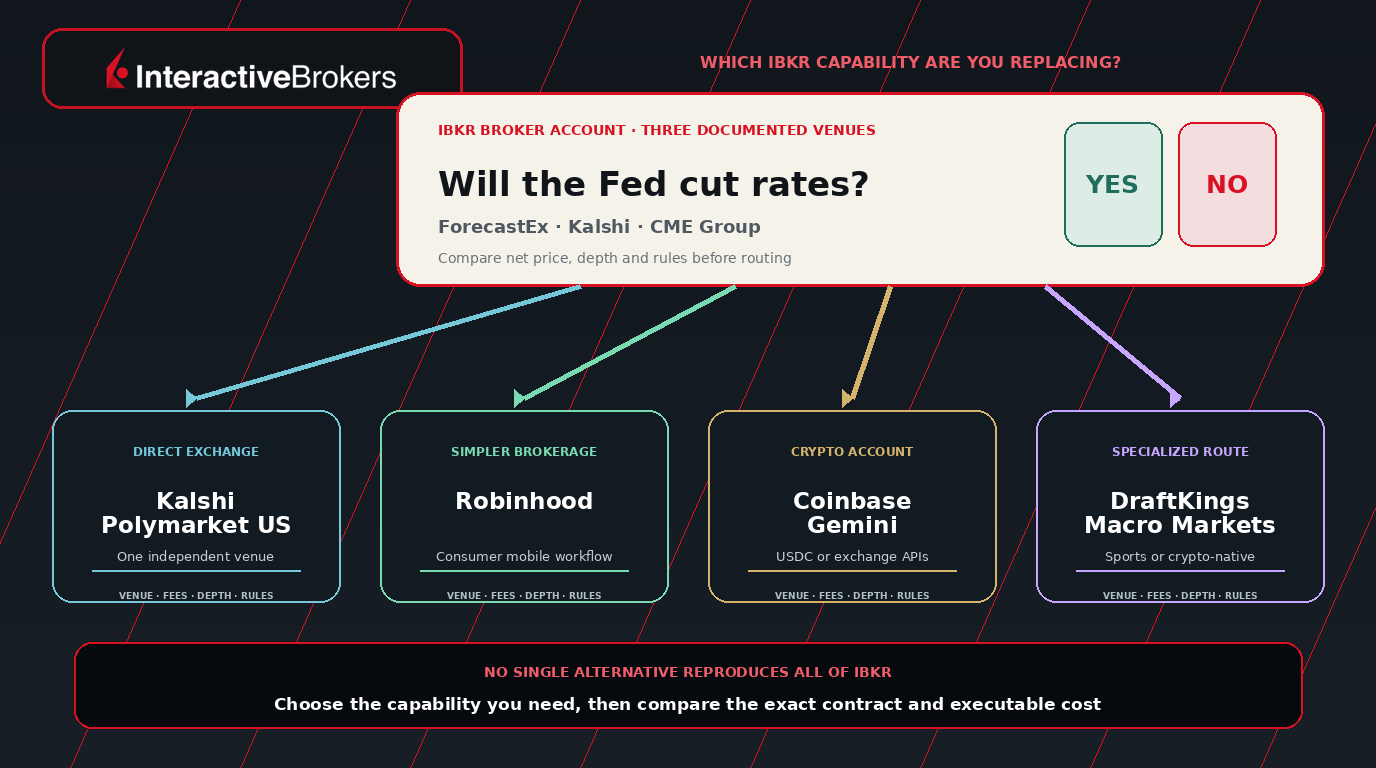
Choose the capability you need first, then compare the exact venue, contract rules, liquidity, and executable cost.
The 7 Best Interactive Brokers Prediction Market Alternatives
1. Kalshi: Best Overall Direct-Exchange Alternative
Kalshi is the strongest general alternative for an eligible US customer who wants a dedicated prediction-market account rather than a full-service brokerage. The CFTC's Kalshi record identifies Kalshi as a designated contract market. It operates the venue, publishes contract rules, and maintains the order book used for direct Kalshi trades.
Kalshi is especially relevant because IBKR already offers access to some Kalshi contracts. A customer leaving IBKR can compare direct Kalshi access with the IBKR route for the same exact ticker. The exchange price may be the same order book, but account workflow, commissions, available tools, and customer support can differ.
Why choose it: You want a focused exchange interface, direct access to Kalshi's catalog, and fewer layers between the account and the contract specification.
Main trade-off: Direct Kalshi does not reproduce IBKR's ForecastEx and CME access, consolidated portfolio, or cross-asset tools. A broad catalog also does not guarantee depth in the specific contract you want.
Check before opening: Eligibility, exact ticker, bid, ask, available size, current fee, settlement source, and whether direct or IBKR access gives the better all-in workflow. Our Kalshi review covers the direct account in detail.
2. Robinhood: Best Simpler Brokerage Alternative
Robinhood is the closest alternative for a customer who still wants event contracts inside a brokerage account but does not need Interactive Brokers' professional workstation. Robinhood Derivatives is a registered futures commission merchant that routes supported contracts to partner exchanges.
Robinhood's current event-contract guide uses a probability-weighted commission. The published coefficient is 5% with Robinhood Gold and 10% without it, rounded up and capped at $0.01 per contract. A partner exchange can add up to another $0.01 per contract.
Why choose it: You already use Robinhood, prefer mobile execution, and value a simpler account experience over advanced desktop features or multi-asset APIs.
Main trade-off: Simplicity can mean less execution control. Venue availability can vary, and each partner exchange keeps its own rules and liquidity. Robinhood does not turn those books into one market.
Check before opening: Partner exchange, Gold subscription economics, total commission, exchange fee, state access, settled buying power, and whether the desired contract appears. Our Robinhood prediction markets review explains the routing model.
3. Coinbase: Best for Settled USDC Convenience
Coinbase fits customers who want prediction markets beside a familiar crypto account and prefer settled USD or USDC. Contracts are offered through Coinbase Financial Markets rather than the international Coinbase exchange business.
Coinbase's official prediction-market introduction at help.coinbase.com/en/coinbase/trading-and-funding/prediction-markets/intro says current markets are operated by Kalshi. The applicable customer fee appears in the order confirmation. We reviewed the page separately because it can return HTTP 403 to automated availability checks.
Why choose it: You already use Coinbase and want browser or mobile access funded with settled USD or USDC.
Main trade-off: Coinbase is currently an access layer to Kalshi, not a substitute for IBKR's three-venue comparison, professional reporting, or event-contract APIs. The familiar account does not create independent liquidity.
Check before opening: Coinbase Financial Markets approval, state access, settled funds, displayed fee, underlying Kalshi rules, and payout timing. See our Coinbase prediction markets review.
4. Gemini Predictions: Best for Exchange-Native APIs and Maker Tools
Gemini Predictions is the strongest alternative when the customer wants an independent exchange connected to a crypto account rather than a broker comparing third-party venues. The CFTC's Gemini Titan record identifies the venue as a designated contract market.
Gemini publishes a prediction-market API for discovery, market data, trading, positions, combinations, rewards, and WebSocket streams. Its fee schedule distinguishes maker and taker orders using a probability-weighted formula. That is a materially different execution model from IBKR's venue-specific per-contract baseline.
Why choose it: You want public exchange-oriented APIs, maker-versus-taker economics, and a crypto-centered account with its own prediction-market venue.
Main trade-off: Gemini Titan is one separate exchange. It does not reproduce IBKR's multi-venue comparison or broad brokerage portfolio. Choosing crypto as the funding source can trigger a sale into USD under Gemini's documented workflow.
Check before opening: Eligibility, maker or taker status, spread, API coverage, funding conversion, contract depth, and exact resolution rules. Our Gemini prediction markets review maps the exchange and clearing structure.
Crypto.com Predict Pro is another professional single-venue option with a crypto-platform account context, but its customer balance, order book and settlement route remain separate from IBKR. The direct Interactive Brokers vs Crypto.com Predict Pro comparison shows when IBKR's three-venue brokerage model or Predict Pro's focused CDNA interface is the better fit.
5. Polymarket US: Best Second Independent US Exchange
Polymarket US provides another exchange-first alternative. The CFTC designation record identifies QCX LLC d/b/a Polymarket US as a designated contract market. That creates a separate venue and price-discovery process from ForecastEx, Kalshi, CME, and Gemini Titan.
The distinction from international polymarket.com is essential. Polymarket US has its own account, rules, fees, order book, and market notices. International crypto-market screenshots and volume claims do not establish the US product's experience.
Why choose it: You want an independent US exchange and the exact Polymarket US contract has suitable rules, pricing, and depth.
Main trade-off: It is another single venue, not a replacement for IBKR's consolidated brokerage tools. The Polymarket brand can also cause users to compare the wrong legal product.
Check before opening: US domain, legal entity, current fee notice, contract source, spread, available size, and settlement procedure. Our Polymarket review explains the US and international split.
6. DraftKings Predictions: Best Sports-Oriented Consumer Alternative
DraftKings Predictions is relevant when a familiar sports brand and consumer web-plus-app workflow matter more than professional APIs or cross-asset portfolio tools. The customer interface and the exchange listing a contract remain separate layers.
Current terms at draftkings.com/predictions-terms state that DraftKings charges $0.01 for each event contract bought or sold and that the listing exchange charges a separate fee. The page can block automated availability checks, so we reviewed it separately rather than presenting a broken clickable link.
Why choose it: You want a recognizable sports-oriented interface and do not need TWS, ScaleTrader, or IBKR's multi-venue API workflow.
Main trade-off: Fixed per-contract charges can matter on low-priced contracts or frequent round trips. Promotions have separate conditions and should not be treated as ordinary execution economics.
Check before opening: Physical-location access, wallet funding, listing exchange, entry and exit charges, cancellation rules, and contract terms. See our DraftKings Predictions review.
7. Macro Markets: Best Crypto-Native Alternative
Macro Markets is the alternative for eligible users who deliberately want digital-asset funding and a crypto-native prediction-market account rather than a US brokerage or direct US exchange. Market themes can include macroeconomics, elections, crypto, technology, sports, and geopolitics.
Transparency note: Macro Markets publishes this page. We include it because its funding and product structure differ materially from Interactive Brokers, not because it should rank above regulated US venues.
Why choose it: You want crypto-native rails and are comfortable evaluating wallets, networks, custody, and jurisdiction directly.
Main trade-off: Macro Markets is not presented as a CFTC-designated US exchange. Its jurisdiction, custody, fee, funding, and regulatory profile differ from IBKR, ForecastEx, Kalshi, CME, Gemini Titan, and Polymarket US.
Check before opening: Local eligibility, KYC, supported assets and networks, custody, liquidity, platform and network costs, withdrawal rules, resolution source, and maximum loss. The Macro Markets help center explains the current market lifecycle.
Fees, Funding, Liquidity, and API Differences
IBKR's current prediction-market commission schedule provides a useful baseline for direct US clients:
- ForecastEx: $0 IBKR commission plus a $0.01 exchange fee per contract.
- Kalshi: $0.01 IBKR commission plus a $0.01 exchange fee per contract.
- CME: $0.01 IBKR commission plus a $0.01 exchange fee per contract.
The schedule can change, and introduced or advised accounts can pay different rates. A displayed one-cent or two-cent route is not the complete cost. Spread and slippage can exceed the commission, especially when the visible size is smaller than the intended order.
Alternatives use different models. Robinhood publishes a probability-weighted customer commission with a per-contract cap and possible exchange fee. Gemini uses maker and taker coefficients. DraftKings publishes a transaction charge plus an exchange charge. Coinbase shows the applicable fee in the order preview. Direct exchanges can publish probability-weighted fees, product-specific schedules, or temporary maker incentives. Crypto-native platforms can add network, conversion, and withdrawal costs.
Normalize every option to the same proposed order:
All-in cost = customer fee + exchange fee + spread + slippage + funding cost + exit cost - usable rebate
Use our prediction-market fee calculator, then replace every example with the live ticket. A low commission cannot compensate for an inferior executable price or contract wording that does not match the intended forecast.
Funding also changes with the alternative. IBKR uses eligible account cash for fully collateralized event positions. Robinhood uses its brokerage funding workflow. Coinbase documents settled USD or USDC. Gemini can sell supported crypto into USD when selected as the payment source. Macro Markets uses crypto-native rails and therefore introduces wallet, network, custody, and conversion choices.
Liquidity must be compared on the same question, side, size, and observation time. Platform-wide volume is not proof that one contract has depth. Even IBKR's unified interface cannot merge separate venue books. Similar ForecastEx and Kalshi questions can have different sources, deadlines, fees, and available size.
APIs are another major switching cost. IBKR's TWS API event-contract documentation explains that event contracts are modeled similarly to options and notes that market scanners do not currently discover them. The separate contract documentation identifies exchange values for ForecastEx, Kalshi, and CME.
Gemini and Kalshi offer their own exchange-oriented developer surfaces. Coinbase, Robinhood, and DraftKings serve more consumer-oriented workflows. Before migrating an automated process, verify instrument discovery, market data, streaming, order types, authentication, rate limits, position reporting, and venue identifiers. A logo on an app is not proof of API equivalence.
How to Choose an IBKR Alternative Safely
Start with the capability you are willing to replace:
- Want a direct US event exchange? Start with Kalshi.
- Want a simpler brokerage app? Compare Robinhood.
- Want settled USDC beside a crypto account? Compare Coinbase.
- Want an independent exchange with public APIs and maker tools? Compare Gemini.
- Want another independent US venue? Evaluate Polymarket US.
- Want a sports-oriented consumer interface? Evaluate DraftKings Predictions.
- Want crypto-native funding? Consider Macro Markets only if eligible and comfortable with its distinct risk profile.
Before opening or funding another account, verify:
- the legal entity holding the customer relationship;
- the exchange listing and settling the exact contract;
- whether the product exposes an independent order book or routes elsewhere;
- current age, residence, state, and physical-location rules;
- funding, conversion, settlement, and withdrawal timing;
- the live bid, ask, and quantity available at the intended price;
- customer and exchange fees on entry and exit;
- the resolution source, observation time, and exceptional-outcome clauses;
- API and order-type requirements if automation matters; and
- whether a total loss would be financially tolerable.
Our prediction-market comparison methodology explains why these checks come before promotions and brand familiarity. The guide to prediction markets and US legality explains why federal registration does not eliminate every state, category, or location question.
Frequently Asked Questions
What is the best Interactive Brokers prediction markets alternative?
Kalshi is the best overall alternative for an eligible US customer who wants direct exchange access. Robinhood is better for a simpler brokerage app. Coinbase is more convenient when settled USDC and an existing crypto account matter most.
Is Kalshi better than Interactive Brokers for prediction markets?
Kalshi is better when you want a focused direct-exchange account. Interactive Brokers is better when multi-venue comparison, professional tools, portfolio reporting, and broader asset access matter. Compare the same exact Kalshi ticker through both routes before assuming one is cheaper.
Does Interactive Brokers operate ForecastEx?
ForecastEx is a wholly owned Interactive Brokers Group subsidiary, while Interactive Brokers LLC is the broker, futures commission merchant, and ForecastEx clearing member. The CFTC's ForecastEx record identifies ForecastEx as a designated contract market. The legal roles are related but distinct.
Which IBKR alternative has the lowest fees?
There is no universal winner. IBKR currently publishes a one-cent ForecastEx exchange fee and a two-cent combined baseline for its Kalshi and CME routes for direct US clients. Alternatives use different formulas. Spread, slippage, funding, and exit costs can be larger than the displayed commission difference.
Which alternative is best for APIs?
Gemini is strong when exchange-native prediction-market endpoints and WebSocket streams matter. Kalshi also provides exchange-oriented developer tools. Neither automatically replaces IBKR's ability to manage event contracts beside other asset classes, so compare the actual discovery, data, order, and reporting endpoints.
Can I access Kalshi without Interactive Brokers?
Yes, eligible customers can open a direct Kalshi account. Direct access and IBKR access can still differ in commission, interface, reporting, and available tools even when the exact contract uses the same Kalshi order book.
Is Polymarket an IBKR alternative in the US?
Polymarket US can be an alternative for eligible US users. It is a separate CFTC-designated exchange product from international polymarket.com. Compare only the US product's account, order book, fees, and rules with IBKR.
Is Macro Markets an Interactive Brokers alternative?
Yes, for eligible users who intentionally want crypto-native funding. It is not a CFTC-designated US exchange or a regulatory equivalent to Interactive Brokers or ForecastEx. Macro Markets publishes this comparison, so readers should independently verify its current eligibility, custody, fees, liquidity, and resolution process.
Can I transfer an IBKR event-contract position to another platform?
Generally, no. A position remains at the venue and account route where it was opened. You normally must offset or close it while the market is tradable, or wait for settlement, before moving available funds under the account's withdrawal rules.
Final Verdict
Start with Kalshi if you want a direct US event exchange and do not need IBKR's consolidated brokerage environment. Choose Robinhood for a simpler brokerage workflow; Coinbase for settled USDC convenience; Gemini Predictions for an independent exchange with maker tools and APIs; Polymarket US for another independent US venue; and DraftKings Predictions for a familiar sports-oriented product.
Consider Macro Markets only when you are eligible and deliberately prefer crypto-native funding. Because Macro Markets publishes this page, independently verify its jurisdiction, custody, costs, liquidity, and resolution rules.
Interactive Brokers remains difficult to replace when the priority is comparing ForecastEx, Kalshi, and CME contracts inside one professional account. The correct alternative is the eligible venue or access route with clear rules, acceptable custody, adequate tools, and the best executable all-in cost for the exact contract. If no option meets those conditions, the right decision is not to trade.
Primary Sources Checked
- Interactive Brokers event contracts
- Interactive Brokers prediction-market commissions
- IBKR TWS API event-contract introduction
- IBKR event-contract API specification
- ForecastEx CFTC designation record
- Kalshi CFTC designation record
- Gemini Titan CFTC designation record
- Polymarket US CFTC designation record
- Robinhood event-contract overview
- Coinbase prediction-market introduction:
help.coinbase.com/en/coinbase/trading-and-funding/prediction-markets/intro(reviewed separately; automated requests can be blocked) - DraftKings Predictions terms:
draftkings.com/predictions-terms(reviewed separately; automated requests can be blocked)
