


Interactive Brokers vs Crypto.com Predict Pro: Fees and Best Fit (2026)

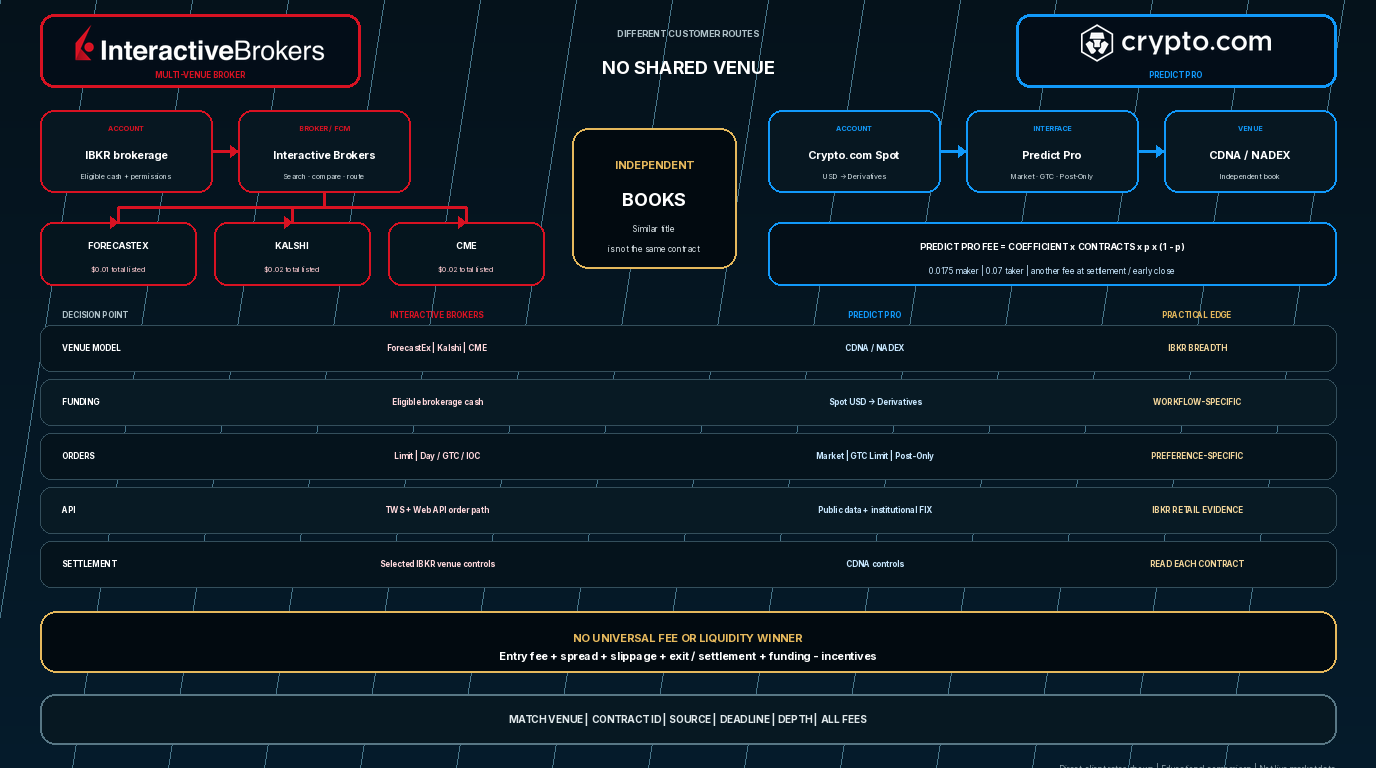
The Interactive Brokers vs Crypto.com Predict Pro decision is a comparison between a professional multi-venue brokerage route and a focused prediction interface tied to one exchange. Interactive Brokers can reach supported contracts on ForecastEx, Kalshi and CME. Predict Pro displays contracts offered by NADEX, doing business as Crypto.com Derivatives North America, or CDNA.
Interactive Brokers is the better fit for an eligible multi-asset trader who wants event contracts beside a broader portfolio, several possible venues, consolidated reporting and documented TWS and Web APIs. Crypto.com Predict Pro is better for an eligible Crypto.com Exchange user who wants a dedicated professional prediction workspace, Market/GTC Limit/Post-Only controls and a transparent maker/taker formula.
The venue lists do not overlap. Similar questions on IBKR and Predict Pro are separate contracts with separate order books, rules, fees and settlement authorities. A price difference is not automatically arbitrage.
Last reviewed and fact-checked: November 3, 2026.
Editorial disclosure: Macro Markets publishes this comparison and operates a prediction-market platform. We include Macro Markets as a disclosed crypto-native alternative, not as an independent recommendation or a CFTC-designated US exchange. This is a documentation-based comparison; we did not place synchronized funded orders through both products. Fees, venues, interfaces, eligibility and contracts can change. Event contracts can settle at $0. This article is educational, not financial, legal or tax advice.
Interactive Brokers vs Crypto.com Predict Pro: Quick Verdict
Choose Interactive Brokers when event contracts are one component of a larger investing and trading workflow. Its current prediction interface can search ForecastEx, Kalshi and CME listings from one funded brokerage account. It also offers professional desktop software, mobile access, consolidated reporting, ScaleTrader and documented TWS and Web API paths.
Choose Crypto.com Predict Pro when prediction markets are the immediate focus and you already use Crypto.com Exchange. Predict Pro offers a professional full-depth workflow, a clear Spot-to-Derivatives funding path and retail controls that distinguish Market, GTC Limit and Post-Only orders.
There is no universal winner. IBKR's multi-venue breadth is more useful when it exposes a better contract or net price. Predict Pro's focused workflow is more useful when the desired CDNA contract has suitable depth and its lower maker fee is realistically obtainable.
Winner by use case
- Existing multi-asset brokerage customer: Interactive Brokers.
- Existing Crypto.com Exchange customer: Predict Pro.
- Several prediction venues in one account: Interactive Brokers.
- Focused professional prediction interface: Predict Pro.
- Documented retail event-order APIs: Interactive Brokers.
- Post-Only maker protection: Predict Pro.
- Portfolio-level reporting: Interactive Brokers.
- Market orders: Predict Pro.
- Lowest explicit opening fee at $0.50: Predict Pro maker in the illustration, if filled.
- Best liquidity: contract and venue-specific; no universal winner.
| Decision factor | Interactive Brokers | Crypto.com Predict Pro | Practical edge |
|---|---|---|---|
| Customer layer | Full-service broker and FCM | Crypto.com Exchange and FCM workflow | Existing-account dependent |
| Listing venues | ForecastEx, Kalshi and CME | CDNA/NADEX | IBKR for breadth |
| Shared book | None with Predict Pro | None with IBKR | Independent liquidity |
| Funding | Eligible brokerage cash | USD Spot → Derivatives | Workflow-specific |
| Fee evidence | Fixed per-contract schedule by venue | Probability-weighted maker/taker schedule plus second fee event | Requires lifecycle math |
| Retail order controls | Limit; Day, GTC and IOC documented | Market, GTC Limit and Post-Only | Preference-specific |
| APIs | TWS and Web APIs document event trading | Public prediction data and institutional FIX | IBKR for retail order evidence |
| Settlement | ForecastEx, Kalshi or CME contract | CDNA contract | Read the exact rules |
| Best for | Multi-asset and multi-venue traders | Focused Exchange users | User-specific |
Read our standalone Interactive Brokers Prediction Markets review and Crypto.com Predict Pro review for deeper product assessments. Our comparison methodology explains why the contract and executable book matter more than the interface logo.
How the Broker, Account and Exchange Routes Differ
Interactive Brokers is the customer broker and futures commission merchant. Its current event-contract page says eligible clients can search and trade contracts from ForecastEx, Kalshi and CME Group in one platform without opening and funding separate accounts at each venue.
That creates a four-layer route:
- The customer holds an eligible Interactive Brokers account.
- IBKR handles account permissions, cash, order entry, routing and reporting.
- ForecastEx, Kalshi or CME supplies the listing and order book.
- The selected exchange's contract defines the source, deadline and settlement procedure.
Predict Pro follows a different path:
- The customer uses Crypto.com Exchange technology.
- An approved FCM/Derivatives account carries the relationship.
- USD moves from Spot into the Derivatives balance.
- CDNA/NADEX offers, matches and settles the event contract.
The Predict Pro overview identifies CDNA/NADEX as the offering exchange. The CFTC lists CDNA as a designated contract market and derivatives clearing organization.
Why there is no shared venue
IBKR's current exchange set is ForecastEx, Kalshi and CME. Predict Pro's venue is CDNA. Even if both interfaces list “Will Bitcoin finish above X?” or a similar election question, the legal contract and liquidity remain independent.
Match all of these before comparing prices:
- Exchange and contract identifier.
- Exact Yes/No proposition.
- Observation time and time zone.
- Official data or result source.
- Cancellation and exceptional-outcome rules.
- Tick size, expiry and position limit.
- Available size at the executable price.
IBKR can compare related contracts across its connected venues, but it does not merge those books. Predict Pro does not add a fourth route to IBKR. Similar economics are not identical legal instruments.
Fees and All-In Trading Cost Compared
Interactive Brokers publishes venue-specific US direct-client charges. Its current prediction-market commission schedule lists:
- ForecastEx: $0.00 IBKR commission plus a $0.01 exchange fee per contract.
- Kalshi: $0.01 IBKR commission plus a $0.01 exchange fee per contract.
- CME event contracts: $0.01 IBKR commission plus a $0.01 exchange fee per contract.
Those rates can change and can differ for introduced, advisor-managed or special-program accounts. They are transaction charges, not proof that ForecastEx offers the lowest executable total. Spread and price impact can dominate a one-cent fee difference.
Predict Pro publishes probability-weighted formulas:
maker fee = 0.0175 × contracts × price × (1 − price)
taker fee = 0.07 × contracts × price × (1 − price)
Its fee guide says the fee appears before confirmation and applies when opening. Another fee applies at settlement or when the position closes early.
Example: 100 contracts at $0.50
| Route | Illustrative opening charge | Important exclusions |
|---|---|---|
| IBKR → ForecastEx | $1.00 | Spread, slippage and possible offsetting trade |
| IBKR → Kalshi | $2.00 | Spread, slippage and possible closing trade |
| IBKR → CME | $2.00 | Spread, slippage and possible closing trade |
| Predict Pro maker | About $0.44 | Fill risk, spread and second fee event |
| Predict Pro taker | $1.75 | Spread, slippage and second fee event |
Predict Pro maker execution has the lowest visible opening charge in this midpoint example. That advantage exists only if the order rests and fills as maker. Post-Only can protect fee classification, but a missed fill can be more expensive than the fee saved.
Predict Pro taker execution costs more than the IBKR ForecastEx route and less than the current IBKR Kalshi/CME route in the same simplified example. Its second fee event changes the lifetime comparison. IBKR can also surface a contract with a better price on one venue, making a higher fixed fee worthwhile.
Which product is cheaper?
Use this framework:
all-in cost = entry fee + spread + slippage + exit or settlement fee + funding and account costs − earned incentives
Capture both order previews at nearly the same time. Record the exchange, contract ID, price, size, maker/taker role, depth and likely exit method. For IBKR, include the venue-specific charge and any currency conversion or account-arrangement cost. For Predict Pro, include both fee events.
A two-cent worse fill costs $2 across 100 contracts. That equals the entire current listed charge for an IBKR Kalshi or CME opening and exceeds several apparent fee advantages. Normalize the tickets with our prediction-market fee calculator and review how bid-ask spreads affect larger orders.
Funding, Eligibility and Portfolio Impact
IBKR uses eligible cash in the brokerage account. The convenience is consolidation: a customer does not need separately funded ForecastEx, Kalshi and CME accounts for supported contracts. Event positions, cash and broader investments appear inside one reporting environment.
That does not mean stocks or margin automatically finance the position. ForecastEx contracts are fully collateralized. IBKR's risk disclosure says sufficient funds must be available before the bid is accepted and ForecastEx positions cannot be used as collateral for margin borrowing. A prediction position can therefore reduce cash flexibility elsewhere in the portfolio.
ForecastEx positions can receive a variable incentive coupon based on daily market value. IBKR currently displays a time-sensitive annualized rate, but the benchmark can change. The coupon does not protect against a contract settling at $0 and should not be treated as guaranteed yield.
Predict Pro uses a distinct transfer path:
USD in Spot → transfer to Derivatives → trade Predict Pro → transfer back to Spot → withdraw
Its getting-started guide says predictions, futures and perpetuals share the Derivatives balance. Crypto held elsewhere must become the required USD before that transfer, potentially adding conversion spread, timing and tax considerations.
Eligibility and account scope
Interactive Brokers says event contracts are available to eligible clients of specified affiliates, generally age 21 or older, with product and election restrictions. Availability depends on account affiliate, residence, permissions, venue and individual contract. A global IBKR login does not guarantee every event listing.
Predict Pro currently requires a US user with an FCM account. Access to the global Crypto.com app, exchange or another derivatives product does not automatically establish Predict Pro eligibility.
Neither service should be accessed through a VPN, false address or borrowed account. The signed-in permission screen and contract ticket are stronger evidence than a general marketing page.
Funding verdict
IBKR is more efficient for a trader who already keeps settled cash and a diversified portfolio at the broker. Predict Pro is more natural for someone already managing Spot and Derivatives balances at Crypto.com Exchange.
The better workflow is the one whose entire cash path you understand: deposit, conversion, internal transfer, collateral treatment, contract settlement and withdrawal. Test the route with a small amount before an event becomes time-sensitive.
Orders, APIs and Professional Trading Tools
Interactive Brokers' event-order documentation says event contracts use limit orders with Day, Good-Till-Canceled or Immediate-Or-Cancel time in force. Orders use whole-contract quantities rather than cash quantity in the TWS API.
Venue behavior still matters. ForecastEx positions are reduced by buying the opposite contract, while CME instruments can be bought and sold under their own product model. IBKR can automatically net opposing ForecastEx positions, but the offset depends on an available opposing price.
IBKR also promotes ScaleTrader for eligible event contracts. It can stage a larger order across price levels, but it cannot manufacture liquidity and can accumulate exposure if the parameters are poorly chosen.
Predict Pro documents:
- Market: seeks immediate execution at the best available price and cancels any remainder.
- GTC Limit: rests until filled, cancelled or the event resolves.
- Post-Only: cancels if it would immediately take liquidity, preserving maker classification.
| Capability | Interactive Brokers | Predict Pro |
|---|---|---|
| Main order type | Limit | Market and Limit |
| Time in force | Day, GTC, IOC documented | GTC for Limit; immediate behavior for Market |
| Maker-only control | Not established in current event docs | Post-Only documented |
| Large-order tooling | ScaleTrader | Full-depth professional ticket |
| Desktop environment | TWS, Desktop and Client Portal | Crypto.com Exchange workspace |
| Mobile access | IBKR Mobile and GlobalTrader | Exchange interface availability |
| Retail event-order API | TWS and Web API documented | Universal retail automated entry not established |
| Institutional connectivity | Broader IBKR professional stack | FIX documented, permission-dependent |
API verdict
IBKR has the stronger documented retail automation path. Its TWS event-contract definition identifies FORECASTX, KALSHI and CME, while the Web API documents event-contract discovery. A developer must preserve exchange, contract ID, expiry, strike and Yes/No side rather than match by title.
Predict Pro publishes prediction-market data and institutional FIX materials. That is useful for analysis and approved professional connectivity, but it does not prove universal retail order-entry access.
IBKR wins for a trader already building on TWS or Web API. Predict Pro wins when a manual trader values Post-Only maker protection and a focused order-book interface. Both require position limits, price caps, partial-fill handling, disconnect recovery and account-permission checks before automation.
Markets, Liquidity, Settlement and Where Macro Markets Fits
IBKR's catalog can span politics, economic indicators, climate, weather and event contracts linked to traditional futures markets. Its breadth comes from ForecastEx, Kalshi and CME rather than one universal exchange.
Predict Pro covers sports, crypto, commodities, foreign exchange, indexes, economics, politics, culture and climate through CDNA. It can therefore be stronger for sports and crypto-specific discovery even though it has one venue route.
Catalog breadth does not establish executable liquidity. Inspect the exact contract:
- best bid and ask;
- quantity available at each level;
- likely average fill for the intended size;
- recent activity and time remaining;
- early-exit demand; and
- venue, rules and official source.
Never combine the displayed liquidity
ForecastEx, Kalshi, CME and CDNA retain independent books. An offer visible on IBKR cannot be added to Predict Pro depth as if the two interfaces were one market. Even closely matched contracts carry separate settlement and operational risk.
IBKR's ability to compare several venues can reveal a better net route inside its own connected set. It does not establish equivalence with CDNA. Compare the full wording before calling a divergence an opportunity.
Who determines settlement?
IBKR does not decide outcomes for all displayed contracts. ForecastEx, Kalshi or CME applies the specification and source for the selected venue. Predict Pro follows the CDNA/NADEX contract and exchange process.
Save the contract version, deadline and named source before trading. A news headline, app label, another exchange or AI answer cannot override the written terms. If the source or deadline differs, the positions are not a clean hedge.
Macro Markets as a disclosed crypto-native alternative
Macro Markets is relevant for eligible users who intentionally want wallet-oriented crypto funding and global prediction-market discovery rather than either US brokerage/FCM path. Its crypto-native structure can be more direct for digital-asset users, but it introduces a different jurisdiction, custody, network and settlement model.
Macro Markets is not presented here as a CFTC-designated exchange or as a regulatory equivalent to Interactive Brokers, ForecastEx, Kalshi, CME or CDNA. Compare supported countries, assets, networks, withdrawals, resolution sources, disputes and executable liquidity independently.
Because Macro Markets publishes this comparison, this section is first-party positioning rather than an independent endorsement. See how Macro Markets works only after confirming eligibility, contract rules, funding network and maximum loss.
For wider context, compare Kalshi vs Interactive Brokers, Coinbase vs Interactive Brokers, Kalshi vs Predict Pro and the ranked Predict Pro alternatives.
Frequently Asked Questions and Final Verdict
Is Interactive Brokers cheaper than Crypto.com Predict Pro?
Not universally. At 100 contracts priced at $0.50, the current listed IBKR opening charge is $1 through ForecastEx or $2 through Kalshi/CME. Predict Pro's opening fee is about $0.44 as maker or $1.75 as taker, but it charges again at settlement or early close. Spread, depth and fill role can reverse the result.
Do IBKR and Predict Pro share liquidity?
No under the currently documented routes. IBKR connects to ForecastEx, Kalshi and CME. Predict Pro uses CDNA/NADEX. Similar questions remain independent contracts and books.
Which platform has better order types?
Predict Pro has more explicit manual execution choices through Market, GTC Limit and Post-Only. IBKR documents limit orders with Day, GTC and IOC and adds professional tooling such as ScaleTrader.
Which platform is better for APIs?
Interactive Brokers has the stronger documented retail event-order path through TWS and Web APIs. Predict Pro documents public prediction data and institutional FIX, but universal retail automated order entry is not established.
Which platform is easier to fund?
IBKR is easier for an existing brokerage customer with eligible settled cash. Predict Pro is easier for an existing Crypto.com Exchange user who already understands Spot and Derivatives transfers. Neither route makes unsettled or ineligible funds immediately usable.
Can I trade several prediction exchanges through IBKR?
Eligible customers can access supported ForecastEx, Kalshi and CME contracts through one account. The venues keep separate order books, fees and rules. Not every direct-exchange contract is necessarily available through IBKR.
Does Predict Pro support market orders while IBKR does not?
Predict Pro explicitly documents Market orders. IBKR's current event-order API documentation specifies Limit orders with Day, GTC or IOC. Always confirm the exact interface and venue ticket because supported behavior can change.
Are both regulated?
They use identifiable US regulated entities but different structures. Interactive Brokers is the FCM access layer for ForecastEx, Kalshi and CME contracts. Predict Pro uses CDNA/NADEX as the exchange and clearing venue. Regulation does not guarantee profit, liquidity or uninterrupted access.
Which platform is better for crypto users?
Predict Pro sits inside Crypto.com Exchange, but its documented funding route uses USD transferred from Spot to Derivatives. IBKR uses brokerage cash. Macro Markets is the disclosed crypto-native alternative for eligible users who deliberately want wallet-oriented funding and accept a different jurisdictional and custody model.
Final verdict
Interactive Brokers is the stronger choice for an eligible multi-asset trader who values three venue routes, consolidated portfolio reporting, desktop software and documented retail APIs. Its main complication is structural: every contract must be checked for the underlying exchange, fee and settlement rule.
Crypto.com Predict Pro is the stronger choice for an active Crypto.com Exchange user who values a focused prediction workspace, Market/GTC/Post-Only controls and explicit maker/taker pricing. Its Spot-to-Derivatives funding path and second fee event remain material trade-offs.
The correct Interactive Brokers vs Crypto.com Predict Pro decision belongs to the specific contract. Identify the exchange, compare the full rules, inspect executable depth and calculate every lifecycle cost. The venue sets do not overlap, so never add their liquidity or treat a similar title as the same instrument. If neither contract offers clear terms and an acceptable exit, the correct choice is neither.
