ForecastEx vs Kalshi Prediction Markets: Which Is Better in 2026?

ForecastEx and Kalshi are both regulated US prediction exchanges, but they solve different problems. ForecastEx is a macro-focused venue normally reached through an eligible futures commission merchant such as Interactive Brokers. Kalshi offers a direct prediction-market account with broad discovery, multiple funding methods and its own API. This ForecastEx vs Kalshi comparison explains which structure is better for different users.
The short answer: choose ForecastEx when you already use Interactive Brokers, want economic or climate contracts and value its simple exchange fee plus variable incentive coupon. Choose Kalshi direct when you want a dedicated prediction-market interface, broader consumer discovery, direct funding and native API access. Do not choose either by brand alone: compare the exact contract rules, executable depth and complete fee preview.
Last reviewed and fact-checked: November 1, 2026.
Editorial disclosure: Macro Markets publishes this comparison and operates a prediction-market platform. We include Macro Markets later as a disclosed crypto-native alternative and do not present it as a CFTC-designated US exchange. This review is based on current official documents and interfaces; we did not place synchronized funded orders in identical live contracts on both venues. Event contracts can settle at $0, and regulation, full collateralization or an incentive coupon does not protect a customer from trading losses. This article is educational, not financial, legal or tax advice.
ForecastEx vs Kalshi: Quick Verdict
The biggest difference is not the logo or the headline probability. It is the customer and contract architecture.
ForecastEx lists separate Yes and No contracts. Both sides buy their own instrument, and a customer who wants to leave early acquires the opposite contract. The retail account, funding and interface usually come from an FCM such as Interactive Brokers.
Kalshi direct combines the account and exchange experience. A customer buys a prediction position and can later submit a sell order. That sale still needs buyers at acceptable prices, so the displayed value is not guaranteed cash.
| Comparison | ForecastEx | Kalshi direct | Practical winner |
|---|---|---|---|
| US regulatory role | CFTC DCM and registered DCO | KalshiEX DCM; Kalshi Klear registered DCO | Tie on legitimate regulated structure; scopes differ |
| Customer access | Usually through an eligible FCM, prominently IBKR | Direct Kalshi account | Kalshi for simplicity; ForecastEx for brokerage integration |
| Contract design | Separate buy-only Yes and No contracts | Prediction positions that can be bought and sold | Preference depends on workflow |
| Early exit | Buy the opposite ForecastEx contract | Sell some or all of the position | Kalshi is more familiar; both require liquidity |
| Published trading fee | $0.01 exchange fee per executed contract | Price- and quantity-based formula; market-specific variants | Depends on price, route and market |
| Collateral earnings | Variable incentive coupon | No equivalent position-value coupon | ForecastEx |
| Market identity | Economics, rates, government, climate and financial benchmarks | Broad consumer event discovery across many categories | Depends on subject |
| Funding | Eligible broker cash, normally USD | ACH, card, wire, selected payment apps and crypto, subject to eligibility | Kalshi for direct choice |
| API | IBKR Web/TWS API route | Native Kalshi REST API | Kalshi for exchange-native development |
| Multi-asset portfolio | Integrated with stocks, options, futures and bonds through IBKR | Separate prediction account | ForecastEx through IBKR |
Choose ForecastEx if
- you already have an eligible Interactive Brokers account;
- CPI, payrolls, Fed Funds, GDP, housing or climate thresholds are the priority;
- a simple per-contract exchange fee matters;
- you understand the separate Yes/No close-out mechanics; and
- you value the variable incentive coupon without treating it as loss protection.
Choose Kalshi if
- you want a dedicated prediction-market account;
- consumer-first discovery and a broad event catalog matter;
- you need direct funding choices, including supported crypto transfers;
- you want a native exchange REST API; or
- selling a position feels more intuitive than buying an opposite contract.
Our full ForecastEx review and Kalshi review cover each platform independently. This page focuses on the decision between them.
Regulation, Accounts and Eligibility
ForecastEx and Kalshi are both part of the US regulated derivatives framework. The CFTC lists ForecastEx as a designated contract market and registered derivatives clearing organization, effective June 24, 2024. KalshiEX received its DCM designation in 2020, with an amended order in January 2025 permitting intermediated futures trading. Kalshi Klear is the associated registered clearing organization.
That confirms legitimate exchange and clearing structures. It does not mean that a price is accurate, every contract is available in every jurisdiction, a customer will be able to exit or a losing contract will be reimbursed.
ForecastEx uses a broker or FCM account
ForecastEx says customers access its contracts through qualified FCM members. Interactive Brokers is the most visible retail route and an affiliate. The broker controls onboarding, identity checks, cash, permissions, interfaces, statements and account support. ForecastEx controls the exchange rulebook, matching, clearing and settlement of its contracts.
This split is useful for an existing IBKR customer because event contracts can sit beside other assets and use supported desktop, web, mobile and API tools. It is additional machinery for someone who only wants a prediction app. The relevant legal entity can also change by residence and IBKR affiliate.
Kalshi offers direct and intermediated access
Kalshi operates a direct customer experience. Eligible customers open and fund a Kalshi account, browse markets and manage prediction positions without first opening a full multi-asset brokerage account. Kalshi also supports intermediated access, including a current IBKR route, but direct and broker-routed fees can differ.
Kalshi's international access guidance says users from many countries may be eligible, subject to its Member Agreement. Country availability is not the same as universal product availability. ForecastEx access likewise depends on residence, broker affiliate, age, account type and contract category. Interactive Brokers currently restricts supported US-election Forecast Contracts to eligible US residents.
Use the live application and order ticket as the final eligibility check. A blog post cannot see account-specific permissions, sanctions screening, state rules or a product restriction added after publication.
Contract Mechanics, Settlement and Early Exit
Both venues use event contracts with a maximum $1 settlement value, but the path to that payoff is structurally different.
ForecastEx's contract guide describes Yes and No as separate contracts with unique identifiers. Prices generally range from $0.01 to $0.99 in one-cent increments. The correct contract receives $1 at settlement and the incorrect contract receives $0. Both participants are described as buyers; ForecastEx does not use an ordinary seller for the other side.
Suppose a ForecastEx customer buys Yes for $0.44. If Yes is correct, the contract returns $1, producing a $0.56 gross difference before fees and coupon income. If Yes is incorrect, the $0.44 contract cost is lost before the same adjustments.
To leave before settlement, the Yes holder buys the matching No contract. The combined positions then produce a fixed $1 under the exchange rules. If No later costs $0.38, the pair costs $0.82 before two execution fees and leaves $0.18 before any eligible coupon. If No costs $0.74, the total contract cost is $1.18 and the offset realizes a loss even before fees.
Kalshi's prediction account uses the more familiar sale workflow. The customer can submit a sell order for some or all of an open position. Kalshi's portfolio documentation is explicit that selling requires buyers at prices allowed by the order. A cash-out estimate can cover only part of the position, and a limit sell may remain unfilled.
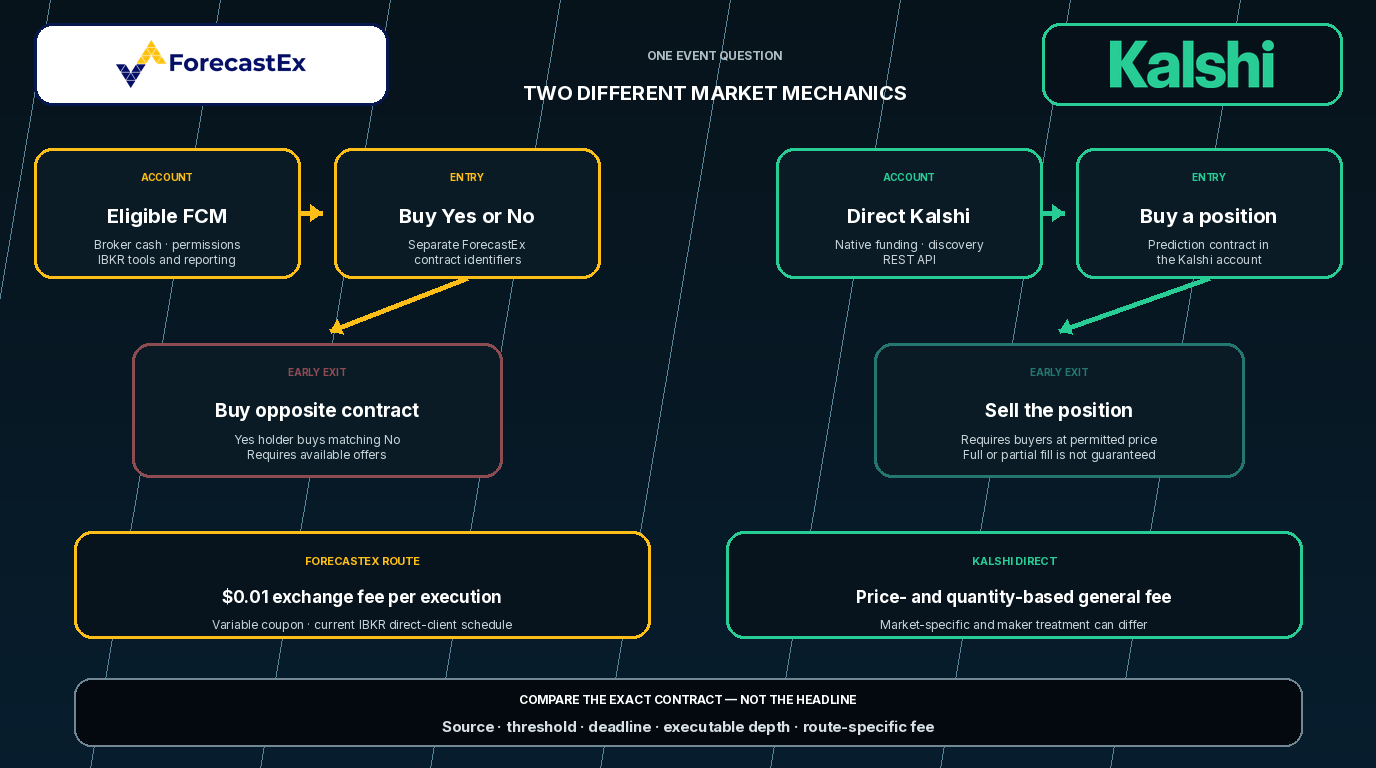
ForecastEx and Kalshi can express a similar forecast through different account and exit mechanics. The exact contract rule, not the headline, controls settlement.
The same question may not be the same contract
A ForecastEx question about annual CPI above a threshold is not automatically fungible with a Kalshi question using similar words. Verify:
- the named data series and source agency;
- annual, monthly or seasonally adjusted measurement;
- first release versus revised value;
- exact threshold and rounding convention;
- observation period, deadline and time zone;
- correction, cancellation and review rules; and
- contract identifier and listing exchange.
If any item differs, the two positions can settle differently. Do not treat one venue as a free hedge for the other without reading both rulebooks.
Which exit model is better?
Kalshi's sell flow is easier to recognize. ForecastEx's opposing-contract method can be useful because the combined $1 payoff makes its close-out arithmetic explicit. Neither creates liquidity. A sale needs bids; an opposite-contract acquisition needs available offers. A halted or thin contract can block both routes.
Size the trade for the possibility of holding through settlement. Our guide to the bid-ask spread in prediction markets explains why a quoted midpoint is not an executable exit.
Markets and Liquidity
ForecastEx has a specialist identity. Its current market catalog emphasizes initial jobless claims, unemployment, payrolls, CPI, retail sales, building permits, housing starts, Fed Funds, real GDP, corporate profits, national debt, global temperature and other capital or financial benchmarks. That makes it a natural research companion for rates, currency, equity and bond traders.
Kalshi has a broader consumer-facing catalog and discovery experience. It can cover economics and financial questions too, but users also encounter politics, sports, weather, technology, entertainment and other event categories. Available markets and legal treatment can change, so the live catalog matters more than a historical category list.
ForecastEx is therefore not automatically the better macro venue for every individual contract, and Kalshi is not automatically deeper because it is more visible. Liquidity belongs to an exact order book at an exact moment.
Before placing an order on either venue, record:
- best executable entry price;
- quantity available at that price;
- depth at the next several prices;
- likely cost of a sale or opposite-side offset;
- time remaining and expected news catalysts; and
- complete fees for the intended size and route.
A $0.48 contract with only ten available units does not offer a $0.48 execution for a 500-contract order. A popular headline can also hide thin distant thresholds. Limit orders control price but do not guarantee execution.
Forecast quality versus trading quality
An event-contract price can be a useful crowd signal even when it is not a good trade. A customer can forecast the outcome correctly and still earn less than expected after paying an aggressive price, crossing a wide spread or closing into thin depth.
Use independent base rates, a calibrated probability estimate and a required margin of safety. Then compare that estimate with executable prices on both platforms. Our prediction-market comparison methodology separates contract comparability, legal role, price quality and operational access rather than collapsing them into one platform score.
ForecastEx vs Kalshi Fees, Coupon and Funding
ForecastEx has the simpler headline fee. Its FAQ publishes a $0.01 transaction fee per contract at execution. Interactive Brokers' current event-contract commission schedule lists ForecastEx at $0 IBKR commission plus that $0.01 exchange fee for US direct clients.
Kalshi's current fee guidance links to a complete schedule that uses a price-sensitive general formula:
Trading fee = round up(M × 0.07 × C × P × (1 − P))
M is the applicable fee multiplier, C is contract quantity and P is contract price in dollars. Under the current general table, 100 contracts at $0.50 cost $1.75. Maker treatment and market-specific multipliers can differ. Cancelling an unfilled resting order does not create a trading fee.
A fair 100-contract comparison
| Route | Current listed fee for 100 executions | Important qualification |
|---|---|---|
| ForecastEx through IBKR | $1.00 | $0 IBKR commission + $0.01 ForecastEx fee per contract on current US direct-client schedule |
| Kalshi direct at $0.50 | $1.75 | Current general table; price, maker status and market-specific rules can change it |
| Kalshi through IBKR | $2.00 | Current schedule lists $0.01 IBKR commission + $0.01 exchange fee per contract |
This is not proof that ForecastEx always costs less. Kalshi's formula changes with price, and a resting maker order can receive different treatment. The larger hidden cost may be spread or price impact. Account arrangements, introduced-client fees, taxes and currency conversion can also change totals. Use our prediction-market fee calculator, then confirm the signed-in order preview.
ForecastEx's incentive coupon
ForecastEx invests fully secured collateral through its member structure and distributes earnings to members. Interactive Brokers passes a variable incentive coupon to eligible customers based on daily closing position value and pays it monthly. IBKR displayed 3.38% APY when this comparison was checked on November 1, 2026.
The rate is variable, the calculation base is position value and account terms matter. It is not a guaranteed return on original cash cost. More importantly, a modest coupon does not rescue a contract that settles at $0 or an exit executed at a poor price. Treat it as a secondary cash-management feature, not the investment thesis.
Funding and buying power
ForecastEx customers normally use eligible brokerage cash. Contracts are USD-denominated, so a customer funding in another currency can face conversion cost and exchange-rate risk. The current IBKR disclosure says Forecast Contracts cannot be used as collateral for margin loans, which can reduce buying power elsewhere in a portfolio.
Kalshi's transfers FAQ lists debit card, ACH, PayPal, Venmo, Cash App deposits, crypto and wire transfers, subject to account and country. International users have a narrower set: debit card, crypto and wire deposits are documented, while ACH and several payment apps are unavailable. Card processing can cost up to 2%; crypto provider and network fees can apply. Deposit and withdrawal holds also affect usable cash.
Kalshi's crypto funding does not make its event contracts crypto-denominated. ForecastEx's brokerage access does not make an event contract a stock. In both cases, identify the exchange contract, account entity, currency and transfer provider separately.
APIs, Safety and Operational Fit
Kalshi provides a native REST API for market discovery, order books and authorized account, order, trade and portfolio functions. That direct model is attractive for developers building alerts, research pipelines or controlled execution around one exchange.
ForecastEx automation runs through the broker layer. Interactive Brokers supports ForecastEx in its Web and Trader Workstation APIs, subject to account and market-data permissions. The TWS documentation uses FORECASTX for ForecastEx and KALSHI for Kalshi. Developers must preserve the exchange, contract ID, expiration, threshold and side rather than matching on a market title alone.
For either API:
- begin with read-only market discovery;
- verify a contract manually before enabling orders;
- enforce maximum quantity, price and daily loss;
- handle partial fills and rejected orders;
- reconcile executions against exchange and account records; and
- use scoped credentials, multifactor authentication and secret rotation.
API availability does not remove market risk. Automated orders can cross a thin book faster than a person can review the damage.
Which is safer?
It is misleading to call one universally safer. Both have regulated US exchange and clearing structures, yet the customer pathways and operational risks differ.
ForecastEx customers depend on the broker/FCM, exchange and clearing workflow. Kalshi direct customers depend on Kalshi's account, exchange, clearing and payment-provider workflow. Both face contract loss, liquidity, settlement-source, halt and cybersecurity risk. Kalshi funding methods can add card, bank or crypto-transfer risks; ForecastEx can add brokerage permissions, currency conversion and portfolio buying-power effects.
Use this safety checklist:
- confirm the account entity and jurisdiction;
- enable strong multifactor authentication;
- read the exact contract rules and settlement source;
- inspect executable depth, not only the last price;
- calculate maximum loss including fees;
- understand withdrawal or cash-settlement timing; and
- avoid using funds needed for near-term obligations.
Our guide to prediction-market legality in the US explains why exchange designation, customer eligibility and contract category are separate questions.
Which Platform Should You Choose?
Choose ForecastEx for an integrated macro workflow. It fits an eligible IBKR customer who already monitors economic releases, understands professional order controls and can hold a binary position through settlement. The clear exchange fee and variable coupon are useful, but the main advantage is access to specialized contracts inside a multi-asset account.
Choose Kalshi for a native prediction-market workflow. Its direct account, broad discovery, multiple funding methods and exchange API reduce the distance between market discovery and execution. Its fee model requires more calculation, and a sell button still depends on real buyers.
Use Interactive Brokers as a comparison layer when you want multiple venues. IBKR can expose supported ForecastEx, Kalshi and CME event contracts in one account. That does not merge their order books or rules. Read our Interactive Brokers Prediction Markets review and Kalshi vs Interactive Brokers comparison before treating the broker as the venue.
Consider Macro Markets when your deliberate preference is crypto-native access. Macro Markets focuses on crypto funding and global market discovery for eligible users. Because Macro Markets publishes this article, treat this inclusion as a first-party disclosure, not an independent endorsement. Verify current jurisdiction, wallet network, custody, fees, liquidity and resolution rules yourself. Macro Markets has a different legal profile and is not represented here as a CFTC-designated US exchange.
For broader shortlists, see the best ForecastEx alternatives, best prediction-market apps, Kalshi alternatives and Interactive Brokers prediction-market alternatives.
Frequently asked questions
Is ForecastEx better than Kalshi?
ForecastEx is better for some eligible IBKR customers seeking macro, climate and financial contracts with a simple exchange fee and variable coupon. Kalshi is better for many users seeking direct access, broad discovery, multiple funding methods and a native API. Compare exact contracts and executable cost.
Is ForecastEx cheaper than Kalshi?
Under IBKR's current US direct-client schedule, ForecastEx costs $0.01 per executed contract and Kalshi through IBKR costs $0.02. Kalshi direct uses a price-sensitive formula; the current general table charges $1.75 for 100 contracts at $0.50. Maker and market-specific fees can differ, and spreads can outweigh commissions.
Can I sell ForecastEx contracts?
ForecastEx uses separate buy-only Yes and No contracts. A customer normally closes early by buying the opposite contract for the same event. Kalshi prediction positions can be sold, but the order needs buyers and may fill partially or not at all.
Does ForecastEx pay interest?
ForecastEx distributes a variable incentive coupon through members such as IBKR. It accrues based on daily closing position value and is paid monthly under current terms. The rate is not fixed and does not protect against an incorrect outcome.
Can international users trade ForecastEx or Kalshi?
Eligibility varies. Kalshi says users from many countries may qualify subject to its Member Agreement, with different international funding methods. ForecastEx availability depends on the FCM, IBKR affiliate, residence, permissions and contract category. Check the live account application.
Which has better liquidity?
Neither platform has permanently better liquidity across all contracts. Compare the exact question, best executable price, available size, spread, depth and time remaining. Similar questions can live in independent books and use different settlement rules.
Which has the better API?
Kalshi has the simpler exchange-native route through its REST API. ForecastEx can be accessed through supported IBKR APIs, which can be better for a multi-asset workflow but introduces the broker layer and its permission model.
Final verdict
ForecastEx and Kalshi are credible but materially different prediction exchanges. ForecastEx is the specialist choice for macro-oriented contracts inside an eligible brokerage workflow. Kalshi is the direct-access choice for broad event discovery, flexible funding and native developer access.
ForecastEx wins on simple listed exchange pricing, the variable coupon and brokerage integration. Kalshi wins on direct account simplicity, funding choice and native market tooling. Neither wins every contract on liquidity or effective cost.
The correct decision is therefore contract-first: confirm the exact source and deadline, compare executable depth, calculate entry and exit cost, and size the position for a possible $0 settlement. Only then should account convenience decide between the two.
Ready to evaluate a disclosed crypto-native option? Open Macro Markets only after confirming that the platform, market and funding route are permitted and appropriate in your jurisdiction.