ForecastEx vs CME Prediction Markets: Which Is Better in 2026?
ForecastEx and CME Group both list regulated event contracts, but they are not interchangeable prediction markets. ForecastEx is a specialist exchange and clearinghouse built around separate buy-only Yes and No contracts, a variable incentive coupon and access through eligible futures commission merchants. CME connects prediction markets to a much larger derivatives ecosystem, with products that can relate to economic indicators, cryptocurrencies, sports and futures benchmarks.
The short answer: choose ForecastEx when you want specialist macro or climate questions, a simple listed exchange fee and the collateral-based incentive coupon inside an eligible broker account. Choose CME when you want broader connection to traditional futures markets, the ability to buy and sell supported event positions and access through a participating broker. If both appear in Interactive Brokers, compare the exact product, rulebook, executable depth and all-in fee rather than choosing by exchange reputation.
Last reviewed and fact-checked: November 2, 2026.
Editorial disclosure: Macro Markets publishes this comparison and operates a prediction-market platform. We include Macro Markets later as a disclosed crypto-native alternative and do not present it as a CFTC-designated US exchange. This article is based on current official exchange, broker and regulatory material. We did not place synchronized funded orders in matched live contracts on both venues. Event contracts can settle at $0, and exchange regulation, full collateralization or coupon income does not protect a customer from market loss. This is educational content, not financial, legal or tax advice.
ForecastEx vs CME Prediction Markets: Quick Verdict
The most important difference is product architecture. ForecastEx created a dedicated market structure for forecast contracts. CME places prediction products inside an established futures and derivatives environment, and the legal classification can vary by product.
| Comparison | ForecastEx | CME Prediction Markets | Practical winner |
|---|---|---|---|
| Exchange identity | Specialist CFTC DCM and DCO | Major derivatives group with prediction products listed on its exchanges | Depends on intended workflow |
| Account access | Eligible FCM member, prominently Interactive Brokers | Participating broker | Tie through IBKR; broker choice may differ |
| Current market identity | Economics, central banks, government, climate and financial thresholds | Sports, economic indicators, cryptocurrencies and other events, including futures-linked products | ForecastEx for specialist macro; CME for derivatives breadth |
| Contract structure | Separate buy-only Yes and No contracts | Supported positions can be bought and sold; product type varies | CME for familiar exit workflow |
| Early exit | Buy the opposite ForecastEx contract | Trade out of the position before completion when liquidity exists | CME is more familiar; neither guarantees liquidity |
| Settlement | Correct side receives $1; incorrect side receives $0 | Correct prediction receives $1; incorrect prediction receives $0 | Tie on headline binary payoff |
| Current IBKR direct-client cost | $0 commission plus $0.01 exchange fee per execution | $0.01 commission plus $0.01 exchange fee per execution | ForecastEx on listed fee alone |
| Collateral earnings | Variable incentive coupon | No equivalent ForecastEx-style coupon stated for the compared CME route | ForecastEx |
| API model through IBKR | Modeled with exchange FORECASTX; opposite contract closes |
CME instruments use the CME route and futures-option-style discovery | Depends on developer workflow |
| Best fit | Focused event forecasting inside an eligible multi-asset account | Event exposure connected to traditional futures and derivatives | Strategy-specific |
Choose ForecastEx if
- scheduled economic releases, central-bank decisions or climate thresholds are the priority;
- you already use an eligible Interactive Brokers account;
- a simple $0.01 listed exchange fee matters;
- you understand that closing early requires the opposite contract; and
- the variable incentive coupon is useful but not the reason for taking the risk.
Choose CME if
- you want prediction markets inside the CME derivatives ecosystem;
- crypto, sports, economic and futures-linked event products are relevant;
- buying and selling a supported position is preferable to the ForecastEx offset method;
- your broker offers the exact CME product you need; or
- you already use futures data, symbols and risk controls in the same workflow.
Read our independent ForecastEx review and standalone CME Prediction Markets review for full evaluations of each venue. The best ForecastEx alternatives and best CME Prediction Market alternatives guides place both venues in broader shortlists.
What ForecastEx and CME Actually Are
ForecastEx is a CFTC-registered designated contract market and derivatives clearing organization. Customers do not ordinarily open a simple consumer exchange account with ForecastEx itself. They reach its contracts through qualified FCM members. Interactive Brokers is the most visible retail route and is an affiliate of ForecastEx.
ForecastEx's official contract guide describes two separate instruments for each binary question. One participant buys Yes and another buys No. There is no ordinary seller taking the opposite side of the same contract. The contracts clear separately, while the paired prices and settlement economics express the market forecast.
CME Group is a much broader derivatives marketplace composed of several designated contract markets. Its Prediction Markets page says CME is the exchange listing the contracts and customers access them through participating brokers. Prediction products sit beside a large futures and options ecosystem rather than defining the entire exchange.
Do not assume every CME prediction product has the same classification
The common $0-to-$1 payoff can hide a legal and operational distinction. Interactive Brokers' current event-contract disclosure says most event contracts are classified as swaps, while certain CME event contracts are cash-settled, European-style, premium-style options on CME-listed futures. The specific CME product code determines which rules apply.
That distinction can affect disclosures, product discovery, tax treatment, broker permissions and the rule chapter a customer must read. It does not necessarily change the intuitive binary experience. A customer may still pay a price between $0.01 and $0.99 for a position that resolves to $1 or $0.
Use this identity check before trading either venue:
- listing exchange and product code;
- swap, option or other stated classification;
- broker or FCM carrying the customer account;
- exact contract rule chapter;
- clearing entity;
- customer eligibility and jurisdiction; and
- settlement source and payout time.
The exchange name alone does not answer all seven questions. Our guide to prediction-market legality in the US explains why exchange registration, product status and customer eligibility are separate layers.
Markets and Contract Selection
ForecastEx has a specialist macro identity. Its catalog is built around measurable releases and thresholds such as inflation, employment, central-bank policy, housing, government finance, capital markets and climate data. The questions often reference agencies such as the Bureau of Labor Statistics, Census Bureau, Bureau of Economic Analysis, Federal Reserve or NOAA.
That structure can be attractive to a trader who already follows economic calendars, rates, bonds or currencies. A contract can target one release, one observation period and one threshold without requiring a leveraged futures position.
CME's current prediction-market catalog is broader at the category level. CME names sports, economic indicators, cryptocurrencies and more. Some products connect naturally to benchmarks and futures already traded across CME, CBOT, NYMEX or COMEX. Others are consumer-facing event questions.
This does not mean CME will list every ForecastEx macro question or that ForecastEx will offer a cleaner instrument for every economic view. Similar wording can describe different contracts.
Match the contract, not the headline
Suppose both venues show a question about quarterly US GDP. Before comparing prices, record:
- the exact GDP series and source agency;
- nominal or real growth;
- annualized or quarter-over-quarter measurement;
- advance release or later revision;
- threshold and inclusive or exclusive wording;
- observation period and time zone;
- last trading, determination and payout times; and
- cancellation, correction and dispute procedure.
If one contract uses the advance estimate and another waits for a revised release, they are not substitutes. If one asks whether GDP is above 2.25% and another asks whether it is at or above 2.25%, a value of exactly 2.25% can produce different outcomes.
The same warning applies to crypto and financial benchmarks. A contract can reference a particular futures settlement, an index observation, an exchange price or a time-window average. Brand familiarity does not make those definitions fungible.
Our prediction-market comparison methodology uses this contract-first test before scoring fees, liquidity or interface quality.
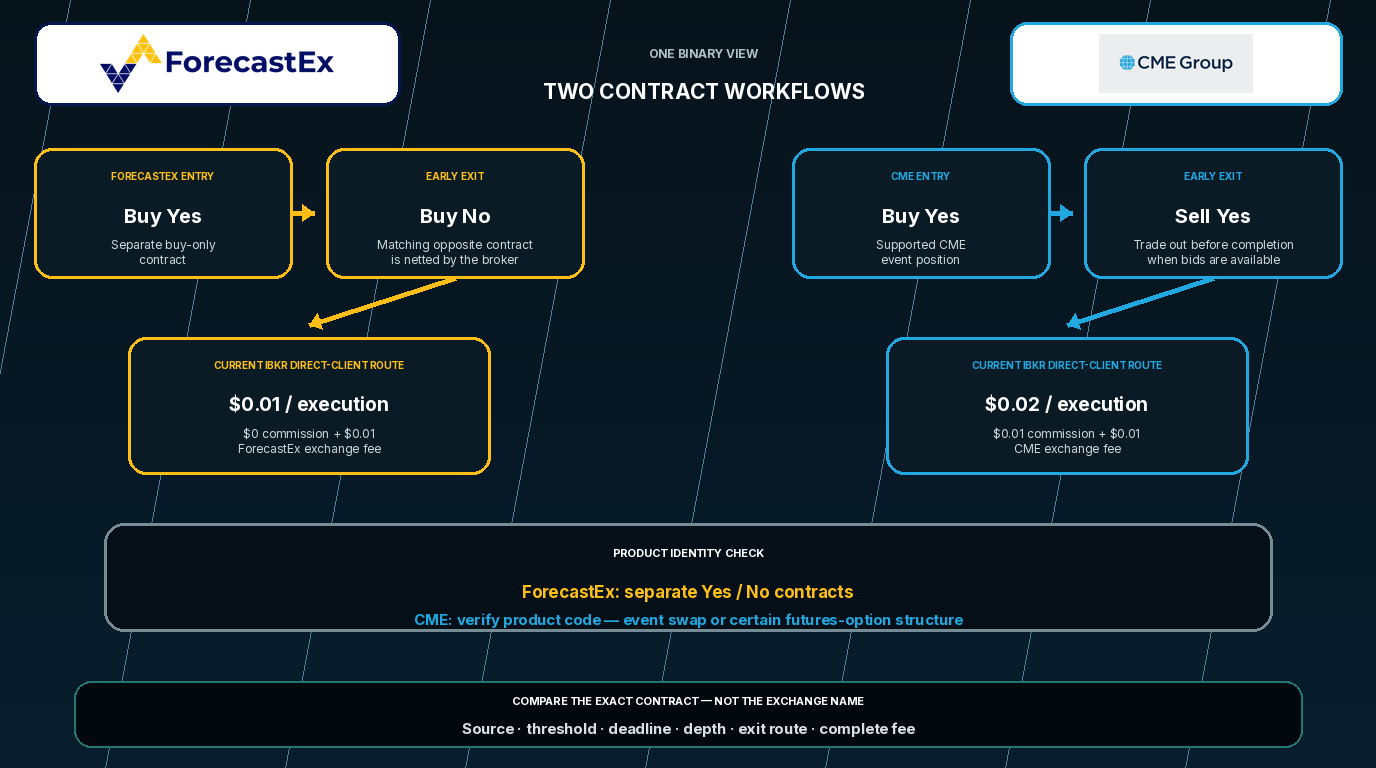
ForecastEx uses separate buy-only Yes and No contracts, while supported CME positions can be bought and sold. Current IBKR direct-client fees and product classifications must be verified before each order.
Contract Mechanics, Settlement and Early Exit
Both venues present prices that can be read as market-implied probabilities, subject to fees, spread and contract design. A price of $0.37 roughly corresponds to a 37% market view, not a calibrated guarantee. If the predicted result occurs, the correct position pays $1. If it does not, the position pays $0.
ForecastEx prices separate Yes and No contracts from $0.01 to $0.99 in one-cent increments. The two prices need not add to exactly $1 in the live book because they are independently quoted instruments. A customer can only buy a ForecastEx contract, not sell it.
To close a ForecastEx Yes position before settlement, the customer buys the matching No contract. Interactive Brokers then nets the opposite positions. If a Yes contract originally cost $0.42 and the matching No later costs $0.31, the gross combined contract cost is $0.73 before two execution fees. The paired positions produce $1 at settlement, leaving $0.27 before fees and eligible coupon income.
If the matching No costs $0.77 instead, the combined cost is $1.19 before fees. The offset locks in a loss. The existence of an opposite contract does not guarantee that enough quantity will be offered at an acceptable price.
CME says customers can trade a position multiple times before an event completes. Interactive Brokers' API documentation makes the operational contrast explicit: supported CME instruments can be bought and sold, while ForecastEx instruments are flattened by buying the opposing contract. Short selling is not permitted in the compared event-contract workflow.
Which early-exit model is better?
CME's buy-and-sell workflow is more familiar to futures and options users. The order record, position reduction and realized result resemble conventional trading. ForecastEx's paired-contract approach is less familiar but makes the eventual fixed $1 combined payoff visible.
Neither model solves a thin order book. A CME sell order needs an executable bid. A ForecastEx offset needs an executable offer in the opposite contract. Both can fill partially, remain open or create material price impact.
Use limit orders and size the position for the possibility of holding through settlement. The bid-ask spread guide explains why a displayed midpoint can overstate the value of an exit.
Settlement sources still control
At expiration, exchange branding does not decide the outcome. The contract's named source, observation method and rule chapter do. Read whether the exchange uses the first published value, a final revision, a futures settlement, an official sports result or a fallback procedure.
Source delays, corrections, canceled events and disputed results can extend determination or trigger special procedures. A trader should know those rules before the event, not after the market moves.
Fees, Incentive Coupon and Effective Cost
The cleanest current comparison uses the same broker route. Interactive Brokers' US prediction-market commission schedule lists the following rates for direct clients:
| Venue through IBKR | IBKR commission | Exchange fee | Listed total per execution |
|---|---|---|---|
| ForecastEx | $0.00 | $0.01 | $0.01 per contract |
| CME | $0.01 | $0.01 | $0.02 per contract |
For 100 opening executions, the listed difference is $1 for ForecastEx versus $2 for CME. An early ForecastEx close through an opposite contract creates another execution and another $0.01 exchange fee per unit. A CME round trip also creates another commission and exchange-fee event. Account arrangements, introduced-client charges, taxes and future schedule changes can alter the total.
Spread can matter more than commission
The useful formula is:
Effective cost = entry price + commission + exchange fee + spread + price impact + funding or currency cost
A two-cent fee advantage is irrelevant if the cheaper venue has an eight-cent worse executable price. Compare the available quantity at several price levels, not only the best displayed quote. Use the prediction-market fee calculator for scenarios, then verify the signed-in order preview.
ForecastEx's incentive coupon
ForecastEx invests secured collateral within its member structure and passes earnings to members through a variable incentive coupon. Eligible members can share that coupon with customers. It accrues based on daily closing contract value and is distributed monthly under current ForecastEx documentation.
This feature is genuinely different from the CME route described here, but it should remain secondary to the forecast and execution. The rate can change. The customer may receive a different passed-through amount depending on the member. A contract that settles at $0 can lose far more than the coupon earned during its life.
Do not compare an annualized coupon rate with a short-term binary profit as if they were the same return measure. The coupon applies to eligible daily position value over time, while the contract result can move the full purchase price to $0 or $1.
Access, APIs, Liquidity and Safety
Neither venue is a simple direct consumer account in this comparison. ForecastEx requires an eligible FCM member. CME directs customers to participating brokers. Interactive Brokers currently offers supported contracts from ForecastEx, CME and Kalshi in one account, making it a useful comparison layer.
The shared interface can obscure venue separation. A ForecastEx contract and a CME contract in the same IBKR screen still have different exchange codes, order books, rulebooks, product identifiers and settlement processes. Cash in one brokerage account does not merge their liquidity.
Our Interactive Brokers Prediction Markets review covers account permissions, portfolio integration and current multi-venue access.
API differences
Interactive Brokers models ForecastEx products with option-like records and the exchange code FORECASTX. CME event contracts use CME discovery and are commonly represented through futures-option-style records in the API. Yes and No appear as call and put rights in parts of the IBKR contract model.
The operational difference must survive into automation:
- ForecastEx positions reduce through a purchase of the opposite contract;
- CME positions can use supported buy and sell actions;
- the exact contract ID, expiration, strike, right and exchange must be stored;
- a market title is not a reliable unique key; and
- product classification and trading class should be verified for CME instruments.
Start automation with read-only discovery. Then enforce maximum size, limit price, daily loss, venue allowlists and manual verification for newly encountered product codes. Reconcile partial fills and settlement against broker records.
Which has better liquidity?
There is no permanent venue-wide winner. CME's scale in futures does not guarantee depth in every prediction contract. ForecastEx's specialist focus does not guarantee a tight book at every threshold. Liquidity belongs to one contract, strike and moment.
Record the best bid and offer, size available at each, spread, recent executions and expected exit route. Compare like-for-like contracts only after verifying the rule differences. Historical volume and a famous exchange name do not guarantee that a future order will fill.
Which is safer?
Both operate inside the US regulated derivatives framework, but regulation is not loss insurance. A correct exchange process can still settle a losing position at $0. Customers also face broker access, account-security, market-halt, source-data, operational and liquidity risks.
ForecastEx adds dependence on the FCM, separate-contract mechanics and coupon administration. CME adds product-code complexity and the need to distinguish event swaps from certain futures-option structures. Neither should be described as universally safer without specifying the risk being measured.
Use multifactor authentication, verify the account entity, read the contract rules, calculate maximum loss including fees and avoid committing money needed for near-term obligations.
Which Platform Should You Choose?
Choose ForecastEx when the goal is a focused economic or climate forecast inside an eligible brokerage account. Its simple listed fee, macro catalog and incentive coupon are differentiated strengths. The trade-off is the buy-only structure and opposite-contract close-out.
Choose CME Prediction Markets when event exposure belongs inside a broader futures and derivatives workflow. CME is stronger when the relevant product connects to a recognized benchmark, crypto future, economic release or sports market offered by a participating broker. The buy-and-sell workflow is more familiar, but product classification and rule chapters demand attention.
Use Interactive Brokers as the comparison layer when both venues are available. Search by exact event, open the rule details, note the exchange code and compare executable depth. Do not assume two similar titles are the same instrument.
Choose neither if the rules are ambiguous, the spread is too wide, the available size is too small or your account cannot tolerate a $0 settlement. A no-trade decision is better than forcing a comparison winner.
Macro Markets as a disclosed crypto-native alternative
Macro Markets is the intentionally different option. It is designed for eligible users seeking crypto funding and global prediction-market discovery rather than a US FCM and traditional derivatives workflow.
That distinction can matter when wallet-native funding, crypto context and international market discovery are explicit requirements. It also creates different due-diligence questions around jurisdiction, custody, supported networks, withdrawal cost, market rules and dispute handling.
Because Macro Markets publishes this article, this inclusion is a first-party disclosure rather than an independent endorsement. Macro Markets is not represented here as a CFTC-designated exchange and should not be assumed to provide the same account, clearing or regulatory protections as ForecastEx or CME.
Choose Macro Markets only when crypto-native access is deliberate and after confirming that the platform, funding route and specific market are permitted and appropriate in your jurisdiction. Open Macro Markets for current first-party product information.
Frequently asked questions
Is ForecastEx better than CME Prediction Markets?
ForecastEx is better for some eligible customers seeking specialist macro or climate contracts, a simple listed fee and a variable incentive coupon. CME is better for many traditional derivatives users seeking broader event categories, futures-linked products and a familiar buy-and-sell workflow. The exact contract and broker route decide.
Is ForecastEx cheaper than CME through Interactive Brokers?
Under the current US direct-client schedule, ForecastEx has a $0 IBKR commission plus a $0.01 exchange fee per contract. CME has a $0.01 commission plus a $0.01 exchange fee. Spread, price impact and account arrangements can be more important than the one-cent listed difference.
Can I sell ForecastEx and CME event contracts?
Supported CME event positions can be bought and sold before completion. ForecastEx contracts are buy-only. A ForecastEx customer closes or reduces a position by buying the matching opposite contract, which IBKR nets against the original position.
Does CME pay an incentive coupon like ForecastEx?
The compared CME route does not advertise an equivalent ForecastEx-style coupon. ForecastEx distributes a variable collateral-based incentive coupon through members. The rate and customer pass-through can change, and coupon income does not prevent a losing settlement.
Are CME prediction markets futures options?
Not all can be described with one classification. Current IBKR disclosures say most event contracts are swaps, while certain CME event contracts are cash-settled European-style premium-style options on CME futures. Check the product code and rule chapter.
Which has better prediction-market liquidity?
Neither venue is permanently more liquid across all contracts. Compare the exact order book, executable price, available size, spread and early-exit route. Similar questions on ForecastEx and CME use independent books and can have different rules.
Can I trade both ForecastEx and CME in one account?
Eligible Interactive Brokers customers can access supported contracts from both venues in one account. Availability depends on residence, permissions and product. The shared account does not merge order books or settlement rules.
Final verdict
ForecastEx wins for specialist forecast-contract design; CME wins for connection to the traditional derivatives ecosystem. ForecastEx offers focused macro and climate questions, a simple listed fee and an unusual incentive coupon. CME offers broader category reach, futures-linked context and a conventional buy-and-sell workflow for supported positions.
The right decision is not ForecastEx versus CME at the brand level. It is one ForecastEx contract versus one CME product through one eligible broker at a specific time. Verify the product classification, source, threshold, deadline, depth, complete fee and exit mechanics. Then choose the venue whose exact instrument expresses the view with the least ambiguity and acceptable execution cost.
For the closest direct-exchange comparison, read ForecastEx vs Kalshi. For a broader shortlist, return to the best ForecastEx alternatives.