ForecastEx vs Polymarket US: Fees and Best Fit (2026)
Polymarket US fee update — November 7, 2026: From November 6 at 1:00 PM ET, the official standard taker schedule uses Θ of 0.095 below $10,000, 0.085 from $10,000 to below $50,000, 0.075 from $50,000 to below $250,000, and 0.0695 at $250,000 or more in qualifying trailing-30-day taker volume. The fee is Θ × contracts × price × (1 − price). For one fill of 100 contracts at $0.50, those fees are $2.38, $2.12, $1.88 and $1.74, respectively, before rebates and other costs. Θ is not a flat percentage of the investment.
New accounts use 0.0695 for their first seven ET calendar days from their first fill. Days 8–30 use the higher of first-seven-day volume × 30/7 and trailing volume; transition accounts and November's October-volume protection can also receive better tiers. Overrides and the coefficient fixed when an order is inserted matter. Table tennis now uses the standard ladder; combos remain separate. Rebate windows also moved to daily trailing-30-day measurement. The updated Polymarket US review explains volume, rounding and exceptions.
Scope of the comparisons below: Every Polymarket US $1.74 midpoint, $0.63 at $0.10/$0.90, and $51.74 total example assumes Θ = 0.0695 and one fill, without rebates. These remain valid conditional examples, not a universal current rate or a live quote. At Θ = 0.095, the midpoint fee is $2.38 and the entry debit is $52.38; comparisons with a $2.00 competing fee reverse at that coefficient. Other brands' facts retain their original review date.
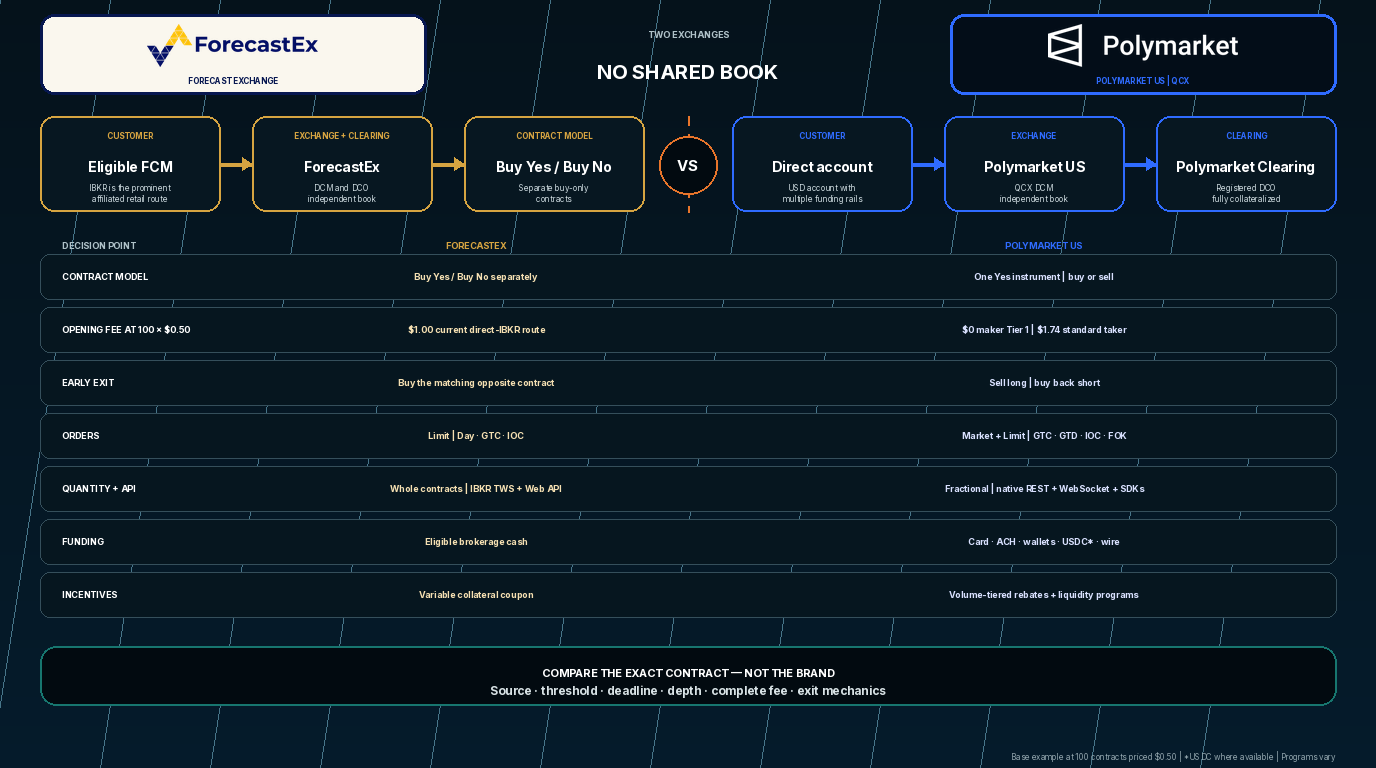
ForecastEx and Polymarket US are regulated US prediction exchanges, but their products work very differently. ForecastEx is a specialist venue reached through an eligible futures commission merchant and built around separate buy-only Yes and No contracts. Polymarket US is a prediction-first exchange with a direct consumer account, one tradable Yes instrument per outcome and a broader sports, politics and current-events catalog.
The short answer: choose ForecastEx when macroeconomic, central-bank, climate or financial-data contracts are the priority and you value a flat per-contract fee, traditional broker tools and the variable collateral coupon. Choose Polymarket US when you want broader event discovery, conventional buying and selling, market and limit orders, direct USD funding and a native API. The two venues never share a contract or order book, even when their headlines look similar.
Last reviewed and fact-checked: November 3, 2026.
Editorial disclosure: Macro Markets publishes this comparison and operates a crypto-native prediction-market platform. We include Macro Markets later as a disclosed alternative, not as an independent recommendation or a CFTC-designated US exchange. This analysis uses current official exchange, broker and regulator documentation. We did not place synchronized funded orders in matching ForecastEx and Polymarket US contracts. Fees, rebates, coupons, access and liquidity can change. Event contracts can lose the full amount committed. This article is educational, not financial, legal or tax advice.
ForecastEx vs Polymarket US: Quick Verdict
ForecastEx is the cleaner specialist choice for an eligible customer who already uses Interactive Brokers or another supported FCM and wants measurable macro thresholds. Polymarket US is the more complete standalone prediction-market product for broad event discovery, direct funding and conventional order-book trading. Read the dedicated Polymarket US review for its current fee curve, rebate thresholds, funding rails, orders, APIs and clearing model before comparing the two venues.
| Decision factor | ForecastEx | Polymarket US | Practical edge |
|---|---|---|---|
| Exchange identity | ForecastEx DCM and DCO | QCX LLC d/b/a Polymarket US DCM; Polymarket Clearing DCO | Separate regulated stacks |
| Customer route | Eligible FCM; Interactive Brokers is the prominent affiliated retail route | Direct Polymarket US account or eligible intermediary | Polymarket for direct access |
| Contract model | Separate buy-only Yes and No instruments | One Yes instrument; buy for long, sell for short/No exposure | Polymarket for familiar trading |
| Shared liquidity | None with Polymarket US | None with ForecastEx | Neither |
| Market emphasis | Economics, central banks, government, climate and financial thresholds | Sports, politics, crypto, commodities, weather, tech, culture and economics | ForecastEx for macro; Polymarket for breadth |
| Opening fee at 100 contracts priced $0.50 | $1 under current direct-IBKR schedule | $1.74 standard taker; maker schedule lists no charge, with no Tier 1 rebate | Order-role dependent |
| Early exit | Buy the matching opposite contract | Reverse the Yes trade by selling a long or buying back a short | Polymarket is more conventional |
| Orders | Limit; Day, GTC and IOC documented | Market and limit; GTC, GTD, IOC and FOK documented | Polymarket for retail flexibility |
| Quantity | Whole contracts through the documented IBKR route | Fractional contracts supported | Polymarket |
| APIs | IBKR TWS and Web API environment | Native retail REST/WebSocket, SDKs and institutional connectivity | Polymarket for venue-native tooling |
| Funding | Eligible brokerage cash | Debit card, ACH, Apple Pay, PayPal, Venmo, USDC where available and wire | Polymarket for direct options |
| Incentives | Variable collateral-based coupon | Volume-tiered maker/taker rebates and liquidity programs | Different behaviors rewarded |
Choose ForecastEx when the exact contract matches a scheduled data release, the unusual opposite-contract exit is acceptable and event trading belongs inside a wider brokerage workflow. Its current direct-IBKR fee is easy to calculate, although spread and a second execution still matter.
Choose Polymarket US when a dedicated app, broad category selection, native order book and conventional buy/sell workflow matter more. A maker order can avoid the standard taker fee, but it may never fill. A marketable order can fill immediately and pay both the taker fee and the spread.
Read our standalone ForecastEx review and Polymarket review for full product evaluations. Our prediction-market comparison methodology explains why the exact contract, executable price and settlement source come before the brand.
What ForecastEx and Polymarket US Actually Are
ForecastEx LLC is an exchange and clearinghouse affiliated with Interactive Brokers Group. The CFTC lists ForecastEx as a designated contract market and registered derivatives clearing organization, both effective June 24, 2024.
Retail customers generally reach ForecastEx through a qualified futures commission merchant. Interactive Brokers is the most visible affiliated route. The FCM carries the customer account, provides funding and permissions and supplies the trading interface. ForecastEx lists, matches, clears and settles the contract.
Polymarket US uses a separate legal stack. The CFTC's designation record identifies QCX LLC d/b/a Polymarket US as a designated contract market. The Polymarket Clearing record identifies QC Clearing LLC d/b/a Polymarket Clearing as a registered DCO permitted to clear fully collateralized futures, options on futures and swaps.
The consumer app, exchange and clearinghouse are related but distinct roles. Polymarket US supplies the customer product and exchange book. Polymarket Clearing manages supported collateral, clearing and settlement.
Polymarket US is not polymarket.com
This distinction is essential. Polymarket US is the regulated US product described in this article. International polymarket.com has a separate account system, legal structure, liquidity pool, funding model and documentation.
Do not use international Polymarket evidence to answer a US-product question. In particular, do not:
- treat polymarket.com volume as Polymarket US liquidity;
- assume an international USDC wallet is the US account balance;
- import international fees or rewards into the US order ticket;
- assume the same market exists on both products; or
- use an international resolution process for a Polymarket US contract.
Similar questions are not the same contract
Suppose both exchanges list a market related to the next US Consumer Price Index release. Before comparing prices, verify:
- headline or core CPI;
- monthly, annual or annualized measurement;
- exact threshold and whether equality counts;
- source agency and release table;
- first publication or later revision;
- final trading, observation and settlement times; and
- correction, postponement and dispute rules.
A ForecastEx position cannot be closed on Polymarket US. A Polymarket US position cannot be offset on ForecastEx. Different prices may reflect different wording, timing, liquidity or participants instead of a risk-free arbitrage.
Fees, Coupon and Polymarket Rebate Tiers
ForecastEx has the simpler base execution fee. Interactive Brokers' current prediction-market commission schedule lists a $0 IBKR commission plus a $0.01 ForecastEx exchange fee per contract for direct US clients. Introduced, advised, managed and non-US account arrangements can differ.
Polymarket US uses a probability-weighted standard taker formula. Its current fee schedule states:
taker fee = 0.0695 × contracts × price × (1 − price)
The formula peaks near a $0.50 contract and falls toward $0.01 or $0.99. Fees are rounded using the schedule's rules. Table tennis now uses the standard tier ladder. Combination contracts follow their own formula, so do not apply these standard examples to combos.
Polymarket's standard schedule does not list a maker charge. Tier 1 makers receive no rebate. Makers with qualifying qualifying volume under the daily trailing-30-day window and applicable account rules can receive rebates using coefficients from 0.0035 to 0.0104, while high-volume takers can earn a percentage rebate paid weekly. Tiers reset and program rules can change.
Worked example: 100 contracts at $0.50
| Route | Opening calculation | Illustrative opening amount | What happens later |
|---|---|---|---|
| ForecastEx through current direct-IBKR pricing | 100 × $0.01 |
$1.00 fee | No new execution if held to settlement; another $1 fee if the opposite contract is bought to exit |
| Polymarket US taker at Θ = 0.0695 | 0.0695 × 100 × 0.50 × 0.50 |
$1.74 fee after schedule rounding | A later closing trade can incur another taker fee or execute as maker |
| Polymarket US maker, Tier 1 | No listed maker fee; no Tier 1 rebate | $0 explicit trading fee | Resting order may not fill; closing execution has its own role and cost |
| Polymarket US maker, qualifying tiers | Rebate coefficient × contracts × price × (1 − price) |
About $0.09 to $0.26 rebate | Volume tier and fill eligibility must be satisfied |
Polymarket maker is the cheapest explicit opening route in this example, but that is not the same as the cheapest executable trade. A resting bid can miss the market. A one-cent worse fill costs $1 on 100 contracts and can erase the fee advantage.
ForecastEx is cheaper than the Polymarket standard taker example at the midpoint. That conclusion can reverse closer to the price extremes or when the ForecastEx side has a wider spread. The correct comparison is:
all-in cost = entry fee − earned rebate + spread + slippage + funding cost + exit fee
Use the prediction-market fee calculator to normalize the formulas, then replace every illustration with the signed-in ticket.
ForecastEx coupon versus Polymarket incentives
ForecastEx can distribute a variable incentive coupon based on eligible collateral value. The current IBKR Forecast Contract disclosure describes daily accrual and monthly distribution under member terms, with a rate linked to prevailing interest conditions.
The coupon is not guaranteed profit. The rate can change, member treatment can differ and the underlying contract can still settle at $0. A short holding period earns only a small time-based amount.
Polymarket US incentives reward different behavior. Maker rebates depend on qualifying maker volume under the daily trailing-30-day window and applicable account rules. Taker rebates depend on qualifying taker volume. The exchange also publishes liquidity and market-maker programs with separate eligibility and quoting requirements.
Do not subtract a coupon or rebate from a fee example unless the exact account, date, market, order and position qualify. Treat every promotional or volume-based program as conditional.
Contracts, Orders, APIs and Early Exit
ForecastEx's defining mechanic is that Yes and No are separate buy-only instruments. Interactive Brokers' event-contract order documentation says the route supports Limit orders with Day, Good-Till-Canceled and Immediate-Or-Cancel time in force. Quantities use whole contracts.
To close a ForecastEx Yes position, the customer buys the matching No contract. To close No, the customer buys the matching Yes. The paired positions produce the fixed settlement amount under the contract rules. This is an offset through a second instrument, not a conventional sale of the original contract.
Polymarket US uses one instrument per market outcome: the Yes contract. Its orders documentation explains the mapping:
- buy Yes to take the long side;
- sell Yes to take the short side, economically equivalent to buying No;
- sell an existing Yes long to close it; and
- buy Yes back to close a short.
Polymarket sellers post full payout-value collateral, while buyers pay the purchase price. The collateral guide says executed positions are fully collateralized, so there is no later margin call on the binary payoff.
| Capability | ForecastEx through IBKR | Polymarket US |
|---|---|---|
| Instrument representation | Separate buy-only Yes and No contracts | One Yes instrument; buy long or sell short |
| Retail order types | Limit documented | Market and limit documented |
| Time in force | Day, GTC, IOC | GTC, GTD, IOC, FOK documented across current materials |
| Quantity | Whole contracts | Fractional contracts supported |
| Early exit | Buy matching opposite contract | Sell long or buy back short |
| API route | IBKR TWS and Web API | Native retail REST, WebSocket and official Python/TypeScript SDKs |
| Market data | Broker data and contract records | Native BBO, order book, trades, history and streaming |
| Institutional path | FCM and broker integration | Direct market-access and institutional APIs subject to onboarding |
Which API is better?
Polymarket US has the clearer prediction-native developer surface. Its official documentation covers events, market data, order books, order placement, cancellation, positions, balances, incentives and WebSocket streams. Official Python and TypeScript SDKs reduce integration work.
ForecastEx is stronger when event contracts must fit an existing Interactive Brokers automation stack. The IBKR event-contract documentation uses FORECASTX as the exchange code and represents the separate outcomes through contract fields already used by broker systems.
Polymarket wins when a developer wants venue-native prediction semantics. ForecastEx can win when reporting, risk controls and automation already span stocks, options, futures and other assets inside IBKR. Both routes require account permissions, stable contract identifiers, rate-limit handling and reconciliation of partial fills.
Neither venue guarantees an early exit
ForecastEx needs an acceptable offer in the matching opposite contract. Polymarket needs enough opposing size in the Yes book. A market order can cross multiple levels; a limit order can remain unfilled.
The bid-ask spread guide explains why a displayed probability or midpoint is not an executable exit. Size each position for the possibility of holding to settlement.
Funding, Markets and Liquidity
ForecastEx funding follows the carrying FCM. Through Interactive Brokers, eligible customers use brokerage cash and manage Forecast Contracts beside stocks, options, futures, bonds, currencies and other positions. Forecast contracts are USD-denominated, and account entity, permissions, collection periods and currency conversion can affect usable buying power.
Polymarket US provides a direct consumer funding workflow. Its current funding guide lists debit card, bank transfer through ACH, Apple Pay, PayPal, Venmo, USDC where available and wire transfer. Deposits must come from accounts in the customer's name and can be subject to verification and clearing holds.
That USDC option does not make Polymarket US identical to polymarket.com or a non-custodial wallet product. It is one supported funding rail into the US regulated account. The contract, collateral and settlement remain governed by Polymarket US and Polymarket Clearing.
Market selection
ForecastEx's strongest identity is objective macro and public-data questions: inflation, payrolls, unemployment, Federal Reserve policy, housing, government finance, capital markets and climate observations. That focus suits users who already work from economic calendars and official releases.
Polymarket US currently displays a much broader consumer catalog across sports, politics, elections, crypto, commodities, weather, technology, culture and economics. It also supports live sports markets, fractional contracts and combination/RFQ workflows in parts of its platform.
Breadth does not guarantee a superior contract. Compare the source, threshold, deadline, spread, depth and settlement rule. A deep Polymarket NFL market proves nothing about an economic threshold. ForecastEx's macro specialization does not guarantee depth at every strike.
Our ForecastEx vs Kalshi comparison covers another macro-specialist versus broad-exchange decision. Kalshi vs Polymarket US compares two consumer-oriented exchange accounts.
Which platform has better liquidity?
No permanent winner can be established without synchronized books for economically matched contracts. ForecastEx liquidity can cluster around scheduled economic releases and central-bank decisions. Polymarket US liquidity can cluster in sports, politics, elections and markets supported by incentive programs.
Inspect the best bid, best offer, available quantity, recent fills and depth for the full intended size. Do not use Interactive Brokers' company-wide volume, international Polymarket volume or a platform marketing total as proof of contract-level liquidity.
Even when two questions are economically similar, do not add the books together. They have separate participants, collateral, operating risk and settlement authorities.
Regulation, Settlement and Risk
Both products have identifiable US exchange and clearing structures. ForecastEx is a CFTC-designated DCM and registered DCO. Polymarket US is a CFTC-designated DCM and uses Polymarket Clearing, a registered DCO. These records matter because they identify the legal entities, public rules and oversight framework.
They do not insure a forecast against loss. A correct regulatory status does not guarantee profit, liquidity, uninterrupted access, a favorable exit or availability of every contract in every location.
ForecastEx's correct side generally receives $1 and the incorrect side receives $0. Polymarket US likewise uses fully collateralized binary contracts in which winners generally settle at $1 and losers at $0. Its settlement documentation notes that some contracts can have predefined alternative terms, making the individual market rules controlling.
For every contract, verify:
- exact proposition and instrument identifier;
- source agency, league or objective data source;
- observation date, deadline and time zone;
- threshold, rounding and equality treatment;
- postponement, cancellation or correction rules;
- review and dispute process; and
- expected clearing and settlement timing.
Which is safer?
Neither platform is universally safer for every user. ForecastEx adds a traditional FCM relationship, an affiliated broker route and fully collateralized separate outcome contracts. Polymarket US adds direct onboarding, its own DCM/DCO stack and conventional long/short mechanics.
Both expose customers to wrong-outcome risk, illiquidity, source-data problems, operational outages, cyber risk and rule misunderstandings. ForecastEx adds opposite-contract exit complexity. Polymarket adds short-collateral mechanics, direct-account funding holds and a broader set of fast-moving sports and political markets.
Use multifactor authentication, limits, maximum-order controls and only funds that can tolerate a complete contract loss. Our guide to prediction-market legality in the US explains why federal exchange status does not eliminate every state, customer or contract-category restriction.
Where Macro Markets fits
Macro Markets is the disclosed alternative for eligible users who deliberately want crypto-native funding and global market discovery. That can be useful when a wallet-oriented workflow matters more than a US broker or direct regulated-exchange account.
The trade-off is structural. Macro Markets is not presented as a CFTC-designated US exchange or as a regulatory equivalent to ForecastEx or Polymarket US. Its jurisdiction, custody, networks, supported assets, fees, liquidity and resolution process must be evaluated separately.
Because Macro Markets publishes this article, treat this section as first-party positioning rather than an independent endorsement. Our Polymarket vs Macro Markets comparison separates Polymarket US from the international product before evaluating the crypto-native alternative.
Which Platform Should You Choose?
Choose ForecastEx when:
- macroeconomic, central-bank, government, climate or financial thresholds are central;
- you already use an eligible FCM, especially Interactive Brokers;
- a flat one-cent exchange fee is preferable to a probability-weighted taker formula;
- event contracts belong inside multi-asset reporting and automation; and
- you understand the separate Yes/No instruments and can hold through settlement.
Choose Polymarket US when:
- you want a dedicated prediction-market account and broad consumer discovery;
- conventional buying, selling and short exposure are easier to manage;
- market orders, fractional contracts and varied time-in-force controls matter;
- direct funding options and native prediction APIs are priorities; and
- the exact US contract has sufficient depth and acceptable rules.
Choose neither when the market is unavailable in your location, the rule is ambiguous, the spread is too wide, the complete fee is unacceptable or a full loss would affect essential expenses.
For wider shortlists, see the best ForecastEx alternatives and best Polymarket alternatives.
Frequently asked questions
Is ForecastEx cheaper than Polymarket US?
ForecastEx is cheaper than a standard Polymarket US taker at 100 contracts priced $0.50 under the current schedules: $1 versus about $1.74. A Polymarket maker order has no listed charge and can qualify for a rebate at higher volume tiers, but it may not fill. Spread, slippage and exit mechanics can reverse the result.
Is Polymarket US the same as polymarket.com?
No. Polymarket US is a separate regulated US product with its own account, exchange, clearing, contracts, fees, funding and liquidity. Do not use international polymarket.com volume, USDC mechanics or resolution evidence for a Polymarket US trade.
Do ForecastEx and Polymarket US share liquidity?
No. ForecastEx and QCX are independent exchanges. Similar questions remain separate instruments with separate order books, participants, collateral and settlement rules.
Can I sell a ForecastEx contract?
Not through the documented route in the conventional sense. ForecastEx lists separate buy-only Yes and No contracts. To close Yes early, buy the matching No contract; to close No, buy Yes. The offset depends on available liquidity and incurs another execution fee.
Can I sell on Polymarket US?
Yes. Polymarket US uses one Yes instrument. Selling Yes creates short exposure equivalent to taking the No side, with full payout-value collateral. A long Yes position can be closed by selling; a short can be closed by buying Yes back.
Which platform is better for APIs?
Polymarket US has the stronger venue-native API, WebSocket and SDK documentation. ForecastEx is attractive when the user already automates through Interactive Brokers and wants event contracts integrated with a multi-asset broker workflow.
Which platform is better for macro markets?
ForecastEx is the stronger default for scheduled economic releases, central-bank decisions and measurable public-data thresholds. Polymarket US offers economics and commodities but has a much broader consumer catalog. The exact live contract and depth remain decisive.
Are both platforms regulated?
Yes, through separate entities. ForecastEx is a CFTC-designated exchange and registered clearing organization. QCX LLC d/b/a Polymarket US is a CFTC-designated exchange, and QC Clearing LLC d/b/a Polymarket Clearing is a registered clearing organization. Regulation does not prevent market losses.
Final verdict
ForecastEx is the stronger specialist choice for eligible broker customers who value macro contracts, a flat fee, traditional portfolio tooling and the variable collateral coupon. Its separate buy-only Yes and No design is less intuitive, and early exits depend on buying the opposite contract.
Polymarket US is the stronger standalone prediction-market choice for broad discovery, direct funding, conventional long/short mechanics, flexible retail orders and native developer tooling. Its standard taker fee can exceed ForecastEx near 50 cents, and maker economics depend on resting execution and volume tiers.
The correct ForecastEx vs Polymarket US decision belongs to the specific contract. Match the proposition, source, deadline, fee, spread and executable depth. Keep the two books separate and never import international Polymarket evidence into the US comparison. If neither venue provides clear rules and a realistic exit, the correct choice is neither.