


Polymarket vs Macro Markets: Which Crypto-Native Platform Fits You?
Polymarket International and Macro Markets both turn real-world events into tradable outcomes and both appeal to crypto-oriented users. The resemblance ends quickly. Polymarket.com is a non-custodial, blockchain-based international platform with a publicly documented central limit order book, on-chain settlement and UMA-based resolution. Macro Markets provides a crypto-native platform account and describes a hybrid execution design that uses a central limit order book first and an automated market maker as fallback.
Our verdict: Choose Polymarket International when you are eligible and prioritize public order-book documentation, on-chain records, a mature developer stack, published category-based fees and a defined oracle-dispute process. Evaluate Macro Markets when you are eligible and want a crypto-oriented platform account, multiple approved funding routes and a hybrid liquidity design. Neither platform is always cheaper or more liquid. The exact contract, executable quote, available size, network, rules and withdrawal route decide the better trade.
Last reviewed and fact-checked: October 31, 2026.
Editorial disclosure: Macro Markets publishes this comparison and is one of the products being compared. We apply the same documentation-first criteria to both platforms, identify first-party claims and state where public evidence is incomplete. We do not present Macro Markets as a CFTC-designated US exchange or as a non-custodial protocol. This is a documentation-based comparison; we did not fund both products and place simultaneous matched orders. Event contracts can lose the full amount committed. This page is educational, not financial, legal or tax advice.
Polymarket vs Macro Markets: Quick Verdict
The central choice is protocol-first transparency versus a hybrid platform workflow.
Choose Polymarket International if you want an inspectable crypto market structure. Its documentation explains the CLOB, wallet types, off-chain matching, on-chain settlement, category-specific taker fees, public APIs and UMA resolution flow. That documentation does not guarantee a good price, but it makes the mechanics easier to audit before trading.
Evaluate Macro Markets if you prefer a platform account with crypto-oriented deposits and withdrawals and want to test its CLOB-primary, LS-AMM-fallback model. The fallback can be useful when a pure order book is thin, but it is not proof of a tight spread, unlimited size or a cheap exit. Verify the implementation and quote on the exact market.
Winner by use case
- Publicly documented international CLOB: Polymarket International.
- Public on-chain trading record: Polymarket International.
- Published category-based taker-fee formula: Polymarket International.
- Public self-service developer documentation: Polymarket International.
- Hybrid CLOB plus AMM fallback: Macro Markets, based on its first-party product description.
- Platform-account experience with crypto withdrawals: Macro Markets.
- Eligible US resident: neither product in this direct comparison; use a permitted US product such as Polymarket US or another eligible exchange.
- Best price, depth or total cost: no permanent winner without a matched-contract snapshot.
- Simplest custody model: depends on whether you prefer managing wallet authority or using a platform account.
Our prediction-market comparison methodology explains why legal access and executable cost outrank promotional claims. For a product-level assessment, read the full Polymarket review. US users comparing regulated exchanges should use Kalshi vs Polymarket, not this international comparison.
Polymarket vs Macro Markets at a Glance
| Decision factor | Polymarket International | Macro Markets | Practical edge |
|---|---|---|---|
| Documented role | International blockchain-based prediction platform | Crypto-native prediction-market platform | Different account and custody models |
| US access | US residents cannot trade on polymarket.com; Polymarket US is separate | Eligibility must be verified under current location rules and signup flow | Do not infer access on either |
| Account and custody | Non-custodial wallet structure; open-position collateral in smart contracts | Platform account; terms describe segregated customer bank accounts or dedicated crypto wallets | Polymarket for public non-custodial documentation |
| Trading collateral | pUSD/USDC-oriented blockchain workflow | Crypto-oriented account using approved payment methods | Depends on supported asset, network and conversion path |
| Execution | CLOB with off-chain matching and on-chain settlement | CLOB-primary with LS-AMM fallback, according to launch materials | Polymarket for detailed public mechanics; Macro for hybrid design |
| Fees | Published taker formula by category; maker fee listed as zero | Current trading and wallet costs must be checked live | Polymarket for public fee transparency |
| Resolution | UMA Optimistic Oracle for prediction markets; Chainlink TWAP for defined up-down markets | AI-agent resolution oracle described in first-party launch materials | Different trust and dispute models |
| API | Public SDKs, market data, order books and authenticated order workflows | REST, GraphQL and websocket capabilities described in launch materials; verify production access | Polymarket for currently verifiable self-service docs |
| Liquidity | Varies by contract, side, time and order size | Varies by contract, side, time and order size | No universal winner |
| Withdrawal | Crypto and bridge/provider route; network and address checks matter | Cryptocurrency sent to the verified user-provided wallet address | Compare asset, network, service fee and review conditions |
Similar questions do not create identical contracts
Both platforms may list an election, central-bank decision, crypto price event or championship. Matching headlines are not enough. The deadline, time zone, official source, cancellation rule, outcome set and dispute process can differ.
Before comparing a 58-cent Yes price with a 55-cent Yes price, match:
- the exact event and outcome;
- the close and observation time;
- the named resolution source;
- postponement, correction and exceptional-outcome rules;
- the quantity available at the executable price;
- the explicit trading fee; and
- conversion, bridge, network and withdrawal costs.
A three-cent screen difference is not an arbitrage when the contracts or routes differ. The displayed number can also be a midpoint or last trade rather than the price available for your size.
Scope: Polymarket International Is Not Polymarket US
This article compares Polymarket International at polymarket.com with Macro Markets because both are crypto-oriented international products. Polymarket US is a separate exchange with a separate account, rulebook, funding system, support team and regulatory structure.
Polymarket's official website-versus-app guide says US residents must use Polymarket US and cannot deposit or trade on polymarket.com. Its international Terms of Use prohibit trading by restricted persons and prohibit VPN or similar circumvention.
Polymarket US is operated by QCX LLC d/b/a Polymarket US and is presented as a CFTC-designated contract market with a regulated clearing framework. That makes it a legitimate option to research for an eligible US user, but its fees, liquidity, custody and resolution rules cannot be imported into this comparison.
The same discipline applies to Macro Markets. An English-language site and crypto support do not establish legal availability in a particular country. Its Terms require the user to be in a jurisdiction where the activity is lawful and allow identity and location controls. Confirm the current signup result for your actual location.
Eligibility, Identity and Custody
Eligibility should be checked before markets, fees or interface design. A product that cannot legally serve the user is not an alternative.
Polymarket International eligibility
Polymarket maintains a current geographic-restrictions page. The blocked list included the United States and Brazil when this comparison was reviewed, along with multiple other jurisdictions. The list can change without making an older article automatically current.
Do not use a VPN to work around the restriction. Besides violating the Terms, circumvention can cause a wallet to enter close-only mode or lose interface access at the moment a position needs management.
International Polymarket is described as non-custodial. Its transparency page says users hold their own private keys and collateral backing open positions sits in smart contracts. Newer accounts use a deposit-wallet architecture, while older accounts can use legacy proxy or Safe wallet types. Non-custodial does not mean risk-free: key loss, malicious signing, bridge errors and smart-contract exposure remain relevant.
Macro Markets eligibility and account model
Macro Markets' Terms create an account relationship with Macro Markets Predictions Company. The platform can request KYC documents to verify identity and location and can restrict deposits, account access or withdrawals until checks are complete.
Its Terms also describe customer funds as held in separate customer bank accounts or dedicated crypto wallets. That is different from Polymarket's documented self-custody model. Do not call Macro Markets permissionless or anonymous merely because it supports crypto.
This distinction changes the diligence checklist:
- With Polymarket, understand the wallet owner, signer, approvals and recovery path.
- With Macro Markets, understand the contracting entity, account controls, KYC process, balance treatment and withdrawal review.
- With either, use a unique password or signer, enable available security controls and verify the official domain before connecting or funding.
Funding, Wallets and Withdrawals
The easiest funding route depends on what asset you already hold and how much operational complexity you accept.
Polymarket funding route
Polymarket International uses a wallet-based, pUSD/USDC-oriented workflow. Supported deposit assets and networks can be bridged into the balance used for trading. The interface and external provider determine current minimums, rates and available routes.
That flexibility introduces several failure points: wrong token, wrong network, wrong destination, bridge delay or provider fee. Always copy the address from the current deposit screen, verify the network at both ends and test with a small amount first.
Withdrawals also require an exact recipient and network. A transaction sent to an incompatible destination may be difficult or impossible to recover. Polymarket says it does not charge its own USDC deposit or withdrawal fee, but Coinbase, MoonPay, bridges, exchanges and blockchain networks can charge separately.
Macro Markets funding route
Macro Markets' Terms say deposits can come from funds the user controls, including a crypto wallet, using approved methods shown in the live wallet. The available asset, network, minimum, maximum and service fee can change.
Cryptocurrency withdrawals are sent to the wallet address the user provides. Macro Markets can request proof that the destination belongs to the user and can apply additional KYC or transaction review. Its Terms also say third-party payment providers or currency conversion can add cost.
The practical comparison is therefore not “both accept crypto.” It is:
starting asset → supported network → conversion or bridge → trading balance → withdrawal asset → destination network
Write down every step and fee before funding. The shorter route for your own starting asset can be more important than a platform-level fee claim.
Fees and All-In Trading Cost
Polymarket publishes the more specific international trading-fee documentation. Macro Markets requires a live quote and wallet check.
Polymarket International fees
Polymarket's current fee documentation lists a category-based taker fee on certain markets and no maker fee. It currently lists geopolitics as fee-free and publishes this formula:
fee = contracts × fee rate × price × (1 − price)
For an illustrative politics trade of 100 shares at $0.50 with the documented 0.04 fee rate:
100 × 0.04 × 0.50 × 0.50 = 1.00 USDC
That is an example from the published formula, not a captured order quote. It excludes the bid-ask spread, slippage, funding provider, bridge, network and withdrawal costs. The market's current parameters and the final confirmation control.
Because the formula contains price × (1 − price), the dollar fee is highest near 50 cents and lower near zero or one dollar. A maker may avoid the explicit trading fee but accepts execution uncertainty while the order rests.
Macro Markets fees
Macro Markets' public Terms say service, payment-provider and currency-conversion fees may apply, and current values appear in the wallet or live flow. We did not find a sufficiently specific public schedule to calculate a universal contract-trading fee comparable with Polymarket's category table.
The defensible conclusion is not that Macro is free or cheaper. It is verify the live order and full wallet route.
For both products, calculate:
all-in cost = trading fee + spread + slippage + conversion/bridge cost + network cost + withdrawal cost
Use our prediction-market fee calculator for scenario analysis. The bid-ask spread guide explains why a low explicit fee can still produce an expensive trade.
Markets, Liquidity and Execution
Polymarket has a strong public record of market discovery across politics, geopolitics, sports, crypto, finance, economics, technology and culture. Macro Markets describes coverage across elections, macroeconomics, central-bank decisions, sports, technology and geopolitical events.
Category breadth does not prove contract-level depth. Liquidity belongs to one outcome, side, time and order size.
Polymarket's CLOB and on-chain settlement
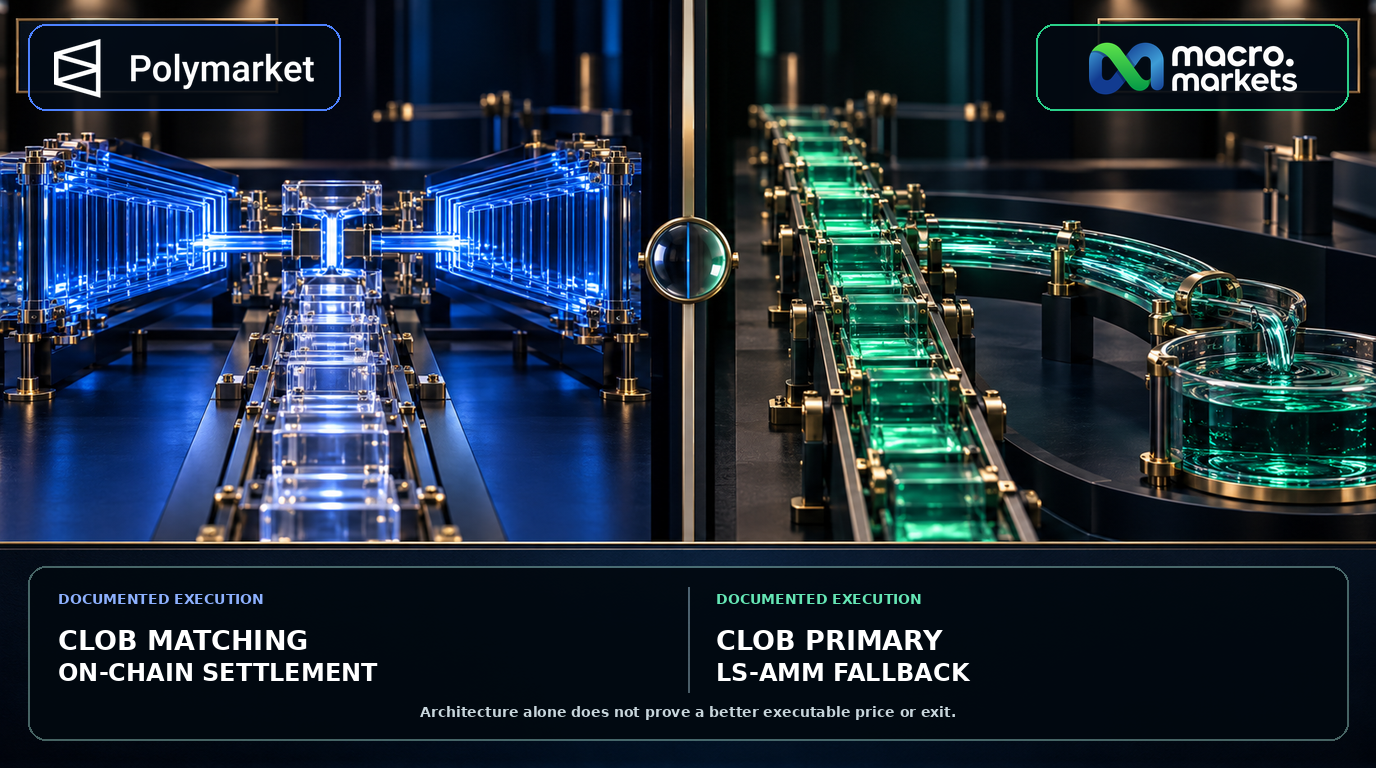
Polymarket's prices and order-book documentation describes a central limit order book with off-chain matching and on-chain settlement. Users submit limit orders, and an immediately executable “market order” is implemented as a limit order priced to cross resting liquidity.
The displayed probability is not necessarily executable. Polymarket says the interface normally displays the bid-ask midpoint, switching to the last traded price when the spread is wider than ten cents. A buyer pays the ask; a seller receives the bid. Inspect the book rather than treating the headline percentage as a guaranteed price.
Macro Markets' hybrid architecture
Macro Markets' launch article describes a CLOB-primary, LS-AMM-fallback architecture. The order book handles trading when counterparties provide depth; the automated market maker is intended to provide a route in thinner markets.
That is a meaningful product difference, but it remains a first-party architecture description. An AMM can quote when a book is thin without guaranteeing a favorable price or unlimited exit. Inspect the curve, quote, size and price impact in the live market.
No permanent liquidity winner
A defensible liquidity test requires matched contracts at the same timestamp. Record:
- best bid and ask;
- available quantity at each level;
- expected average fill for the chosen size;
- explicit fee;
- settlement rule and deadline; and
- likely exit value if you cannot hold to resolution.
Company-wide volume, market count and social visibility are not substitutes for this snapshot. Polymarket may have deeper liquidity in a high-profile election while Macro has a more usable quote in another event. The opposite can also occur.
Resolution and Dispute Models
Both platforms emphasize resolution, but they describe different trust models.
Polymarket: UMA and Chainlink
Polymarket's resolution documentation says ordinary prediction markets use the UMA Optimistic Oracle. A proposer posts a bond, a challenge window opens and a disputed result can escalate to additional proposals and a token-holder vote. Defined up-down markets can use a Chainlink time-weighted average price instead.
This process is inspectable, but the oracle cannot repair a poorly understood contract. Read the named source, end time, edge cases and clarification language before entering. An undisputed proposal can resolve quickly; a dispute can add days.
Macro Markets: agentic resolution
Macro Markets says its resolution oracle uses multiple AI agents to gather primary sources, cross-check evidence and debate ambiguous cases. That can support faster evidence processing and a different audit trail, but readers should verify how the live market publishes its source, decision, challenge path and final authority.
Our dedicated article on agentic oracle resolution and Polymarket examines this narrower design question. The platform comparison does not assume one method is universally superior. A precise contract with a transparent challenge path matters more than the label attached to the oracle.
APIs and Developer Experience
Polymarket is the clearer current choice for a developer who needs public self-service documentation. It publishes SDK examples, market discovery, order-book endpoints, real-time data, wallet authentication, order placement and position workflows. The official quickstart shows authenticated order submission against its CLOB.
Macro Markets' launch materials describe REST, GraphQL and websocket access. Confirm the current production endpoint, authentication method, permissions, rate limits and trading availability before choosing it for a bot or data product.
Developer fit is not only documentation. Compare:
- market and outcome identifiers;
- historical and real-time data coverage;
- order types and cancellation behavior;
- signer or API-key custody;
- rate limits and reconnect behavior;
- settlement and redemption events; and
- jurisdictional restrictions for the intended users.
Never put a wallet private key in a client application or repository. Use scoped credentials where supported and test every order flow with minimal size.
A Five-Minute Live Comparison
Use this procedure before choosing either platform for a specific event:
- Confirm eligibility. Check the current country or location rule and account agreement.
- Match the contract. Align outcome, deadline, source and edge-case language.
- Record executable prices. Capture the bid, ask and quantity for the same side and size.
- Preview the complete cost. Add explicit fee, spread, slippage, conversion, bridge, network and withdrawal costs.
- Plan the exit. Decide whether you will hold through resolution and what happens if liquidity disappears.
If the contracts cannot be matched, compare the platforms as alternatives rather than claiming one has a better price for the same asset. Our guide to trading prediction markets provides a complete pre-order checklist.
Frequently Asked Questions
Is Macro Markets like Polymarket?
Both are crypto-oriented prediction-market products, but the account, custody, execution and resolution models differ. Polymarket International documents a non-custodial CLOB with on-chain settlement and UMA resolution. Macro Markets uses a platform account and describes hybrid CLOB/AMM execution plus an AI-agent resolution process.
Can US residents use Polymarket International?
No. Polymarket says US residents must use the separate Polymarket US product and cannot trade on polymarket.com. Do not use a VPN to bypass the restriction.
Can Brazil residents use Polymarket International?
Brazil appeared on Polymarket's blocked-country list when this article was reviewed. Check the current official list before relying on this dated statement. Do not attempt to bypass a location restriction.
Is Macro Markets available in the United States?
Do not infer US eligibility from an English-language website or crypto support. Macro Markets requires users to be in a permitted jurisdiction and can apply location and identity controls. Confirm the current terms and signup result for the exact location.
Which platform has lower fees?
There is no universal answer. Polymarket publishes category-specific international taker fees and a zero maker-fee schedule. Macro Markets requires checking the live trading and wallet flow. Spread, slippage, conversion, bridge, network and withdrawal costs can reverse the headline comparison.
Which platform has better liquidity?
Neither platform wins every market. Compare the same economic contract, side, timestamp and order size. Use the executable book or quote, not company-wide volume or a displayed midpoint.
Is Polymarket non-custodial?
Polymarket International describes itself as non-custodial: users control wallet authority and open-position collateral is held in smart contracts. Polymarket US is a separate regulated product with a different clearing and custody framework.
Is Macro Markets non-custodial?
This comparison does not describe Macro Markets as non-custodial. Its Terms describe a platform account, approved payment methods and customer funds held in dedicated bank accounts or crypto wallets. Verify the current custody and withdrawal arrangement before funding.
Does Macro Markets require KYC?
Its Terms reserve the right to request KYC documents to confirm identity and location and to restrict access, payments or withdrawals until verification is complete. Crypto support does not mean anonymous access.
Which resolution model is better?
Neither label guarantees a correct outcome. Polymarket's UMA process has public proposal, challenge and escalation mechanics. Macro Markets describes a multi-agent evidence process. The better market is the one with precise rules, a credible source, a clear challenge route and an auditable final decision.
Which is better for developers?
Polymarket currently has the clearer public self-service SDK and API documentation. Macro Markets describes REST, GraphQL and websocket capabilities, but developers should verify current production access and limits.
Final Verdict
Polymarket International is the stronger documented protocol-first choice. Eligible users get a public CLOB model, on-chain settlement, non-custodial wallet structure, category-specific fee formula, UMA resolution process and extensive developer documentation. Its trade-offs are geographic restrictions, wallet and network complexity, contract-specific liquidity and oracle disputes.
Macro Markets is the more differentiated hybrid-platform alternative. Its appeal is the combination of crypto-oriented funding, a platform account, broad event discovery and a CLOB-primary/LS-AMM-fallback architecture. Its trade-offs include a different custody and jurisdiction profile and less public numerical detail for fees, live execution and production API access.
Choose Polymarket International when public mechanics, on-chain records and developer tooling are your priorities. Evaluate Macro Markets when you prefer a crypto-oriented platform account and want to test a hybrid liquidity route. Then judge the actual trade independently.
Platform fit gets you to the market. The contract rules, executable price, available size and complete funding route determine whether the position deserves to be opened.
If neither platform fits your location or preferred account model, compare seven different routes in our guide to the best Polymarket alternatives.
Primary sources reviewed
- Polymarket International Terms of Use
- Polymarket website versus US app
- Polymarket geographic restrictions
- Polymarket prices and order-book documentation
- Polymarket fee documentation
- Polymarket resolution documentation
- Polymarket trading quickstart
- Polymarket transparency page
- Polymarket US Trust and Safety Hub
- Macro Markets launch and product architecture
- Macro Markets Terms of Service
Fact-check method: current operator terms, product documentation, help materials and public trust disclosures. No funded matched-order execution or withdrawal test was performed.
