


ForecastEx vs Coinbase Prediction Markets: Fees and Best Fit (2026)

ForecastEx and Coinbase both offer eligible US customers a way to trade event outcomes, but they are not two front ends for the same prediction market. ForecastEx is a listing and clearing venue. Coinbase Predictions is a customer access product offered through Coinbase Financial Markets, while Coinbase's current documentation says Kalshi operates its prediction markets. That means the books, rules and settlement authorities are separate.
Our verdict: choose ForecastEx through Interactive Brokers if you want transparent per-contract pricing, limit-order control, professional trading tools and API support. Choose Coinbase if you want a simpler browser/mobile workflow and convenient funding with settled USD or USDC inside an existing Coinbase relationship. For any specific trade, compare the exact contract language, executable price, depth and complete fee rather than the brand name.
Last verified: November 3, 2026. Product access, fees, venue relationships and state eligibility can change.
Editorial disclosure: Macro Markets publishes this comparison and operates a prediction-market platform. We include Macro Markets as a contextual crypto-native alternative, apply the same criteria and do not present it as a CFTC-designated US exchange. This is a documentation-based comparison; we did not place synchronized funded orders on both routes. Event contracts can settle at $0 and lose the entire amount committed. This page is educational, not financial, legal or tax advice.
ForecastEx vs Coinbase Prediction Markets: Quick Verdict
The shortest useful answer is that ForecastEx wins for market structure, price control and automation, while Coinbase wins for consumer convenience and crypto-account adjacency.
ForecastEx is the better fit when you already use Interactive Brokers, care about an explicit public fee schedule, want to place a limit order or need TWS and Web API support. Its catalog emphasizes measurable economic, government, climate and related outcomes. A direct US IBKR client currently sees $0 IBKR commission plus a $0.01 ForecastEx exchange fee per contract, subject to the published conditions.
Coinbase is the better fit when you are approved for Predictions, already keep settled USD or USDC at Coinbase and prefer a familiar mobile or browser flow. Coinbase Financial Markets handles the customer relationship. Kalshi currently operates the listed prediction markets, supplies the underlying rules and determines the final result.
Winner by use case
- Explicit published route fee: ForecastEx through direct IBKR pricing.
- Settled USDC funding: Coinbase.
- Limit orders, desktop tools and APIs: ForecastEx through IBKR.
- Simple consumer browser/mobile flow: Coinbase.
- Economic and climate contract focus: ForecastEx.
- Broad current consumer catalog: Coinbase's Kalshi route.
- Shared liquidity: neither; these are separate venues under the current documented structure.
- Universal best platform: neither; contract quality and total cost decide the trade.
| Comparison | ForecastEx through IBKR | Coinbase Predictions | Practical winner |
|---|---|---|---|
| Legal/market role | ForecastEx is the DCM and DCO; IBKR is the common broker/FCM access route | CFM is the customer intermediary; Kalshi currently operates the market | Different structures |
| Underlying exchange | ForecastEx | Kalshi under current Coinbase documentation | No shared book |
| Funding | Eligible brokerage cash | Settled USD or USDC in predictions balance | Depends on account |
| Customer fee | $0 IBKR commission + $0.01 ForecastEx exchange fee per contract for published US direct-client route | Fee breakdown shown at order confirmation | ForecastEx for public specificity |
| Order control | Limit only; Day, GTC or IOC | Consumer buy and early-sell flow; review live ticket | ForecastEx |
| Interfaces | ForecastTrader, IBKR platforms, TWS and Web APIs | Coinbase browser and mobile | Depends on workflow |
| Exit before resolution | Buy the opposite ForecastEx instrument and let IBKR net | Sell early when available and liquid | Coinbase is more familiar |
| Resolution | ForecastEx rules and named source | Kalshi rules and named source | Read exact contract |
The distinction prevents a common error. A ForecastEx price and a Coinbase price can look like competing probabilities, but they can refer to contracts with different thresholds, release times, data sources or exception clauses. They are not interchangeable merely because the headline question sounds the same.
What ForecastEx and Coinbase Actually Are
ForecastEx is a regulated exchange and clearing organization. The CFTC's designated-contract-market list identifies ForecastEx as a DCM, and the agency maintains its separate clearing registration. ForecastEx writes the contract specifications, operates its book and applies the resolution rules for its own products.
Retail users commonly reach ForecastEx through Interactive Brokers. The customer relationship, permissions, cash and order interface sit at IBKR, but the instrument remains a ForecastEx contract. IBKR's documentation describes $1 winning payouts, one-cent price increments and markets tied to economic, government and environmental indicators.
Coinbase has a different chain. Coinbase's official Predictions introduction says the product is offered through Coinbase Financial Markets, or CFM. It also says the markets are operated by Kalshi and that Kalshi determines results from the source named in each market's rules. Coinbase cannot manually override that resolution.
This is not a semantic detail. The customer sees Coinbase, but the current prediction contract is a Kalshi contract. Coinbase provides access, account integration and the order experience; Kalshi supplies the exchange market, book and settlement decision.
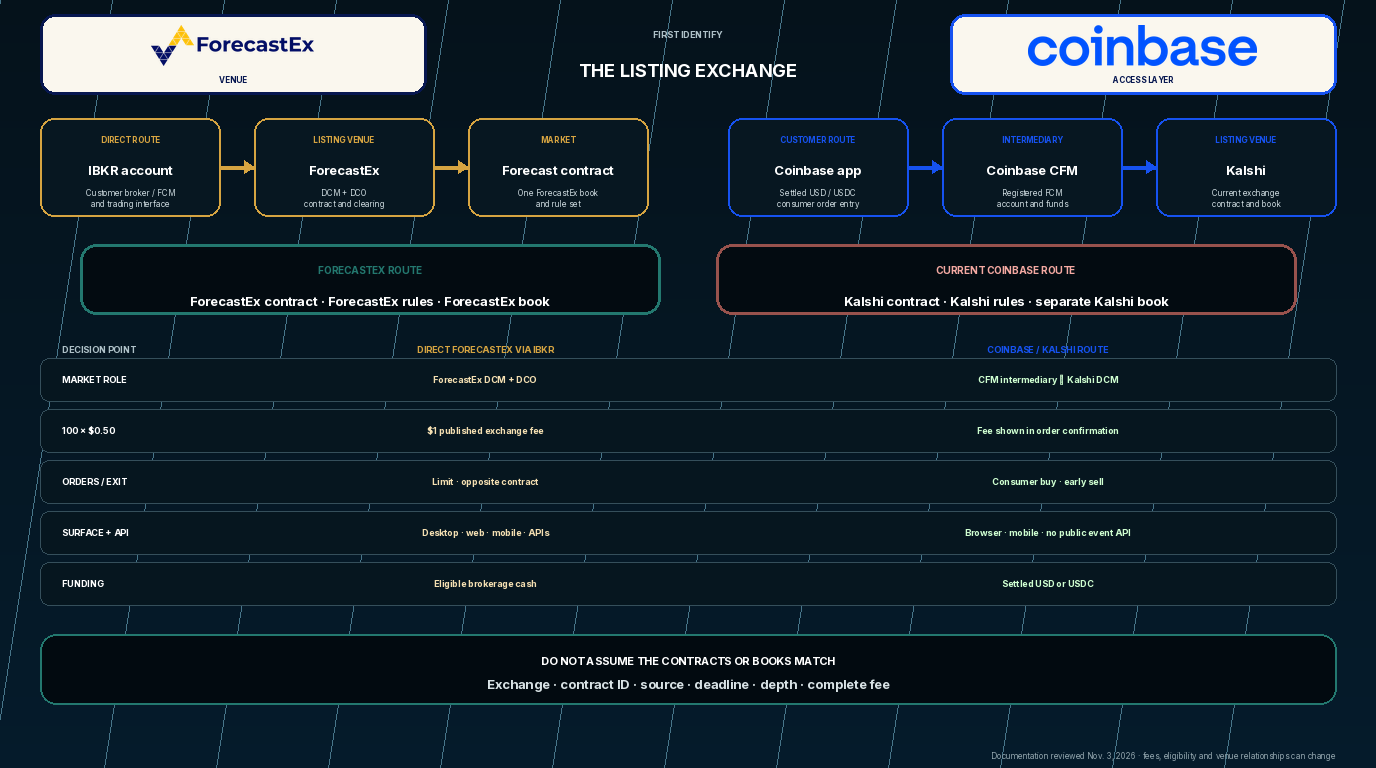
The current documented routes lead to different exchanges and separate books.
Why there is no shared ForecastEx-Coinbase book
Under the current public documentation, Coinbase Predictions does not route to ForecastEx. It routes to Kalshi. Therefore:
- a ForecastEx order joins a ForecastEx book;
- a Coinbase prediction order reaches a Kalshi market;
- participants and available depth can differ;
- the contracts can use different wording and sources; and
- a position cannot be transferred from one venue to the other.
Even when both venues ask whether the Federal Reserve will change rates, the legally controlling questions may differ. One can reference the upper bound of a target range, another the effective rate. Observation timestamps, rounding, revisions and extraordinary-event provisions can also change the payout.
Before comparing prices, match the event, threshold, observation window, source agency, publication vintage, resolution time and exception rules. If any element differs, treat the prices as information from related but distinct markets, not a riskless arbitrage.
For a broader intermediary comparison, see Coinbase vs Interactive Brokers prediction markets. For the venue itself, our ForecastEx review covers its contract mechanics in more depth.
Fees, Funding and a Matched Cost Test
ForecastEx has the clearer public fee route. Interactive Brokers' current US schedule for direct clients lists $0 commission plus a $0.01 ForecastEx exchange fee per contract. IBKR warns that rates can change and that introduced, managed or other arrangements can add charges.
Coinbase uses a preview-based disclosure. Its public help page says the confirmation screen displays the applicable fee breakdown before the order is submitted. That is useful at execution time, but it does not support one universal fee number for every customer, contract and quantity. Do not substitute Coinbase Advanced spot-crypto fees or a direct Kalshi fee schedule for the actual CFM prediction order preview.
| Cost item for 100 contracts at $0.50 | ForecastEx through published direct IBKR route | Coinbase Predictions |
|---|---|---|
| Contract debit | $50 if all 100 fill at $0.50 | $50 if all 100 fill at $0.50 |
| Published customer/venue charge | $1 total ForecastEx exchange fee; $0 IBKR commission | Use the fee shown on the live confirmation |
| Minimum modeled cash outlay | $51 before any funding or tax effects | $50 plus the displayed fee |
| One-cent adverse execution move | Adds $1 across 100 contracts | Adds $1 across 100 contracts |
| Correct comparison | Executable debit + $1 route fee | Executable debit + previewed fee |
This is an illustration, not a quote. A limit order may fill partially or not at all. A displayed Coinbase price can change before confirmation. The meaningful equation is:
all-in entry cost = filled contract debit + customer fee + exchange fee + spread + slippage + funding friction
A one-cent worse execution across 100 contracts costs the same $1 as ForecastEx's published exchange fee. This is why the cheapest-looking fee schedule can lose to a better executable price, and why a midpoint or last trade is not enough.
Our prediction-market fee calculator helps normalize contract quantities, price and fees. Enter the live order-preview value for Coinbase rather than guessing.
Funding differences
ForecastEx through IBKR uses eligible brokerage cash and requires the relevant account permission. Fully collateralized event contracts do not create ordinary margin borrowing capacity. If the account base currency is not US dollars, conversion cost and currency exposure can matter.
Coinbase says prediction contracts can be bought with settled USD or USDC. Customers top up a separate predictions balance from the primary Coinbase balance. Recent deposits can be held, and unrealized prediction gains are not settled buying power. This is Coinbase's most distinctive advantage for a crypto-oriented user: USDC can sit beside the broader crypto account even though the prediction contract itself is a regulated event contract operated by Kalshi.
Do not call that “paying with any crypto.” The official workflow names settled USD and USDC. Selling another asset to obtain them can introduce a separate trade, spread, fee and tax consequence.
Contracts, Orders, APIs and Early Exit
ForecastEx contracts are deliberately structured as separate Yes and No instruments. IBKR's API documentation says they are buy-only: a customer does not sell a ForecastEx contract to close it. To reduce or exit a position, the customer buys the opposing instrument and IBKR nets the paired positions.
ForecastEx event contracts support limit orders rather than market orders. Documented time-in-force choices are Day, Good-Til-Canceled and Immediate-Or-Cancel. Quantities must be whole contracts. These constraints make price control explicit, but they also require the user to understand which side to buy and how an offset works.
Coinbase presents a more familiar consumer flow. Its official buy-and-sell guide directs a customer to fund USD or USDC, choose Predictions, review the event and rules, enter a spend amount or contract quantity, and inspect the confirmation. The product also describes selling early when the market is open and sufficient liquidity exists.
| Trading capability | ForecastEx through IBKR | Coinbase Predictions |
|---|---|---|
| Contract model | Separate buy-only Yes and No instruments | Kalshi outcome contract through CFM interface |
| Price control | Limit orders only | Use the order choices and quote shown in the live interface |
| Time in force | Day, GTC, IOC | Confirm in live ticket; public help emphasizes consumer flow |
| Quantity | Whole contracts | USD/USDC spend or contract count, subject to limits |
| Early exit | Buy opposing ForecastEx contract; IBKR nets | Sell early if the market is open and liquid |
| Desktop | IBKR Desktop and TWS | Browser account experience |
| Mobile | IBKR mobile surfaces | Coinbase app |
| Public execution API | TWS and Web API event-contract support | No consumer prediction-specific execution API documented |
API advantage: ForecastEx
The ForecastEx route is substantially stronger for systematic users. IBKR documents contract discovery, rule retrieval, market data and order submission for event contracts. A workflow can store conids, retrieve the market's named source and payout terms, enforce limit prices and preserve the exact contract identity in a research database.
Automation does not remove contract risk. It can amplify a mapping error if a script confuses a threshold, month or side. A robust system should store the venue, product code, contract ID, side, source, release time, payout time, price increment and rule URL before an order is allowed.
Coinbase has broad developer products for crypto, but its current consumer Predictions help material does not document a comparable prediction-market execution API. Do not assume that an Advanced Trade API endpoint can place a CFM/Kalshi prediction order.
Markets, Liquidity and User Experience
ForecastEx's identity is strongest around measurable macro and environmental outcomes: CPI, Fed decisions, employment, government statistics, temperature and related indicators. That makes it attractive for traders who already follow scheduled releases and want contracts anchored to official data.
Coinbase's current Kalshi route can expose a broader consumer mix, including sports, crypto prices, politics and elections, weather and economic data. The exact catalog changes. Coinbase's help center notes that different categories use different settlement sources, from official league results to weather agencies and benchmark crypto indexes.
Catalog breadth is not liquidity. Evaluate each book with the size you intend to trade. Useful checks include the best executable price, depth across multiple levels, spread, recent volume, open interest where available and the cost of leaving early. A highly visible market can still be expensive for a large order.
User experience trade-off
Coinbase reduces context switching for an approved existing customer. The same brand relationship provides the primary balance, USDC access, mobile interface and prediction section. Its weakness is abstraction: users may incorrectly believe Coinbase writes the contract or controls resolution.
ForecastEx through IBKR exposes more of the financial machinery. The customer can use professional account reporting, desktop tools and APIs, but must understand permissions, event-instrument conventions and venue-specific exit behavior. The learning curve is higher, especially for someone expecting a sportsbook-style button.
Neither interface makes a traded probability objectively correct. Prices reflect orders and available capital under one contract's rules. Thin liquidity, concentrated positions and breaking information can move them quickly.
Regulation, Settlement, Risk and the Macro Alternative
Both routes exist inside the US derivatives framework, but the registered roles differ. ForecastEx is the DCM and DCO for its contracts. On the Coinbase route, CFM is the customer-facing intermediary and Kalshi is the current DCM operating the market. Registration is important, but it does not prevent trading losses, outages, contract disputes or unfavorable execution.
Settlement begins with the written rules, not the headline. For a macro contract, verify whether the source uses the first release or a later revision. For a crypto-price contract, verify the benchmark and sampling window. For sports, check regulation versus overtime. Coinbase's official overview explicitly warns that category-specific definitions can differ from ordinary assumptions.
ForecastEx applies its own rulebook and data source. Kalshi applies its rules to current Coinbase markets, and Coinbase says it cannot override the official outcome. A complaint about interface wording does not transform the controlling exchange contract.
Eligibility and account risk
Coinbase currently says Predictions is available to US residents except Nevada and Michigan, subject to approval, holds, limits and regulatory conditions. ForecastEx access through IBKR depends on residence, affiliate, age, account type, permissions and the individual instrument. Always treat the signed-in ticket as the controlling availability check.
Position limits also matter. Coinbase says its maximum can reflect certified financial information and market conditions. ForecastEx and IBKR can enforce their own limits and risk controls. Splitting an idea between two venues does not make an oversized position prudent.
Where Macro Markets fits
Macro Markets is a crypto-native alternative for users who value onchain-style funding and a different market experience. It can be relevant to a reader comparing Coinbase because both sit closer to crypto-native behavior than a traditional desktop brokerage.
It is not a regulatory substitute for ForecastEx or the current CFM/Kalshi route. Availability, custody, settlement, market rules and legal treatment can differ by jurisdiction. Compare the exact market, collateral, resolution source and withdrawal path before committing funds. Our disclosure matters here: Macro Markets publishes this article and operates the platform.
For more options, see ForecastEx alternatives and Coinbase prediction-market alternatives, then compare the exact contract before choosing an app.
Which Platform Should You Choose?
Choose ForecastEx through Interactive Brokers when:
- you want an exchange focused on economic, government and climate outcomes;
- a published one-cent-per-contract exchange fee matters;
- limit orders and explicit time-in-force controls are important;
- you use TWS, IBKR Desktop or event-contract APIs;
- you can work with separate buy-only Yes and No instruments; and
- event positions belong inside a broader brokerage workflow.
Choose Coinbase Predictions when:
- you already have an approved Coinbase relationship;
- settled USD or USDC is the most convenient funding source;
- you prefer a consumer browser or mobile experience;
- a broad Kalshi-powered catalog fits your interests;
- you are comfortable checking the fee on every order confirmation; and
- you understand that Kalshi, not Coinbase, currently operates and resolves the market.
Choose neither until you can answer five questions: Which exchange lists the contract? What exact event and source control resolution? What price can the full quantity execute at? What is the complete fee? How will you exit if the thesis changes?
Frequently asked questions
Is Coinbase a ForecastEx broker?
Not under the current public Coinbase documentation. Coinbase says its prediction markets are operated by Kalshi. ForecastEx is a separate exchange commonly accessed through Interactive Brokers.
Do ForecastEx and Coinbase share liquidity?
No under the current documented routes. ForecastEx orders join ForecastEx books; Coinbase prediction orders reach Kalshi markets. Similar event titles do not create a shared book.
Which is cheaper?
ForecastEx has the more explicit public route: the published direct IBKR schedule currently lists $0 commission plus a one-cent exchange fee per contract. Coinbase shows its applicable fee at confirmation. The cheaper total trade depends on the executable contract price, fee and slippage.
Can I fund Coinbase Predictions with Bitcoin or other crypto?
Coinbase's current help page names settled USD and USDC. Converting another asset first is a separate transaction with its own possible costs and tax effects.
Which platform has an API?
Interactive Brokers documents TWS and Web API support for ForecastEx event contracts. Coinbase does not currently document a consumer prediction-specific execution API comparable to that workflow.
Can I sell a ForecastEx contract before settlement?
ForecastEx instruments are buy-only in IBKR's documented model. To reduce or close, buy the opposite side and IBKR nets the positions. Coinbase describes an early-sale flow for eligible liquid positions.
The final choice should be contract-by-contract. ForecastEx is the stronger specialist tool; Coinbase is the simpler consumer access layer. Neither label replaces the work of reading the rules and measuring the complete executable cost.
