


Coinbase vs Robinhood Prediction Markets: Which Is Better in 2026?

Coinbase and Robinhood both let approved US customers trade prediction contracts inside a familiar financial account. Neither brand currently acts as the exchange operator for every contract shown. Coinbase Financial Markets currently provides access to Kalshi-operated markets. Robinhood Derivatives can route contracts to several partner exchanges, including Kalshi.
Our verdict: choose Coinbase when you value browser and mobile execution, settled USD or USDC and a simpler current venue chain. Choose Robinhood when you already use its brokerage app, want access to multiple exchange partners or value supported limit, dollar, fractional and combination workflows. Always check the listing exchange because Coinbase and Robinhood can sometimes be two doors to the same Kalshi market rather than independent liquidity venues.
Last reviewed and fact-checked: November 1, 2026.
Editorial disclosure: Macro Markets publishes this comparison and operates a prediction-market platform. We include Macro Markets as a contextual crypto-native alternative, apply the same comparison criteria and do not present it as a CFTC-designated US exchange. This is a documentation-based comparison; we did not place synchronized funded orders or complete a deposit-to-withdrawal test on both access paths. Event contracts can settle at $0 and lose the full amount committed. This page is educational, not financial, legal or tax advice.
Coinbase vs Robinhood: Quick Verdict
Choose Coinbase Predictions if you want a relatively simple current structure. Coinbase Financial Markets, or CFM, manages the customer relationship. Coinbase's current public documentation says Kalshi operates the prediction markets and determines settlement. Eligible customers can use settled USD or USDC and trade through a browser or mobile app.
Choose Robinhood Prediction Markets if brokerage integration and venue breadth matter more. Robinhood Derivatives is the customer intermediary. Its current support documentation says contracts can be offered through KalshiEX, ForecastEx, Rothera Exchange and Clearing or North American Derivatives Exchange, also referred to as CDNA. The venue depends on the contract.
Winner by use case
- Web and mobile execution: Coinbase; Robinhood execution remains mobile-only.
- Existing brokerage-account convenience: Robinhood.
- Settled USDC funding: Coinbase.
- Multi-exchange access: Robinhood.
- Simpler current venue chain: Coinbase.
- Supported GTD limit, dollar and fractional workflows: Robinhood, subject to the contract.
- Custom or preset combinations: Robinhood where an exchange quote is available.
- Universal fee winner: neither; compare the final preview and executable price.
- Best liquidity: contract-specific; first identify whether both listings reach Kalshi or different exchanges.
This comparison is not Coinbase versus Robinhood as companies. It is CFM access to a current Kalshi contract versus Robinhood Derivatives access to the exchange named on a specific order. That distinction controls the book, rules, settlement and possible exchange fee.
For standalone assessments, read our Coinbase Prediction Markets review and Robinhood Prediction Markets review. Our comparison methodology explains why contract identity and executable depth matter more than app popularity.
Coinbase vs Robinhood at a Glance
| Decision factor | Coinbase Predictions | Robinhood Prediction Markets | Practical edge |
|---|---|---|---|
| Customer intermediary | Coinbase Financial Markets | Robinhood Derivatives | Depends on preferred account |
| Current documented exchanges | Kalshi for the consumer markets described by Coinbase | KalshiEX, ForecastEx, Rothera or CDNA, depending on contract | Robinhood for venue breadth |
| Possible liquidity overlap | Coinbase contract reaches Kalshi | A Robinhood contract may also reach Kalshi | Check contract ID before counting two books |
| Funding | Eligible settled USD or USDC | Event buying power with eligible brokerage sweeps | Coinbase for USDC; Robinhood for brokerage integration |
| Platform fee | Applicable amount shown in order confirmation | Probability-weighted commission capped at $0.01 per contract | Robinhood publishes more formula detail |
| Exchange fee | Included in the complete Coinbase preview | Separate exchange fee can be up to $0.01 per contract | Compare the complete ticket |
| Trading surface | Browser and mobile | Mobile execution; web view-only; no Legend | Coinbase |
| Orders | Consumer buy and early-sell flow | IOC, GTD limit, dollar and some fractional orders | Robinhood |
| Settlement | Kalshi contract rules control | Named partner exchange rules control | Read the exact contract |
| Public prediction API | No consumer prediction-specific execution API documented | No retail prediction-specific execution API documented | Neither for automation |
Both are intermediaries
Coinbase Financial Markets and Robinhood Derivatives are futures commission merchants that provide the customer layer. An FCM handles onboarding, customer funds, order access and support responsibilities. The listing exchange creates the contract, operates the market and determines the result under its rulebook.
Robinhood's current prediction-market structure guide explains the separation between exchanges and brokers or FCMs. Coinbase uses the same broad regulatory architecture even though its current public consumer flow names Kalshi as the exchange across its prediction product.
The Same-Exchange Question
Coinbase currently describes this route:
- The customer uses Coinbase.com and applies for CFM predictions access.
- Settled USD or USDC is moved into the predictions balance.
- The customer submits the order through Coinbase.
- Kalshi operates the current market and applies its rules.
- Proceeds return through the CFM and Coinbase balance workflow.
Robinhood describes this route:
- The customer has an eligible individual account and applies for Robinhood Derivatives.
- Event buying power is funded with eligible cash or account sweeps.
- The customer submits an order in the Robinhood mobile app.
- Robinhood routes the contract to the named partner exchange.
- That exchange applies the market rules and determines settlement.
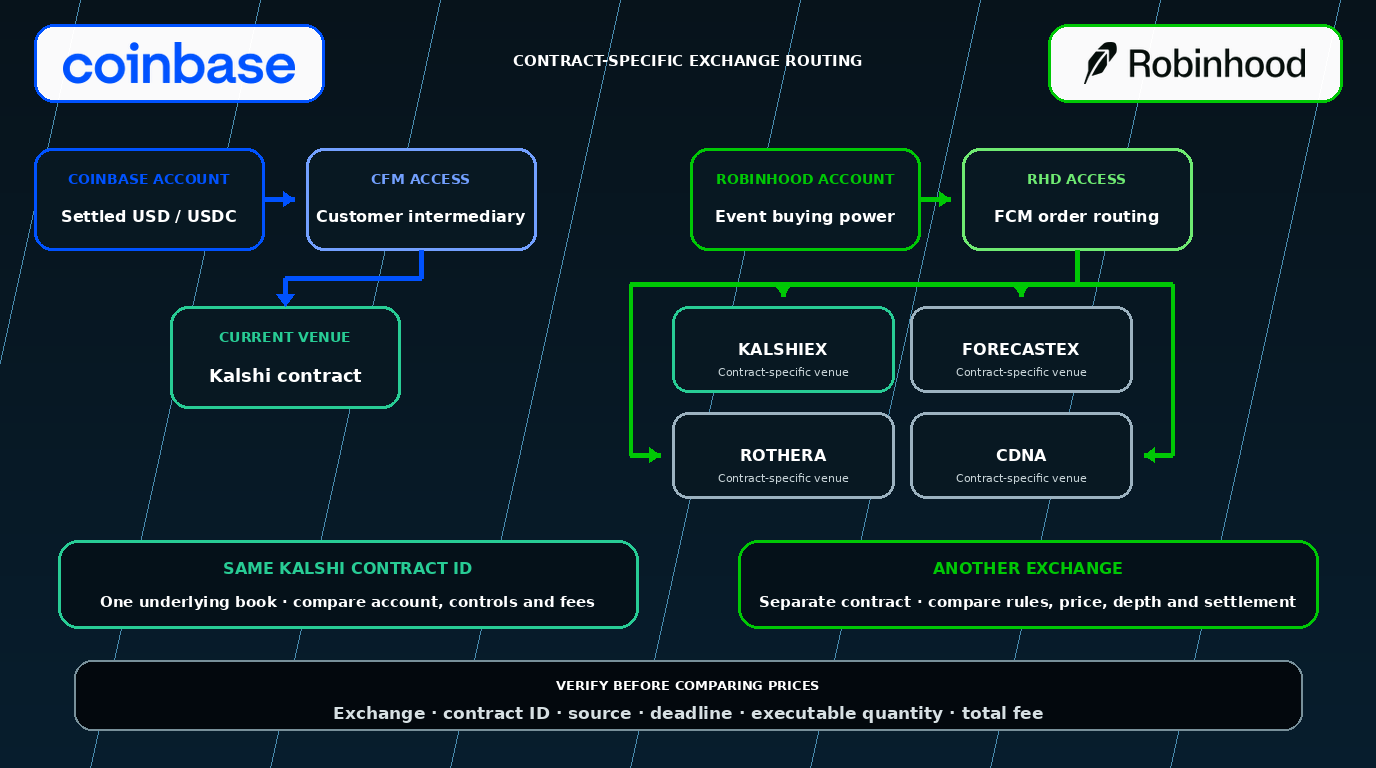
A Robinhood contract routed to Kalshi can overlap with Coinbase's current venue; another Robinhood venue creates a separate contract and liquidity pool.
When both paths name Kalshi
If Coinbase and Robinhood display the same Kalshi contract identifier, do not count them as two independent exchange books. The screens can show different values because of refresh timing, rounding, quantity, fee presentation or an order that moved the market. That does not prove separate liquidity.
Compare:
- the exchange name;
- exact contract identifier;
- event and outcome wording;
- close and observation time;
- named resolution source;
- available quantity at the executable price; and
- complete customer fee preview.
When the identifiers match, the decision is primarily about account, funding, controls, support and customer-facing cost.
When Robinhood names another exchange
If the Robinhood contract is listed by ForecastEx, Rothera or CDNA, it is a separate market. Similar titles can still hide different thresholds, settlement sources, deadlines, cancellation rules and order-book depth. A price difference is not an arbitrage until the contracts are economically equivalent.
Robinhood has continued expanding its venue network. Its September 2026 announcement says selected football contracts can route to Crypto.com's regulated exchange and clearinghouse through the OG.com partnership, while other contracts continue through Kalshi, ForecastEx and Rothera. The live contract disclosure remains the controlling evidence because product routing can change.
Fees, Prices and Liquidity
Coinbase says the applicable prediction-market fee appears in the order confirmation. It does not currently publish one universal consumer formula in its overview. The complete preview should be recorded for the exact side, quantity and contract.
Robinhood publishes a probability-weighted commission:
commission = k × p × (1 − p) × c
p is the contract price, c is quantity and k is currently 5% for Robinhood Gold customers or 10% without Gold. Robinhood rounds the commission up to the nearest cent and caps it at $0.01 per contract. The listing exchange can charge an additional fee of up to $0.01 per contract.
The current Robinhood event-contract overview describes those two cost layers. Both the Robinhood commission and exchange fee can apply when opening and closing.
A 100-contract example at 50 cents
For 100 contracts at $0.50:
- The contract debit is $50 before fees.
- Robinhood's formula reaches the $0.01-per-contract cap, producing a $1 commission with or without Gold.
- A separate exchange fee can add up to $1.
- The Robinhood entry total can therefore reach $52 before spread, slippage or funding friction.
Coinbase cannot be assigned a universal dollar total from public overview documentation. Record the actual order confirmation rather than assuming the direct Kalshi schedule equals the customer-facing CFM fee.
Gold can matter away from the middle of the probability range, where the commission does not hit the cap. At $0.90 for 100 contracts, the formula produces $0.45 with Gold and $0.90 without Gold before an exchange fee. The subscription cost must be considered separately.
All-in execution decides the winner
Use this model:
all-in cost = contract debit + intermediary fee + exchange fee + spread + slippage + funding friction
A one-cent worse executable price across 100 contracts costs $1. That can outweigh a small fee difference. Compare the best available offer for the full entry quantity and the bid likely available for an early exit.
Liquidity belongs to the named exchange and exact contract. Robinhood's overall prediction volume does not prove depth in a specific market. Coinbase's broad brand does not add a second book to Kalshi. Use our prediction-market fee calculator for matched scenarios and the bid-ask spread guide for execution risk.
Funding, Trading Tools and Eligibility
Coinbase lets eligible customers move settled USD or USDC from the broader account into a predictions balance. Recent deposits can remain subject to holds. Unrealized prediction gains cannot fund new orders until they settle. After a sale or final result, transfers back to the primary balance follow Coinbase's documented business-day processing windows.
Robinhood maintains event-contract buying power separately from ordinary brokerage and crypto balances, although eligible funds can be swept automatically. Instant Deposits may not be available. If settled cash is required, a bank transfer can take several business days. Account familiarity does not guarantee immediate buying power for a time-sensitive event.
Browser versus mobile
Coinbase supports prediction trading through browser and mobile. Robinhood's current event-contract trading guide says contracts can be viewed on the web but executed only in the mobile app. They are not available in Robinhood Legend.
That gives Coinbase a practical advantage for desktop-first research and order review. Robinhood can still be the more familiar mobile workflow for an existing brokerage customer.
Robinhood offers more documented order formats
Robinhood currently documents:
- IOC contract orders: execute immediately within the limit and cancel the remainder.
- GTD limit orders: rest until filled or the stated expiration.
- Dollar orders: calculate quantity from a dollar amount and use IOC behavior.
- Fractional contracts: supported in selected markets and workflows.
- Preset or custom combinations: available where the exchange returns a quote.
These controls do not guarantee a fill. A resting order can expire, an IOC can partially execute and a combo can remain impossible to close when no counterparty appears.
Coinbase's current consumer documentation emphasizes buy and early-sell workflows rather than a comparable public catalog of prediction-specific advanced order types. Check the live ticket instead of inferring functionality from Coinbase's crypto exchange tools.
Eligibility is product-specific
Coinbase currently limits prediction markets to US residents and excludes Nevada and Michigan. Approval requires the CFM account process and certified customer information.
Robinhood requires an eligible US individual account and approval for Robinhood Derivatives. State, exchange and event-category restrictions can apply. The live app decision controls because sports and other contract access can change faster than an evergreen comparison.
Eligibility on one platform does not prove eligibility on the other. Do not use inaccurate information or location-masking tools to bypass controls.
How to Choose Safely
Use this sequence:
- Confirm eligibility. Check the current account, state and contract restrictions.
- Identify the exchange. Never infer the venue from the app logo.
- Match the contract. Compare identifier, source, threshold, deadline and exceptional rules.
- Measure executable depth. Use the same side, quantity and observation time.
- Preview total cost. Include platform commission, exchange fee, spread and slippage.
- Check buying power. Confirm that USD, USDC or brokerage cash is actually settled and available.
- Plan the exit. A displayed portfolio value is not a guaranteed sale price.
- Start small. Test order behavior, support and settlement before increasing size.
If neither account model fits, Macro Markets is a crypto-native alternative for eligible users who deliberately prefer crypto funding and global market discovery. Because Macro Markets publishes this comparison, treat that inclusion as a disclosed first-party statement. Verify current jurisdiction, eligibility, supported networks, custody, fees, liquidity and resolution independently. Macro Markets has a different legal profile and is not presented here as a CFTC-designated exchange.
For wider shortlists, compare the best Coinbase prediction-market alternatives, Robinhood prediction-market alternatives and best prediction-market apps. The direct comparisons Kalshi vs Coinbase and Kalshi vs Robinhood explain each intermediary against direct exchange access.
Frequently Asked Questions and Final Verdict
Does Coinbase or Robinhood operate the prediction exchange?
Coinbase Financial Markets and Robinhood Derivatives provide customer access. Coinbase says Kalshi operates its current markets. Robinhood routes each contract to the partner exchange named in its terms, which can include Kalshi or another venue.
Can Coinbase and Robinhood show the same Kalshi contract?
Yes. When both paths identify the same Kalshi contract, they can reference the same underlying book and settlement rules. Compare customer fees, funding, order controls and support rather than counting them as two independent liquidity pools.
Is Robinhood cheaper than Coinbase?
There is no universal answer. Robinhood publishes a probability-weighted commission and can add a separate exchange fee. Coinbase shows its applicable fee in the order confirmation. Executable price, spread and available size can outweigh the fee difference.
Which is better for USDC users?
Coinbase has the clearer documented route because eligible settled USDC can fund the predictions balance. Robinhood centers event buying power on eligible cash within its derivatives and brokerage relationship.
Which is better for desktop trading?
Coinbase. Its predictions product supports browser and mobile execution. Robinhood currently permits mobile execution only, although markets can be viewed on the web.
Who determines settlement?
The listing exchange does. Kalshi determines current Coinbase outcomes. On Robinhood, the named partner exchange applies its own contract rules. Neither intermediary can override the exchange because a third-party app or news report shows a different result.
Is Macro Markets an alternative?
Macro Markets can be an alternative for eligible users seeking a crypto-native workflow, but its jurisdiction, custody and regulatory profile differ. Macro Markets publishes this article and is not represented here as a CFTC-designated US exchange.
Final verdict
Coinbase is better for approved users who prioritize browser and mobile access, settled USD or USDC and a simpler current Kalshi venue chain. Robinhood is better for existing brokerage customers who prioritize a familiar mobile app, multiple partner exchanges and more documented order formats.
The better trade remains contract-specific. Identify the exchange first. If both products show the same Kalshi contract, compare the account and complete order preview. If Robinhood names another venue, compare the rules and liquidity as separate markets.
Regulation does not guarantee profit or an early exit. Either contract can settle at $0, and a thin market can make closing expensive or impossible.
