Polymarket US vs Robinhood Prediction Markets: Which Is Better in 2026?
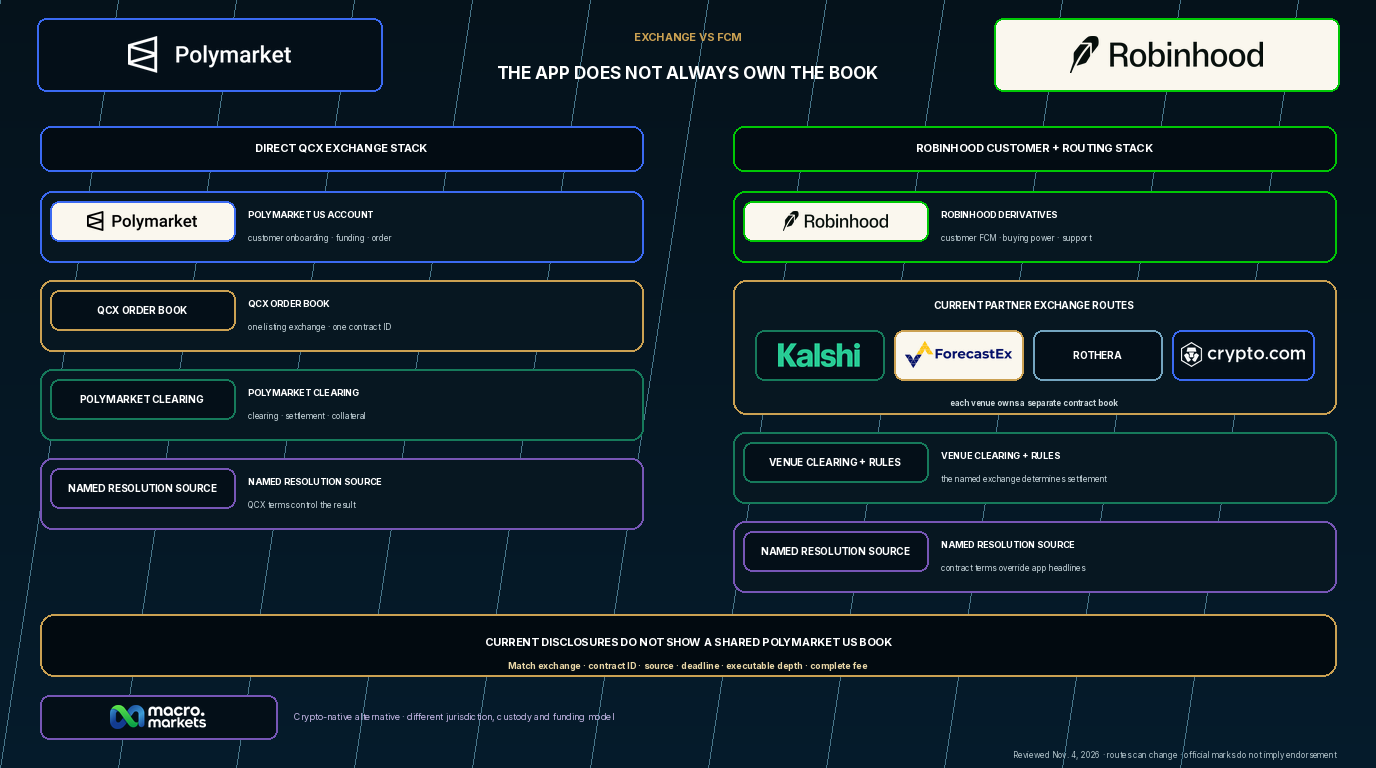
Polymarket US and Robinhood both give eligible US customers access to event contracts, but they occupy different layers of the market. Polymarket US operates a designated contract market and its own order book. Robinhood Derivatives is a futures commission merchant that provides the customer account and routes each contract to a partner exchange.
Our verdict: choose Polymarket US when you want a prediction-first exchange, direct QCX liquidity, market and limit orders, broad documented funding methods and public developer tools. Choose Robinhood when you already use its brokerage app, prefer a single familiar mobile account and value access to several partner exchanges, dollar orders, GTD orders, fractional closing support and combinations where available.
The most important comparison is not the color of the app. It is this chain:
customer account → intermediary → listing exchange → order book → clearing → resolution source
As of November 4, 2026, Robinhood's official venue disclosure names KalshiEX, ForecastEx, Rothera and Crypto.com Derivatives North America. It does not name Polymarket US. A similar headline on the two apps is therefore not evidence of a shared contract or shared liquidity.
Last reviewed and fact-checked: November 4, 2026.
Editorial disclosure: Macro Markets publishes this comparison and operates a prediction-market platform. We include Macro Markets as a disclosed crypto-native alternative, apply the same contract-level comparison framework and do not present it as a CFTC-designated US exchange. This is a documentation-based comparison; we did not place synchronized funded orders on both products. Event contracts can settle at $0, and early exit depends on executable liquidity. This page is educational, not financial, legal or tax advice.
Polymarket US vs Robinhood: Quick Verdict
Choose Polymarket US if you want the listing exchange and customer product to share one brand. QCX LLC d/b/a Polymarket US defines the contract, operates the central limit order book and applies its exchange rules. Polymarket Clearing handles the clearing and settlement layer.
Choose Robinhood Prediction Markets if you want event contracts inside a broader brokerage relationship. Robinhood Derivatives manages onboarding, buying power, the order ticket and customer support, but the exchange named on each contract controls the book, rules and result.
Winner by use case
- Dedicated prediction exchange: Polymarket US.
- Existing brokerage-account convenience: Robinhood.
- Current partner-exchange breadth: Robinhood.
- Direct relationship with the listing venue: Polymarket US.
- Documented market and limit orders on app and web: Polymarket US.
- Mobile dollar, IOC, GTD and combination workflows: Robinhood, where supported.
- Public market-data and trading API documentation: Polymarket US.
- Android execution: neither has a clear advantage in current public documentation; verify the live product.
- Universal fee winner: neither; price, role, exchange fee, spread and size change the answer.
- Universal liquidity winner: neither; compare the exact contract and executable depth.
| Decision factor | Polymarket US | Robinhood Prediction Markets | Practical edge |
|---|---|---|---|
| Customer relationship | Direct Polymarket US account | Robinhood Derivatives inside broader Robinhood relationship | Preference-specific |
| Legal role | QCX is the listing exchange | Robinhood Derivatives is the FCM/intermediary | Different layers |
| Current exchange route | QCX order book | KalshiEX, ForecastEx, Rothera or CDNA, depending on contract | Robinhood for venue breadth |
| Shared liquidity today | Own QCX contract and book | Partner-exchange book | No shared book shown in current disclosures |
| Standard customer fee | Probability-weighted taker formula; volume-gated rebates | Probability-weighted Robinhood commission plus possible exchange fee | Compare complete preview |
| Funding | Debit, ACH, Apple Pay, PayPal, Venmo, USDC where available and wire | Event buying power swept from eligible settled cash | Different workflows |
| Execution surface | Official docs describe app and web orders; consumer help remains iOS-led | Mobile execution; web view-only; not in Legend | Polymarket US for web execution |
| Orders | Market and limit, with several expiry choices | IOC, GTD, dollar orders, some fractional closing and combos | Use-case dependent |
| API | Public data, WebSocket, SDK and trading-integration documentation | No retail prediction-specific execution API documented | Polymarket US |
| Settlement authority | QCX contract and named source | Partner exchange contract and named source | Read exact terms |
For standalone assessments, read our Polymarket US review and Robinhood Prediction Markets review. Our prediction-market comparison methodology explains why contract identity and executable depth matter more than app popularity.
Exchange vs FCM: What You Are Actually Comparing
The CFTC lists QCX LLC d/b/a Polymarket US as a designated contract market. The agency separately lists QC Clearing LLC d/b/a Polymarket Clearing as a derivatives clearing organization.
That produces a relatively direct stack:
- The customer opens and verifies a Polymarket US account.
- The customer funds the account and selects a QCX contract.
- A market or limit order interacts with the QCX central limit order book.
- QCX applies its contract terms and named resolution source.
- Polymarket Clearing processes the resulting settlement.
Robinhood is structurally different. Robinhood Derivatives is the FCM that carries the customer relationship. Robinhood's event-contract overview says contracts are offered through KalshiEX, ForecastEx, Rothera or Crypto.com Derivatives North America. The exact venue depends on the contract.
Its route is:
- The customer maintains an eligible Robinhood individual brokerage account.
- The customer applies for Robinhood Derivatives access.
- Robinhood presents a contract and complete order ticket in the mobile app.
- Robinhood routes the order to the exchange identified for that contract.
- That exchange owns the book and determines settlement under its rules.
Do Polymarket US and Robinhood share liquidity?
Not according to the current public venue disclosures. Polymarket US contracts trade on QCX. Robinhood's current list names four other exchange routes and does not include QCX or Polymarket US.
That means an election, sports or economic question with similar wording can still be two independent products. They can have different:
- contract identifiers;
- observation windows and time zones;
- official data sources;
- cancellation or postponement rules;
- tick sizes and position limits;
- trading close times;
- fees and rebates; and
- order-book depth.
Do not add their displayed volume or depth together. Do not call a price difference an arbitrage until the propositions, sources, deadlines and exceptional rules are economically equivalent. Product relationships can change, so the live order disclosure remains the controlling evidence.
Polymarket US is not Polymarket.com
Polymarket's website-versus-app guide says Polymarket.com serves eligible international users, while US residents use the separate Polymarket US product. Accounts and support are separate.
Do not import these international-product facts into this comparison:
- Polymarket.com USDC-only funding assumptions;
- international volume or liquidity;
- international category fee schedules;
- wallet, smart-contract or oracle behavior; or
- international API credentials and positions.
This page compares Robinhood with the regulated US exchange product only.
Fees, Spreads and 100-Contract Examples
Both products publish probability-weighted customer charges, but the formulas are not identical and Robinhood can add a separate exchange fee.
Polymarket US's current fee schedule lists the standard taker formula:
standard taker fee = 0.0695 × contracts × price × (1 − price)
The dollar charge is highest near a 50-cent contract and falls toward the extremes. Maker and taker rebates depend on prior-month volume. A resting order does not automatically earn a rebate, and the lowest maker tier receives none.
Robinhood publishes this commission:
Robinhood commission = k × price × (1 − price) × contracts
k is 5% with Robinhood Gold and 10% without Gold. Robinhood rounds up to the nearest cent and caps its commission at $0.01 per contract. Its current overview says the listing exchange can charge an additional fee of up to $0.01 per contract. Opening and early-closing trades can each create another fee event.
Matched examples before spread and slippage
| Example | Polymarket US standard taker | Robinhood with Gold | Robinhood without Gold |
|---|---|---|---|
| 100 contracts at $0.50 | About $1.74 | $1.00 commission | $1.00 commission |
| Possible Robinhood exchange fee | Not applicable as a separate Robinhood layer | Up to $1.00 | Up to $1.00 |
| 100 contracts at $0.90 | About $0.63 | $0.45 commission | $0.90 commission |
| Contract debit at $0.50 | $50.00 | $50.00 | $50.00 |
At the midpoint, Robinhood's own commission is lower than the standard Polymarket US taker fee, but a full one-cent-per-contract exchange fee can make the Robinhood charge reach $2.00. At 90 cents, Gold lowers Robinhood's commission, but the subscription cost and exchange fee remain separate.
This is not a permanent fee ranking. The Polymarket order may be a maker fill, a Robinhood exchange may charge less than its maximum, either platform may change a schedule and one book may offer a worse executable price.
All-in execution decides the real winner
Use this model for the same contract size and observation time:
all-in cost = contract debit + customer commission + exchange fee − earned rebate + spread + slippage + expected exit cost
A two-cent worse average fill across 100 contracts costs $2. That can exceed the difference between the displayed fee formulas. An early sale also requires a bid and may trigger another taker commission or exchange fee.
Compare:
- best ask and quantity available for entry;
- average fill price for the complete order;
- current customer and exchange fees;
- best bid and likely cost of an early exit;
- contract-specific rebates actually earned, not advertised maximums; and
- funding and withdrawal friction.
Use our prediction-market fee calculator for matched examples and the bid-ask spread guide to measure execution risk.
Funding, Eligibility and Device Access
Polymarket US publishes a wider menu of direct funding methods. Its funding guide lists debit card, ACH, Apple Pay, PayPal, Venmo, USDC on iPhone where available and wire transfer.
The guide currently lists:
- a $50,000 daily limit and three to four business days for debit deposits;
- a $50,000 daily limit and three to four business days for ACH;
- a $5,000 wire minimum, no stated maximum and an estimated one business day; and
- possible instant buying power for non-wire deposits, with withdrawals held until the deposit clears.
Robinhood uses event-contract buying power inside its account system. Its buying-power guide says event buying power is separate from brokerage and crypto buying power, although eligible value is swept automatically. Instant Deposits may not be available. When they are not, a bank transfer can take one to five business days before cash is usable.
Eligibility is contract-specific
Both products require identity verification and an approved account. Robinhood requires an individual brokerage account, US residence and approval for Robinhood Derivatives. State and category restrictions can apply. Its current help page, for example, lists specific restrictions for sports and other categories in several states as of November 2, 2026.
Polymarket US applies its own account, location and contract restrictions. Approval for one platform does not establish eligibility on the other. Never use a VPN, false address or borrowed identity to bypass controls.
Web and mobile access
Polymarket US's order-type documentation explicitly describes market and limit orders in the app and on the web. Its broader consumer separation guide still presents the iOS app as the primary US consumer product and says Android is coming soon. Confirm which surface your approved account can actually use.
Robinhood's trading guide says prediction markets can be viewed on the web but traded only in the mobile app. They are not available in Robinhood Legend.
That gives Polymarket US the clearer current advantage for browser execution and Robinhood the convenience advantage for an existing mobile brokerage customer.
Orders, APIs and Trading Tools
Polymarket US documents two core order types on its CLOB:
- Market order: seeks immediate execution at the best available prices within quote-based protection; unfilled quantity does not rest.
- Limit order: executes at the limit or better and can remain open after a partial fill.
Limit-order expiries include Good 'til cancelled, a daily cutoff, start of game for eligible sports contracts and Immediate or Cancel. Execution follows price-time priority. A limit order controls price but cannot guarantee a fill.
Robinhood currently documents:
- IOC contract orders: fill immediately within the natural-price limit or cancel the remainder.
- GTD limit orders: rest at a user-defined limit and expire on the stated schedule.
- Dollar orders: calculate quantity from a dollar amount and always use IOC behavior.
- Fractional closing orders: available for some contracts and specifications.
- Combinations: preset or custom multi-leg positions where the exchange provides a quote; closing can require a complete fill.
Robinhood's workflow is more varied for a guided mobile customer. Polymarket US gives the customer a more direct exchange order book and more flexible published limit-order duration.
API and market-data comparison
Polymarket US publishes API references, WebSockets, SDKs, market data, trading integration and institutional connectivity. Public documentation does not mean every account can place automated orders. Credentials, endpoint permissions, rate limits and compliance requirements still apply.
Robinhood does not currently document a public retail prediction-specific execution API. Do not infer event-contract automation from stock, crypto or brokerage APIs.
| Tool | Polymarket US | Robinhood |
|---|---|---|
| Market orders | Yes | IOC contract and dollar workflows |
| Resting limit orders | Yes, with several expiries | GTD contract orders |
| Fractional contracts | Documented separately by contract | Some closing and dollar workflows |
| Combination contracts | Separate combo fee and market rules | Preset or custom combos where quoted |
| Browser execution | Documented | No; view-only |
| Public market data | Extensive public documentation | Consumer display; no prediction-specific public execution API documented |
| Programmatic trading path | API credentials and permissions documented | Not documented for retail event contracts |
Markets, Liquidity, Resolution, Safety and Final Choice
Both products cover multiple categories, including sports, politics, economics, weather and entertainment. Robinhood can offer broader venue diversity because different exchanges specialize in different products. Polymarket US offers one coherent exchange catalog and direct QCX market identity.
Neither structure guarantees a better contract. Before comparing a price, match:
- exact Yes or No proposition;
- listing exchange and contract identifier;
- observation deadline and time zone;
- official data source;
- cancellation, postponement and exceptional-outcome rules;
- tick size, position limit and trading close; and
- executable quantity at each price level.
Liquidity belongs to the exchange book
Polymarket US depth belongs to QCX. Robinhood depth belongs to the exchange named on the contract. Robinhood's total prediction volume does not prove liquidity in a specific ForecastEx or Kalshi listing. Polymarket US brand awareness does not prove that a particular QCX contract can absorb a large order.
Record the full book for the quantity you intend to trade. A displayed midpoint or last trade is not the price available for the whole order. If the exit book is thin, an unrealized gain may not be realizable without significant slippage.
Who determines settlement?
On Polymarket US, QCX applies the contract terms and named resolution source, then Polymarket Clearing processes settlement. On Robinhood, the partner exchange determines the official result. Robinhood's settlement guide says the contract terms under the About section identify the controlling source.
Robinhood also notes that payout timing and withdrawal availability are different. Proceeds are generally available for withdrawal within one business day of settlement, while some events, such as elections, can take longer to become official.
A news headline, another prediction market, a weather app or an AI answer cannot override the named source. Save the contract terms before taking a material position.
Regulation does not remove trading risk
Both routes operate within CFTC-regulated market infrastructure, but registration does not guarantee:
- profit or accurate forecasting;
- continuous liquidity;
- an early exit at the displayed price;
- immediate settlement or withdrawal;
- availability in every state; or
- protection from a contract settling at $0.
Size the trade so a full loss does not impair essential expenses. Test funding, order behavior, support and withdrawal with a small amount before increasing exposure.
Which Platform Should You Choose?
| Choose Polymarket US when... | Choose Robinhood when... |
|---|---|
| You want a dedicated prediction exchange and direct QCX book | You already use Robinhood and value one familiar mobile account |
| Browser execution or public developer documentation matters | Multi-exchange access matters more than one direct exchange relationship |
| You want published market and limit orders with several expiry choices | Dollar orders, GTD orders, fractional closing or combos fit your workflow |
| Its funding menu fits your cash or available USDC route | Automatic buying-power sweeps fit your brokerage cash workflow |
| The exact QCX contract has better rules, depth and all-in price | The named partner-exchange contract has better rules, depth and all-in price |
Use this selection sequence:
- Confirm account and location eligibility.
- Identify the listing exchange before comparing prices.
- Match proposition, source, deadline and exceptional rules.
- Measure the average fill for the intended quantity.
- Add the complete customer fee, exchange fee, spread and exit cost.
- Confirm settled buying power and withdrawal holds.
- Decide whether browser, mobile, API or advanced-order access matters.
- Start with a small test and assume the full amount can be lost.
Where Macro Markets fits as a crypto-native alternative
Macro Markets can suit eligible users who deliberately want crypto-oriented funding and global prediction-market discovery rather than either US regulated-account workflow. Its crypto-native approach has a different jurisdiction, custody, network, conversion, withdrawal and resolution profile.
Macro Markets is not presented as a CFTC-designated US exchange or a regulatory equivalent to QCX or Robinhood's partner venues. Because Macro Markets publishes this comparison, this section is first-party positioning, not an independent endorsement. Verify current eligibility, supported assets and networks, platform fees, executable liquidity, custody and dispute rules independently.
Read how Macro Markets works after completing those checks. Our Polymarket vs Macro Markets comparison covers the crypto-native decision in more detail, while the best Polymarket US alternatives and best Robinhood alternatives provide broader regulated and account-interface shortlists.
Frequently Asked Questions and Final Verdict
Is Polymarket US the same as Robinhood Prediction Markets?
No. Polymarket US is the QCX listing exchange and has its own order book. Robinhood Derivatives is an FCM that provides customer access to contracts listed by partner exchanges.
Does Robinhood route orders to Polymarket US?
Robinhood's current public event-contract disclosure names KalshiEX, ForecastEx, Rothera and Crypto.com Derivatives North America. It does not name Polymarket US. Check the live contract disclosure because partner relationships can change.
Which platform is cheaper?
There is no permanent winner. Polymarket US publishes a standard taker formula and volume-gated rebates. Robinhood publishes a Gold or non-Gold commission and can add a separate exchange fee. The executable price, spread, depth and expected exit cost can outweigh the headline fee.
Which platform has better liquidity?
Liquidity is contract-specific. Compare the QCX book with the exact partner-exchange book shown by Robinhood at the same timestamp and quantity. Do not use platform-wide volume as proof of depth.
Can I trade on a computer?
Polymarket US documentation describes app and web orders. Robinhood currently allows web viewing but requires its mobile app for event-contract execution and does not support the product in Legend.
Which platform offers better order types?
Polymarket US offers market and limit orders with several expiry choices. Robinhood offers IOC, GTD, dollar and some fractional workflows, plus combinations where quoted. The better set depends on whether direct exchange price control or guided mobile flexibility matters more.
Who resolves the contract?
QCX resolves Polymarket US contracts under their written terms. On Robinhood, the named partner exchange resolves the contract. Robinhood supplies the customer interface but does not replace the exchange's official source.
Is Polymarket US the same as international Polymarket.com?
No. They have separate products, accounts, support, funding and market infrastructure. US residents use Polymarket US. International Polymarket.com volume, wallet behavior and fees do not describe the US exchange.
Is Macro Markets an alternative?
Macro Markets can be relevant to eligible users seeking a crypto-native workflow and global discovery, but it has a different jurisdiction, custody and funding model. Macro Markets publishes this article and is not represented as a CFTC-designated US exchange.
Final verdict: Polymarket US or Robinhood?
Polymarket US is better for an eligible user who wants a dedicated prediction exchange, direct QCX liquidity, browser execution, published market and limit orders and extensive developer documentation. Its standard taker fee can be higher than Robinhood's own commission in some matched examples, and device, location and rebate eligibility require current verification.
Robinhood is better for an existing brokerage customer who prioritizes a familiar mobile workflow, several partner exchanges and flexible dollar, GTD, fractional or combination order paths. Its exchange layer changes by contract, its complete cost can include two fee layers and execution remains mobile-only.
The correct choice is the better exact contract, not the more familiar logo. Identify the exchange, read the source and deadline, compare the complete executable book and fees, and size for a total loss. If neither product offers clear terms and acceptable exit liquidity, the correct choice is neither.