


Gemini vs Robinhood Prediction Markets: Which Is Better in 2026?
Gemini and Robinhood both place prediction markets inside a familiar financial account, but the market structure underneath is different. Gemini operates Gemini Titan, its own event exchange, with clearing through Gemini Olympus. Robinhood Derivatives acts as an intermediary and routes each contract to the exchange named on the order.
Our verdict: choose Gemini if you value browser execution, an exchange-operated order book, explicit maker/taker pricing or prediction-specific APIs. Choose Robinhood if you already use its brokerage app, want access to several exchange partners or prefer supported mobile workflows such as dollar orders, fractional contracts and combinations. Neither is universally cheaper or more liquid; the exact contract, executable depth and fee preview decide the trade.
Last reviewed and fact-checked: November 1, 2026.
Editorial disclosure: Macro Markets publishes this comparison and operates a prediction-market platform. We include Macro Markets as a contextual crypto-native alternative, apply the same comparison criteria and do not present it as a CFTC-designated US exchange. This is a documentation-based comparison; we did not place synchronized funded orders or complete a deposit-to-withdrawal test on both platforms. Event contracts can settle at $0 and lose the full amount committed. This page is educational, not financial, legal or tax advice.
Gemini vs Robinhood: Quick Verdict
Choose Gemini Predictions if you want the account provider to operate the underlying exchange, need desktop or browser execution, plan to place maker orders, or want documented REST and WebSocket access. A Gemini contract trades on Gemini Titan's own book and clears through Gemini Olympus. That vertical structure makes venue identity relatively direct, although every market still has its own rules and liquidity.
Choose Robinhood Prediction Markets if you want event contracts inside an existing brokerage relationship and value a broader set of exchange partners. Robinhood Derivatives handles the customer layer, but the listing exchange varies by contract. Its support documentation currently names KalshiEX, ForecastEx, Rothera and CDNA among possible venues. Execution remains mobile-only.
Winner by use case
- Browser and desktop execution: Gemini.
- Existing brokerage-account convenience: Robinhood.
- Own exchange and clearing stack: Gemini.
- Multi-exchange discovery: Robinhood.
- Prediction-specific APIs: Gemini.
- Published maker discount: Gemini, subject to the current schedule and promotion.
- Dollar, fractional and combination workflows: Robinhood, where supported.
- Universal fee winner: neither; calculate the exact ticket.
- Best liquidity: contract-specific; compare executable size, not the brand.
For standalone assessments, read our Gemini Prediction Markets review and Robinhood Prediction Markets review. Our comparison methodology explains why venue, rulebook and executable depth matter more than app popularity.
Gemini vs Robinhood at a Glance
| Decision factor | Gemini Predictions | Robinhood Prediction Markets | Practical edge |
|---|---|---|---|
| Customer relationship | Gemini account | Robinhood brokerage plus Robinhood Derivatives | Depends on preferred account |
| Exchange operator | Gemini Titan | Named partner exchange for each contract | Gemini for a direct venue identity; Robinhood for breadth |
| Clearing | Gemini Olympus | Venue-specific clearing arrangement | Check the contract disclosure |
| Order book | Gemini Titan book | Book operated by the named exchange | Neither platform-wide |
| Standard customer fee | Published maker/taker probability formula | Probability-weighted Robinhood commission plus possible exchange fee | Depends on order and contract |
| Trading surface | Web and mobile | Mobile execution; web view-only; no Legend | Gemini |
| Developer access | Prediction-specific REST and WebSocket documentation | No retail prediction-specific execution API documented | Gemini |
| Funding context | USD; supported crypto may be sold into USD | Event buying power funded from eligible brokerage cash | Depends on existing balance |
| Order workflows | Exchange order-book workflow | IOC, GTD limit, dollar, fractional and some combination orders | Robinhood for documented retail variety |
| Settlement authority | Gemini Titan contract rules | Named exchange's contract rules | Read the exact rulebook |
The Structural Difference That Matters
Gemini's route is vertically integrated:
- An eligible customer uses a Gemini account.
- The prediction order reaches Gemini Titan, the designated contract market.
- Gemini Titan operates the market and order book.
- Gemini Olympus provides affiliated clearing.
- The written Gemini contract specification controls settlement.
Robinhood's route separates the customer app from the venue:
- An eligible brokerage customer applies for Robinhood Derivatives.
- Robinhood provides the interface, buying-power workflow and customer support layer.
- The order is routed to the exchange identified for that contract.
- That exchange operates the book and applies its rulebook.
- Robinhood reports the resulting position and payout through the brokerage experience.
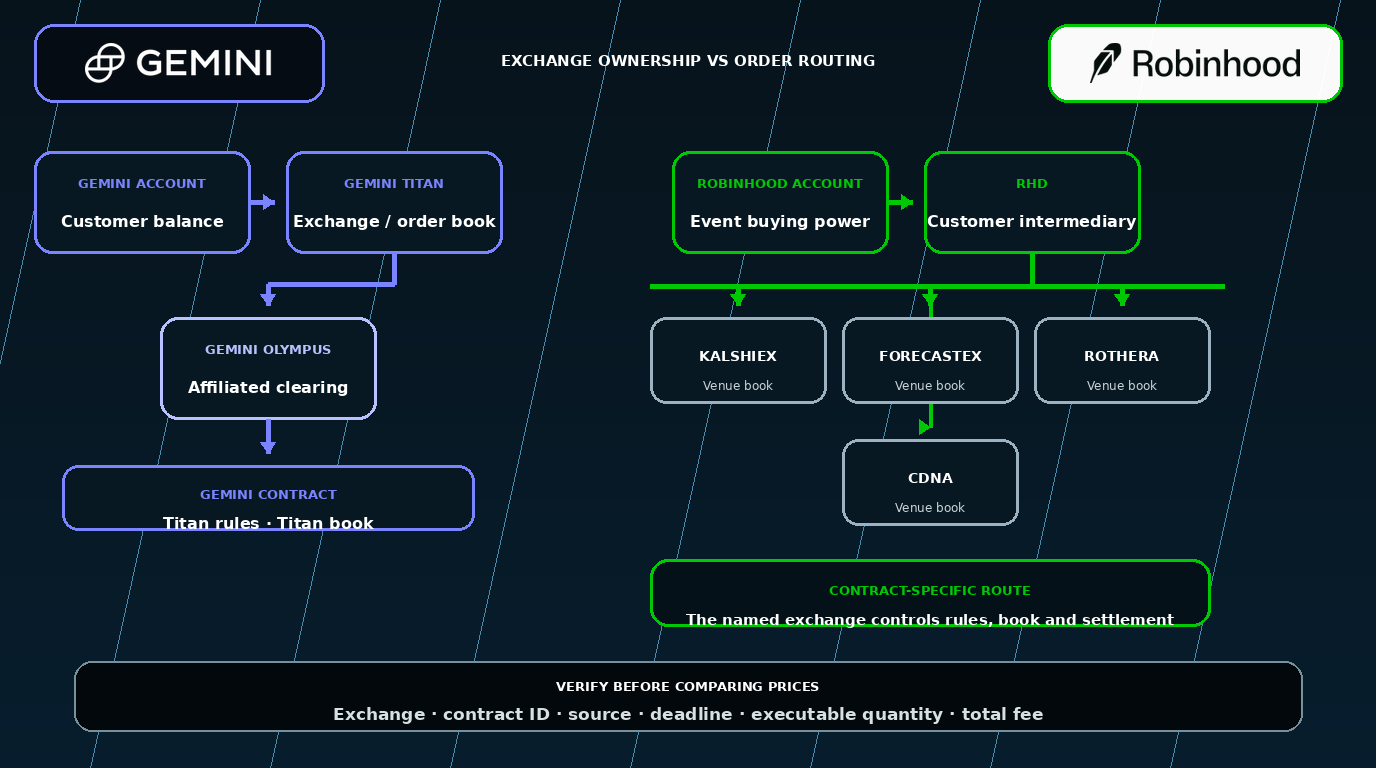
Gemini routes to its own exchange and clearing stack; Robinhood routes each contract to the partner exchange identified on the ticket.
Robinhood's prediction-market structure guide explains that brokers and futures commission merchants can provide access while exchanges list contracts and determine outcomes. That distinction is essential when comparing two similar market titles.
Similar events can still be separate markets
Suppose both apps show a contract about US payroll growth. The Gemini version and a Robinhood-listed version may use different exchanges, thresholds, observation times, sources, correction policies and close times. They also have separate liquidity unless the venue and exact contract identity match.
Before comparing prices, record:
- the listing exchange;
- exact contract or ticker identifier;
- outcome wording and side;
- observation and close time;
- named resolution source;
- quantity available at the executable price; and
- every customer and exchange fee.
A 52-cent Yes contract is not automatically cheaper than a 55-cent alternative. The lower quote may cover less size, use a different rule or disappear before execution.
Fees: Maker/Taker vs Commission Plus Exchange Fee
Gemini's current prediction-market fee schedule publishes this standard formula:
fee = rate × C × P × (1 − P)
C is the number of contracts and P is the price from 0 to 1. The standard rate is 0.0175 for a maker order and 0.07 for a taker order, with the result rounded up to the next cent. A maker order rests on the book and adds liquidity; a taker order matches immediately and removes it.
Gemini's current prediction-market builder program advertises zero maker fees for qualifying maker-side prediction trades through December 31, 2026. Treat that as a temporary program, not a permanent platform characteristic. Verify eligibility and the live schedule before relying on it.
Robinhood publishes a different probability-weighted commission:
commission = k × p × (1 − p) × c
p is price, c is quantity and k is currently 5% for Robinhood Gold customers or 10% without Gold. Robinhood rounds up to the nearest cent and caps its commission at $0.01 per contract. The listing exchange can charge an additional fee of up to $0.01 per contract. The current Robinhood event-contract overview explains both cost layers.
Example: 100 contracts at 50 cents
Ignoring spread and slippage:
| Route | Calculation | Illustrative customer fee |
|---|---|---|
| Gemini standard maker | 0.0175 × 100 × 0.50 × 0.50 |
$0.4375, rounded to $0.44 |
| Gemini qualifying promotional maker | Current temporary program | Potentially $0, if eligible |
| Gemini standard taker | 0.07 × 100 × 0.50 × 0.50 |
$1.75 |
| Robinhood commission | Formula reaches the $0.01-per-contract cap | $1.00 with or without Gold |
| Robinhood possible exchange fee | Up to $0.01 per contract | Up to $1.00 additional |
The Robinhood entry cost can therefore reach $2 before spread or slippage in this example. Gemini's standard taker fee is $1.75, while its maker price is lower. That does not make Gemini universally cheaper. A resting maker order may not fill, and a Robinhood partner venue may offer a better executable price or more depth.
Use the complete model:
all-in cost = fee + spread + slippage + conversion cost + withdrawal cost
Gold can matter away from the middle of the probability range, where Robinhood's commission does not reach the cap. The subscription cost must be evaluated separately. Use our prediction-market fee calculator and enter the actual side, price and quantity.
Liquidity and Execution
Gemini and Robinhood do not have one platform-wide liquidity score. Liquidity lives in each specific order book. On Gemini, that is the Gemini Titan market. On Robinhood, it is the book of the exchange named for that contract.
Compare:
- best executable bid and ask;
- quantity available at each level;
- depth beyond the top quote;
- expected price impact for the full order;
- likelihood that a maker order will fill; and
- the cost of exiting before settlement.
A brand can report high overall activity while a niche economic contract remains thin. A market can also settle correctly but be expensive or impossible to exit early. Our guide to the bid-ask spread explains why a displayed last trade is not the same as an executable quote.
Robinhood's order workflow
Robinhood documents immediate-or-cancel and good-til-date limit behavior, along with dollar-based and certain fractional orders. It also supports preset and custom combinations where the relevant exchange provides a quote. These features can make a mobile ticket convenient, but they do not remove venue risk or guarantee a fill.
Execution currently requires the Robinhood mobile app. The web experience is view-only for event contracts, and Robinhood Legend is not supported. For a trader who works from a desktop, that is a meaningful operational difference.
Gemini's API advantage
Gemini's Prediction Markets API specification documents REST and WebSocket interfaces for market data, orders, positions and related workflows. That gives Gemini a clear documented advantage for developers and systematic users in this comparison.
API access is not a liquidity advantage by itself. Test authentication, rate limits, identifier stability, order-state transitions, cancellation behavior and market-data latency before building a production integration.
Funding and Account Experience
Gemini places predictions beside a crypto-centered account. That can be convenient for an existing customer, but the funding mechanics deserve attention. Gemini explains that a supported crypto balance can be sold into USD to fund a prediction order. The sale can create price, fee and tax consequences, and the conversion may complete even if the subsequent prediction order does not.
Robinhood uses event buying power within an eligible brokerage relationship. Eligible cash can move into that balance through supported sweeps, but not every deposit or pending credit is necessarily available immediately. The preview and buying-power screen control.
Compare the full path, not only the deposit button:
| Step | Gemini question | Robinhood question |
|---|---|---|
| Funding | Will fiat be used or will crypto be sold into USD? | Which brokerage cash is eligible for event buying power? |
| Conversion | What sale price, fee and tax consequence can arise? | Does any transfer hold or restriction apply? |
| Execution | Is the order maker or taker, and what depth exists? | Which exchange receives the contract and what fees apply? |
| Exit | What bid supports the full position? | What does the venue book support for the full position? |
| Settlement | Which Gemini specification controls? | Which partner-exchange rulebook controls? |
Eligibility, Regulation and Settlement
Gemini Titan is a US designated contract market and Gemini Olympus is a registered derivatives clearing organization. Robinhood Derivatives is a futures commission merchant that provides access to contracts listed by regulated partner exchanges. These are not interchangeable roles.
Regulatory registration does not guarantee profit, liquidity, uptime, product access or correct user predictions. Eligibility can vary by state, account type and category, and live onboarding is the controlling source. Do not use location-masking tools to bypass restrictions.
Settlement begins with the exact rulebook. Gemini Titan controls Gemini's contract specification and named source. For Robinhood, the listing exchange named on the ticket controls the result. Robinhood cannot replace that exchange's rules because a news headline or another platform displays a different outcome.
Before trading, save or read:
- the complete outcome definition;
- the named source and observation time;
- rounding and threshold conventions;
- postponement, cancellation and correction provisions;
- close and settlement timing; and
- the support path for a disputed result.
Which Should You Choose?
Choose Gemini when most of these are true:
- you already use Gemini and understand its balance flow;
- you want web or desktop execution;
- you prefer a Gemini-operated exchange and clearing stack;
- you expect to place genuine maker orders; or
- you need documented prediction-market APIs.
Choose Robinhood when most of these are true:
- you already manage cash and investments in Robinhood;
- mobile-only execution is acceptable;
- access to several exchange partners matters;
- dollar, fractional or combination workflows fit your process; or
- you prefer one brokerage app over a dedicated exchange relationship.
If neither model fits, Macro Markets is a crypto-native alternative worth evaluating for eligible users who deliberately prefer crypto funding and global market discovery. Because Macro Markets publishes this article, treat that inclusion as a disclosed first-party statement. Verify its current jurisdiction, eligibility, wallet networks, fees, liquidity and resolution rules independently. Macro Markets has a different legal and custody profile and is not presented here as a CFTC-designated US exchange.
For a wider shortlist, see our guide to the best prediction market apps and the dedicated Gemini alternatives and Robinhood alternatives pages.
Frequently Asked Questions
Does Robinhood use Gemini's prediction exchange?
Robinhood's current public documentation names KalshiEX, ForecastEx, Rothera and CDNA among possible exchanges, depending on the contract. It does not list Gemini Titan as a standard current venue. Check the exchange disclosure on the live ticket because routing relationships can change.
Is Gemini cheaper than Robinhood for prediction markets?
Not always. Gemini's published standard maker coefficient is low, and qualifying maker trades may currently receive a temporary zero-fee promotion. Robinhood caps its commission at one cent per contract but can add an exchange fee of up to one cent per contract. The actual winner depends on order status, price, quantity, spread and available depth.
Which is better for desktop trading?
Gemini. It supports browser execution, while Robinhood currently limits event-contract execution to its mobile app. Robinhood's web experience is view-only, and Legend does not support these contracts.
Which is better for API trading?
Gemini has the clearer documented advantage because it publishes prediction-specific REST and WebSocket specifications. Robinhood does not currently document a comparable retail prediction-market execution API. Availability, permissions and rate limits still need to be tested.
Are matching prices on Gemini and Robinhood the same contract?
No. Similar names or prices do not establish contract equivalence. Check the exchange, identifier, outcome definition, deadline, resolution source and exceptional-event rules. Gemini Titan and a Robinhood partner venue generally maintain independent contracts and books.
Final verdict
Gemini is the better fit for web access, maker-sensitive trading, direct exchange identity and API use. Robinhood is the better fit for an existing brokerage customer who wants multi-venue event discovery and flexible mobile order workflows.
Do not choose from the app logo alone. Match the contract, compare the executable quote and size, preview every fee and read the controlling rulebook. Either position can settle at zero, and an early exit may not be available.
Ready to explore a crypto-native alternative? Open Macro Markets only after checking whether the platform, market and funding route are available and appropriate in your jurisdiction.
