


Polymarket US vs Crypto.com Predict Pro: Fees and Best Fit (2026)
Polymarket US fee update — November 7, 2026: From November 6 at 1:00 PM ET, the official standard taker schedule uses Θ of 0.095 below $10,000, 0.085 from $10,000 to below $50,000, 0.075 from $50,000 to below $250,000, and 0.0695 at $250,000 or more in qualifying trailing-30-day taker volume. The fee is Θ × contracts × price × (1 − price). For one fill of 100 contracts at $0.50, those fees are $2.38, $2.12, $1.88 and $1.74, respectively, before rebates and other costs. Θ is not a flat percentage of the investment.
New accounts use 0.0695 for their first seven ET calendar days from their first fill. Days 8–30 use the higher of first-seven-day volume × 30/7 and trailing volume; transition accounts and November's October-volume protection can also receive better tiers. Overrides and the coefficient fixed when an order is inserted matter. Table tennis now uses the standard ladder; combos remain separate. Rebate windows also moved to daily trailing-30-day measurement. The updated Polymarket US review explains volume, rounding and exceptions.
Scope of the comparisons below: Every Polymarket US $1.74 midpoint, $0.63 at $0.10/$0.90, and $51.74 total example assumes Θ = 0.0695 and one fill, without rebates. These remain valid conditional examples, not a universal current rate or a live quote. At Θ = 0.095, the midpoint fee is $2.38 and the entry debit is $52.38; comparisons with a $2.00 competing fee reverse at that coefficient. Other brands' facts retain their original review date.
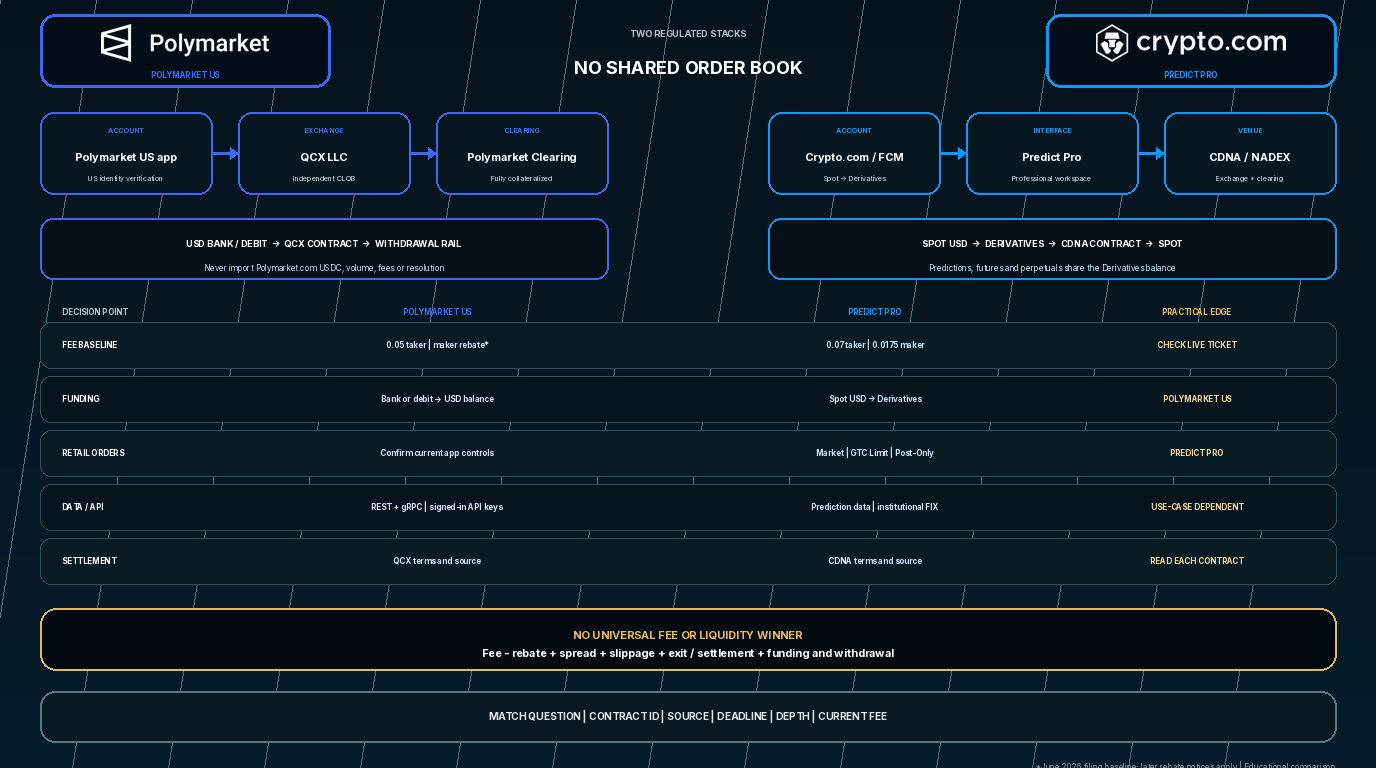
The Polymarket US vs Crypto.com Predict Pro decision is a comparison between two independent US event-contract exchanges, not two skins over the same prediction market. Polymarket US is operated by QCX LLC and clears through Polymarket Clearing. Predict Pro displays contracts offered by NADEX, doing business as Crypto.com Derivatives North America, or CDNA.
Polymarket US is the better fit for an eligible consumer who wants a dedicated prediction-first iPhone app, direct USD deposits and a Polymarket US account. Crypto.com Predict Pro is better for an eligible Crypto.com Exchange user who wants a professional derivatives workspace, clearly documented Market, GTC Limit and Post-Only orders, and a Spot-to-Derivatives funding route.
The word “US” matters. Polymarket.com is a separate international crypto product. Its USDC funding, fees, wallet model, volume and resolution process are not evidence about Polymarket US and are excluded from this comparison.
Last reviewed and fact-checked: November 3, 2026.
Editorial disclosure: Macro Markets publishes this comparison and operates a prediction-market platform. We include Macro Markets as a disclosed crypto-native alternative, not as an independent recommendation or a CFTC-designated US exchange. This is a documentation-based comparison; we did not place synchronized funded orders on both products. Fees, rebates, interfaces, eligibility and contracts can change. Event contracts can settle at $0. This article is educational, not financial, legal or tax advice.
Polymarket US vs Crypto.com Predict Pro: Quick Verdict
Choose Polymarket US if prediction markets are the product you want, not an extra tab inside a broader exchange. Its current consumer route is a US iPhone app, its listings span event categories, and its public materials describe a dedicated US account with USD deposits. It also documents read-only market data and signed-in access to programmatic trading credentials. Our standalone Polymarket US review provides the current fee schedule, funding limits, order types, clearing structure and safety analysis behind that verdict.
Choose Crypto.com Predict Pro if you already use Crypto.com Exchange and value explicit execution controls. Predict Pro documents Market, GTC Limit and Post-Only orders, displays a professional order book and publishes maker and taker fee formulas. Its funding path is more layered, because USD moves from Spot into the Derivatives balance before trading.
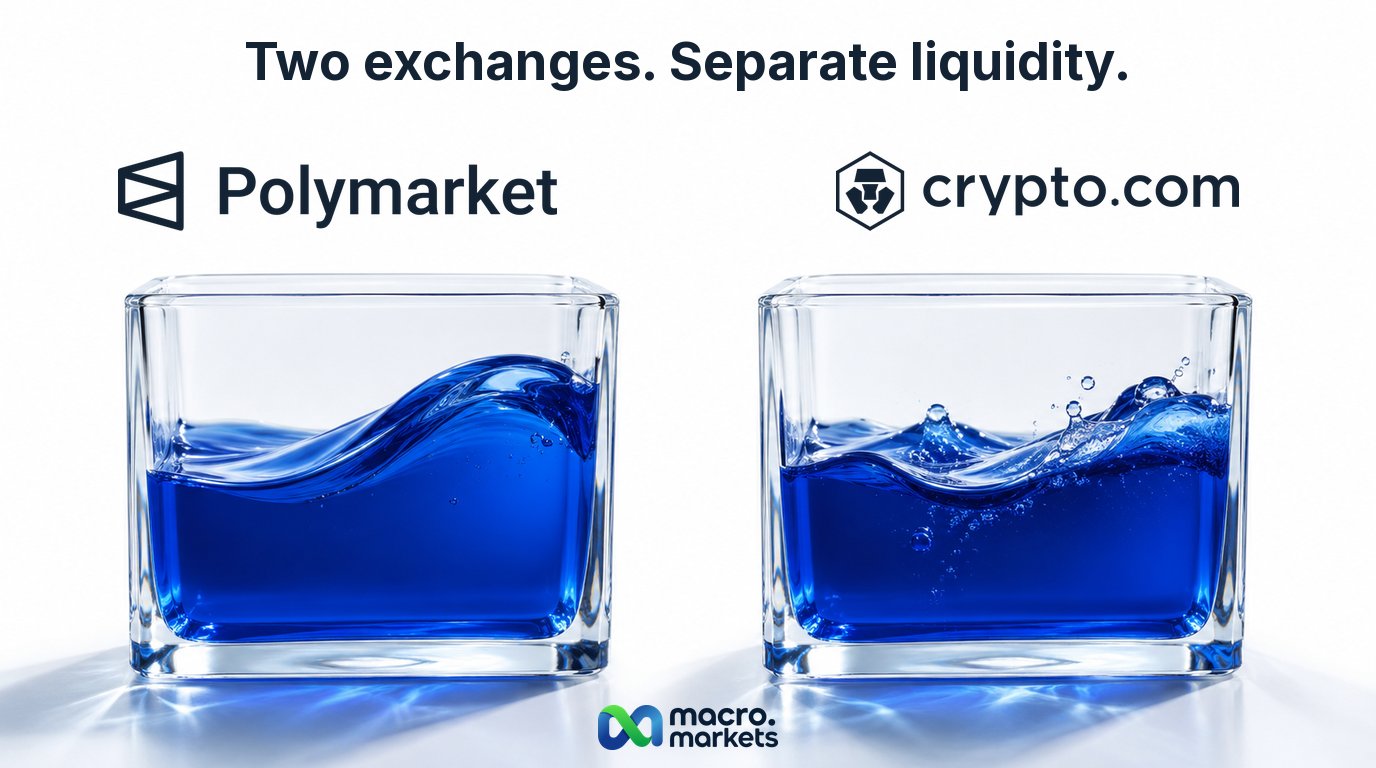
Neither platform wins every contract. Their order books are independent. The better venue for one question is the one with the clearer rules, tighter executable spread, enough depth for your intended size and a funding and withdrawal route you can actually use.
Winner by use case
- Dedicated consumer prediction app: Polymarket US.
- Existing Crypto.com Exchange user: Predict Pro.
- Published retail order controls: Predict Pro.
- Direct USD bank or debit funding: Polymarket US.
- GTC and maker-only instructions: Predict Pro.
- Public read-only BBO and L2 data: Polymarket US.
- Signed-in programmatic-trading access: Polymarket US has the clearer public entry point.
- Institutional FIX evidence: both exchange stacks document professional connectivity, subject to approval.
- Best liquidity: contract-specific; never inferred from the brand.
| Decision factor | Polymarket US | Crypto.com Predict Pro | Practical edge |
|---|---|---|---|
| Exchange | QCX LLC d/b/a Polymarket US | CDNA/NADEX | Independent venues |
| Clearing | Polymarket Clearing | CDNA clearing structure | Independent stacks |
| Consumer interface | Prediction-first US iPhone app | Crypto.com Exchange professional workspace | Preference-specific |
| Funding | USD by bank transfer or debit card | USD Spot → Derivatives | Polymarket US for directness |
| Fee structure | Central-book taker formula and maker rebate; programs can change | Published maker and taker formulas; second fee event | Must model full lifecycle |
| Retail orders | Verify controls in the current app | Market, GTC Limit, Post-Only | Predict Pro |
| Data/API | Public REST/gRPC data; signed-in trading API entry | Public prediction data; institutional FIX | Use-case dependent |
| Settlement | QCX contract terms and source | CDNA contract terms and source | Read the exact contract |
| Best for | Prediction-first US consumer | Active Exchange user | User-specific |
Read our standalone Polymarket review and Crypto.com Predict Pro review for deeper product assessments. Our comparison methodology explains why the written contract and executable book matter more than the app logo.
What the Two Regulated Exchange Stacks Actually Are
Polymarket US is the consumer-facing US product for QCX LLC d/b/a Polymarket US. The CFTC lists QCX as a designated contract market. Polymarket's trust materials say trades clear through QC Clearing LLC d/b/a Polymarket Clearing, a registered derivatives clearing organization, and that every account receives identity verification.
Predict Pro is a professional prediction interface inside Crypto.com Exchange technology. Its official overview says the event contracts are offered by NADEX, doing business as Crypto.com Derivatives North America. The CFTC separately lists CDNA as a designated contract market and derivatives clearing organization.
The two routes are therefore:
- Polymarket US: customer → Polymarket US app/account → QCX order book → Polymarket Clearing.
- Predict Pro: customer → Crypto.com Exchange/FCM workflow → Predict Pro interface → CDNA order book and clearing.
A similar market title does not connect those routes. Each exchange can define a different proposition, observation window, source, cancellation rule, tick size and settlement process. The displayed probabilities may diverge for rational reasons.
Polymarket US is not Polymarket.com
Polymarket's website-versus-app guide says Polymarket.com serves international users, while US residents must use the Polymarket US app. It also says the accounts and support teams are separate and that US users cannot deposit funds or place trades on the website.
That distinction prevents five common comparison errors:
- quoting international USDC deposits as a Polymarket US funding method;
- using polymarket.com volume as proof of US liquidity;
- applying international maker/taker fees to the US app;
- describing the US product as non-custodial; and
- importing an international resolution mechanism into a QCX contract.
This article uses Polymarket US evidence only. When the international product is relevant, it is named explicitly as Polymarket.com.
Fees and All-In Trading Cost Compared
Polymarket US's current standard taker formula is fee = Θ × contracts × price × (1 − price). The November 6 ladder and account exceptions are explained in the dated update above. The June 2026 coefficients previously used in this comparison are historical and have been removed from the current cost examples. Maker rebates depend on qualifying tiers, with no rebate below $10 million of qualifying maker volume; combo fills carry no maker rebate.
Predict Pro publishes these customer formulas:
maker fee = 0.0175 × contracts × price × (1 − price)
taker fee = 0.07 × contracts × price × (1 − price)
Its fee guide says the charge appears before confirmation and applies when opening. A second fee applies when the position settles or closes early.
Example: 100 contracts at $0.50
| Route | Illustrative opening amount | What can change the result |
|---|---|---|
| Polymarket US standard taker | $1.74–$2.38 across the current coefficient ladder | Applicable volume tier, account exceptions, rebates, spread and exit |
| Polymarket US maker | $0 rebate at the lowest maker tier; approximately $0.09–$0.26 if a higher tier qualifies | Actual maker tier, fill eligibility and fill probability |
| Predict Pro maker | About $0.44 fee | Rounding, fill probability, spread and second fee event |
| Predict Pro taker | $1.75 fee | Spread, slippage and second fee event |
The Polymarket maker line is a rebate, not a cost, and it does not mean a resting order will fill. The Predict Pro maker line is a lower fee, not a rebate. At prices closer to $0 or $1, every probability-weighted amount falls because price × (1-price) becomes smaller.
Which platform is cheaper?
At the midpoint, Polymarket US taker fees can be below or above the reviewed Predict Pro $1.75 opening fee depending on the applicable tier. Its maker treatment can reward qualifying liquidity provision. Predict Pro provides a stable, clearly documented retail maker/taker distinction but charges again at settlement or early exit. Neither observation proves the cheapest lifetime trade today.
Use this calculation:
all-in cost = opening fee − earned rebate + spread + slippage + closing or settlement fee + funding and withdrawal cost
Compare both live tickets within the same minute and record price, role, quantity, available depth and the written fee. A two-cent worse average fill costs $2 on 100 contracts, which is larger than several of the explicit-fee differences above. Normalize the numbers with our prediction-market fee calculator and review how bid-ask spreads affect larger orders.
Funding, Access and the Path Back to Cash
Polymarket US's current App Store description says customers trade in US dollars and can deposit by bank transfer or debit card. The trust page says funds are fully collateralized under a regulated clearing framework, while also warning that they are not bank deposits and are not insured as bank deposits.
The operational path is relatively direct:
bank or debit card → Polymarket US balance → QCX contract → Polymarket US withdrawal route
Deposit availability is not the same as immediate withdrawal eligibility. Payment clearing, account review, contract settlement and the selected withdrawal rail can add time. Check the signed-in limits and holds before an event becomes time-sensitive.
Predict Pro uses a two-balance workflow:
USD in Crypto.com Spot → transfer to Derivatives → trade Predict Pro → transfer back to Spot → withdraw
The getting-started guide says predictions, futures and perpetuals share the Derivatives balance. Crypto assets held elsewhere in the account must become the required USD before that transfer, potentially adding conversion spread, timing and tax considerations.
Eligibility and device access
Polymarket's official separation guide currently identifies the Polymarket US iOS app as the US consumer product and says Android is coming soon. The App Store listing makes broad availability claims, but the contract shown in a verified account remains the safer evidence because state, category and account restrictions can change.
Predict Pro is currently available to US users with an FCM account. A global Crypto.com account or access to another Crypto.com service does not automatically prove Predict Pro eligibility.
Neither service should be accessed with a VPN, false address or borrowed identity. Both require a real regulated-account relationship. Approval for the app does not guarantee every contract is available in every location.
Payout timing is more than resolution
A winning contract still must reach official settlement. After that, the balance must pass through the platform's withdrawal workflow. For Polymarket US, that means the QCX and clearing process followed by the account's available withdrawal method. For Predict Pro, it means the CDNA position and Derivatives balance, then a transfer back through Spot.
Test the full deposit, trade and withdrawal path with a small amount. The platform with fewer visible steps can still be slower if a payment hold applies; the platform with more steps can be predictable for a user already familiar with the account.
Orders, APIs and Professional Trading Tools
Predict Pro has the clearer public retail-order documentation. Its markets and order-types guide lists:
- Market: seeks immediate execution and cancels any unfilled remainder.
- GTC Limit: rests until filled, cancelled or the event resolves.
- Post-Only: cancels if it would immediately take liquidity, protecting maker classification.
That combination matters for fee-sensitive traders. Post-Only reduces the risk of unexpectedly paying the taker coefficient, while GTC allows a price to remain on the book beyond one session. It does not guarantee a fill or a profitable exit.
Polymarket US is more explicit about the exchange data layer than its public consumer help pages are about every retail ticket control. Its data guide documents read-only REST and gRPC access to best bid/offer, L2 depth, instruments, symbols, volume and open interest. Its developer page lets a signed-in Polymarket US customer create API keys for programmatic trading.
The exchange-level developer materials separately describe an application, integration testing and production-credential process for participants and technology partners. Retail API availability and institutional connectivity should not be treated as identical permission levels.
| Capability | Polymarket US | Predict Pro |
|---|---|---|
| Consumer focus | Dedicated prediction app | Professional Exchange workspace |
| Retail order documentation | Verify current controls in app | Market, GTC Limit, Post-Only |
| Public market data | REST and gRPC; BBO and L2 documented | Prediction REST data documented |
| Programmatic orders | Signed-in API-key entry; permissions apply | Institutional FIX documented; retail order access not universal |
| Maker protection | Confirm current order instruction | Post-Only documented |
| Operating schedule | 24/7 except maintenance | 24/7 subject to listing, expiry and liquidity |
| Historical exchange reports | Daily market and time-and-sales reports | Exchange transaction history and venue records |
API verdict
Polymarket US has the clearer public path from consumer account to trading API credentials and offers strong read-only market-data documentation. Predict Pro has the clearer retail order-control documentation and established institutional FIX evidence. Neither should be called an unrestricted automated-trading service without confirming account approval, endpoint permissions, rate limits and compliance obligations.
For a manual trader, Predict Pro wins on documented order behavior. For a research or programmatic workflow, Polymarket US deserves a closer look. For either product, test in a low-risk environment before trusting an unattended strategy.
Markets, Liquidity, Settlement and Where Macro Markets Fits
Polymarket US currently displays categories including midterms, sports, esports, crypto, commodities, politics, weather, tech, culture and economics. Predict Pro describes sports, crypto, commodities, foreign exchange, indexes, economics, politics, culture and climate.
Category overlap is not contract equivalence. Before comparing a price, match:
- exact Yes/No proposition;
- listing exchange and contract identifier;
- observation deadline and time zone;
- official source and measurement method;
- cancellation, postponement and exceptional-outcome rules;
- tick size, position limit and trading close; and
- quantity available at the executable price.
How to compare liquidity correctly
Do not compare a Polymarket US headline price with a Predict Pro headline price and stop. Record the best bid, best ask and depth at several levels. Estimate the average fill for your full size, then repeat for a possible early exit.
The two books must never be added together. QCX liquidity belongs to Polymarket US; CDNA liquidity belongs to Predict Pro. Even a perfectly matched question remains a cross-exchange position with separate settlement, operational and account risk.
Who determines settlement?
Polymarket US contracts resolve under their QCX specifications and named source. Predict Pro contracts resolve under the CDNA/NADEX specification and exchange process. The app, a news headline, another exchange or an AI answer cannot override the written terms.
Read the rules before trading, save the contract version and identify the source that decides the outcome. If the two sources or deadlines differ, the positions are not a clean hedge and any apparent arbitrage can fail.
Macro Markets as a disclosed crypto-native alternative
Macro Markets is relevant for eligible users who intentionally want wallet-oriented crypto funding and global prediction-market discovery rather than either US regulated-account workflow. Its crypto-native approach can reduce the conceptual distance between digital assets and event trading, but it introduces a different custody, network, jurisdiction and settlement model.
Macro Markets is not presented here as a CFTC-designated exchange or as a regulatory equivalent to QCX or CDNA. Compare supported countries, assets, chains, custody, withdrawals, resolution sources, disputes and executable liquidity independently.
Because Macro Markets publishes this comparison, this section is first-party positioning rather than an independent endorsement. See how Macro Markets works only after confirming eligibility, contract rules, funding network and maximum loss. Our direct Polymarket vs Macro Markets comparison separates the US and international Polymarket products before evaluating the crypto-native alternative.
For broader shortlists, see Polymarket alternatives, Predict Pro alternatives, Kalshi vs Polymarket US, Polymarket US vs Robinhood and Kalshi vs Predict Pro.
Frequently Asked Questions and Final Verdict
Is Polymarket US cheaper than Crypto.com Predict Pro?
It can be, but there is no permanent winner. Polymarket US standard taker coefficients now range from 0.0695 to 0.095 with account-specific rules, while the Predict Pro schedule reviewed here uses 0.07 taker and 0.0175 maker coefficients and charges again at settlement or early close. Compare the current ticket, spread, depth and complete lifecycle.
Is Polymarket US the same as Polymarket.com?
No. Polymarket says they are separate products with separate accounts and support. US residents use Polymarket US and cannot deposit or trade on Polymarket.com. Do not apply international USDC funding, wallet behavior, fees, liquidity or resolution procedures to the US app.
Do Polymarket US and Predict Pro share liquidity?
No. Polymarket US uses the QCX order book and Polymarket Clearing. Predict Pro contracts are offered through CDNA/NADEX. Similar wording does not create a shared contract or order book.
Which platform has better order types?
Predict Pro has the clearer published retail controls: Market, GTC Limit and Post-Only. Polymarket US provides strong market-data and programmatic-trading documentation, but customers should verify the exact consumer order controls shown in the current app.
Which platform is better for APIs?
Polymarket US documents read-only REST and gRPC market data and offers signed-in access to API keys for programmatic trading. Predict Pro documents prediction data and institutional FIX. In both cases, permissions and account status control what can actually be automated.
Which product is easier to fund?
Polymarket US is more direct for a customer using a bank transfer or debit card. Predict Pro requires USD to move from Spot into the Derivatives balance and back through Spot for withdrawal. Existing Crypto.com Exchange users may still find that route familiar.
Can I use Polymarket US on Android?
Polymarket's current product-separation guide says the US iOS app is available and the Android app is coming soon. Check the official store and help page for the latest release status rather than using an unofficial download.
Are both regulated?
Yes, through different exchange stacks. QCX LLC d/b/a Polymarket US is a CFTC-designated contract market and uses Polymarket Clearing. CDNA/NADEX is the exchange and clearing venue behind Predict Pro. Regulation does not guarantee profit, liquidity, uninterrupted access or availability in every location.
Which platform is better for crypto users?
Predict Pro sits inside Crypto.com Exchange, but its documented funding path uses USD in Spot and Derivatives. Polymarket US also uses US dollars. Macro Markets is the disclosed crypto-native alternative for eligible users who intentionally want wallet-oriented funding and accept a different jurisdictional and custody model.
Final verdict
Polymarket US is the stronger choice for an eligible US consumer who wants a prediction-first app, direct USD funding and documented public market data plus a path to programmatic trading. Its fee and rebate programs require current verification, and its consumer device availability is narrower while Android remains pending.
Crypto.com Predict Pro is the stronger choice for an active Crypto.com Exchange user who values a professional workspace, explicit Market/GTC/Post-Only controls and a clearly published maker/taker schedule. Its more layered funding path and second fee event are material trade-offs.
The correct Polymarket US vs Crypto.com Predict Pro decision belongs to the specific contract. Compare the written terms, current fee preview, full depth and path back to cash. Never import international Polymarket data into the US comparison, never combine the two order books and never treat a similar headline as proof of identical settlement. If neither book offers clear rules and an acceptable exit, the correct choice is neither.
