


Polymarket vs Opinion: Which Prediction Market Is Better in 2026?
Polymarket International and Opinion look similar at first glance: both let eligible users connect a wallet, trade event outcomes through order-book infrastructure and settle positions on-chain. The decisive differences are underneath. Polymarket International runs on Polygon with USDC collateral and usually resolves markets through UMA, while Opinion documents BNB Chain, settlement assets such as USDT and Opinion AI as the primary oracle for most current markets.
Our verdict: Choose Polymarket International when you are eligible, want its established Polygon and USDC workflow, prefer UMA's public proposal-and-dispute process, or find materially better executable depth on the exact contract. Choose Opinion when you are eligible, already operate on BNB Chain, prefer its current fee structure for your order, want its macro-oriented product surface, or need its documented APIs and CLOB SDKs. Neither is universally cheaper or more liquid. Compare the live order, rules and exit route.
Last reviewed and fact-checked: October 31, 2026.
Editorial disclosure: Macro Markets publishes this comparison. It is not one of the two products ranked here, but we discuss it as an alternative below. This analysis is based on current first-party documentation and public product surfaces; it does not include synchronized funded trades on both venues. Prediction-market positions can lose their full value. This article is educational, not financial, legal or tax advice.
Polymarket vs Opinion: Quick Answer
The shortest answer is Polygon and UMA versus BNB Chain and Opinion AI.
Polymarket International is the stronger fit for an eligible trader who already uses Polygon and USDC, wants a mature public order book and values a resolution process in which an outcome is proposed, can be challenged and may proceed to an UMA vote. Opinion is the more natural fit for an eligible trader who uses BNB Chain and settlement assets such as USDT, wants Opinion's macro-focused catalog or developer stack, and accepts Opinion AI as the primary resolution route on most current markets.
Location can end the comparison before features matter. Opinion currently prohibits trading from the United States, United Kingdom, France, Ontario and several Asian jurisdictions. Polymarket International currently blocks a broader published list that includes the United States, Brazil, United Kingdom, France, Germany and Australia. US readers should not confuse polymarket.com with the separate Polymarket US product.
Winner by use case
- Polygon and USDC workflow: Polymarket International.
- BNB Chain and USDT-oriented workflow: Opinion.
- Public proposal and challenge process: Polymarket's UMA route.
- AI-centered primary resolution process: Opinion.
- Small taker orders: often Polymarket, because Opinion's documented $0.25 minimum fee can dominate a small fill; verify the live category and order.
- Geopolitical markets with no explicit platform trading fee: Polymarket currently documents geopolitics as fee-free.
- Macro-oriented discovery: Opinion may feel more focused, but compare the live catalogs.
- Maker orders: both currently document zero maker fees, subject to the exact market and current terms.
- Best liquidity: no permanent winner; inspect the executable book for the exact contract and size.
- US users: neither international product. Polymarket US is separate; Opinion's Terms currently prohibit US trading.
Our Opinion prediction market review and Polymarket review examine each platform separately. This page focuses only on the decision between them.
Polymarket International vs Opinion at a Glance
| Factor | Polymarket International | Opinion | Practical meaning |
|---|---|---|---|
| Product | International blockchain prediction market | Crypto-native prediction exchange | Both are international crypto products, not US-regulated exchange accounts |
| US access | No; Polymarket US is a separate product | No under current Terms | US readers need a different product |
| Wallet model | Non-custodial; email or supported self-hosted wallet | Self-hosted Web3 wallet or documented social connection | Key control and recovery route differ by setup |
| Network | Polygon | BNB Chain mainnet | Determines tokens, gas, bridges and wallet configuration |
| Collateral | USDC-backed outcome shares | Settlement assets such as USDT | Verify token contract and network before transferring |
| Execution | CLOB with off-chain matching and on-chain settlement | CLOB with on-chain confirmation | Compare spread, depth and fill behavior live |
| Maker fee | Currently zero | Currently zero | A resting order can avoid explicit maker fees but may not fill |
| Taker fee | Category and probability based; geopolitics currently fee-free | 0–1% documented range; $0.25 minimum fee | Order size and category can reverse the cheaper venue |
| Resolution | Usually UMA Optimistic Oracle under market rules | Market-specific; most current markets use Opinion AI | Read the exact source and edge cases |
| User-created markets | Users suggest; Polymarket says users do not directly create markets | Opinion describes permissionless market creation in its stack | Listing control and quality-control model differ |
| Developer surface | Public APIs, CLOB docs and SDK tooling | OpenAPI, WebSockets and CLOB SDKs | Both are credible developer options; verify current limits |
| Publisher verdict | Best for Polygon/USDC and UMA preference | Best for BNB/USDT and Opinion's product focus | Eligibility and executable cost remain decisive |
The table is a starting point, not a substitute for checking a live market. A technically similar question can use a different deadline, resolution source or definition on each venue.
First, Make Sure You Are Comparing the Right Polymarket
The word “Polymarket” now covers two distinct products.
The official product guide says polymarket.com is the international product, while US residents use a separate Polymarket US app with separate accounts and support. The international wallet, fee, chain and UMA claims in this article do not automatically describe Polymarket US.
This comparison therefore covers:
- Polymarket International at polymarket.com; and
- Opinion at opinion.trade.
It does not compare Opinion with Polymarket US. A US resident cannot solve the access problem by connecting a different wallet or using a VPN. Both platforms prohibit circumvention of geographic controls.
That distinction also matters for search results. A headline about Polymarket's US regulatory status does not make polymarket.com a CFTC-regulated international exchange. Conversely, international volume and liquidity do not establish what is available in the separate US app.
Eligibility and Geographic Access
Check location before funding a wallet or studying fees.
Opinion's current Terms of Use prohibit trading for users in the United States, United Kingdom, France, Ontario, Singapore, Poland, Thailand, South Korea, the People's Republic of China, Taiwan Province and Hong Kong, as well as comprehensively sanctioned regions. The list can change.
Polymarket's current geographic restrictions cover more countries, including the United States, Brazil, Australia, Germany, France and the United Kingdom. The page distinguishes fully blocked and close-only locations and says physical location controls permissions. Its Terms prohibit VPN circumvention.
Two practical consequences follow:
- A platform can be technically reachable but unavailable for trading.
- Eligibility can change while a position is open, so understand the close, redeem and withdrawal process in advance.
Do not infer legal access from “decentralized,” “non-custodial” or “global.” Those words describe architecture or positioning, not permission to trade where you are. Check current Terms, the in-product notice and local law.
What about identity checks?
Neither a wallet connection nor an email login guarantees anonymous, permanent access.
Polymarket says its international product can be entered with an email address or supported self-custody wallet, while wallet screening and additional information requests can apply. Opinion's product documentation supports Web3 wallets and social connection methods, while its Terms reserve compliance controls. A platform may restrict an account or request information even when the base interaction is on-chain.
If privacy or identity requirements are decisive, read the live onboarding flow before transferring funds. Do not rely on an old tutorial.
Wallets, Chains and Funding
The chain choice changes the whole transaction path.
Polymarket International: Polygon and USDC
Polymarket describes its international product as non-custodial: users hold their own keys, while collateral backing open positions is held in smart contracts. Its product overview says outcome pairs are fully collateralized by USDC and winning shares settle at $1.
The convenient route can still involve several components:
- obtain a supported asset;
- move or bridge it to the supported Polygon route;
- connect or create the supported wallet setup;
- trade outcome shares; and
- redeem or sell, then withdraw through the chosen provider.
Polymarket currently says it does not charge a platform fee to deposit or withdraw USDC, but Coinbase, MoonPay, a bridge, wallet service or network can impose its own cost. “No Polymarket fee” does not mean the complete round trip is free.
Opinion: BNB Chain and settlement assets such as USDT
Opinion's documentation describes a self-hosted-wallet workflow on BNB Chain mainnet. It supports named Web3 wallets and documents settlement assets such as USDT. Trades are matched through its order-book system and confirmed on-chain.
Opinion says it covers gas for trade matching and settlement, while certain lower-frequency actions can require user-paid gas. Its current fee page also lists a $5 minimum withdrawal. Your real funding cost can include exchange withdrawal fees, token conversion, network gas and a later return transfer.
Which wallet route is better?
Choose the route you can verify and recover safely.
- Polygon and USDC may be easier if that is already where your working capital sits.
- BNB Chain and USDT may be easier if you already use that ecosystem.
- Moving between them introduces bridge, token-contract and wrong-network risk.
- A social login can feel simpler but still needs a recovery and custody review.
Before funding either platform, send a small test amount, confirm the token contract and network, and test the exit path. Never copy an address from an ad or unsolicited message.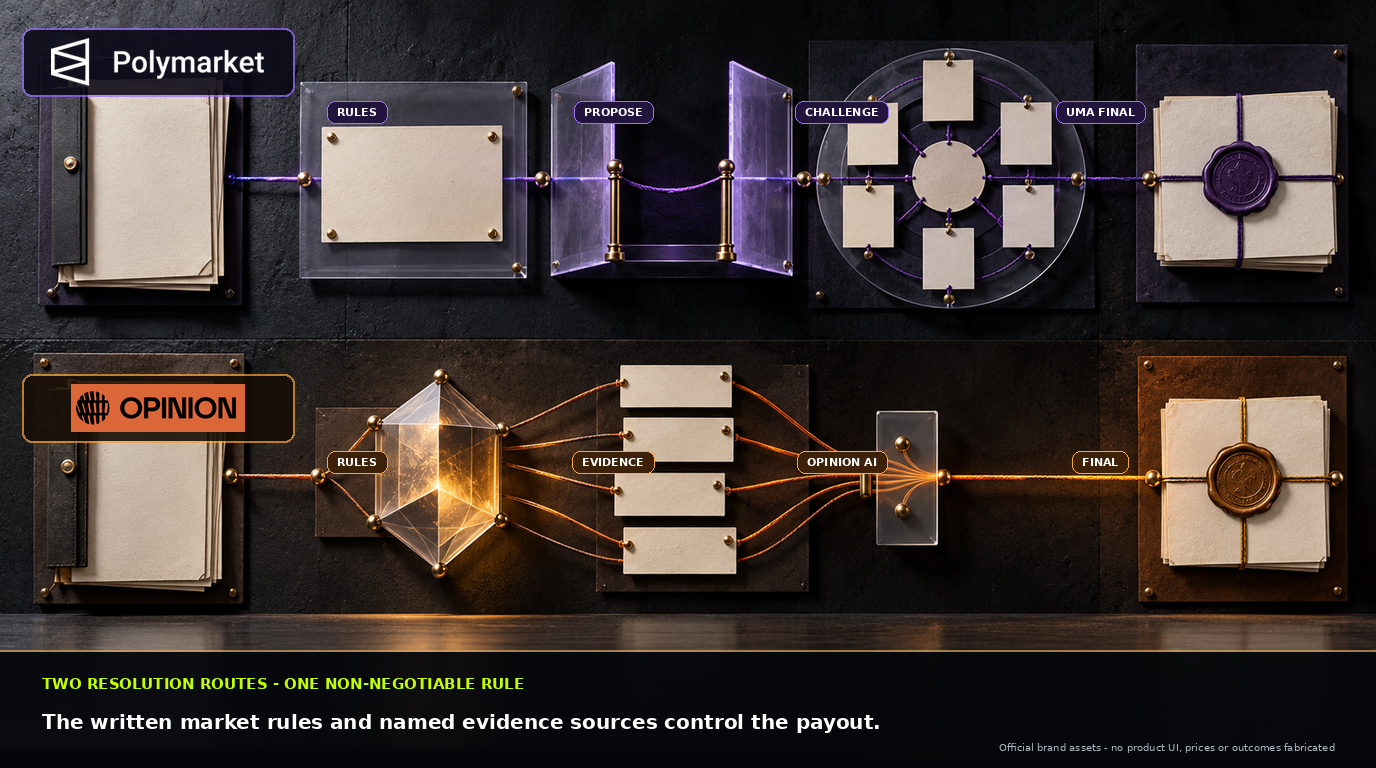
Fees: Which Platform Is Cheaper?
There is no honest platform-wide winner.
Opinion's live fee documentation currently says:
- makers pay no trading fee;
- taker fees range from 0% to 1%;
- the curve is highest near a 50% market probability;
- the minimum order is $5;
- the minimum fee is $0.25; and
- the minimum withdrawal is $5.
That $0.25 floor matters. On a $5 taker fill, the minimum alone equals 5% of notional. On a $100 fill, it equals 0.25% before considering whether the calculated curve fee is higher. Because fees are assessed per matched fill, fragmentation can matter too.
Polymarket's current trading-fee guide says makers are not charged and taker fees apply in multiple categories. The documented formula is:
fee = contracts × category fee rate × price × (1 − price)
Current category coefficients differ. Crypto is listed at 0.07, politics at 0.04 and economics at 0.05, while geopolitical and world-event markets are currently fee-free. Fees are rounded to five decimals, with a stated minimum precision of 0.00001 USDC.
For an illustrative 100-contract politics order at $0.50:
100 × 0.04 × 0.50 × 0.50 = 1.00 USDC
That is an example from the published formula, not a quoted live order. It excludes spread, slippage, transfer costs and the cost of exiting.
Why the cheaper venue can reverse
Suppose Opinion shows a better ask but its minimum fee applies. Polymarket may be cheaper for a small order. Increase the size, change the probability or move to a fee-enabled Polymarket category and the result can reverse. A wider spread can erase either fee advantage.
Use this equation:
all-in cost = explicit fee + spread + slippage + funding cost + withdrawal cost + network/provider cost
Our prediction market fee calculator helps organize the explicit components. The guide to bid-ask spreads explains why a displayed probability is not always your executable price.
For every comparison, match the same contract definition and calculate the average fill for your intended size. A one-cent better top-of-book quote is meaningless if only a few shares are available there.
Markets, Liquidity and Execution
Both venues use order-book logic, but platform-level popularity does not answer an order-level question.
Polymarket International uses a central limit order book with off-chain matching and on-chain settlement. Opinion also documents market and limit orders through a CLOB, with final on-chain trade records. On both platforms:
- a maker order rests in the book and may never fill;
- a taker order executes against available liquidity and may cross several levels;
- the visible midpoint may differ from the price you receive; and
- the ability to enter does not guarantee a cheap exit.
Polymarket describes itself as the world's largest prediction market. That scale claim can be relevant, but aggregate volume is not a guarantee of depth in a niche contract. Opinion emphasizes global macro and economic markets, yet a focused catalog does not guarantee that the contract you want has a tight spread.
Compare contracts, not just topics
Two markets with similar headlines can differ on:
- deadline and time zone;
- primary resolution source;
- whether revisions count;
- how postponement or cancellation is handled;
- what constitutes an official announcement;
- whether an edge case produces invalid, unknown or another outcome; and
- when trading stops relative to the event.
If the rules differ, the positions are not interchangeable and a price gap may be rational rather than an arbitrage.
Can users create markets?
Polymarket's market-creation guide says users cannot directly create markets, although they can suggest ideas. Opinion's broader stack describes permissionless market creation and AI-assisted rule construction. Verify whether creation is open in the live product, what collateral or approval is required, and who can remove or clarify a market.
More listing freedom can produce useful niche markets, but it also raises the burden of evaluating rules, liquidity and resolution quality.
Resolution: UMA vs Opinion AI
Resolution is the clearest architectural difference.
How Polymarket resolves markets
Polymarket's resolution guide says most markets use the UMA Optimistic Oracle. A proposed outcome is backed by a bond and enters a challenge period. If challenged, the dispute can proceed through UMA's process; the dispute guide describes evidence discussion and token-holder voting. Once finalized by UMA, Polymarket says the result is immutable.
This process creates visible steps and economic incentives, but it does not make ambiguous wording harmless. A market can still be disputed, delayed or resolve differently from a trader's intuition because the written rules control.
How Opinion resolves markets
Opinion's resolution page says the method is specified on each market page and that most current markets use Opinion AI as the primary oracle mechanism. Its broader documentation describes multi-agent AI analysis for complex, unstructured evidence.
An AI-centered process can examine many sources quickly, but “AI” is not a correctness guarantee. The important questions remain:
- Which sources are authoritative?
- What is the cutoff time?
- How are contradictory reports handled?
- Can a result be challenged?
- Who has final authority?
- What happens when the event is ambiguous?
Which resolution model is better?
Choose based on inspectability and the specific market, not the label.
UMA provides a public proposal-and-challenge path with an established dispute mechanism. Opinion AI may appeal to users who want an evidence-processing system designed for complex macro questions. Either can produce an outcome a trader dislikes when the contract wording and evidence do not support the trader's interpretation.
Save the rules before taking a meaningful position. If the resolution source is vague, use neither venue.
APIs and Developer Experience
Both platforms provide more than a consumer interface.
Polymarket publishes APIs and CLOB tooling for market discovery, prices, books, orders and trading integrations. Its public documentation is extensive, and its on-chain records make settlement activity inspectable. Developers still need to manage signatures, allowances, token decimals, stale data, order reconciliation and regional controls.
Opinion publishes an OpenAPI surface, WebSocket channels and CLOB SDK documentation. Current documentation covers market data, books, order placement, cancellation, positions and BNB Chain operations. Rate limits and authentication differ between public and private routes.
For either integration:
- isolate signing keys and never embed them in client code;
- verify the chain and token address;
- reconcile submitted, matched and confirmed states;
- stop on stale books or uncertain nonce state;
- implement idempotency and cancellation checks;
- enforce location and account permissions; and
- test redemption and withdrawal, not only order placement.
Developer documentation is not proof of uptime, fill quality or legal access. Build a read-only monitor before automating real orders.
Safety and Risk
Both products expose wallet and smart-contract risk in addition to ordinary market risk.
Polymarket publishes a non-custodial architecture, public transaction record and wallet-screening controls. Opinion publishes multiple scope-specific audit reports covering named contracts and components. These are useful evidence surfaces, not guarantees.
The main risks include:
- loss or theft of private keys;
- phishing and malicious wallet approvals;
- wrong-chain or wrong-token transfers;
- smart-contract defects;
- oracle or resolution disputes;
- thin liquidity and inability to exit at the displayed price;
- stablecoin depegging or provider failure;
- front-end, RPC or network outages;
- geographic restrictions and compliance reviews; and
- total loss when the position settles at $0.
A code audit only covers the reviewed scope and commit. A non-custodial label does not protect a user who signs a malicious transaction. An established oracle does not repair vague rules.
Start with a small amount, use a dedicated wallet, review approvals and verify the complete withdrawal route.
Where Macro Markets Fits as an Alternative
Macro Markets is relevant when the self-hosted-wallet model is the wrong fit.
Unlike Polymarket International and Opinion, Macro Markets' Terms describe a platform account with crypto-oriented funding and withdrawals. Macro also describes CLOB-primary execution with an LS-AMM fallback and a multi-agent evidence process for resolution. Those are first-party product descriptions and do not guarantee access, liquidity, a particular fee or a correct outcome.
Consider Macro Markets when you are eligible and prefer:
- an account-based experience rather than direct wallet signing for every workflow;
- crypto-oriented deposits and withdrawals;
- a hybrid order-book and automated-liquidity design; or
- a different catalog or resolution architecture.
Do not describe Macro as non-custodial or assume it is available in your location. Compare Polymarket vs Macro Markets and Opinion vs Macro Markets under the same standards used here. Broader shortlists are available in Polymarket alternatives and Opinion alternatives.
Five-Minute Live Comparison Checklist
Before choosing Polymarket or Opinion for a real trade:
- Confirm eligibility. Check the current blocked list and in-product notice.
- Match the contract. Compare wording, deadline, time zone and source.
- Read edge cases. Look for revisions, cancellations, ties and ambiguous outcomes.
- Inspect both books. Record bid, ask and available size near your order.
- Calculate the taker fee. Include Opinion's floor or Polymarket's category coefficient.
- Estimate slippage. Calculate an average fill, not just the best quote.
- Add transfer costs. Include exchange, bridge, provider, gas and withdrawal fees.
- Understand resolution. Identify the oracle, challenge path and final authority.
- Test the wallet route. Deposit and withdraw a small amount first.
- Use a limit order when appropriate. A maker order may lower explicit fees but carries non-fill risk.
Our prediction-market comparison methodology explains why this checklist is more reliable than choosing from a brand-level score.
Which Should You Choose?
Choose Polymarket International if:
- your location is permitted;
- you already use Polygon and USDC;
- the exact contract has the clearer rules or better executable depth;
- you prefer UMA's proposal, challenge and dispute process;
- its category fee, spread and transfer path produce the lower total cost; and
- you are comfortable securing a self-hosted wallet.
Choose Opinion if:
- your location is permitted;
- you already use BNB Chain and supported settlement assets such as USDT;
- its macro-focused market or developer surface better fits your use case;
- its live order book produces a better average fill after the fee floor;
- you understand the market's Opinion AI resolution route; and
- you are comfortable with its wallet and withdrawal workflow.
Use neither if the market rules are ambiguous, your location is restricted, the exit book is too thin, you cannot verify the token route, or losing the entire position would cause financial harm.
Frequently Asked Questions
Is Opinion better than Polymarket?
Opinion is better for some eligible BNB Chain users and for markets where its order book, fee and rules are superior. Polymarket International is better for some eligible Polygon and USDC users, particularly those who prefer UMA resolution. Compare the exact contract rather than choosing a permanent winner.
Is Polymarket cheaper than Opinion?
Often for very small taker orders, because Opinion currently documents a $0.25 minimum fee while Polymarket uses a much smaller rounding floor. But Polymarket charges category-based taker fees in many markets, and a spread or liquidity difference can reverse the result. Makers are currently fee-free on both.
Can US users trade on Opinion or polymarket.com?
No under the current international-product rules. Opinion's Terms prohibit US trading, and polymarket.com blocks US users. Polymarket US is a separate product with separate accounts, support, markets and rules.
Which platform has more liquidity?
Polymarket reports greater platform scale, but liquidity is contract-, price-, time- and size-specific. Inspect both live order books. Aggregate volume does not guarantee that your niche order can enter or exit cheaply.
Does Opinion use an AI oracle?
Opinion says each market page specifies its resolution method and that most current markets use Opinion AI. Read the individual market rules because the label alone does not define sources, edge cases or challenge rights.
Does Polymarket use UMA for every market?
Most standard international markets use UMA, but the exact market rules control and some product types can use a different resolution route. Never infer the oracle from the platform name alone.
Is either platform risk-free because it is non-custodial?
No. Self-custody changes who controls keys; it does not remove phishing, approval, contract, oracle, stablecoin, liquidity, network or legal risk.
Can I move the same position between Polymarket and Opinion?
Do not assume so. They use different chains, collateral routes, contracts and resolution systems. Similar-looking markets are separate instruments unless an official bridge or interoperability mechanism explicitly supports them.
What is the best alternative to both?
For eligible users who prefer a platform account, Macro Markets is a relevant crypto-oriented alternative. Regulated exchange products such as Kalshi or Polymarket US may fit eligible US users. Availability, contracts and legal treatment vary by location.
Final Verdict
The best choice in Polymarket vs Opinion is not the platform with the loudest volume or technology claim. It is the eligible venue offering the clearer contract and better executable result for your specific order.
Polymarket International wins for Polygon and USDC familiarity, public UMA dispute mechanics and an established international order-book ecosystem. Opinion wins for BNB Chain and USDT-oriented users, its macro-focused positioning and its Opinion AI and developer stack. The fee winner depends on category, probability, order size, spread and transfer path.
Before trading, confirm location, read the rules, compare depth, calculate the full round trip and test withdrawal. If any of those steps is unclear, do not place the order.
