


Polymarket Stock: Can You Invest Before the IPO?

Polymarket stock is not publicly traded. There is no Polymarket ticker on Nasdaq or the New York Stock Exchange, and buying a Yes or No share on Polymarket does not make you a shareholder in the company.
Eligible investors may still encounter private Polymarket share opportunities through secondary marketplaces such as Hiive and Forge. Both maintain Polymarket-specific pages. That does not mean shares are continuously available or that a displayed price can be executed. Eligibility, security structure, seller supply, transfer restrictions, company approval and settlement all matter.
Quick answer: You cannot buy Polymarket stock in a normal retail brokerage account today. Accredited investors may be able to pursue pre-IPO exposure through Hiive or Forge, subject to a live opportunity and a transaction that actually closes.
Last reviewed and fact-checked: October 31, 2026.
Editorial disclosure: Macro Markets publishes this article and operates a crypto-native prediction-market platform. Macro Markets does not sell Polymarket equity and is not a private-share marketplace. We mention Macro only to explain the difference between company ownership and outcome trading. We did not fund or complete a Polymarket private-share transaction on Hiive or Forge for this review. This page is educational, not investment, legal or tax advice.
Polymarket Stock: The Essential Facts
| Question | Answer |
|---|---|
| Is Polymarket publicly traded? | No. Polymarket is privately held. |
| Does Polymarket have a stock ticker? | No public ticker exists. |
| Can you buy it in a normal brokerage account? | Not as a listed public stock. |
| Can accredited investors buy private shares? | Potentially through Hiive or Forge, subject to eligibility, availability, structure and transfer completion. |
| Are Polymarket outcome shares company stock? | No. They are positions on event outcomes, not equity. |
| Is a private-market model price an official stock price? | No. It is a platform-specific data point, not a universal public quote. |
| Has Polymarket filed for an IPO? | No public S-1 filing was identified in the sources checked for this article. |
The critical distinction is between Polymarket the business, private shares in a Polymarket-related issuer and event-outcome shares traded on the product. Only the second category could represent company ownership, and the transaction documents—not the marketing label—determine exactly what an investor owns.
Our Polymarket review covers the prediction product. This guide answers the separate ownership question.
Is Polymarket a Public Company?
No. Polymarket does not have a listed common stock, official public ticker or consolidated exchange order book. A retail investor cannot type “Polymarket” into a standard brokerage account and buy the company as they would buy ICE, Coinbase or another listed business.
In October 2025, Intercontinental Exchange announced an agreement to invest up to $2 billion in Polymarket at an approximately $8 billion pre-investment valuation. ICE also agreed to distribute Polymarket data. This is meaningful financing context, but it is not a current public market capitalization, an IPO price or a guarantee that every private share has the same economics.
Forge currently publishes its own derived Polymarket price and valuation. On October 31, 2026, its public page displayed a $134.55 Forge Price and a $13.87 billion Forge Price valuation. Those are proprietary Forge indicators, not an official Polymarket quote. The page separately displayed illustrative market rows and warned that the image was not current. Treat platform data according to its label and date.
Why there is no single Polymarket stock price
A private-share price can change with:
- common versus preferred share class;
- liquidation preferences and conversion rights;
- direct ownership versus an SPV or fund interest;
- block size and minimum investment;
- platform, legal and administrative fees;
- company consent and right of first refusal, or ROFR;
- seller urgency and buyer eligibility; and
- the date and status of the underlying signal.
A funding valuation, model price, bid, ask, indication of interest and completed transfer are different evidence. Do not compare them as if they were identical public trades.
Can You Buy Polymarket Stock Before an IPO?
Potentially. Existing shareholders may seek liquidity by selling restricted private securities to another eligible investor. Private secondary marketplaces help surface these opportunities, but they do not remove securities-law restrictions or the issuer's contractual rights.
The SEC notes that private-company securities are often illiquid and restricted. A resale needs an available registration exemption, applicable state-law compliance and satisfaction of the security's governing documents. A negotiated price can therefore fail to become settled ownership.
For this search, the two most relevant named routes are Hiive and Forge.
Buying Polymarket Stock Through Hiive
Hiive's Polymarket stock page presents private-market information and a route for eligible investors to explore opportunities. Hiive says shareholders can confidentially list stock, receive offers and negotiate with eligible buyers. It also states that company approval may apply.
Hiive publishes pricing insights based on activity on its marketplace. A Hiive Price is not a Nasdaq-style last sale, and a company page does not prove that a security matching your needs is available.
Before acting on a Hiive opportunity, verify:
- whether there is a live listing or only an informational company page;
- the legal issuer named in the documents;
- direct shares, SPV interests or a fund structure;
- common or preferred share class and attached rights;
- minimum investment and full fee load;
- transfer restrictions, ROFR and company approval; and
- the steps and expected timing to settlement.
Hiive says accredited investors may be able to invest in private companies such as Polymarket. Some opportunities can impose stricter criteria. Account approval is only the beginning; the offered security must also pass diligence.
Buying Polymarket Stock Through Forge
Forge also maintains a dedicated Polymarket page at forgeglobal.com/polymarket_stock/. Forge describes an accredited-investor workflow: create and verify an account, inspect active market interest, submit or negotiate a bid, and complete paperwork and approvals if the parties match.
Forge says settlement typically takes 45–60 days and that a transaction can depend on company policy, demand, transfer restrictions and a possible ROFR. That is fundamentally different from buying a listed share with near-immediate execution.
Forge Price is a derived indicator that can incorporate financing information, secondary transactions, bids, asks and indications. It is useful context, but it is not a guaranteed executable price for every share class. Inspect the actual opportunity, documents and costs available to your account.
Hiive vs Forge for Polymarket Private Shares
Neither marketplace is universally better. The better route is the one offering a real security you understand, at terms you accept, through a transaction that can clear every condition.
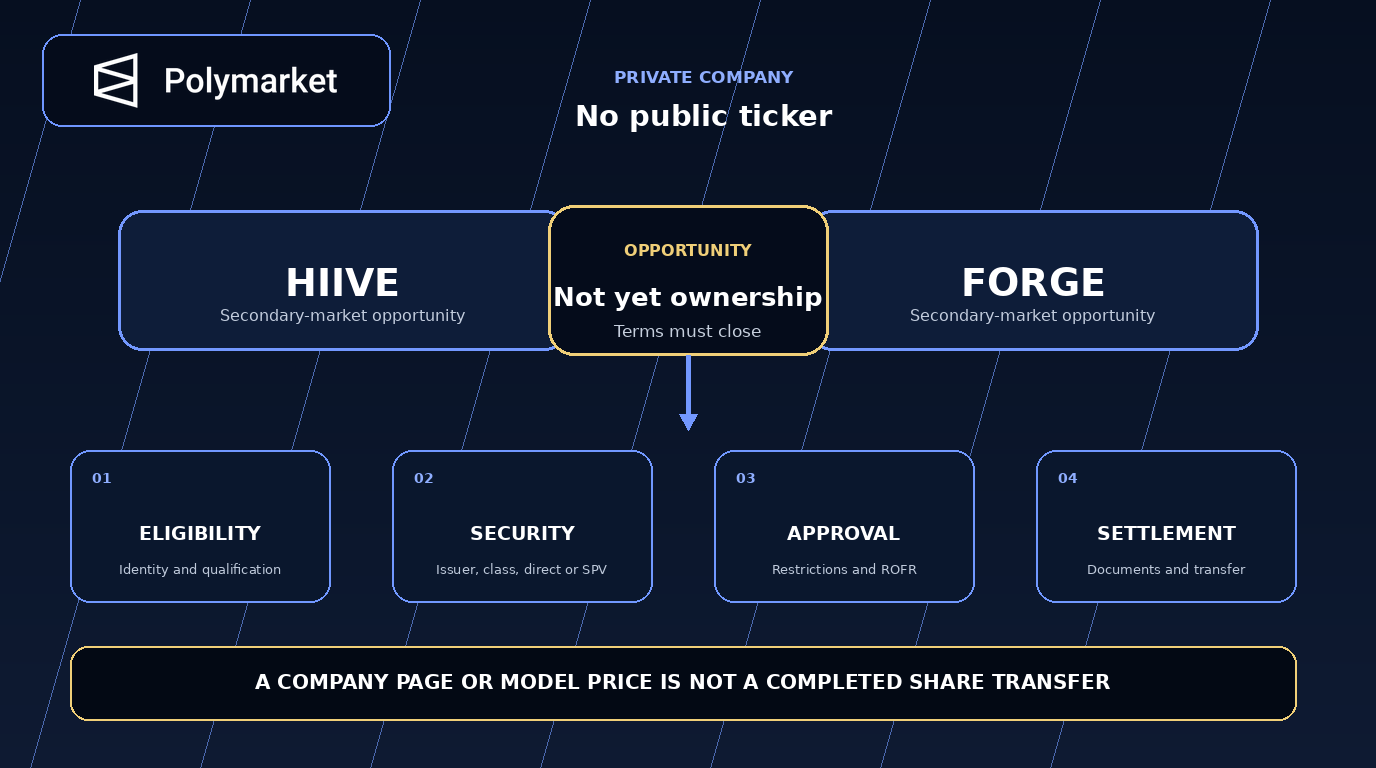
Hiive and Forge can surface Polymarket private-market opportunities, but eligibility, the exact security, transfer restrictions, ROFR and settlement determine whether ownership changes hands.
| Decision factor | Hiive | Forge | What to verify |
|---|---|---|---|
| Polymarket-specific page | Yes | Yes | A page does not guarantee live supply |
| Typical buyer gate | Accredited-investor eligibility; some deals may be stricter | Accredited-investor verification | Offering-specific rules control |
| Price signal | Marketplace activity and Hiive Price | Marketplace activity and Forge Price | Neither is a public exchange quote |
| Security format | Varies by opportunity | Direct, SPV or fund structures can appear | Read the actual documents |
| Transfer condition | Company restrictions may apply | Approval and ROFR may apply | A match is not settlement |
| Liquidity | Not guaranteed | Not guaranteed | Assume a long, illiquid holding |
Do not choose between Hiive and Forge using only the larger or lower number displayed on a given day. Signals can differ because of timing, share class, structure, sparse activity and proprietary methodology.
How a Private Secondary Transaction Actually Works
- Eligibility. The marketplace verifies identity and qualification for the opportunity.
- Security review. The buyer identifies the issuer, share class, direct or SPV structure, rights, fees and minimum size.
- Offer and negotiation. Buyer and seller try to agree on price, quantity and conditions.
- Ownership verification. The platform reviews seller ownership and relevant documentation.
- Transfer process. The issuer or another rights holder may review the deal, enforce restrictions or exercise a ROFR.
- Documents and funding. The parties sign and fund according to the closing instructions.
- Settlement. The direct shares or SPV interest transfer only after all conditions are satisfied.
Any step can stop the transaction. “Matched,” “indicated,” “pending” and “settled” are not synonyms.
What Exactly Would You Own?
Ask for the legal name of both the issuer and security. Polymarket operates products through more than one legal entity, and a brand name alone is not a cap-table description. The current international site's terms, for example, identify Adventure One QSS, Inc. as the interface company and describe separate software developed by Blockratize Inc. That does not establish which entity a particular secondary offering represents.
The transaction documents must answer whether you receive:
- direct common shares;
- direct preferred shares;
- an interest in an SPV that owns shares;
- an interest in a fund; or
- another contractual exposure.
An SPV can add manager discretion, fees, transfer limits and different voting or information rights. It may provide economic exposure without putting the investor directly on Polymarket's cap table.
Risks of Buying Polymarket Pre-IPO Shares
Illiquidity and no guaranteed IPO
There may be no buyer when you want to sell. Polymarket can remain private, raise more capital, pursue a strategic transaction or never complete an IPO. Build the thesis without assuming a public exit.
Valuation and share-class risk
Strategic investors can receive negotiated preferred terms that do not apply to a secondary common-share buyer. A headline valuation does not reveal liquidation preferences, dilution, option pools or the economics of your specific security.
Transfer and structure risk
Company consent, ROFR, holding restrictions or SPV terms can delay, change or block a deal. Even a valid seller and willing buyer do not guarantee settlement.
Limited disclosure
Private companies generally provide less standardized continuous disclosure than listed issuers. Decide whether the available financial, capitalization, legal and governance information is enough before committing capital.
Business, regulatory and product risk
Polymarket's business spans international blockchain-based markets and a separate U.S. regulated operation. Product access, regulation, market integrity, competition and technology can affect company value. Private equity exposure is not the same risk profile as a single outcome trade.
Polymarket Stock Is Not a Polymarket Outcome Share
Polymarket's own help center explains that Yes and No outcome shares trade between $0 and $1 and the winning side pays $1 at resolution. These shares express a view on an event. They do not provide company voting rights, dividends or a claim on Polymarket's profits.
Likewise, owning private company equity would expose the investor to the value of the business, not the fixed resolution of a particular market.
If your goal is event-outcome trading, compare our Polymarket alternatives, Polymarket vs Macro Markets and Kalshi vs Polymarket. Macro Markets offers a crypto-native prediction-market experience for eligible users. It is not a route to own Polymarket stock.
Is Polymarket Planning an IPO?
No verified IPO date, public ticker or public S-1 filing was identified in the sources checked for this article. Forge labels Polymarket as a potential IPO company but also states that no IPO price exists. That is a research category, not issuer confirmation.
Treat a claimed IPO date or ticker as unverified until Polymarket announces it and an SEC filing supports it. Monitor official company communications, SEC EDGAR and formal exchange notices—not social-media speculation.
Polymarket Stock Due-Diligence Checklist
Before pursuing an opportunity on Hiive, Forge or another private venue, answer these questions:
- Is there a live opportunity rather than only a company page?
- Am I eligible for this exact transaction?
- Which legal entity issued the security?
- Is it a direct share, SPV interest or fund interest?
- Which share class, rights and preferences apply?
- Is the shown value a model, bid, ask or completed transaction?
- What are the total platform, legal and administrative fees?
- What minimum investment and funding deadline apply?
- Can the company or another holder exercise a ROFR?
- Which approvals are needed before settlement?
- Can I hold the asset for years with no liquidity?
- Does the thesis still work if no IPO occurs?
If the documents cannot answer these questions, the opportunity is not ready for a decision.
Frequently Asked Questions
What is the Polymarket stock symbol?
Polymarket has no public stock symbol because it is privately held. An unofficial ticker, token or prediction-market contract is not company equity.
Can I buy Polymarket stock on Robinhood or Coinbase?
Not as a publicly listed share. A broker or crypto platform may offer prediction products or ecosystem exposure, but that does not create ownership in Polymarket.
Can I buy Polymarket stock on Hiive?
Hiive maintains a Polymarket private-stock page. Eligible investors may be able to pursue a live opportunity, subject to accreditation, supply, security structure, fees, transfer restrictions and company approval. The page and its model price are not guaranteed execution.
Can I buy Polymarket stock on Forge?
Forge maintains a Polymarket private-stock page. Accredited investors may be able to review market interest and negotiate an opportunity. Completion still depends on documentation, availability, transfer restrictions, ROFR and approval.
Is Hiive or Forge better for Polymarket stock?
Compare actual opportunities, not homepage numbers. Security type, share class, ownership structure, fees, minimum size, documents and probability of settlement matter more than a model-price difference.
What is Polymarket's stock price?
There is no official public stock price. Forge displayed a $134.55 proprietary Forge Price on October 31, 2026; Hiive also publishes marketplace-derived information. Neither is a universal exchange quote or guaranteed transaction price.
Do I need to be an accredited investor?
Private secondary offerings are commonly limited to accredited investors, and a particular deal can impose additional qualifications. The SEC lists current wealth, income and professional pathways, but the marketplace and offering documents determine the applicable verification.
Does the ICE investment mean Polymarket is public?
No. ICE announced a strategic private investment of up to $2 billion at an approximately $8 billion pre-investment valuation. ICE itself is public; that does not turn Polymarket into a listed company.
Primary Sources Checked
- Polymarket product explanation
- Polymarket Terms of Use
- ICE October 2025 report noting the Polymarket investment
- ICE investor-relations announcement with the approximately $8 billion pre-investment valuation:
ir.theice.com/press/news-details/2025/ICE-Announces-Strategic-Investment-in-Polymarket/default.aspx(reviewed separately; automated requests are blocked) - Hiive Polymarket stock page
- Forge Polymarket stock page:
forgeglobal.com/polymarket_stock/ - Forge Polymarket IPO page:
forgeglobal.com/polymarket_ipo/ - SEC private secondary-market guidance
- SEC accredited-investor guidance
Final Answer
Polymarket has no public ticker and cannot be bought as a listed stock in a normal brokerage account.
For eligible investors, Hiive and Forge are relevant private secondary-market routes, but neither guarantees available shares or a completed transfer. Verify the legal issuer, direct-versus-SPV structure, share class, rights, full costs, ROFR, approval process and settlement before committing capital.
For other investors, the honest route is to wait for a verified public offering rather than treating a private-market model price, event share or IPO rumor as publicly tradable Polymarket equity.
