Polymarket US vs Interactive Brokers Prediction Markets: Fees and Best Fit (2026)
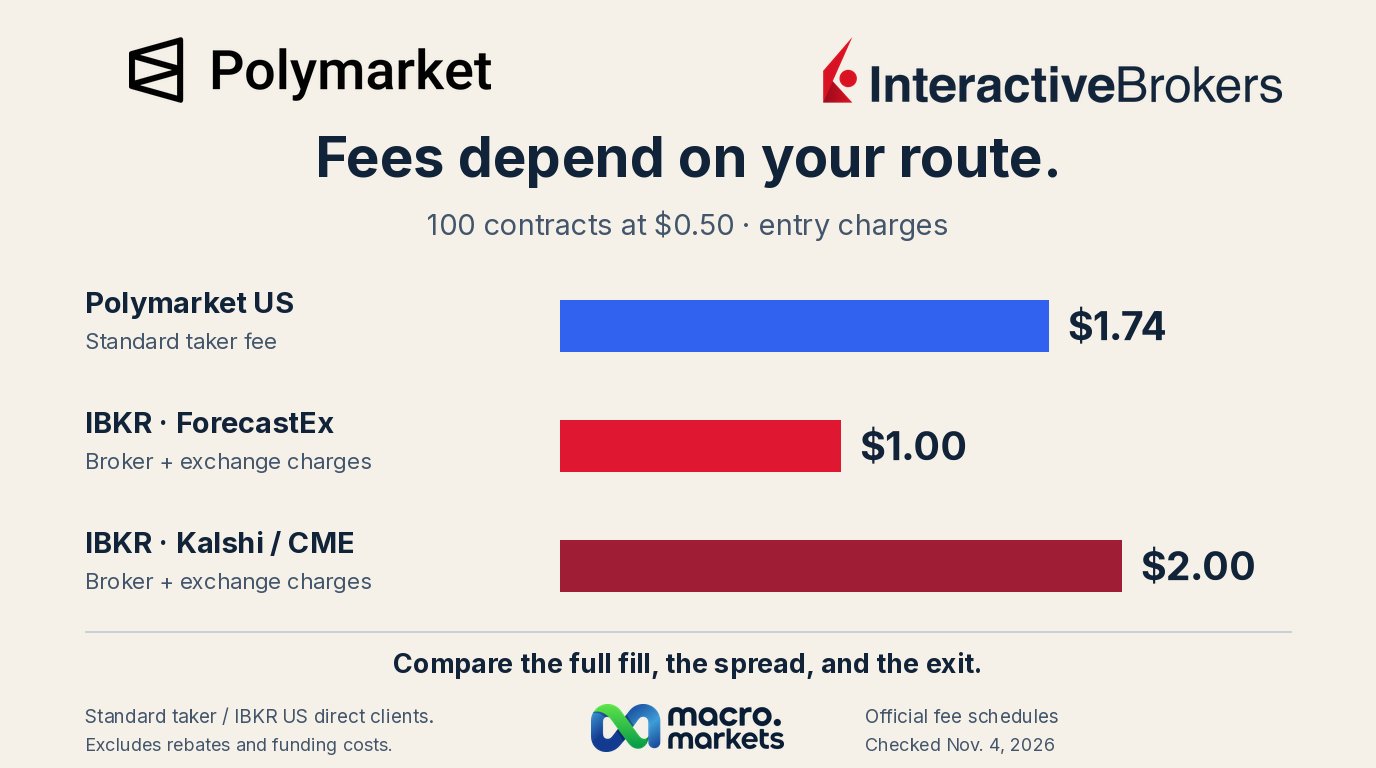
Polymarket US fee update — November 7, 2026: From November 6 at 1:00 PM ET, the official standard taker schedule uses Θ of 0.095 below $10,000, 0.085 from $10,000 to below $50,000, 0.075 from $50,000 to below $250,000, and 0.0695 at $250,000 or more in qualifying trailing-30-day taker volume. The fee is Θ × contracts × price × (1 − price). For one fill of 100 contracts at $0.50, those fees are $2.38, $2.12, $1.88 and $1.74, respectively, before rebates and other costs. Θ is not a flat percentage of the investment.
New accounts use 0.0695 for their first seven ET calendar days from their first fill. Days 8–30 use the higher of first-seven-day volume × 30/7 and trailing volume; transition accounts and November's October-volume protection can also receive better tiers. Overrides and the coefficient fixed when an order is inserted matter. Table tennis now uses the standard ladder; combos remain separate. Rebate windows also moved to daily trailing-30-day measurement. The updated Polymarket US review explains volume, rounding and exceptions.
Scope of the comparisons below: Every Polymarket US $1.74 midpoint, $0.63 at $0.10/$0.90, and $51.74 total example assumes Θ = 0.0695 and one fill, without rebates. These remain valid conditional examples, not a universal current rate or a live quote. At Θ = 0.095, the midpoint fee is $2.38 and the entry debit is $52.38; comparisons with a $2.00 competing fee reverse at that coefficient. Other brands' facts retain their original review date.
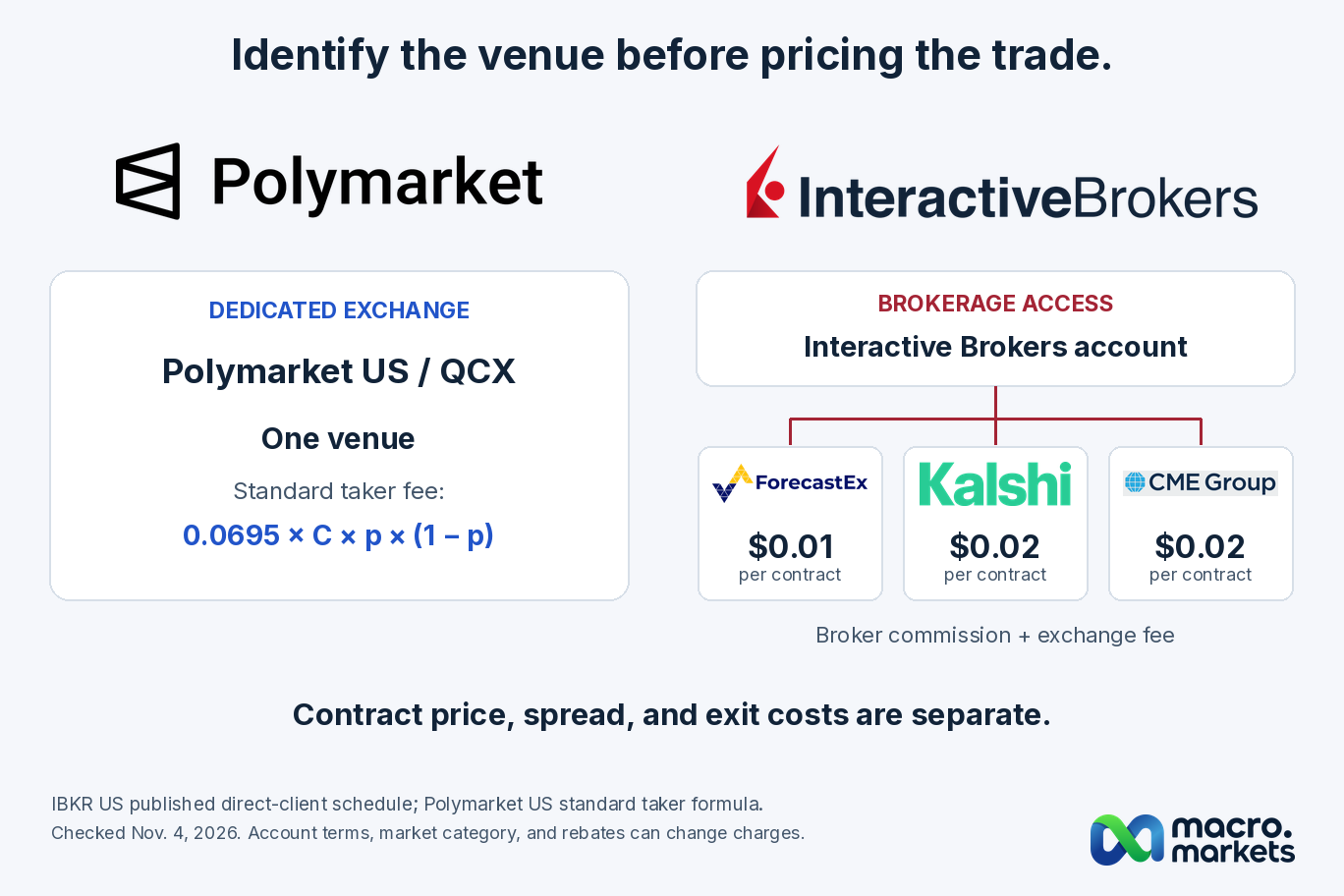
The Polymarket US vs Interactive Brokers prediction markets decision starts with a structural difference: Polymarket US is a dedicated event-contract exchange, while Interactive Brokers, or IBKR, is a broker offering access to several exchanges. Choosing IBKR does not mean choosing ForecastEx for every trade.
Our verdict: Polymarket US is the more direct starting point for someone who wants a dedicated prediction-market experience. IBKR deserves a close look if you already use its brokerage account, want to compare exchange-listed contracts across venues, or manage event positions alongside other investments. The better trade still depends on the specific contract, executable price, fees, and exit.
For a hypothetical purchase of 100 contracts at $0.50, Polymarket US's taker formula at Θ = 0.0695 produces a $1.74 fee. IBKR's published US direct-client schedule implies $1.00 for ForecastEx, or $2.00 for Kalshi or CME, combining the listed broker commission and exchange fee. Those are different routes through IBKR, not one universal IBKR price.
This comparison was checked on November 4, 2026, using first-party documentation and CFTC records. We did not conduct simultaneous funded trades or rank current liquidity. Macro Markets publishes this article and competes in prediction markets; we disclose our own crypto-native alternative below.
Polymarket US vs Interactive Brokers: Quick Comparison
| Decision factor | Polymarket US | Interactive Brokers prediction markets |
|---|---|---|
| Customer relationship | Dedicated USD event-contract platform | Brokerage account with event-contract access |
| Underlying venues | QCX LLC, doing business as Polymarket US | ForecastEx, Kalshi, and CME, subject to eligibility |
| Published fee structure | Standard taker formula varies with contract price | Broker commission plus the applicable exchange fee |
| Illustrative 100-contract midpoint entry | $1.74 standard taker fee | $1.00 ForecastEx; $2.00 Kalshi or CME |
| Portfolio context | Focused on event contracts | Event contracts alongside other supported investments |
| ForecastEx incentive coupon | Not part of this Polymarket US comparison | Relevant to eligible ForecastEx positions; variable terms |
| Best starting point | Dedicated prediction-market workflow | Existing IBKR user seeking access to several venues |
The table describes product structure, not a guarantee that every account can trade every listed contract. IBKR's TWS prediction-market guide identifies ForecastEx, Kalshi, and CME as supported venues. Your account permissions and contract availability still determine what you can actually trade.
If you want a standalone assessment first, see our Polymarket US review and Interactive Brokers prediction markets review. This article focuses on the choice between them rather than repeating either review.
Which Fits Your Starting Point?
- You want event contracts to be the whole experience: start by checking Polymarket US's listings, funding, and executable quotes.
- You already have an eligible IBKR account: inspect the available venues before opening another account. Existing access may reduce the work of managing another balance and reporting workflow.
- You care mainly about cost: compare the exact exchange route and full quantity. A headline fee cannot tell you which order will cost less to execute.
- You want crypto-native prediction markets: distinguish both USD event-contract routes from the alternatives discussed later.
One Dedicated Exchange vs Access to Several Venues
Polymarket US documentation distinguishes its USD product from the international, blockchain-based Polymarket service. This article concerns the US-regulated product, rather than importing the international product's wallet or settlement assumptions.
The CFTC's QCX designation record identifies QCX LLC, doing business as Polymarket US, as a designated contract market. A designated contract market is the regulated venue that lists and operates the relevant contracts.
IBKR sits at a different point in the chain. Its event-contract product page describes access to ForecastEx, Kalshi, and CME through an eligible brokerage account. The broker relationship helps organize access; the selected exchange still supplies the contract rules and trading venue.
ForecastEx is an IBKR affiliate, but that does not turn every contract displayed through IBKR into a ForecastEx contract. The CFTC separately records ForecastEx's designation and its exchange and clearing registrations.
Why the Exchange Label Matters
Suppose two screens ask whether inflation will exceed a threshold. You still need to match the reference period, data series, publication source, treatment of revisions, expiration, and settlement terms. Similar wording does not establish an identical payoff.
Nor does one brokerage account create a common order book across different exchanges. A quote on a ForecastEx contract and a quote on a QCX contract belong to their respective markets. Do not assume you can move an open position from one to the other, or that buying opposing positions automatically nets their collateral.
That distinction is the central question to resolve before comparing fees. Our ForecastEx vs Polymarket US comparison examines the venue-level choice; this page adds the broader IBKR account and access decision.
Fees: Compare the IBKR Route With the Polymarket US Formula
The useful comparison is the cost of a particular trade. Separate the contract debit, explicit execution charges, spread, possible price impact, funding costs, and any later exit. Do not compare a broker's commission alone with another venue's entire trading fee.
IBKR Publishes Different Charges by Exchange
The US event-contract commission schedule lists these charges for direct clients:
| IBKR route | Broker commission per contract | Exchange fee per contract | Combined published charge per contract |
|---|---|---|---|
| ForecastEx | $0.00 | $0.01 | $0.01 |
| Kalshi | $0.01 | $0.01 | $0.02 |
| CME | $0.01 | $0.01 | $0.02 |
The combined column is our arithmetic addition of the two published charges. Account arrangements, introducing brokers, advisors, and applicable taxes may change the amount due. Confirm the live order preview before committing funds.
This is why an IBKR description mentioning zero broker commission cannot be read as zero total cost for every prediction-market trade. The venue matters. Equally, the exchange fee shown for a route through IBKR should not be substituted for the exchange's direct retail pricing elsewhere.
Polymarket US Uses a Price-Sensitive Standard Fee
Polymarket US's fee documentation gives the tier-dependent formula; the conditional Θ = 0.0695 example is 0.0695 × contracts × price × (1 − price), with the price expressed in dollars. It uses banker's rounding to the nearest cent. A taker order executes against available liquidity.
The following hypothetical entries assume one fill, no rebates, the conditional Polymarket US coefficient of 0.0695, and IBKR's published US direct-client charges. The same price is used only to isolate fees; it does not claim that equivalent contracts are available at identical prices.
| Price per contract | Debit for 100 contracts | Polymarket US standard taker fee | IBKR ForecastEx charges | IBKR Kalshi or CME charges |
|---|---|---|---|---|
| $0.10 | $10.00 | $0.63 | $1.00 | $2.00 |
| $0.50 | $50.00 | $1.74 | $1.00 | $2.00 |
| $0.90 | $90.00 | $0.63 | $1.00 | $2.00 |
At the midpoint, the entry debit plus these charges would be $51.74, $51.00, and $52.00 respectively. At $0.10, the standard Polymarket US fee is lower than either illustrated IBKR route. There is no universal fee winner across contract prices.
Table tennis shares the standard tier ladder. Combos, maker activity and rebate eligibility need separate treatment; these examples exclude those effects. Use our prediction-market fee calculator as a starting point, then check that its assumptions match the actual route and contract.
Execution and Exits Can Outweigh the Fee Difference
A one-cent difference in purchase price costs $1.00 across 100 contracts. That is already larger than the $0.74 midpoint fee difference between the illustrated Polymarket US and IBKR ForecastEx entries. Displayed price and available size therefore deserve at least as much attention as the fee schedule.
For a hypothetical order, buying 20 contracts at $0.50 and the other 80 at $0.53 costs $52.40 before fees. Buying all 100 at $0.51 elsewhere costs $51.00 before fees. The best visible quote for a small quantity does not establish the lowest full-order debit.
These are arithmetic examples, not synchronized market observations. We do not infer that either provider consistently has more depth, narrower spreads, or faster fills.
ForecastEx Has a Distinct Exit Mechanism
ForecastEx's explanation of forecast contracts states that a position is closed by purchasing the opposite contract. Closing a Yes position involves acquiring the corresponding No position, and vice versa.
This matters when a trading screen uses familiar language such as closing or selling a position. For a ForecastEx route, evaluate the price and quantity available on the opposite contract. Do not copy that mechanism onto every other venue available in IBKR.
As a hypothetical example, 100 Yes contracts bought at $0.60 cost $60. If you later acquire the matching 100 No contracts at $0.35, the combined purchase cost is $95. The paired outcomes have a combined $100 contractual payout, before charges and subject to the exchange's offset rules. At one cent per contract for each acquisition, the two sets of charges total $2, leaving a $3 difference before any other costs or coupon.
That calculation illustrates the economics, not a promise of immediate cash availability. If the opposite contract is unavailable or expensive, the exit can fail to deliver the expected result.
Polymarket US separately documents selling before settlement. Check executable demand for your position and the applicable closing fee rather than treating an entry quote as a guaranteed exit quote.
Funding, Permissions, and Available Buying Power
The first practical question is whether you can trade the intended contract with settled, usable funds. An approved account, a completed deposit, available buying power, and withdrawable cash can be different states.
Polymarket US Funding
The Polymarket US funding guide lists debit card, ACH bank transfer, Apple Pay, PayPal, Venmo, USDC on iPhone where available, and wire transfer. Supported methods and limits should be checked in the live account.
The guide distinguishes instant buying power from cleared deposits: some deposits may support trading while processing, but withdrawal availability waits for clearance. A stablecoin funding option does not turn the US product into the international onchain service.
If your decision depends on moving cash out quickly after an event, inspect the funding and withdrawal conditions first. A correct prediction and a settled contract do not automatically remove an unrelated deposit hold.
IBKR Funding and Permissions
IBKR's funding page describes bank transfers, wire funding, and other supported methods, including stablecoin funding that credits USD. Methods and timing depend on the account and available service. Do not assume a transfer method offered on a public page is enabled for every affiliate or residence.
Event-contract access also requires the relevant trading permissions. The current IBKR prediction-market disclosures specify eligible clients aged 21 and older; election products have additional residence restrictions. Having permission for stocks does not establish permission for event contracts.
Check four things in the account before comparing execution: the relevant venue is available, the exact contract appears, usable USD covers the trade and charges, and the intended order is permitted. These checks are more reliable than assuming every feature shown in a marketing overview applies to you.
Trading Tools, Portfolio Context, and the ForecastEx Coupon
IBKR's appeal is strongest when the brokerage workflow itself matters. An existing user may value consolidated positions and reporting, or prefer to inspect an economic event alongside other exposures. That convenience does not make a contract a suitable hedge by itself.
For example, a yes-or-no inflation threshold and a bond position react to different things. A contract can resolve as expected while the portfolio still loses money because of unrelated price changes, timing, or sizing. Start with the risk you intend to express before choosing the account interface.
Match the Tool to the Contract
The IBKR prediction-market platform page describes its trading workflow and tools, including ScaleTrader. Availability of an algorithm or order feature must be verified for the selected contract. General brokerage functionality is not proof that every event venue supports the same API or order handling.
For Polymarket US, inspect the documented order types and the actual order ticket. A dedicated interface can be convenient, but the meaningful questions remain price control, available quantity, cancellation behavior, and the treatment of any unfilled remainder.
If you are new to the mechanics, our prediction-market trading guide explains the basic order and settlement workflow before introducing more complex execution tools.
The Coupon Belongs to the ForecastEx Route
ForecastEx's coupon explanation describes earnings distributed to members based on the value of positions, with customer payments depending on the member arrangement. IBKR describes eligible ForecastEx positions earning a variable incentive coupon based on their daily closing market value, accrued daily and paid monthly.
Do not apply that feature to every Kalshi or CME position displayed in IBKR. It is also different from interest on idle brokerage cash. Check the applicable rate and customer terms when placing the trade; this article does not freeze a variable promotional or benchmark-linked rate.
The coupon does not insure the contract's principal or compensate for every unfavorable fill. A losing outcome can still settle at zero. Treat any expected coupon as a separate, uncertain component of the economics after considering the purchase price, charges, and time held.
Rules, Resolution, and Risk
Read the contract definition before treating a price as a probability. The event question, observation period, official data source, correction policy, and resolution deadline define what you are buying. A short title can conceal differences that change the payout.
Polymarket US describes its market-resolution process and contract settlement separately. For IBKR, inspect the rules of the actual listing venue. Broker support and exchange resolution perform different roles.
ForecastEx's customer risk disclosure specifically addresses difficulty obtaining an offsetting position, trading halts, changing coupon amounts, and potential losses on an early exit. These are useful questions to ask of any proposed trade, even though the mechanisms differ by venue.
CFTC oversight identifies the regulatory framework; it does not make an event contract a guaranteed return. Nor should a brokerage account lead you to assume that every position receives the same protections as a different asset held in that account.
Keep enough information to reconstruct a trade: the contract identifier, chosen venue, rule text, execution price, quantity, charges, and resolution notice. For the broader framework, see our US prediction-market legality guide.
Where Macro Markets Fits
Macro Markets is our own crypto-native prediction-market alternative. We include it because readers comparing account and funding models should see it, and we disclose the commercial interest rather than presenting ourselves as an independent ranking service.
Consider Macro Markets if you want to evaluate a crypto-native experience alongside these USD exchange and brokerage routes. Check the current markets, supported funding, trading mechanics, fees, settlement terms, and geographic eligibility directly. A crypto-oriented workflow is a product distinction, not evidence of lower costs or better execution.
Macro Markets is not presented here as a CFTC-designated US exchange or as an automatic substitute for an eligible IBKR account. If your requirement is specifically access to ForecastEx, Kalshi, or CME through a broker, a different product model does not meet that requirement by implication.
Our best prediction-market apps guide and Polymarket US alternatives broaden the comparison. Review the account and jurisdiction requirements before choosing a platform or depositing funds.
Frequently Asked Questions
Is Interactive Brokers the Same as ForecastEx?
No. IBKR is a broker and a ForecastEx affiliate. ForecastEx is a separately designated exchange and clearing organization. IBKR also lists access to Kalshi and CME, so identify the venue for the contract you want.
Is Polymarket US Cheaper Than Interactive Brokers?
It depends on the contract price, IBKR venue, execution, and charges. For the hypothetical 100-contract midpoint entries above, Polymarket US taker fees at Θ = 0.0695 are $1.74, compared with $1.00 for IBKR ForecastEx and $2.00 for IBKR Kalshi or CME. Different prices or account terms can change the comparison.
Can I Trade Polymarket US Contracts Through IBKR?
The current IBKR materials reviewed here identify ForecastEx, Kalshi, and CME. They do not establish Polymarket US/QCX access. Verify any future addition directly rather than assuming that a shared event topic means a shared listing.
Does the ForecastEx Coupon Make a Trade Risk-Free?
No. The coupon varies and depends on eligible positions and applicable customer terms. It does not prevent a losing contract from settling at zero, remove execution costs, or guarantee an affordable early exit.
Does Using USDC Make Either Route the International Polymarket Product?
No. A funding method and a trading venue are different things. Polymarket US documents a separate USD product; IBKR describes stablecoin funding that credits USD. Check the supported network, conversion terms, and eligibility before transferring funds.
How to Choose Between Them
Start with the contract and your existing account. Polymarket US fits a dedicated event-contract workflow; IBKR fits a brokerage workflow with access to multiple venues. Either preference still needs an executable quote that makes sense for your quantity.
Compare the full entry, identify the real exit mechanism, and read the resolution rules. For an IBKR order, record whether the route is ForecastEx, Kalshi, or CME. For Polymarket US, confirm the applicable fee category rather than assuming the standard example covers every market.
A good comparison ends with a practical decision you can verify: the right contract is available, the account is eligible and funded, the total cost is understood, and you know how the position can close or settle. Brand familiarity alone cannot answer those questions.