


Coinbase vs Crypto.com Predict Pro: Fees, Funding and Best Fit (2026)

The Coinbase vs Crypto.com Predict Pro decision is not simply a choice between two crypto brands. Coinbase Financial Markets provides the customer access layer for prediction contracts currently operated by Kalshi. Predict Pro connects eligible Crypto.com Exchange users to a separate CDNA/NADEX exchange and clearing stack.
Coinbase is the better fit for an approved US customer who wants a familiar account, settled USD or USDC, and straightforward browser or mobile access. Predict Pro is better for an eligible Crypto.com Exchange user who values full order-book depth, published maker/taker formulas, Market and Post-Only controls, and a professional Derivatives workspace.
There is no universal fee winner. Coinbase displays the applicable customer charge in the order confirmation rather than publishing one fixed prediction formula. Predict Pro publishes its formula, but documents another fee at settlement or early close. The exact contract, live price, depth and total lifecycle cost decide the trade.
Last reviewed and fact-checked: November 2, 2026.
Editorial disclosure: Macro Markets publishes this comparison and operates a prediction-market platform. We include Macro Markets as a disclosed crypto-native alternative, not as an independent recommendation or a CFTC-designated US exchange. This is a documentation-based comparison; we did not place simultaneous funded orders on both products. Fees, access, exchange partners, interfaces and contracts can change. Event contracts can settle at $0. This article is educational, not financial, legal or tax advice.
Coinbase vs Crypto.com Predict Pro: Quick Verdict
Choose Coinbase Predictions when account familiarity and consumer simplicity matter most. Approved customers can fund with settled USD or USDC, trade from browser or mobile, and manage the product through the broader Coinbase relationship. The trade-off is less public fee and execution detail: the final order confirmation controls.
Choose Crypto.com Predict Pro when execution tools matter more. Predict Pro documents Market, GTC Limit and Post-Only orders, displays full depth, publishes maker and taker formulas and sits inside a professional Derivatives environment.
Winner by use case
- Existing Coinbase customer: Coinbase.
- Existing Crypto.com Exchange user: Predict Pro.
- Settled USDC funding: Coinbase.
- Published fee formula: Predict Pro.
- Professional order-book controls: Predict Pro.
- Consumer web and mobile simplicity: Coinbase.
- Public prediction-market data and institutional connectivity: Predict Pro.
- Fast reuse of resolved proceeds for new predictions: Coinbase.
- Best liquidity: contract-specific; no platform-wide winner.
- Independent exchange book: both reach regulated exchanges, but different venues.
| Decision factor | Coinbase Predictions | Crypto.com Predict Pro | Practical edge |
|---|---|---|---|
| Customer layer | Coinbase Financial Markets | Crypto.com Exchange / FCM workflow | Existing-account dependent |
| Current listing exchange | Kalshi for the markets described by Coinbase | NADEX / Crypto.com Derivatives North America | Separate venues |
| Funding | Settled USD or USDC | USD Spot → Derivatives | Coinbase for direct USDC |
| Fee evidence | Fee breakdown in final confirmation | Published maker/taker formulas | Predict Pro for transparency |
| Later fee treatment | Check the live Coinbase preview and statement | Another fee at settlement or early close | Must compare live all-in cost |
| Retail order controls | Consumer buy/sell flow; public prediction docs do not establish Post-Only | Market, GTC Limit and Post-Only | Predict Pro |
| Developer access | No public prediction-specific trading API established | Public REST data and institutional FIX | Predict Pro, subject to permissions |
| Access | Approved US residents; NV and MI currently excluded | US users with an FCM account | Account-specific |
| Settlement authority | Kalshi | CDNA/NADEX | Read each contract |
| Best for | Coinbase users seeking a simple integrated route | Active Crypto.com Exchange users | User-specific |
Start with our Coinbase Prediction Markets review or Crypto.com Predict Pro review for a standalone assessment. Our comparison methodology explains why the exchange, contract and executable book matter more than the front-end logo.
What Coinbase Predictions and Predict Pro Actually Are
Coinbase Predictions is offered through Coinbase Financial Markets, or CFM. Coinbase's current prediction-market introduction (help.coinbase.com/en/coinbase/trading-and-funding/prediction-markets/intro, reviewed separately because automated checks receive HTTP 403) says the markets are operated by Kalshi. Kalshi determines the result from the source named in the written contract, and Coinbase cannot override that decision.
The customer route therefore has several layers:
- A Coinbase.com relationship supplies the familiar interface and primary balances.
- Coinbase Financial Markets handles the regulated customer account and suitability process.
- Kalshi operates the current underlying market and order book.
- The Kalshi contract rules define the source, timing and settlement outcome.
Predict Pro uses a different stack. Its official overview says the event contracts are offered by North American Derivatives Exchange, doing business as Crypto.com Derivatives North America. The CFTC identifies that entity as a designated contract market and registered derivatives clearing organization.
Both products lead to regulated US exchange infrastructure. They do not lead to the same exchange, contract or book.
Coinbase is an access layer, not a new venue
The Coinbase interface does not create a second independent liquidity pool for a Kalshi-operated contract. A Coinbase user and a direct Kalshi user may be reaching the same underlying market, although customer fees, account controls and order experience can differ.
This matters when comparing platform activity. Counting Coinbase and Kalshi as two separate venues can double-count one market structure. It also matters for settlement: the Coinbase spot chart, customer support team or another prediction platform cannot replace the source named by Kalshi.
Predict Pro has a separate CDNA book. A similar question shown on Coinbase and Predict Pro can have a different identifier, source, observation time, cutoff, dispute rule and available quantity.
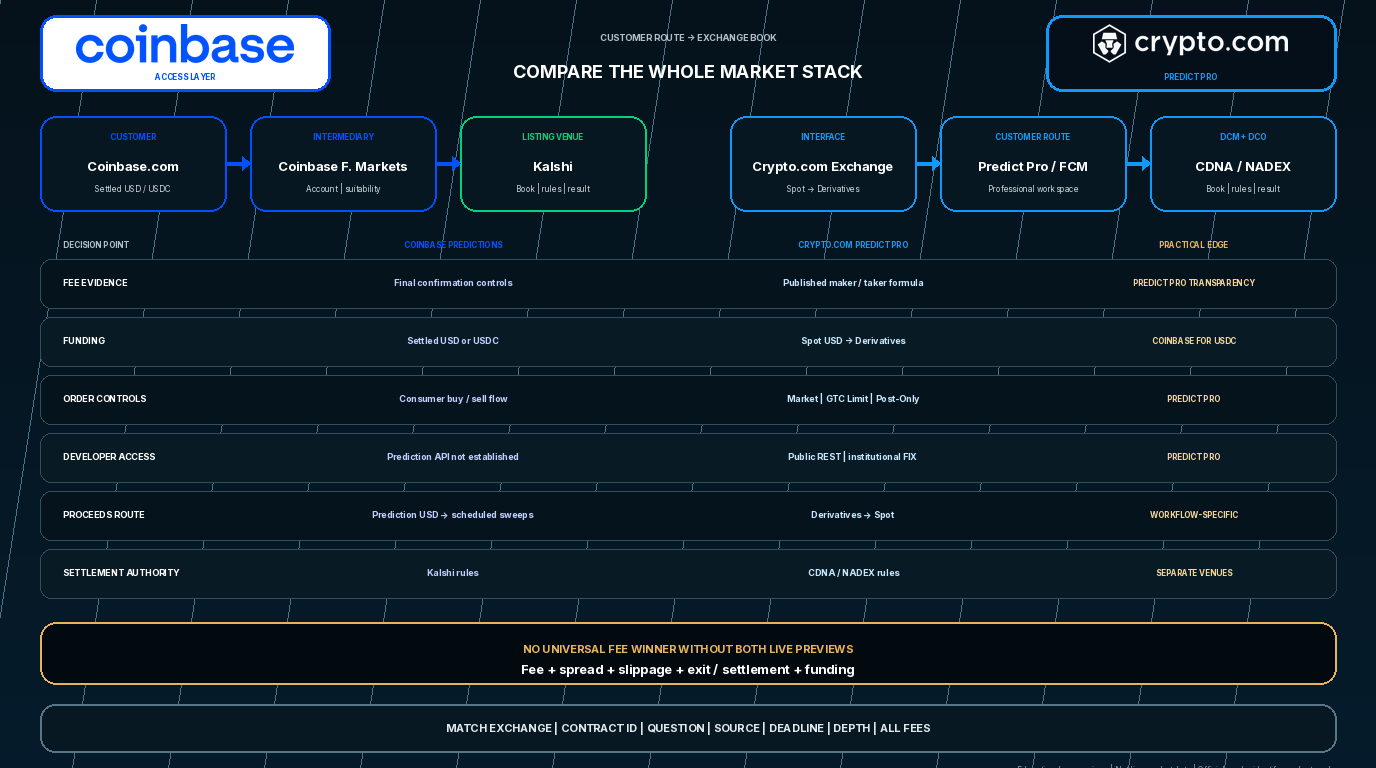
Match the contract before comparing the price
For every pair of similar markets, verify:
- The listing exchange and contract identifier.
- The exact Yes and No wording.
- The threshold, range or action being measured.
- The observation time and time zone.
- The official source and correction policy.
- Cancellation, delay and dispute treatment.
- The available size at the quoted price.
Coinbase documents a useful example for crypto-price contracts: Kalshi can use the CF Benchmarks Real Time Index and a 60-second average before expiration. That result can differ from an instantaneous Coinbase spot price. Predict Pro's own exchange specification and named source control its contract.
Do not treat a price gap as arbitrage until the terms match economically. Similar labels are not enough.
Fees and All-In Cost Compared
Predict Pro publishes a probability-weighted schedule:
maker fee = 0.0175 × contracts × price × (1 − price)
taker fee = 0.07 × contracts × price × (1 − price)
Its fee page says the charge appears before confirmation. It also says another fee applies when the position settles or closes early.
At 100 contracts priced at $0.50, one standard Predict Pro fee event produces:
- Maker:
0.0175 × 100 × 0.50 × 0.50 = $0.4375, displayed after rounding. - Taker:
0.07 × 100 × 0.50 × 0.50 = $1.75.
These figures describe one fee event, not the full lifetime cost.
Coinbase does not publish one universal consumer prediction formula in its current overview. It says the order confirmation displays the fee breakdown. That live CFM preview is the authoritative customer-facing number.
Why direct Kalshi fees cannot fill the Coinbase column
Coinbase currently routes the underlying contract to Kalshi, but that does not prove the direct Kalshi fee schedule equals the complete Coinbase customer charge. The access path can add or package fees differently. Copying a Kalshi calculation into the Coinbase column would create false precision.
A defensible matched comparison requires nearly simultaneous order previews for the same economic contract and quantity. Record:
- total contract debit;
- customer or exchange fee;
- best bid and ask;
- available depth;
- expected early-exit charge;
- settlement treatment; and
- funding or conversion friction.
The calculation is:
all-in cost = order fee + spread + slippage + early-exit or settlement fee + funding cost
Which is cheaper?
Predict Pro is more transparent before login because it publishes its maker and taker formulas. Coinbase can still be cheaper on a particular order, but the public documentation does not support a permanent platform-wide verdict.
Predict Pro's second fee event can offset a competitive entry calculation. Coinbase's preview can hide no fee, a low fee or a higher fee until the customer reaches confirmation. The correct answer comes from the two live tickets, not a copied percentage.
The spread can dominate both. A four-cent spread costs $4 across 100 contracts before any separate charge. Use our prediction-market fee calculator and bid-ask spread guide to normalize the full trade.
Funding, Access and Payout Timing
Coinbase has the clearer direct USDC route. Its official documentation says prediction contracts use settled USD or USDC. The customer can top up the predictions balance from the primary Coinbase balance, subject to holds and availability.
“Settled” is important. A recent bank deposit or transfer can appear in the broader account while still being unavailable for predictions. Unrealized gains also cannot fund a new contract.
Predict Pro uses a more segmented workflow:
Deposit or available USD in Spot → transfer USD to Derivatives → trade Predict Pro
Its getting-started guide says predictions, futures and perpetuals share one Derivatives balance. Withdrawals move back through Spot. Crypto must first become the USD required by the documented route, which can add spread, market exposure and tax consequences.
Eligibility
Coinbase currently limits predictions to approved US residents and excludes Nevada and Michigan. The CFM application collects identity, employment and financial information and can assess product suitability. If a customer moves outside the United States, Coinbase says CFM may liquidate contracts and close unfilled orders.
Predict Pro is currently available to US users with an FCM account. A global Crypto.com crypto account does not automatically qualify. Opening the Derivatives account requires additional regulatory information.
Neither product should be accessed through a location workaround. The signed-in eligibility result and current agreement control.
Coinbase payout sweeps versus Predict Pro balances
Coinbase's payout guide (help.coinbase.com/en/coinbase/trading-and-funding/prediction-markets/payouts, reviewed separately because automated checks receive HTTP 403) says resolved funds are immediately available for new prediction trades inside the Prediction Market USD balance. Transfers to the primary Coinbase balance follow automatic sweeps every two hours from 6:00 AM to 4:00 PM Eastern Time on business days. No sweeps occur on weekends or US bank holidays.
That distinction matters. A Saturday settlement may support another prediction immediately but remain unavailable in the primary account until the next business-day window.
Predict Pro positions remain in the Derivatives environment and transfers return through Spot. Existing Exchange users may prefer that separation. Customers who expect a simple consumer cash balance may prefer Coinbase's familiar route, while still needing to understand the sweep schedule.
Funding verdict: Coinbase wins for documented settled USDC use and consumer simplicity. Predict Pro fits users already comfortable managing a professional Spot and Derivatives workflow.
Orders, APIs and Professional Trading Tools
Predict Pro is the clear execution-tool winner. Its order documentation describes:
- Market orders that seek an immediate fill and cancel any remainder;
- GTC Limit orders that rest until filled, cancelled or resolved; and
- Post-Only instructions that cancel instead of taking liquidity immediately.
Post-Only protects maker classification under the published fee schedule. It does not guarantee that the order will fill before the event moves.
The interface also emphasizes full depth. That helps a trader estimate whether a larger order will move across several price levels.
Coinbase's current prediction-specific help center describes choosing an outcome, entering an amount or contract count, reviewing the transaction and buying or selling. It does not publicly establish a prediction-specific Post-Only control. Coinbase Advanced spot-market order types should not be projected onto CFM predictions without explicit product documentation.
API verdict
Predict Pro also has the stronger documented professional connectivity. Crypto.com's current API materials describe public prediction REST data and institutional FIX routes. Retail automated order entry still depends on account and protocol permissions; it should not be assumed for every customer.
Coinbase maintains extensive APIs for crypto, exchange and derivatives products, but its current consumer prediction documentation does not establish a public CFM prediction-order API. A general Coinbase spot endpoint should not be used as proof of prediction-market support.
| Capability | Coinbase Predictions | Predict Pro |
|---|---|---|
| Browser and mobile | Yes | Professional Exchange interface |
| Published prediction fee formula | No; final preview controls | Yes |
| Market / GTC Limit / maker-only publicly documented | Not established in current prediction docs | Yes |
| Full order-book depth emphasis | Consumer flow | Yes |
| Public prediction market data | Not established as a dedicated API | REST documented |
| Institutional connectivity | Not established for CFM predictions | FIX documented |
An API or advanced order type does not make the contract better. It only changes how the order reaches the book. Developers and active traders still need position limits, contract mapping, error handling, rate-limit controls and settlement reconciliation.
Markets, Liquidity, Settlement and Where Macro Markets Fits
Coinbase's current documentation covers crypto prices, sports, weather, politics/elections and economic data. The catalog is a customer-facing subset of markets available through the current Kalshi relationship; it should not be assumed to include every direct Kalshi contract.
Predict Pro covers sports, crypto, commodities, foreign exchange, indexes, economics, politics, culture and climate. Its retail documentation also lists sports structures such as moneyline, spread, total, player prop, range and league markets.
Category breadth does not establish contract quality. Compare the exact book:
| Measurement | What it answers | What it cannot prove |
|---|---|---|
| Best bid and ask | What can execute now? | The full price for a larger order |
| Depth | How much quantity exists nearby? | Future exit liquidity |
| Recent volume | Has the contract traded? | A counterparty exists now |
| Displayed position value | What is the interface estimating? | Guaranteed cash-out value |
Coinbase and direct Kalshi access may share an underlying book for the same contract. Predict Pro's CDNA book is independent. Platform-wide volume does not guarantee an exit in either specific contract.
Who determines settlement?
Kalshi determines the official result for current Coinbase prediction contracts. Coinbase honors that determination and cannot manually override it. The Kalshi market rules and named source control.
For Predict Pro, the CDNA/NADEX contract specification and exchange process control. Crypto.com Exchange technology displays the position but does not replace the listing exchange as settlement authority.
An app spot price, AI summary, social-media consensus or another prediction platform cannot override either written contract.
Macro Markets as a disclosed crypto-native alternative
Macro Markets is relevant for eligible users who deliberately want wallet-oriented crypto funding and global prediction-market discovery instead of either US FCM workflow. That is a different custody, jurisdictional and settlement model.
Macro Markets is not presented here as a CFTC-designated exchange or a regulatory equivalent to Kalshi or CDNA. Compare supported countries, assets, networks, custody, withdrawals, resolution sources, dispute process and executable liquidity independently.
Because Macro Markets publishes this article, this section is first-party positioning rather than an independent endorsement. Explore how Macro Markets works only after verifying the exact market and funding path.
For wider context, read Kalshi vs Coinbase, Kalshi vs Crypto.com Predict Pro, Gemini vs Predict Pro, Coinbase alternatives and Predict Pro alternatives.
Frequently Asked Questions and Final Verdict
Is Coinbase cheaper than Crypto.com Predict Pro?
There is no permanent public-data answer. Coinbase shows the applicable fee in the final order confirmation. Predict Pro publishes maker and taker formulas but charges again at settlement or early close. Compare simultaneous live previews, spread, depth and full lifecycle cost.
Does Coinbase use its own prediction-market exchange?
Not for the current consumer markets described in Coinbase's help center. Coinbase Financial Markets handles the customer relationship, while Kalshi operates the markets and determines official outcomes.
Do Coinbase and Predict Pro share liquidity?
No. Current Coinbase contracts reach Kalshi markets, while Predict Pro uses the CDNA/NADEX book. Similar event titles do not create shared orders, positions or settlement.
Which platform is better for USDC?
Coinbase. Its documentation explicitly allows settled USD or USDC to fund the predictions balance. Predict Pro documents USD transferred from Spot to Derivatives.
Which platform has better order controls?
Predict Pro. It publicly documents Market, GTC Limit and Post-Only orders plus visible depth. Coinbase's public prediction documentation focuses on a simpler consumer buy/sell flow and should not inherit features from unrelated Coinbase spot products.
Which platform has the better API?
Predict Pro has the stronger documented prediction connectivity through public REST data and institutional FIX. Retail order permissions still need confirmation. Coinbase does not currently establish a public prediction-specific CFM order API in its consumer documentation.
Can I sell early?
Both products support reducing a position before resolution when liquidity is available. Coinbase says an early sale can require an extra business day for settlement in some weekend or holiday cases. Predict Pro documents another fee when a position closes early.
Are both regulated?
Coinbase Financial Markets is a registered FCM and its current markets are operated by Kalshi, a designated contract market. Predict Pro contracts use the CDNA/NADEX DCM and DCO stack. Regulation does not guarantee profit, liquidity, uninterrupted access or identical customer protections.
Final verdict
Coinbase is the stronger choice for an approved customer who prioritizes a familiar account, settled USD or USDC, and a simple browser/mobile experience. Its main limitation is that the public fee and execution model must be confirmed on the final ticket.
Crypto.com Predict Pro is the stronger choice for a professional Exchange user. Published maker/taker formulas, full depth, Market and Post-Only controls, and documented professional connectivity provide more execution detail. The second fee event and separate Derivatives workflow remain important trade-offs.
The Coinbase vs Crypto.com Predict Pro decision still belongs to the contract. Identify the listing exchange, match the rules, inspect executable depth and calculate the complete cost. If neither book offers a clear contract and acceptable exit, the correct choice is neither.
