


Polymarket US vs Coinbase Prediction Markets: Which Is Better in 2026?
Polymarket US fee update — November 7, 2026: From November 6 at 1:00 PM ET, the official standard taker schedule uses Θ of 0.095 below $10,000, 0.085 from $10,000 to below $50,000, 0.075 from $50,000 to below $250,000, and 0.0695 at $250,000 or more in qualifying trailing-30-day taker volume. The fee is Θ × contracts × price × (1 − price). For one fill of 100 contracts at $0.50, those fees are $2.38, $2.12, $1.88 and $1.74, respectively, before rebates and other costs. Θ is not a flat percentage of the investment.
New accounts use 0.0695 for their first seven ET calendar days from their first fill. Days 8–30 use the higher of first-seven-day volume × 30/7 and trailing volume; transition accounts and November's October-volume protection can also receive better tiers. Overrides and the coefficient fixed when an order is inserted matter. Table tennis now uses the standard ladder; combos remain separate. Rebate windows also moved to daily trailing-30-day measurement. The updated Polymarket US review explains volume, rounding and exceptions.
Scope of the comparisons below: Every Polymarket US $1.74 midpoint, $0.63 at $0.10/$0.90, and $51.74 total example assumes Θ = 0.0695 and one fill, without rebates. These remain valid conditional examples, not a universal current rate or a live quote. At Θ = 0.095, the midpoint fee is $2.38 and the entry debit is $52.38; comparisons with a $2.00 competing fee reverse at that coefficient. Other brands' facts retain their original review date.
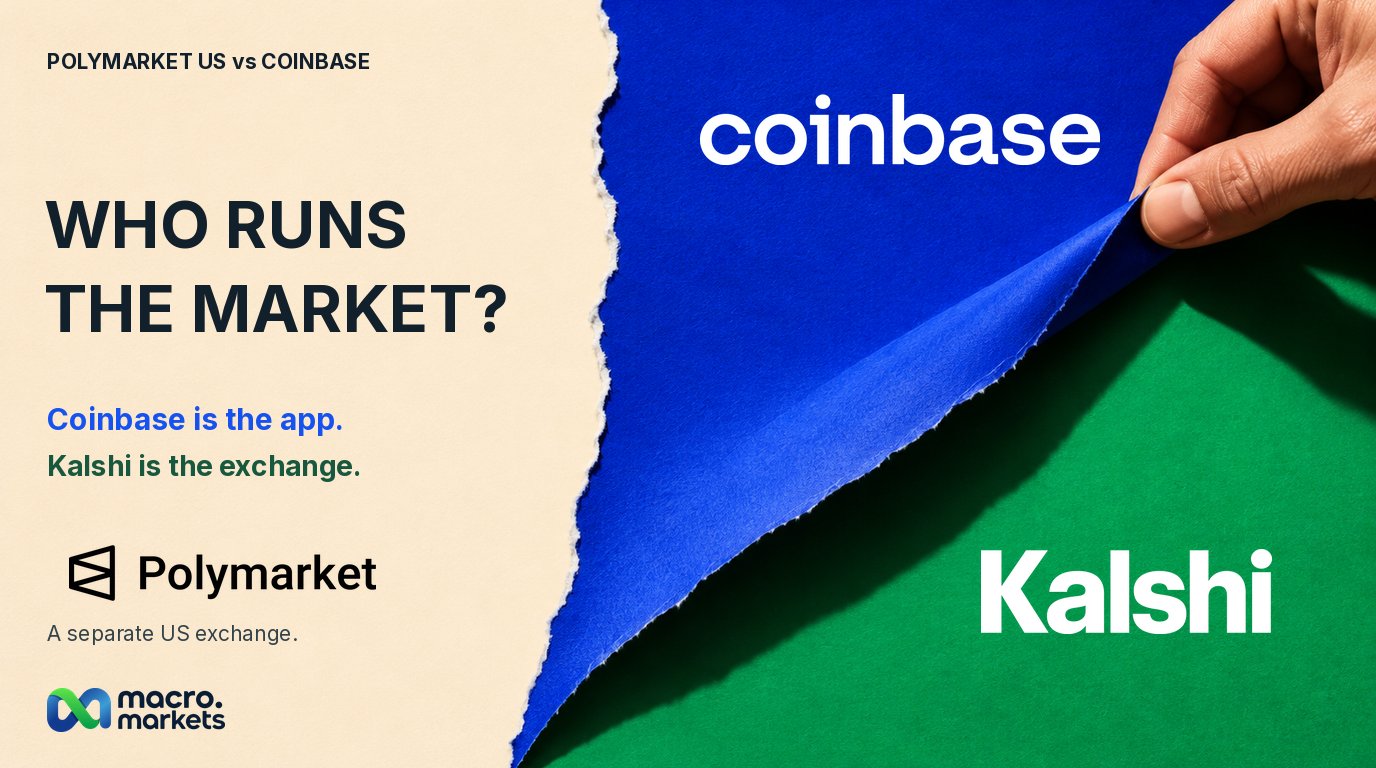
Polymarket US and Coinbase both let eligible US customers take positions on future events, but they do not play the same role. Polymarket US operates the QCX exchange and its order book. Coinbase Financial Markets supplies the customer account and access layer, while Coinbase's current documentation says the underlying prediction markets are operated by Kalshi.
Our verdict: choose Polymarket US when you want a dedicated prediction exchange, direct QCX liquidity, transparent standard fee formulas, market and limit orders and public developer documentation. Choose Coinbase when you already use Coinbase, want event contracts beside a crypto account and prefer funding with settled USD or USDC through one familiar interface.
The key comparison is not simply one app against another. It is:
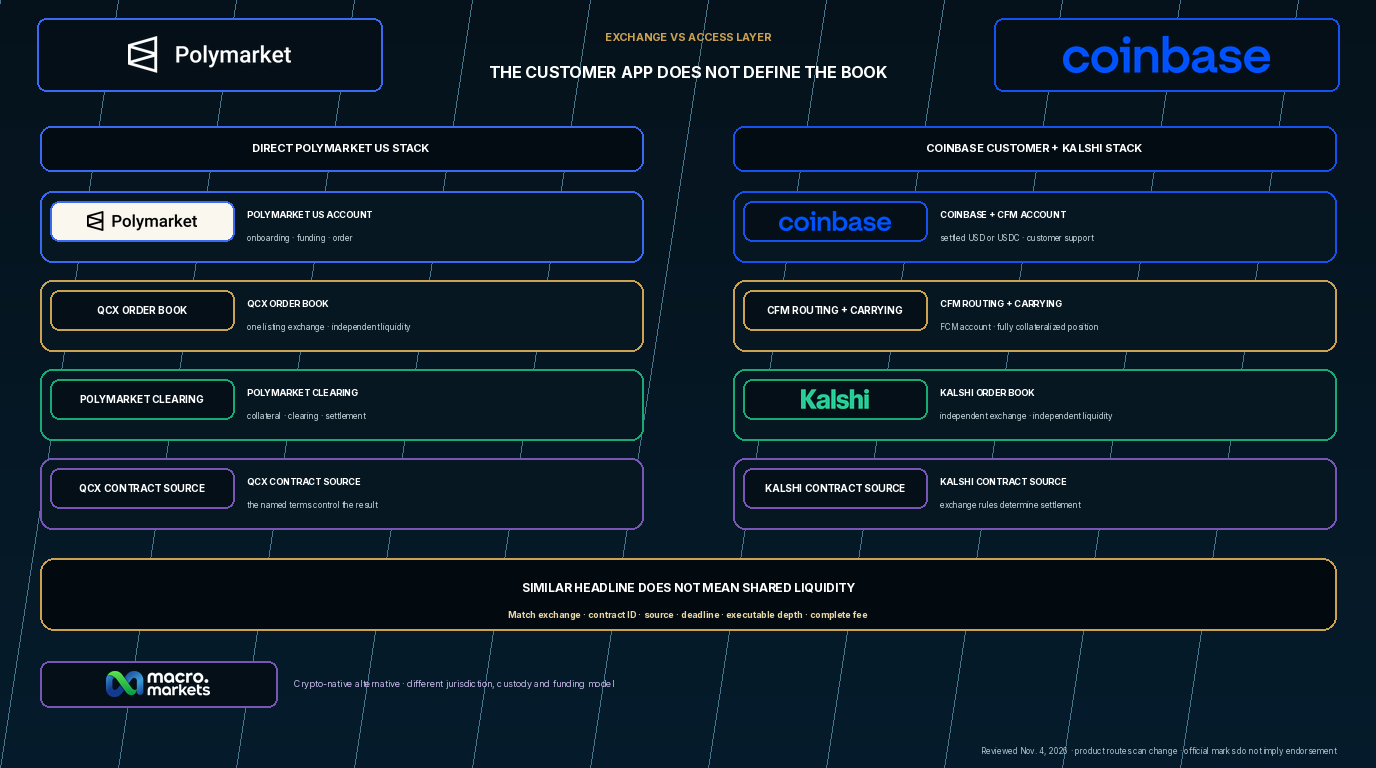
customer account -> intermediary or exchange -> order book -> clearing -> resolution source
As of November 4, 2026, a similar question on Polymarket US and Coinbase is not the same contract. Polymarket US liquidity sits on QCX. Coinbase's prediction-market help center says Kalshi operates its markets. Prices, depth, rules and settlement can therefore differ.
Last reviewed and fact-checked: November 4, 2026.
Editorial disclosure: Macro Markets publishes this comparison and operates a prediction-market platform. We include Macro Markets as a disclosed crypto-native alternative, apply the same contract-level framework and do not present it as a CFTC-designated US exchange. This is a documentation-based comparison; we did not place synchronized funded orders on both products. Event contracts can settle at $0, and an early exit depends on executable liquidity. This page is educational, not financial, legal or tax advice.
Polymarket US vs Coinbase: Quick Verdict
Choose Polymarket US if you want the customer product and listing exchange under the same prediction-market brand. QCX LLC d/b/a Polymarket US defines the contract, operates the central limit order book and applies the exchange rules. Polymarket Clearing handles the clearing layer.
Choose Coinbase Prediction Markets if you want Kalshi contracts in the broader Coinbase experience. Coinbase Financial Markets, or CFM, acts as the futures commission merchant. Coinbase handles account access, the order flow and balance transfers, but Kalshi owns the market rules and official result.
Winner by use case
- Dedicated prediction exchange: Polymarket US.
- Existing crypto-account convenience: Coinbase.
- Direct relationship with the listing venue: Polymarket US.
- Settled USD or USDC workflow inside a crypto platform: Coinbase.
- Published standard fee formula: Polymarket US.
- Public prediction-market API documentation: Polymarket US.
- Simple browser and mobile consumer access: Coinbase documents both.
- Universal liquidity winner: neither; compare the exact QCX and Kalshi books.
- Universal safety winner: neither; both involve regulated entities but retain contract, liquidity and operational risk.
| Decision factor | Polymarket US | Coinbase Prediction Markets | Practical edge |
|---|---|---|---|
| Customer relationship | Direct Polymarket US account | Coinbase account plus CFM account | Preference-specific |
| Listing exchange | QCX LLC d/b/a Polymarket US | Kalshi, according to current Coinbase help | Different exchanges |
| Order book | QCX book | Kalshi book accessed through Coinbase | No shared liquidity |
| Published customer fee | Probability-weighted standard taker formula and volume tiers | Applicable fee shown on order confirmation | Polymarket US for pre-trade public transparency |
| Funding | ACH, debit, wire, digital wallets and USDC where available | Settled USD or USDC from Coinbase primary balance | Coinbase for existing-account convenience |
| Orders | Market and limit orders with published expiry choices | Buy and early-sell workflow in dollars or contracts | Polymarket US for documented order control |
| API | Public market data, WebSockets, SDKs and integration docs | No public retail prediction execution API documented | Polymarket US |
| Resolution | QCX contract source | Kalshi contract source | Read the exact contract |
For standalone product analysis, read our Polymarket US review and Coinbase Prediction Markets review. Our prediction-market comparison methodology explains why executable depth and contract identity matter more than app recognition.
Exchange vs Access Layer: What You Are Comparing
The CFTC lists QCX LLC d/b/a Polymarket US as a designated contract market. The agency separately lists Polymarket Clearing as a derivatives clearing organization. That creates a direct exchange stack:
- The customer opens and verifies a Polymarket US account.
- The customer selects a QCX contract.
- A market or limit order interacts with the QCX order book.
- QCX applies the contract terms and named result source.
- Polymarket Clearing processes clearing and settlement.
Coinbase uses a different stack. The Coinbase Financial Markets account agreement says CFM acts as an FCM that executes, clears or carries futures and event contracts for the customer. Coinbase's official Prediction markets - Introduction help page says the prediction markets are operated by Kalshi.
Its current route is:
- The customer maintains an active Coinbase account and opens the connected CFM account.
- Settled USD or USDC moves into the predictions balance.
- Coinbase presents the contract and order confirmation.
- The order reaches the Kalshi market.
- Kalshi applies the contract rules and determines the official result.
- CFM carries the position and Coinbase manages the customer-facing balance flow.
Do Polymarket US and Coinbase share liquidity?
No. Current official disclosures point to separate exchanges. Polymarket US contracts trade on QCX. Coinbase says its prediction markets are operated by Kalshi.
A similar sports, election, crypto-price or economic question can still have different:
- contract identifiers and exact propositions;
- observation times and time zones;
- official data sources;
- cancellation or postponement rules;
- tick sizes and position limits;
- trading close times;
- fees and rebates; and
- executable depth.
Do not add their displayed volumes together. Do not describe a price gap as arbitrage until every material contract term matches. Even then, execution, transfer timing and settlement risk can remove the apparent edge.
Polymarket US is not Polymarket.com
Polymarket's product-separation guide says Polymarket.com is for eligible international users, while US residents use the separate Polymarket US product. The accounts and support teams are separate.
Do not import these international-product assumptions into this comparison:
- international liquidity or volume;
- wallet and smart-contract behavior;
- international fee schedules;
- international API credentials; or
- the availability of Polymarket.com in the United States.
This page compares Coinbase with the regulated US exchange product only.
Fees, Spreads and Matched Examples
Polymarket US publishes a standard fee formula. Coinbase's current prediction-market introduction says the order confirmation displays the applicable fee breakdown, but it does not publish one universal retail formula on that help page. That makes an exact pre-login fee comparison impossible without inventing a Coinbase number.
Polymarket US's fee schedule lists the standard taker formula:
taker fee = 0.0695 x contracts x price x (1 - price)
The fee is highest around a 50-cent contract and falls toward the extremes. Table tennis now uses the same tier ladder. Maker and taker rebate eligibility depends on qualifying volume under the daily trailing-30-day window and applicable account rules, and the lowest maker tier receives no maker rebate.
What 100 Polymarket US contracts cost before spread
| Contract price | Contract debit | Standard Polymarket US taker fee | Total before spread |
|---|---|---|---|
| $0.10 | $10.00 | About $0.63 | About $10.63 |
| $0.50 | $50.00 | About $1.74 | About $51.74 |
| $0.90 | $90.00 | About $0.63 | About $90.63 |
For Coinbase, record the fee shown on the confirmation screen for the same contract count and price. Do not substitute Coinbase spot-crypto trading fees. Crypto exchange fees and prediction-contract fees are separate products governed by different disclosures.
A defensible matched comparison
Use this worksheet immediately before submitting each order:
| Cost component | Polymarket US | Coinbase |
|---|---|---|
| Contract quantity | Same quantity | Same quantity |
| Average executable price | QCX asks for complete size | Kalshi asks displayed through Coinbase |
| Customer fee | Published formula or current tier | Confirmation-screen amount |
| Maker or taker rebate | Count only if actually earned | Count only if explicitly shown |
| Early-exit cost | QCX bid, spread and fee | Coinbase/Kalshi bid, spread and fee |
| Funding friction | Method, hold and withdrawal timing | Coinbase availability and sweep timing |
The real comparison is:
all-in cost = contract debit + fees - earned rebates + spread + slippage + expected exit cost
A two-cent worse average fill across 100 contracts costs $2. That can exceed the visible fee difference. A narrow top-of-book spread can also be misleading when only a few contracts are available at the best price.
Use our prediction-market fee calculator for probability-weighted examples and our bid-ask spread guide to assess depth and early-exit risk.
Fee transparency winner
Polymarket US wins on public pre-trade formula transparency because its standard curve and volume tiers are documented outside the account. Coinbase can still be cheaper on a specific trade, but the customer must compare the live confirmation and executable price.
That is not a permanent price ranking. Both platforms can change schedules, market-specific charges can differ and a better fill can outweigh a higher fee.
Funding, Eligibility and Account Access
Polymarket US publishes a broad direct funding menu. Its funding guide lists debit card, ACH, Apple Pay, PayPal, Venmo, USDC on iPhone where available and wire transfer.
The current guide lists:
- a $50,000 daily limit and three to four business days for debit deposits;
- a $50,000 daily limit and three to four business days for ACH;
- a $5,000 wire minimum, no stated maximum and an estimated one business day; and
- possible instant buying power for some non-wire deposits, while withdrawals wait for clearance.
Coinbase uses the broader Coinbase balance relationship. Its official Prediction markets - Introduction help page says contracts can be bought only with settled USD and USDC. The official Buy and sell prediction market contracts guide says the customer funds the primary Coinbase balance and then tops up the predictions balance when needed.
Crypto ownership is not prediction buying power
Holding BTC, ETH or another asset in Coinbase does not mean that asset can directly collateralize a prediction contract. The documented eligible funds are settled USD and USDC. You may need to sell or convert another asset first, then wait for funds to become eligible.
Coinbase also warns that deposit holds can prevent cash from being used for prediction contracts. Check the available balance before comparing a visible market opportunity.
Eligibility and location
Coinbase currently says prediction markets are available to US residents except Nevada and Michigan. CFM's account agreement also requires a US person located in the United States. Product, state and contract restrictions can change.
Polymarket US applies its own identity, location and contract eligibility rules. Approval on Coinbase does not guarantee approval on Polymarket US, and vice versa. Never use a VPN, false address or borrowed identity to bypass restrictions.
Mobile and browser access
Coinbase documents buying, selling and portfolio viewing on mobile and browser. That is useful for customers who already monitor crypto and cash balances in Coinbase.
Polymarket US's order-type documentation describes market and limit orders in the app and on the web. Its consumer help center still distinguishes the US app from the international Polymarket.com website, so use only the surface made available to your verified US account.
| Access question | Polymarket US | Coinbase |
|---|---|---|
| Separate product approval | Yes | Yes, connected CFM account |
| Eligible trading funds | Account cash and supported deposit methods | Settled USD or USDC |
| Mobile access | Yes | Yes |
| Browser workflow | Documented in US trading docs | Buy, sell and portfolio viewing documented |
| International Polymarket account transferable | No | Not applicable |
| Existing crypto-account convenience | Limited | Strong |
Orders, APIs and Trading Controls
Polymarket US documents two core order types:
- Market order: seeks immediate execution at the best available prices within quote-based protection. Unfilled quantity does not remain open.
- Limit order: executes at the selected price or better and can remain open after a partial fill.
Published limit-order durations include Good 'til cancelled, daily cutoff, start of game for eligible sports contracts and Immediate or Cancel. Price control does not guarantee execution.
Coinbase's consumer workflow lets customers buy in dollars or contract quantities and sell positions before expiration. Its official help page says users cannot buy both sides of the same open market at once. Position limits depend on certified financial information and market conditions.
Order-control comparison
| Tool | Polymarket US | Coinbase Prediction Markets |
|---|---|---|
| Immediate execution | Market order | Consumer buy/sell flow |
| Resting limit order | Explicitly documented | Verify the live order ticket for the contract |
| Partial fills | Documented for market and limit orders | Depends on live exchange execution and order ticket |
| Early sale | Yes, subject to bids | Yes, before expiration |
| Public prediction API | Market data, WebSockets, SDKs and trading integration docs | No retail prediction execution API documented |
| Position limits | Contract and account controls | Based on certified information and market conditions |
API winner
Polymarket US has the clearer public developer path. Its documentation covers APIs, WebSockets, SDKs, data and integration. Access to documentation does not guarantee unrestricted automated trading; credentials, permissions, rate limits and compliance requirements still apply.
Coinbase has extensive crypto developer products, but those should not be assumed to execute retail prediction contracts. As of this review, Coinbase does not document a public retail prediction-specific execution API in the consumer help pages cited here.
Controls that matter more than order labels
Before submitting a meaningful order on either product:
- open the complete contract rules;
- confirm the listing exchange;
- inspect the average price for the full quantity;
- verify maximum loss and all fees;
- note the cancellation and close conditions; and
- save a copy of the terms and confirmation.
The Kalshi vs Coinbase comparison explains why the same underlying venue can still create different customer workflows. The present comparison is different because Polymarket US and Coinbase/Kalshi use separate exchange books.
Markets, Liquidity, Resolution and Safety
Both products can cover sports, politics, economics, weather, entertainment and crypto-related events. Category labels do not prove the contracts are equivalent. Match the exact wording and settlement source.
Liquidity belongs to the exchange book
Polymarket US depth belongs to QCX. Coinbase prediction-market depth belongs to Kalshi. Brand popularity, app downloads or total platform volume do not establish the quantity available in one contract at one price.
For the order size you intend to trade, record:
- best bid and ask;
- quantity at each price level;
- average entry price for the entire order;
- likely early-exit price;
- current fees; and
- time remaining before the market closes.
A displayed probability is not a guaranteed forecast. It is the price of the most recent or currently available contract activity under a specific set of rules.
Who determines the result?
On Polymarket US, QCX applies the contract terms and named source. On Coinbase, the official help center says Kalshi determines the final result. Coinbase cannot manually override the exchange outcome.
For Coinbase crypto-price contracts, the official Payouts from prediction markets guide says the CF Benchmarks Real Time Index can control settlement. That index uses a 60-second average and can differ from the instantaneous BTC or ETH price displayed in the Coinbase app.
This is a concrete reason to read the rules. Seeing BTC touch a level on a spot chart does not prove that a Kalshi contract using a specified index and averaging window will resolve Yes.
Settlement and balance timing
Coinbase says a winning contract pays $1 minus fees, while a losing contract pays $0. Earnings become available for further prediction trading in the prediction balance after resolution. Transfers to the primary Coinbase account occur during scheduled business-day windows, not continuously on weekends or US bank holidays.
Polymarket US settlement follows the QCX contract and Polymarket Clearing process. Resolution timing, review periods and withdrawal availability can differ by contract and funding method.
Regulation does not eliminate loss
Both routes involve CFTC-regulated entities, but registration does not guarantee:
- profit or forecast accuracy;
- continuous liquidity;
- a fill at the displayed price;
- immediate settlement or withdrawal;
- availability in every state; or
- recovery if the contract settles at $0.
The CFM agreement says event-contract positions are fully collateralized, meaning the customer must secure the maximum possible loss before trading. A fully collateralized position can still lose its entire purchase amount and fees.
For broader context, see our guide to prediction-market legality in the United States.
Which Platform Should You Choose?
Choose Polymarket US if direct exchange identity, public fee formulas, advanced order control or developer documentation is central to your decision. Choose Coinbase if the convenience of an existing Coinbase account, settled USD or USDC funding and a familiar cross-asset interface matters more.
| Choose Polymarket US when... | Choose Coinbase when... |
|---|---|
| You want a dedicated prediction exchange | You already maintain an active Coinbase account |
| You want the QCX contract and book directly | You want Kalshi access through CFM |
| You need a published standard taker formula | You are comfortable checking the live confirmation fee |
| Market and limit order documentation matters | A simple consumer buy-and-sell flow matters |
| Public prediction APIs and WebSockets matter | Crypto-account funding convenience matters |
| You want broader documented deposit methods | Settled USD and USDC fit your workflow |
A five-minute decision checklist
- Confirm both products are available in your state.
- Match the exact proposition, deadline and settlement source.
- Compare full-size executable prices, not the displayed probability alone.
- Record the Polymarket US fee and Coinbase confirmation-screen fee.
- Test funding, order behavior and withdrawals with a small amount.
Where Macro Markets fits
Macro Markets is a crypto-native prediction-market alternative for users who prefer a market experience built around digital-asset rails and global macro questions. It is not presented here as Polymarket US, Kalshi, Coinbase Financial Markets or a CFTC-designated US exchange.
That distinction matters. A crypto-native platform can differ in eligibility, collateral, custody, resolution, liquidity and legal framework. Compare the actual route available to you rather than treating every prediction market as interchangeable.
Explore Polymarket US alternatives and Coinbase prediction-market alternatives if neither workflow fits your requirements.
Frequently asked questions
Is Polymarket US the same as Coinbase Prediction Markets?
No. Polymarket US is the QCX exchange and uses its own order book. Coinbase provides customer access through Coinbase Financial Markets, while current Coinbase documentation says Kalshi operates the underlying prediction markets.
Do Polymarket US and Coinbase show the same prices?
Not necessarily. Similar questions trade on separate QCX and Kalshi books. Prices can differ because the rules, liquidity, deadlines, fees and participants differ.
Does Coinbase use the Coinbase Derivatives exchange for prediction markets?
Coinbase's current consumer help page says prediction markets are operated by Kalshi. Coinbase Derivatives is a separate CFTC-designated business, but that does not override the venue disclosure for the consumer prediction product reviewed here.
Can I fund Coinbase predictions directly with Bitcoin?
The current Coinbase help page lists settled USD and USDC as eligible funds. Holding Bitcoin in the account does not by itself make it prediction-contract buying power.
Which platform has lower fees?
There is no universal winner. Polymarket US publishes a probability-weighted standard taker formula. Coinbase shows its applicable fee on the order confirmation. Compare both fees plus spread, slippage and potential exit cost for the same quantity.
Which platform is better for APIs?
Polymarket US. It publishes prediction-specific market data, WebSocket, SDK and integration documentation. Coinbase does not currently document a public retail prediction execution API in the consumer materials cited here.
Can I sell before the event resolves?
Both products support early exits, subject to an available bid and the applicable order rules. An early sale can realize a loss and create additional fees.
Is Coinbase safer because it is a larger brand?
Brand size does not remove contract or trading risk. Coinbase uses CFM and Kalshi-regulated infrastructure; Polymarket US uses QCX and Polymarket Clearing. On either platform, the contract can settle at $0, liquidity can disappear and operational delays can occur.
Final verdict
Polymarket US is the stronger choice for a prediction-first trader who wants direct QCX access, transparent standard fees, documented order control and public developer tools. Coinbase is the stronger choice for an existing Coinbase customer who wants Kalshi event contracts funded with settled USD or USDC inside a familiar account.
The decisive question is not which logo you prefer. It is which contract, exchange book, fee preview, funding route and resolution source best match the trade you actually intend to place.
