


Polymarket US vs FanDuel Predicts: Fees, Markets and Best Fit (2026)
Polymarket US fee update — November 7, 2026: From November 6 at 1:00 PM ET, the official standard taker schedule uses Θ of 0.095 below $10,000, 0.085 from $10,000 to below $50,000, 0.075 from $50,000 to below $250,000, and 0.0695 at $250,000 or more in qualifying trailing-30-day taker volume. The fee is Θ × contracts × price × (1 − price). For one fill of 100 contracts at $0.50, those fees are $2.38, $2.12, $1.88 and $1.74, respectively, before rebates and other costs. Θ is not a flat percentage of the investment.
New accounts use 0.0695 for their first seven ET calendar days from their first fill. Days 8–30 use the higher of first-seven-day volume × 30/7 and trailing volume; transition accounts and November's October-volume protection can also receive better tiers. Overrides and the coefficient fixed when an order is inserted matter. Table tennis now uses the standard ladder; combos remain separate. Rebate windows also moved to daily trailing-30-day measurement. The updated Polymarket US review explains volume, rounding and exceptions.
Scope of the comparisons below: Every Polymarket US $1.74 midpoint, $0.63 at $0.10/$0.90, and $51.74 total example assumes Θ = 0.0695 and one fill, without rebates. These remain valid conditional examples, not a universal current rate or a live quote. At Θ = 0.095, the midpoint fee is $2.38 and the entry debit is $52.38; comparisons with a $2.00 competing fee reverse at that coefficient. Other brands' facts retain their original review date.
The Polymarket US vs FanDuel Predicts decision starts with the trade you want to make, not the logo on the app. Both let eligible users take positions on event outcomes. They can still give you different contracts, prices, fees and ways to close a position.
Our verdict: Start with Polymarket US if you want a dedicated event-contract exchange and direct control over order pricing. Consider FanDuel Predicts if its consumer trading experience and available markets fit your needs. In either case, match the contract rules, check your location and compare the complete order before funding it.
The most useful fee distinction is the denominator. Polymarket US's standard taker calculation changes with the contract price. FanDuel's dedicated fee guidance describes charges relative to potential payout and says an early-sale charge can use the original potential payout, even when you cash out for less. A headline percentage alone can hide that difference.
Checked November 5, 2026. This comparison uses official documents, including FanDuel support pages read in a browser through a configured proxy. It is not a report of simultaneous funded-account trades or measured liquidity. Macro Markets publishes this article and operates a competing crypto-native platform, disclosed below.
Polymarket US vs FanDuel Predicts at a Glance
| Check | Polymarket US | FanDuel Predicts |
|---|---|---|
| Customer relationship | Dedicated US event-contract exchange | Account with FanDuel Prediction Markets LLC, an FCM |
| Listing venue | QCX, doing business as Polymarket US | Contract-specific exchange; CME and OG routes are documented |
| Standard fee comparison | Price-sensitive taker formula | Published fee ceiling plus the actual checkout quote |
| Early exit | Sell when an executable order is available | Cash out when offered and liquidity permits |
| Pricing controls | Market and limit orders | Market-order workflow described in support |
| Main access check | Account eligibility and trading restrictions | Physical location, account approval and market category |
These are product distinctions, not a ranking of execution quality. The same broad topic can be represented by different event wording, deadlines or settlement sources. A contract that looks similar in a search result may be unsuitable for a direct price comparison.
If you need a fuller introduction to either product, read our Polymarket US review and FanDuel Predicts review. This page focuses on choosing between them for a specific trade.
Identify the Exchange Behind the App
Polymarket US's official overview distinguishes its US-dollar, regulated exchange from the international, blockchain-based Polymarket product. Here, Polymarket US means the QCX exchange experience. It does not mean that an international Polymarket account, balance or market listing carries over.
FanDuel Predicts has a different relationship with the customer. Its risk disclosure identifies FanDuel Prediction Markets LLC as a futures commission merchant, or FCM. An FCM handles the customer account and access to exchange-listed contracts. That role differs from being the exchange that writes the rules for every contract.
Do not describe FanDuel Predicts as CME-only. FanDuel's announcement of its Crypto.com and OG partnership documents additional sports, entertainment and combination contracts alongside its CME offering. The relevant venue is the one named for your particular market.
Match the Outcome, Not Just the Topic
Before comparing two prices, check the event, outcome, time period, official data source and treatment of unusual circumstances. A team winning a game, winning a tournament and reaching a particular score are separate claims. So are an economic indicator's first release and its later revised value.
This matters to an early exit as well as final settlement. You cannot assume that a position bought through one venue can be sold against another venue's order book. Treat the two products as separate trading arrangements unless their current documentation explicitly establishes otherwise.
For a broader view of the category, our prediction-market apps guide maps the different account and exchange models.
Fees: Put Both Platforms on the Same Basis
Use a fixed number of contracts and a defined payout before comparing fees. A $100 maximum settlement payout is not the same thing as a $100 purchase budget. The latter may include charges and therefore buy a different number of contracts.
The Polymarket US fee schedule gives the standard taker calculation as:
Conditional example at Θ = 0.0695: fee = 0.0695 × contracts × price × (1 − price)
Here, price is the decimal dollar price. Fees use banker's rounding to the nearest cent. Table tennis uses the same tier ladder; combo contracts have separate treatment, and rebates can affect eligible users' net costs. The examples below use the standard taker category without rebates.
FanDuel's dedicated Predicts fee guidance describes a purchase charge of up to two cents per dollar of potential payout. It also provides a price-dependent fee table. We use its stated maximum here, rather than presenting that ceiling as a flat charge at every price.
A Hypothetical Purchase of 100 Contracts
Assume each contract can settle for $1, so the original potential payout is $100. These are calculations, not live executable offers. The FanDuel column is a published ceiling, while the Polymarket US column applies the specified standard formula.
| Contract price | Polymarket US fee | FanDuel stated ceiling |
|---|---|---|
| $0.10 | $0.63 | Up to $2.00 |
| $0.50 | $1.74 | Up to $2.00 |
| $0.90 | $0.63 | Up to $2.00 |
At the midpoint, the contract premium is $50 before fees. The illustrated Polymarket US debit is $51.74. A FanDuel order at the stated maximum would require $52; a lower applicable charge would change that comparison. Read the actual confirmation rather than treating a ceiling as a quote.
Execution can outweigh a small fee gap. Buying 100 contracts one cent more expensively adds $1 to the premium. That is larger than the difference between the midpoint fee and FanDuel's maximum in this illustration. Compare the full fill, not just the smallest displayed quantity.
Our prediction-market fee calculator explains the components. Confirm that its selected model matches the particular order and current schedule.
Early Exit: The Original Payout Still Matters
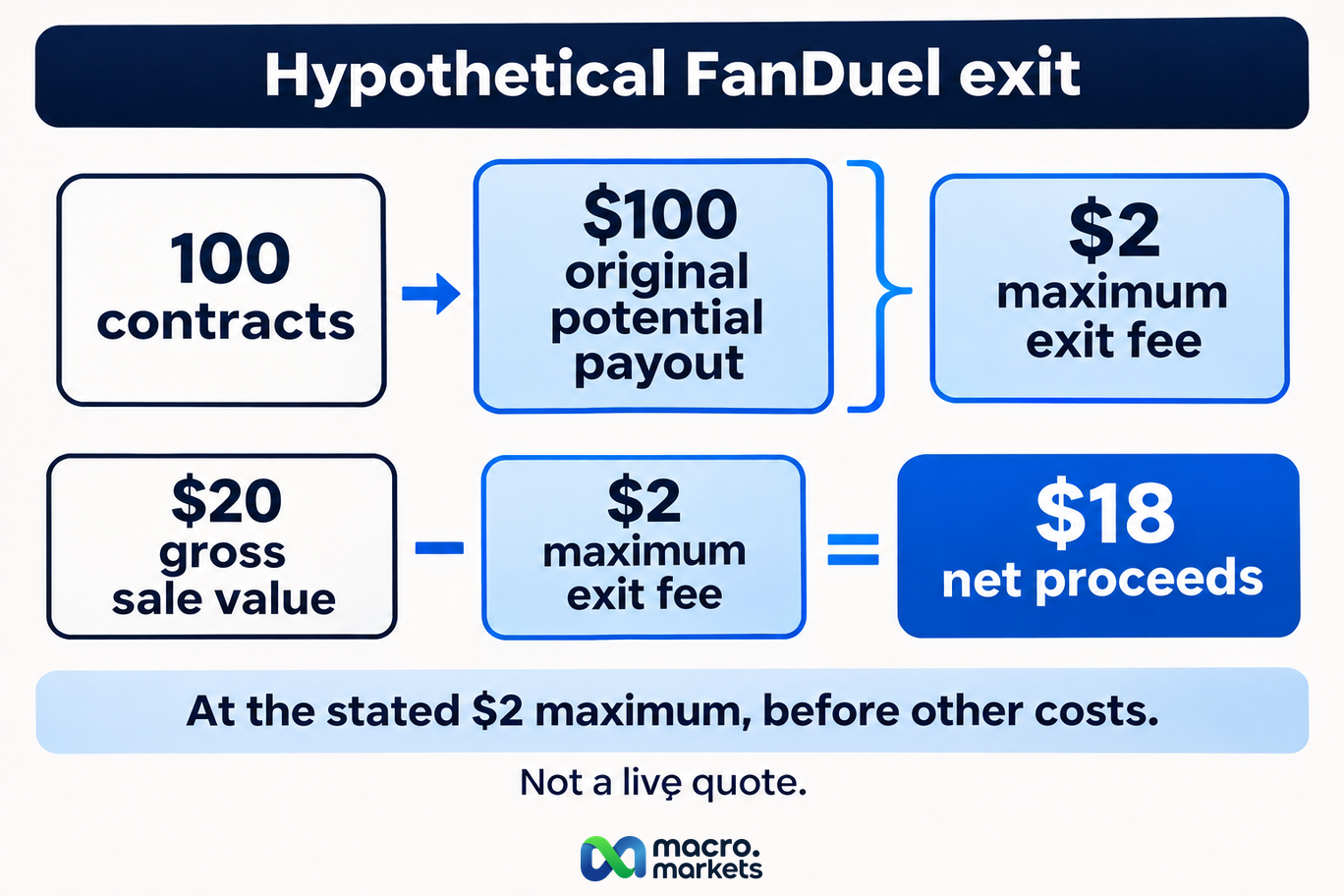
FanDuel's dedicated fee page says an early cash-out charge can be based on the original potential payout, even if the amount received from selling the position is smaller. That is the important qualification when reading a simple percentage.
Consider a separate, hypothetical exit. You originally bought 100 contracts with a $100 potential settlement payout. Their gross sale value later falls to $20. At the published $2 maximum exit charge, the amount left would be $18, before any other applicable adjustment. Charging 2% of the $20 sale value would instead produce a $0.40 fee. Those are different calculations.
This is a maximum-fee illustration, not a claim that every FanDuel exit costs $2. The actual cash-out preview may already include the charge. Do not subtract it a second time from a value shown as net proceeds.
Under the standard Polymarket US taker formula, selling 100 contracts at $0.20 produces a $1.11 fee after rounding. On a $20 gross sale, that leaves $18.89 before other applicable costs. This calculation does not establish that either platform would fill that quantity at that price.
A position can have a displayed value without an immediately executable exit. Before entering, decide whether you could tolerate holding until the contractual outcome is settled.
Order Controls and Available Liquidity
Polymarket US's order-type documentation distinguishes market and limit orders. A limit order lets you set a price boundary, but does not guarantee a fill. An unfilled order is not an executed position, and a resting order should not automatically be treated as qualifying for a rebate.
FanDuel's order-type guidance describes market orders that can average execution across several price points. It says the workflow fills the full order amount rather than a partial amount and may return the customer to checkout after a sufficiently large price change.
The practical question is how each workflow handles your intended size. Check the executable quantity, average price, confirmation and any remaining order. A platform's simple interface does not prove that liquidity is deep, and an exchange's limit-order feature does not prove that someone will trade against your price.
We have not run a controlled order-book study for this comparison. We therefore do not name a liquidity winner or publish a measured slippage ranking. For a meaningful test, the contracts, timestamps, sizes and outcomes would need to match.
Access, Funding and the Balance You Can Use
Availability has several layers: whether the product accepts your account, whether your current physical location permits trading and whether the specific category is offered there. A statement about nationwide financial markets should not be applied automatically to sports contracts.
Use FanDuel's current availability information and the live account checks. A state list in an older review or promotion can become outdated. Traveling can also affect what the app presents, so check access again before assuming you can close a position from another location.
Polymarket US's funding documentation lists several payment routes, including bank and card methods and USDC where available. Some deposits can provide buying power before the underlying funds finish clearing. That distinction matters: a tradable balance is not necessarily a balance you can withdraw immediately.
A USDC funding option does not turn Polymarket US into the international onchain product. The account, contracts and US-dollar trading framework remain the relevant product definition.
FanDuel's explanation of its app changes says Predicts and Sportsbook retain separate wallets, history and promotions while the FanDuel account remains the same. Familiar login details do not make the two balances interchangeable. Check the payment methods and cleared buying power available to your Predicts account.
When an outcome settles favorably, FanDuel's payout guide distinguishes pending payouts from funds ready for withdrawal. That is another reason to assess entry, settlement and access to cash separately.
Resolution and Risk
Polymarket US explains its market-resolution process in its documentation. For FanDuel Predicts, the applicable exchange and individual contract rules determine settlement. Read the official source, cutoff and exceptions before treating a result shown elsewhere as final.
A postponed game, corrected statistic or amended economic release can matter differently under different rules. If you cannot explain which result will settle the position, the price comparison is premature.
Regulatory oversight does not insure a position against an unfavorable outcome. A contract can expire worthless, and paid fees remain part of the economics. An available early-sale feature also does not guarantee a buyer at a price you would accept. Our US prediction-market legality guide provides additional background on the regulatory distinction.
Which Workflow Fits Your Trade?
| Your priority | First comparison to make | What could change the decision |
|---|---|---|
| Price control | Polymarket US market and limit orders | Fill probability and available quantity |
| FanDuel familiarity | Predicts account and available markets | Separate balance and category restrictions |
| Frequent early exits | Net proceeds at your intended size | Spread, fees and an unavailable cash out |
| Low-priced positions | Fee relative to premium and payout | Applicable price band and execution price |
| Fast access to cash | Cleared funds and withdrawal rules | Funding holds and settlement timing |
Start with a position size you can afford to lose. Save the actual quote and rules before submitting. If the total debit or expected exit does not make sense, reduce the uncertainty in the calculation before choosing a platform.
Our FanDuel Predicts alternatives and Polymarket US alternatives are useful when neither workflow meets your needs. A third product should face the same contract, cost and eligibility checks.
Where Macro Markets Fits
Macro Markets is our own crypto-native prediction-market alternative. We include it because a reader's preferred account and funding model can affect the comparison, and we disclose our commercial interest.
Consider it if you want to evaluate a crypto-native workflow alongside the two US products. Review the markets actually offered, supported funding, fees, settlement process and geographic eligibility. Crypto positioning alone does not establish lower costs, stronger liquidity or availability from every jurisdiction.
We do not present Macro Markets as a CFTC-designated US exchange or as an account connected to QCX, CME or OG. A similar market topic does not make a Macro Markets position interchangeable with a contract on another venue.
The right alternative is the one whose product terms and execution fit your intended use. Apply that standard to Macro Markets as carefully as to the other providers.
Frequently Asked Questions
Is This the Same as Polymarket vs FanDuel Sportsbook?
No. This comparison concerns Polymarket US and FanDuel Predicts. International Polymarket and FanDuel Sportsbook have different product structures and access conditions. Mixing them into the same fee table can produce a misleading conclusion.
Is FanDuel Predicts Limited to CME Contracts?
No. FanDuel has documented an expanded offering through Crypto.com and OG alongside CME. Identify the venue for the market you are considering instead of assigning every contract to one exchange.
Is Polymarket US Always Cheaper?
No universal ranking follows from the examples. They compare one standard formula with FanDuel's published maximum. The applicable fee, executable price, size, rebate eligibility and eventual exit determine the actual comparison.
Does a 2% Fee Always Mean 2% of My Cash-Out Value?
No. FanDuel's dedicated fee guidance identifies the original potential payout as the basis for its stated early-exit charge. Check the precise denominator and whether the displayed cash-out amount is already net of fees.
Can I Transfer a FanDuel Sportsbook Balance Into This Trade?
Do not assume so. FanDuel describes separate wallets and product-specific histories and promotions. Confirm the usable Predicts balance and funding options in the account before placing an order.
Final Verdict
Choose between Polymarket US and FanDuel Predicts by checking a complete trade: the exact outcome, listing exchange, permitted access, total entry debit and realistic exit proceeds. The brand and headline percentage are useful starting points, but they do not answer those questions.
Polymarket US may fit a trader who values explicit order-price controls. FanDuel Predicts may fit someone who prefers its consumer workflow and finds the relevant markets available. Neither description establishes a guaranteed fill, an easy withdrawal or the cheapest total result.
Keep the comparison in consistent units. Separate contract premium from potential payout, a fee ceiling from an actual quote, and a visible position value from cash you can receive today. Those distinctions make the choice more reliable than a simple scorecard winner.
