


Polymarket US vs DraftKings Predictions: Fees, Markets and Best Fit (2026)
Polymarket US fee update — November 7, 2026: From November 6 at 1:00 PM ET, the official standard taker schedule uses Θ of 0.095 below $10,000, 0.085 from $10,000 to below $50,000, 0.075 from $50,000 to below $250,000, and 0.0695 at $250,000 or more in qualifying trailing-30-day taker volume. The fee is Θ × contracts × price × (1 − price). For one fill of 100 contracts at $0.50, those fees are $2.38, $2.12, $1.88 and $1.74, respectively, before rebates and other costs. Θ is not a flat percentage of the investment.
New accounts use 0.0695 for their first seven ET calendar days from their first fill. Days 8–30 use the higher of first-seven-day volume × 30/7 and trailing volume; transition accounts and November's October-volume protection can also receive better tiers. Overrides and the coefficient fixed when an order is inserted matter. Table tennis now uses the standard ladder; combos remain separate. Rebate windows also moved to daily trailing-30-day measurement. The updated Polymarket US review explains volume, rounding and exceptions.
Scope of the comparisons below: Every Polymarket US $1.74 midpoint, $0.63 at $0.10/$0.90, and $51.74 total example assumes Θ = 0.0695 and one fill, without rebates. These remain valid conditional examples, not a universal current rate or a live quote. At Θ = 0.095, the midpoint fee is $2.38 and the entry debit is $52.38; comparisons with a $2.00 competing fee reverse at that coefficient. Other brands' facts retain their original review date.
The Polymarket US vs DraftKings Predictions choice is about the contract you can trade, the price you can execute, and the account you want to use. A familiar sports brand or a lower advertised fee cannot answer those questions by itself.
Our verdict: Polymarket US is a natural starting point for someone seeking a dedicated event-contract exchange. DraftKings Predictions is worth comparing if you prefer DraftKings' consumer trading experience and its available sports and other event markets. Check the listing exchange, current location requirements, usable balance, and actual order preview before deciding.
The fee comparison is closer than a simple “cheap vs expensive” label suggests. For a hypothetical purchase of 100 contracts at $0.50, Polymarket US's taker calculation at Θ = 0.0695 gives $1.74, while DraftKings' current standard CDNA/DKeX and CME schedules give $2.00. At other prices, the schedules behave differently. A slightly better execution price can outweigh that midpoint difference.
Checked November 5, 2026. This is a documentation-based comparison, not a report of simultaneous funded trades. We do not claim a measured liquidity winner. Macro Markets publishes this article and operates a competing crypto-native prediction-market platform, which we disclose as an alternative below.
Polymarket US vs DraftKings Predictions at a Glance
| Decision factor | Polymarket US | DraftKings Predictions |
|---|---|---|
| Product relationship | Dedicated USD event-contract platform | Predictions account carried by a futures commission merchant |
| Listing venue | QCX LLC, doing business as Polymarket US | Contract-specific venue; official rules list DKeX, CDNA, and CME |
| Standard fee approach | Price-sensitive taker formula, with separate exceptions and rebates | Price bands that differ between CDNA/DKeX and CME |
| Hypothetical midpoint entry | $1.74 standard taker fee for 100 contracts | $2.00 under the standard schedules used here |
| Trading controls to inspect | Market or limit order, fill quantity, and expiry | Eligible slippage settings, trade preview, and available quantity |
| Account detail to verify | Available USD and deposit clearance | Funds usable for Predictions and applicable product restrictions |
| Best initial fit | A focused event-contract workflow | A customer who values the DraftKings interface and eligible listings |
The table describes a starting point, not universal access or a guarantee of execution. Neither provider's brand tells you whether a particular contract is available to your account today.
For broader product assessments, read our Polymarket US review and DraftKings Predictions review. This comparison concentrates on the decision between them, with current fee examples and a practical pre-trade checklist.
Which Should You Check First?
Start with Polymarket US if you want to inspect a dedicated prediction-market account and order workflow. Start with DraftKings Predictions if you already know its interface and want to see whether it offers the event exposure you need.
Then reverse the comparison. Find the closest eligible contract on the other platform and read its definition. If the event, timing, or settlement source differs, the two quoted prices are not interchangeable. Comparing logos first and rules later can turn an apparently cheaper trade into a different position altogether.
The Exchange Behind the App Matters
Polymarket US is distinct from the international Polymarket product. Its US product documentation describes trading in USD under the US exchange framework. Do not bring international wallet, blockchain settlement, or access assumptions into this comparison.
The CFTC's QCX designation record identifies QCX LLC, doing business as Polymarket US, as a designated contract market. That is the listing-venue layer of the product.
DraftKings Predictions has a different customer relationship. Its current FCM regulatory page identifies the futures commission merchant framework and publishes financial reports. An FCM carries the customer account; that role is different from operating the exchange that lists a particular contract.
DraftKings' rules and settlements page lists DKeX, CDNA, and CME and directs customers to the rules for the market in their trade slip. DKeX's own regulatory compliance page identifies DraftKings Futures Commission Merchant as an affiliate that introduces customers to the exchange. That relationship does not make every listing a DKeX contract.
Match the Contract Before Matching the Price
Imagine two markets asking whether a team will win. One could refer to a particular game, another to a tournament, and another to a season outcome. Even apparently identical game contracts can differ in how they handle postponements, abandoned play, overtime, or a changed official result.
For an economic contract, the same problem appears through the reference month, data series, threshold, release time, and treatment of revisions. A lower Yes price only becomes a meaningful comparison after those terms match closely enough for your purpose.
Record the exact question and venue for both candidates. A position on QCX does not become transferable to a DraftKings-supported venue because the screens display the same sporting event. Treat the books, rules, and account balances as separate unless the applicable documentation expressly says otherwise.
Fees: Use the Current Schedule, Not an Old Promotional Shortcut
For this comparison, the relevant sources are the Polymarket US fee schedule and DraftKings Predictions fee disclosure. Both should be checked again when you place an order.
An older DraftKings promotion describes a one-cent transaction fee plus an exchange charge. The dedicated current disclosure instead presents standard price bands for CDNA/DKeX and a separate CME schedule. Do not add an old promotional description on top of the current schedule by assumption.
At Θ = 0.0695, Polymarket US's conditional taker calculation is 0.0695 × contracts × price × (1 − price), using the decimal dollar price and banker's rounding to the nearest cent. A taker order executes against liquidity already available on the book.
DraftKings' disclosed CDNA/DKeX rate is $0.006941 per contract in the $0.091–$0.119 band and $0.02 in the $0.30–$0.94 band. Its separate CME schedule is $0.01 per contract at $0.10 and $0.02 at $0.50 or $0.90. Use the applicable band for the actual contract and preview.
A Hypothetical 100-Contract Entry
These examples isolate explicit entry charges at the same hypothetical price. They do not assert that equivalent contracts are simultaneously available at those prices. Polymarket examples use the standard taker category, and none include rebates, funding costs, spreads, or an exit.
| Price per contract | Polymarket US standard taker fee | DraftKings CDNA/DKeX listed fee, rounded | DraftKings CME total fee |
|---|---|---|---|
| $0.10 | $0.63 | $0.70 | $1.00 |
| $0.50 | $1.74 | $2.00 | $2.00 |
| $0.90 | $0.63 | $2.00 | $2.00 |
At $0.10, 100 contracts cost $10 before charges. Multiplying DraftKings' listed CDNA/DKeX rate by 100 gives $0.6941. Its purchase-rounding rule brings the combined debit to $10.70. That is why the displayed fee example is $0.70 rather than $0.69.
At the midpoint, the entry debit plus the illustrated fee is $51.74 on Polymarket US and $52.00 under the two DraftKings schedules. That difference describes this example, not a permanent overall cost ranking.
What the Examples Leave Out
Polymarket US table tennis follows the standard tier ladder; combos retain a separate curve, and rebates have separate eligibility rules. DraftKings pricing depends on the applicable venue, band, and current terms. Multiple fills can also require more detailed reconciliation than a single-fill illustration.
Use our prediction-market fee calculator to understand the components, then verify that its selected model actually matches the order you intend to place. The live confirmation is the relevant check on what will be charged.
The Quote and Full Fill Can Matter More Than the Fee
A $0.01 price difference across 100 contracts changes the purchase debit by $1.00. That is almost four times the $0.26 midpoint fee difference in the preceding example. A fee comparison that ignores execution can therefore point in the wrong direction.
Suppose, hypothetically, one order book offers 25 contracts at $0.50 and the remaining 75 at $0.53. Buying all 100 costs $52.25 before fees. An alternative offering the whole quantity at $0.51 costs $51.00 before fees. The first screen has the better small-quantity quote and the higher full-order debit.
That example is arithmetic, not an observation about either provider's current depth. Check available size, permitted order type, and what happens to any unfilled quantity. A displayed price is not a commitment to fill your entire order there.
Price Controls Serve Different Workflows
Polymarket US documents market and limit orders, including partial fills and choices for the unfilled remainder. A limit order controls the price you will accept, but it does not guarantee execution.
DraftKings' slippage settings guide explains how eligible trades can use a maximum acceptable price. A lower platform price-band limit can still apply, and the setting does not guarantee a fill.
Do not treat those controls as interchangeable without reviewing the order ticket. For either provider, inspect the maximum debit and resulting quantity rather than assuming that the headline amount you entered describes the final position. Our beginner trading guide explains the basic order workflow.
Selling a Contract Is Different From Sportsbook Early Exit
An event contract is a position that can gain or lose value before resolution. To leave it early, you need an available trading mechanism and an acceptable executable price. The ability to enter does not guarantee a convenient exit later.
DraftKings' Predictions trading guide describes buying more, selling, or holding until resolution. Selling is a new trading decision with its own price and applicable charges, rather than a reversal of the original trade.
There is also an important product-name distinction. DraftKings' Early Exit explanation for Predictions says the Sportsbook feature for a player being ruled out does not apply to Predictions trades. That does not mean every Predictions position must be held until settlement; it means the named Sportsbook protection should not be assumed to apply.
For Polymarket US, use its documented order process to inspect an executable sale. A mark on an open-position screen can be different from the proceeds available for your full quantity.
Before entering, decide how you would handle three possibilities: holding to resolution, accepting an early loss, or being unable to sell at the price you want. If your plan depends on an immediate exit during a fast-moving event, a small headline fee is a secondary consideration.
Funding and Account Access: Check the Usable Balance
An account login, a displayed balance, trading eligibility, and withdrawable cash are different things. This matters particularly when the same company offers several products through familiar branding.
Polymarket US Deposits
The Polymarket US funding guide lists bank transfer, debit card, Apple Pay, PayPal, Venmo, wire transfer, and USDC on iPhone where available. Check the methods and limits enabled for your account.
Some deposits may receive buying power before they finish processing, while withdrawal availability depends on clearance. Using USDC as a funding option does not turn the US product into the international blockchain-based Polymarket service.
If you are depositing for a specific event, allow for processing and verification. If you plan to withdraw immediately afterward, check deposit holds separately from the event's settlement timing.
DraftKings Product Restrictions
DraftKings' deposit guidance says methods vary by product and jurisdiction. Its Predictions terms also restrict certain deposits made through affiliated products, including credit-card, gift-card, and retail sportsbook deposits, from being used for Predictions.
The practical check is the amount actually available for a Predictions trade. Do not assume that every balance or funding method associated with another DraftKings product can be used for it. Equally, do not assume all cross-product funds movement is impossible: consult the current account terms and supported options.
DraftKings' withdrawal overview explains that methods vary by product and jurisdiction and that withdrawals may be routed back to the funding source. Review your enabled options rather than inferring withdrawal speed from the speed of a trade.
Eligibility, Location, and Resolution Rules
Check eligibility for the specific product and market category, not merely whether an app can be downloaded. DraftKings' current Predictions terms require US residency and the applicable minimum age; its availability page distinguishes market categories by physical location. Contract access can change while you travel.
Polymarket US separately documents trading restrictions. Approval for one account or product does not establish approval for another, and access today does not guarantee that every event category will remain available everywhere.
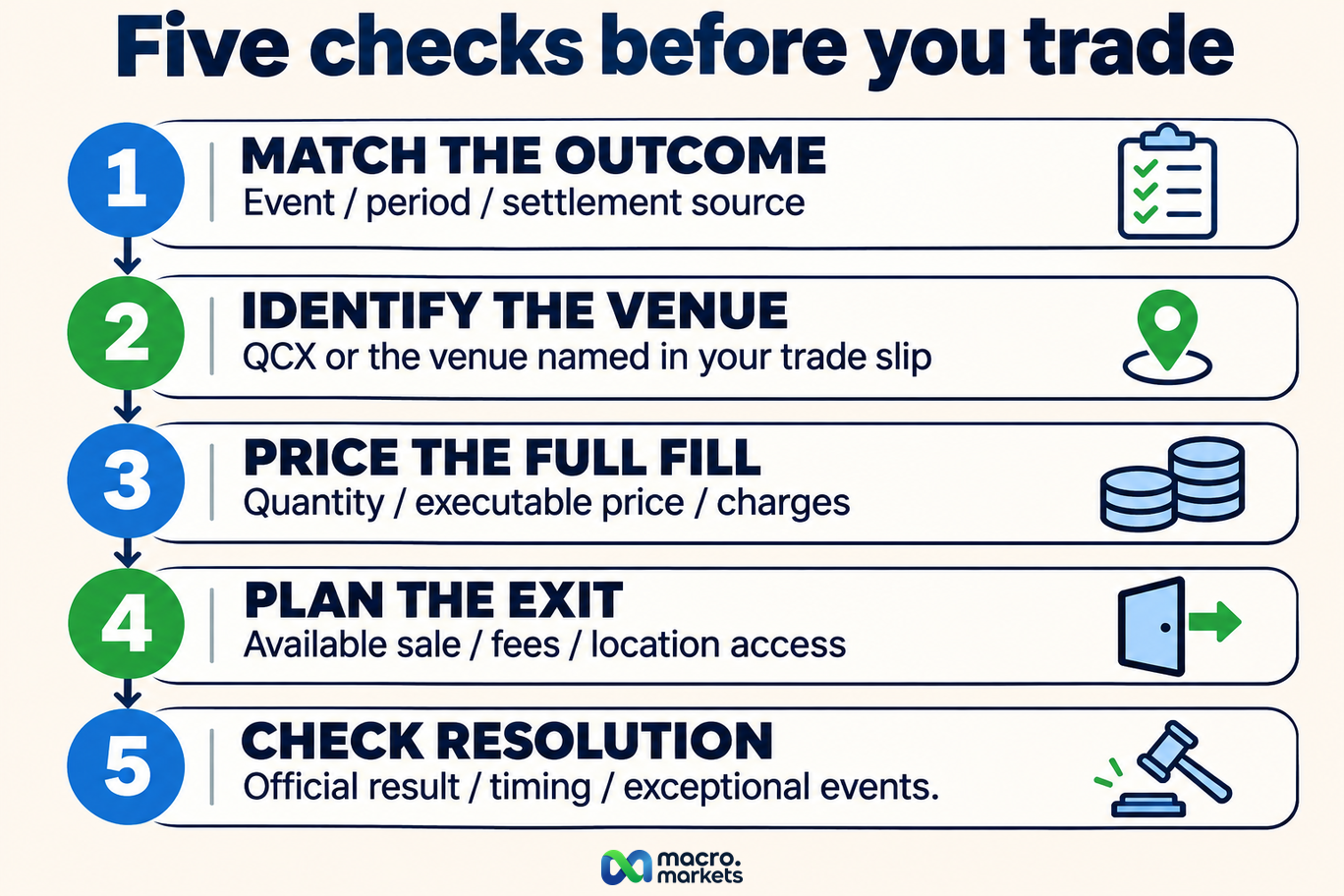
A Practical Contract Checklist
| Before trading | What to confirm | Why it changes the comparison |
|---|---|---|
| Match the outcome | Same event, threshold, period, and settlement source | Similar titles can describe different payoffs |
| Identify the venue | QCX or the exchange named in the DraftKings rules | Venue-specific fees and rules apply |
| Price the full fill | Quantity, executable price, charges, and unfilled remainder | The best small quote may not be the cheapest whole order |
| Plan the exit | Available sale, possible charges, and location restrictions | An entry fill does not guarantee later liquidity |
| Check resolution | Official source, timing, and treatment of exceptional events | A display or unofficial result is not final settlement |
Polymarket US publishes its resolution process. DraftKings directs users to the rules linked from the individual trade slip. Read those documents before inferring what a postponed game, revised data release, or disputed result would mean for a position.
CFTC registration or designation identifies a regulatory framework; it does not insure a trade against an unfavorable outcome. For the broader background, see our US prediction-market legality guide.
Where Macro Markets Fits
Macro Markets is our own crypto-native prediction-market alternative. We include it because account model and funding preferences can matter to readers comparing these products, and we disclose the commercial interest.
Consider Macro Markets alongside Polymarket US and DraftKings Predictions if you want to evaluate a crypto-native trading experience. Review its current markets, fees, supported funding, settlement mechanics, and geographic eligibility directly. That positioning is not evidence of lower costs, superior execution, or access from every jurisdiction.
Macro Markets is not presented here as a CFTC-designated US exchange, as a DraftKings-connected account, or as a replacement for a particular QCX or DKeX contract. Choose it only after checking whether its product and market terms fit your intended use.
Our Polymarket US alternatives and DraftKings Predictions alternatives provide broader comparison paths. Apply the same checks to every provider, including Macro Markets.
Frequently Asked Questions
Is DraftKings Predictions the Same as DraftKings Sportsbook?
No. Predictions uses event contracts under its own account and trading terms. Sportsbook features, funding rules, promotions, and named protections should not be assumed to carry across simply because both products use the DraftKings brand.
Is Polymarket US Cheaper Than DraftKings Predictions?
The standard examples above give Polymarket US a lower explicit entry fee at the three illustrated prices. That is not a complete trading-cost ranking: the actual venue, market category, execution price, quantity, rebates, and eventual exit can change the result.
Does Every DraftKings Predictions Trade Use DKeX?
No. The official rules page also identifies CDNA and CME. Use the venue shown for the individual contract rather than assuming the app's affiliated exchange handles every market.
Can I Close a Predictions Trade Before the Event Ends?
Both products describe ways to trade before resolution, but execution depends on current access, available liquidity, and the applicable rules. Selling a position is different from receiving an automatic refund or Sportsbook Early Exit protection.
Is This a Comparison With International Polymarket?
No. This page compares Polymarket US with DraftKings Predictions. The international Polymarket product has a different product and access model, so its assumptions should be evaluated separately.
How to Choose Between Them
Choose the workflow after checking the trade. Polymarket US offers a dedicated event-contract experience; DraftKings Predictions offers a familiar consumer interface connected to contract-specific exchanges. Neither description answers whether your intended position is eligible, affordable to execute, or easy to exit.
Start by matching the event rules. Then compare the full quantity at an executable price, add the current charges, inspect usable funds, and plan for resolution or an early sale. Treat a sports brand, a promotional description, or a one-cent headline as a starting point for research rather than a completed comparison.
If you are still choosing a product category, our best prediction-market apps guide maps the wider field. Keep the decision anchored in the contract and account conditions you can verify today.
