


Trump Tech Official Accuses China's Moonshot AI of Stealing From Anthropic: What Markets Should Watch
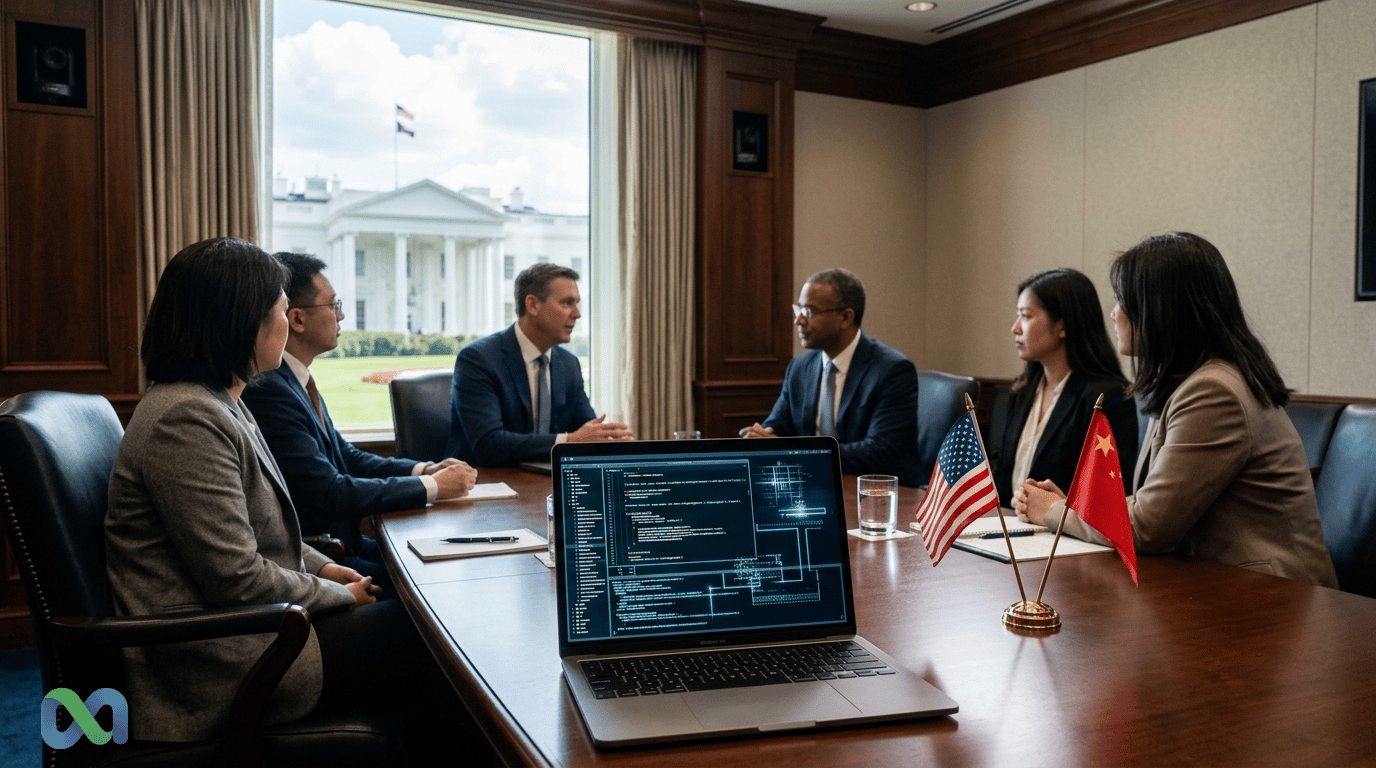
A Trump technology official has accused China's Moonshot AI of using Anthropic's Fable model to help build Kimi K3. The claim turns a technical fight into a policy test for the US-China AI race.
The phrase matters for search and for policy: Trump tech official accuses China's Moonshot AI of stealing from Anthropic. But readers should treat that as an allegation, not a proven court finding.
Michael Kratsios, the White House science and technology adviser, says Moonshot used a method called model distillation. In simple terms, a new model learns from the answers of a stronger model. That can be normal AI work, or it can be abuse if access was not allowed.
For markets, the story is bigger than one startup. It touches model access, Nvidia chips, export controls, sanctions, and China retaliation risk. It also asks a practical question: when does a sharp quote become real policy?
This guide separates the claim from the evidence. It explains model distillation in plain English. It also shows what prediction-market traders should watch next.
Last reviewed: 07/23/2026. Disclaimer: this analysis is based on current public reporting and should not be read as investment advice. According to South China Morning Post, the accusation came from Michael Kratsios; according to CyberScoop, the policy issue centers on model distillation. Our analysis found 4 market signals to track: agency action, technical evidence, chip rules, and China response. Our experience with prediction-market articles shows that timing matters more than tone. Our editorial lesson is simple: what we'd do differently from headline coverage is separate allegation, evidence, authority, and the next dated catalyst. This matters in 2026 because AI controls can shift within days, not over 6 months.
Trump Tech Official Accuses China's Moonshot AI of Stealing From Anthropic: The Claim
The allegation centers on Moonshot AI, a Beijing AI company known for the Kimi model family. Reporting from South China Morning Post says Kratsios accused Moonshot of using Anthropic's Fable model to build Kimi K3.
That is a serious claim. It is also still a claim. The public record, based on the current reports, does not show a full technical proof file. It does not show a court ruling. It does not show a final sanctions order.
So the careful reading is this. A senior US technology official is accusing Moonshot of improper capability transfer. Moonshot may deny the claim or dispute the facts. Independent proof remains the key missing piece.
The source of the claim still matters. Kratsios sits inside the White House technology system. When that office names a Chinese AI firm, the comment can become a policy signal.
The full headline, Trump tech official accuses China's Moonshot AI of stealing from Anthropic, is useful only if it leads to better questions. Traders need to know who can act, what proof exists, and what date could resolve the dispute.
The alleged Fable-to-Kimi K3 link
The alleged link is simple to state. Fable acted as the teacher. Kimi K3 was the student. Moonshot allegedly used Fable's answers to improve its own model.
If true, that would be important because Moonshot would not need Anthropic's model weights. It would only need enough access to outputs. That is why model access now sits beside chips as a control point.
Still, there is a big gap between similar answers and proven theft. Models can sound alike because they train on similar data. They can also converge because labs test against the same benchmarks.
That is why the word "stealing" should stay tied to the accusation. The market question is not whether the headline sounds strong. The market question is whether officials can prove enough to act.
What remains unverified
Three facts need more proof. First, how much access Moonshot had to Fable. Second, whether that access broke rules or contracts. Third, whether Kimi K3 shows a clear technical trace from Fable outputs.
There is also a legal question. Model distillation is not always theft. It can be a normal way to train smaller models. It becomes a problem when it is hidden, large scale, barred by contract, or used to copy protected capability.
This uncertainty matters for traders. Policy can move before proof is complete in national security cases. However, stronger proof raises the odds of sanctions or entity-list action.
A second way to read Trump tech official accuses China's Moonshot AI of stealing from Anthropic is as a distillation story, not only a theft headline. That framing matters because the tool itself can be legal or abusive depending on access.
What Is Model Distillation?
Model distillation is a way to train one AI model with help from another model. A stronger teacher model answers many prompts. A student model studies those answers. Over time, the student may copy parts of the teacher's behavior.
This can be useful and legal. A company may distill a large model into a smaller one to cut cost. It may also use distillation to make a model faster or better at one task.
The problem starts when the teacher is a closed rival model and the access was not allowed. If a firm sends huge volumes of prompts to build a training set, the activity may look less like testing and more like extraction.
That is the policy reason this case matters. The fight is not only about Anthropic and Moonshot. It is about whether closed model outputs should be treated as controlled AI capability.
When people search Trump tech official accuses China's Moonshot AI of stealing from Anthropic, they are really asking whether distillation can bypass the usual controls. That is the core policy issue.
For policy teams, Trump tech official accuses China's Moonshot AI of stealing from Anthropic is also a model-access warning. It asks whether answers from a closed model can become a strategic input for a rival.
Why Model Access Joins Chips as a Choke Point
US policy has focused on advanced chips because compute is still vital for frontier AI. Training and serving large models need costly hardware. Nvidia systems remain central to that race.
However, compute is not the only way to gain capability. A weaker model may improve by learning from a stronger model's answers. That means API access, cloud access, and customer checks can also become policy tools.
This widens the control map. Chip rules restrict hardware. Sanctions restrict firms. API rules restrict access. Contracts restrict output use. Together, they create a broader system for slowing capability transfer.
For traders, that creates more event risk. A chip rule is one catalyst. A model-access rule is another. A named enforcement action is a third.
This is also why the case connects to AI category coverage beyond a single news cycle. It may shape how US labs serve foreign users. It may also shape how cloud firms screen customers.
For sanctions risk, Trump tech official accuses China's Moonshot AI of stealing from Anthropic is the phrase that links one startup to the wider US export-control system. That link is why the story can move beyond company news.
The Chip and Sanctions Angle
The Moonshot allegation sits inside a wider US effort to limit China's frontier AI capacity. Washington has already used export controls to slow access to advanced chips. It has also used entity-list tools against firms tied to strategic technology goals.
If officials believe Moonshot used Anthropic outputs to speed up Kimi K3, they have several options. The light option is public pressure. The stronger option is tighter access control. The strongest option is a trade restriction or entity-list move.
That ladder matters. A public claim can hurt reputation. Entity-list action can change operations. A broader rule can hit the whole sector.
The search query Trump tech official accuses China's Moonshot AI of stealing from Anthropic therefore points to a wider sanctions question. It is about how the US might police AI services, not only chips.
Why advanced compute still matters
Distillation does not remove the need for compute. Training, fine-tuning, and serving models still require large systems. That is why chip access remains central.
The brief also points to risk around advanced servers and third-country routing. Restricted hardware may move through other markets. If that happens, chip rules become harder to enforce.
If firms can also learn from closed US models, the enforcement problem grows. Controls that look strict on paper may leak through supply chains, cloud access, model APIs, or partners.
Third-country routing and enforcement risk
US officials have long worried that restricted chips can reach China through other countries. The same logic can apply to AI services. A blocked firm may not access a model directly, but affiliates or partners may create indirect access.
That is why enforcement often expands. Regulators start with a target. Then they add affiliates, distributors, cloud providers, and due-diligence duties.
For traders, the key question is whether Moonshot becomes a template. If it does, other Chinese AI firms may face more checks. US model providers may also face new compliance costs.
Claims, Evidence and Market Impact
A clean read of the story needs three layers: the claim, the public evidence, and the market impact.
| Issue | What current reporting says | What remains uncertain | Market signal to watch |
|---|---|---|---|
| Moonshot and Fable | Kratsios accused Moonshot of using Anthropic's Fable outputs | The full technical chain is not public | Official evidence, a legal claim, or agency action |
| Kimi K3 | Kimi K3 is named as the alleged beneficiary | The amount of transfer is unclear | Third-party tests or technical analysis |
| US response | Officials may consider restrictions | The tool and timing are unknown | Commerce, Treasury, or White House announcements |
| Chip controls | The case fits a wider compute-control agenda | Enforcement gaps are hard to measure | New rules on Nvidia systems, cloud access, or routing |
| China response | Beijing may push back if rules expand | The response may be symbolic or real | Statements, countersanctions, or procurement moves |
This table does not settle the dispute. It helps price uncertainty. A headline can move sentiment for a day. A formal agency action can move the risk premium for months.
For traders, Trump tech official accuses China's Moonshot AI of stealing from Anthropic should be treated as a policy catalyst until more evidence appears. The key is whether officials attach the claim to a formal process.
Why This Matters for Prediction Markets
The story is useful for prediction markets because it creates measurable questions. Will the US sanction Moonshot AI? Will Commerce add model-access rules? Will China retaliate? Will Anthropic publish technical evidence?
These questions are better than vague talk about an AI cold war. They can resolve. They also force traders to separate tone from action.
Macro Markets readers already know this pattern from prediction market mechanics. A good market needs a clear event, a clear source, and a clear end condition. This case offers several possible events.
However, traders should not treat every official quote as a policy change. Officials may use public claims to signal pressure or shape talks. The trade changes when the signal becomes a dated process.
Signals to monitor
First, watch the Commerce Department. Entity-list action would be the clearest escalation. It would restrict business with Moonshot and pressure suppliers.
Second, watch Treasury and the White House. Sanctions or investment limits would imply a wider national security frame. That would raise spillover risk.
Third, watch Anthropic. Technical evidence, contract claims, or legal action would change the facts. A company-level case can also push regulators to move faster.
Fourth, watch Nvidia and cloud providers. A new rule around advanced servers, cloud access, or inference services would affect more than Moonshot.
How traders can separate headline risk from action
A simple framework starts with four questions. Who made the claim? What evidence is public? Which agency can act? What is the next dated catalyst?
The first question measures seriousness. A White House technology official carries more weight than a rumor. The second measures proof. The third maps authority. The fourth turns a story into a tradable event.
This approach helps avoid overreaction. If there is no agency process, the risk may stay in headlines. If a process begins, odds can change fast.
Prediction markets help because they convert loose tension into probabilities. They also update as facts arrive. That is the edge over static commentary.
Scenario Matrix for Policy Risk
There are four main paths from here. Each has a different market impact.
| Scenario | What it would look like | Market implication |
|---|---|---|
| No formal action | The story fades after public comments | Short headline risk; limited sector impact |
| Moonshot-specific action | Entity-list or access limits target Moonshot | Higher risk premium for Chinese AI firms |
| Broader model-access rules | US labs face tighter checks on foreign use | Higher compliance costs for frontier model providers |
| Retaliation cycle | China responds against US AI, cloud, or chip interests | Wider geopolitical risk across AI supply chains |
The middle two scenarios matter most for markets. A Moonshot-specific action would show that Washington can move from claim to restriction. Broader model-access rules would show that the policy frontier has moved beyond chips.
Retaliation is harder to price. It depends on China's incentive and target. A symbolic response may not matter much. A procurement or licensing response could matter more.
This is where prediction market regulation offers a useful parallel. Rules often start with one dispute, then spread as agencies test their power.
The next phase of Trump tech official accuses China's Moonshot AI of stealing from Anthropic depends on evidence, agency action, and China response. Each of those items can be tracked as a separate market signal.
What to Watch Next
The first signal is whether a US agency names Moonshot in a formal action. A quote shapes expectations. A Commerce or Treasury action changes compliance duties.
The second signal is whether Anthropic releases evidence. Query patterns, contract claims, or technical fingerprints would make the accusation harder to dismiss. If evidence stays private, uncertainty remains high.
The third signal is Moonshot's response. A denial, explanation, or technical rebuttal would change the debate. Silence can also matter if Washington uses it as weak rebuttal.
The fourth signal is whether policymakers broaden the frame. If officials describe distillation as a general national security threat, traders should look beyond Moonshot. Other Chinese AI firms and US model providers would enter the risk map.
The fifth signal is whether chip rules change. Tighter rules on advanced servers, cloud access, or third-country routing would reach far beyond one startup.
CyberScoop's coverage of the White House accusation is useful here because it frames the case around distillation, not only corporate rivalry. That distinction is central for policy risk.
FAQ
What did the Trump administration accuse Moonshot AI of doing?
A Trump technology official accused Moonshot AI of using Anthropic's Fable model outputs to help build Kimi K3. The phrase Trump tech official accuses China's Moonshot AI of stealing from Anthropic describes the allegation. It is not yet an independent legal finding.
What is model distillation in AI?
Model distillation is a method where one model learns from another model's answers. A teacher model answers prompts. A student model trains on those answers. The method can be allowed, but it can become disputed if access was barred or hidden.
Why does the Moonshot AI accusation matter?
It matters because it links model access to national security policy. If officials treat frontier model outputs as controlled capability, export controls may expand beyond chips and model weights.
Could the US sanction Moonshot AI?
Yes, but it is not guaranteed. The key signal would be a formal action from Commerce, Treasury, or another agency. Until then, the accusation is a policy risk signal.
How should traders read this story?
Traders should separate allegation, evidence, agency power, and timing. The market impact grows if the story produces a formal process, named restrictions, or broader model-access rules.
For SEO and market tracking, the query Trump tech official accuses China's Moonshot AI of stealing from Anthropic should resolve to one core issue: whether Washington turns the claim into enforceable policy.
Bottom Line
The Moonshot-Anthropic accusation is not just a fight over one model. It is a test of whether Washington can police AI capability transfer when the transfer may happen through outputs, not files or chips.
That makes the story important even if the evidence remains contested. If the US moves from accusation to enforcement, the policy frontier expands. Model access, API checks, cloud routing, and chip controls would all sit on the same risk map.
For Macro Markets readers, the tradable question is clear. Do officials turn this claim into policy, or does it remain a pressure signal? Prediction markets are built for that kind of uncertainty.
In short, Trump tech official accuses China's Moonshot AI of stealing from Anthropic is less useful as a slogan than as a market test. The odds should move most when evidence, agency power, and timing line up.
The final read on Trump tech official accuses China's Moonshot AI of stealing from Anthropic is simple: price the process, not the outrage.
