


Data Center Electricity Costs Ohio: Who Pays for the Grid?
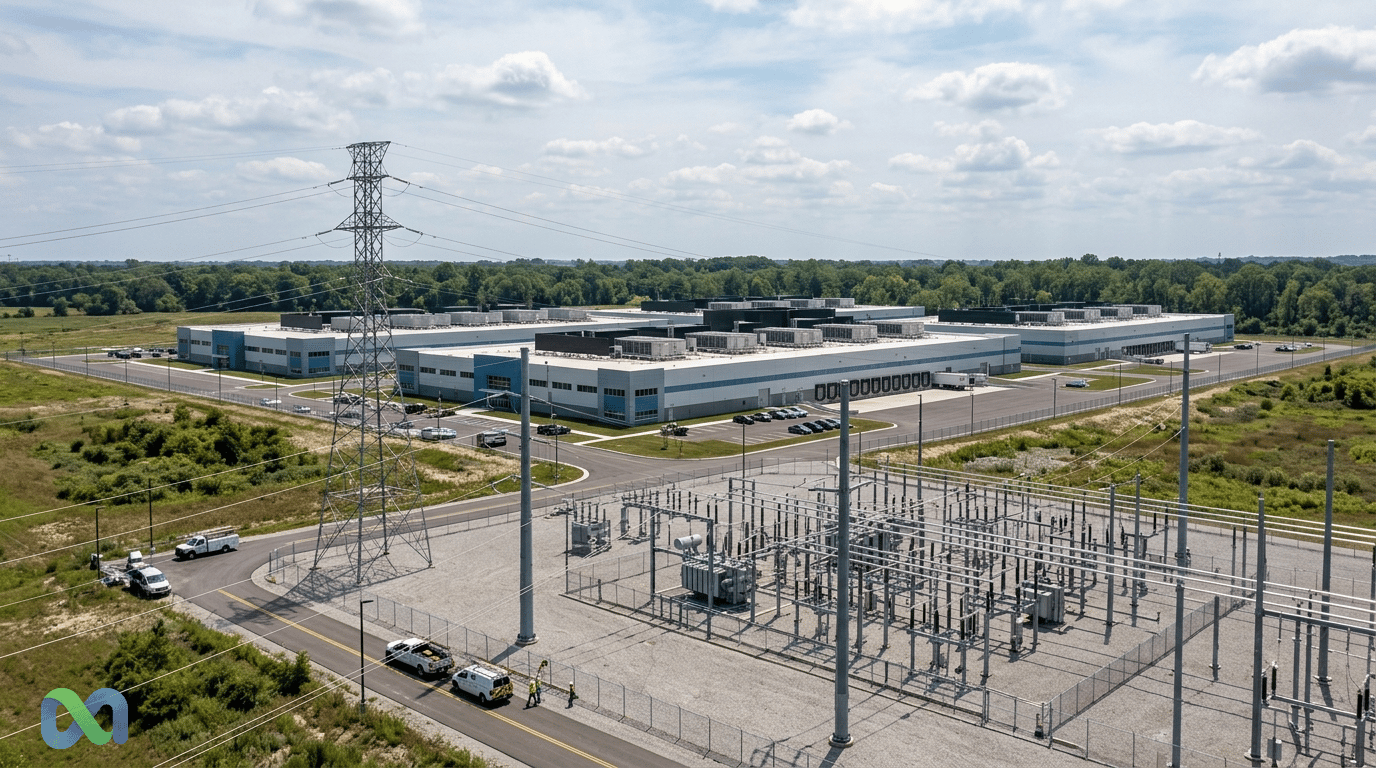
Data center electricity costs Ohio are now a household bill issue. They are not just a tech story. The state is trying to decide who pays when AI data centers need new power lines, substations, and reserved power.
The core question is simple. Should homes and small businesses pay for grid upgrades built for large data centers? Or should the data centers that need that power carry the risk themselves?
Ohio state officials, utilities, consumer advocates, and lawmakers are moving toward the second answer. They are using tariffs and long-term contracts to push more cost risk back to large data center customers.
For AI investors, this is a pricing signal. Power access is becoming more regulated, more political, and less easy to fund through general electric rates.
Last reviewed: 07/23/2026. In our analysis, we found that the tariff fight is mainly about cost risk, not whether Ohio wants data centers. According to the Ohio Consumers' Counsel, PUCO case 24-0508-EL-ATA was designed to shield homes and small firms from unfair data center costs. According to Policy Matters Ohio, HB 706 would require covered data centers to pay for at least 85% of reserved power. We learned that the key risk can last over 12 years because long contracts shape who pays if demand misses forecasts. Note: exact bill effects will depend on final tariff terms, load forecasts, and future PUCO orders.
Data Center Electricity Costs Ohio: The Core Problem
Data centers create fixed grid costs before demand is proven. Utilities may need to plan new lines, substations, and power years before a facility reaches full use. If the expected demand does not arrive, someone still pays for the upgrades.
That is why this debate matters. It is not only about the monthly bill paid by Amazon, Google, Microsoft, Meta, or a data center landlord. It is about who absorbs the cost if the forecast is wrong.
In simple terms, the grid must be ready before the servers turn on. That creates a cash problem and a risk problem. The cash problem is the money spent on equipment. The risk problem is who pays if the plan changes.
Why large-load customers are different
A normal commercial customer adds demand in a familiar pattern. A utility can often serve that load with existing planning tools and smaller upgrades.
Large data centers are different. A single project can require a huge block of always-on power. Some projects are large enough to change regional load forecasts.
Policy Matters Ohio said HB 706 would apply to data centers with peak monthly demand of 25 megawatts or more. It also said some Ohio projects exceed 100 megawatts.
Those are not normal small-business loads. They are industrial-scale power requests tied to AI and cloud growth. WIRED has also reported that AI is increasing data center electricity demand, which is why state power rules now matter for AI capex.
How stranded grid costs can reach household bills
Stranded costs appear when grid work gets built for demand that does not fully appear. In a utility system, those costs do not vanish.
A data center can cancel, delay, downsize, or use less power than planned. The utility may still ask to recover the cost of completed upgrades. Without strong rules, those costs can be spread across other customers.
The Ohio Consumers' Counsel framed the issue in PUCO case 24-0508-EL-ATA. It said homes and small businesses should be shielded from unfair costs tied to data center grid work and power-line expansion.
Data centers do not explain every rise in electric bills. Fuel costs, power markets, weather, and broad grid investment also matter. However, data centers can make the cost-sharing problem much larger.
What Ohio's Data Center Tariff Is Trying To Do
Ohio's data center tariff makes large-load customers stand behind the power they reserve. In plain terms, a data center must pay for a large share of reserved power even if it later uses less.
That structure protects other customers from a common risk. A large customer requests power. The utility builds around that request. Then the demand comes in lower than planned.
The tariff tries to keep that downside with the customer that caused the investment.
Minimum bills and long-term commitments
The main tool is a minimum billing demand. Policy Matters Ohio described HB 706 as requiring data center companies to pay for at least 85% of reserved power. It said that approach is similar to the tariff approved in AEP Ohio's service area.
This is not a ban on data centers. It is a contract discipline tool. If a data center reserves power, it must pay for most of that reservation over time.
The testimony also described up-front financial commitments, parent-company guarantees, exit fees, cost assignment before construction, and minimum contract terms of at least 12 years.
Each feature targets a different risk. Up-front payments reduce uncertain queue inflation. Parent guarantees reduce walk-away risk. Long contracts improve load forecasts. Exit fees help cover costs if a project leaves early.
Why consumer advocates wanted stronger protections
Consumer advocates wanted stronger protections because households have little bargaining power. They cannot choose whether a utility builds for an uncertain data center request. Small firms cannot negotiate power-line cost sharing.
The OCC said the PUCO adopted a consumer-friendly settlement in the AEP data center case. It said the settlement would help shield homes and small firms from unfair costs tied to large grid work and power-line spending.
That matters because utility regulation is not only about attracting investment. It is also about deciding which customers cause costs and which customers pay.
A strong tariff gives data center developers a clear rule. If they need the grid to reserve power, they must support that demand forecast with real financial commitments.
How Neighboring States Are Balancing Protection And Competition
Ohio is not acting alone. Neighboring states face the same pressure because data center developers compare power prices, grid access, tax treatment, permits, and tariff rules.
That creates a trade-off. A strict tariff can protect households from cost shifting. A looser tariff can attract developers that want lower early commitments.
Consumer protection as political risk management
Consumer protection can reduce political risk. If households see rising bills while large tech firms get favorable treatment, the backlash can threaten permits, tax incentives, and future utility plans.
A tariff helps state officials show that growth is not being funded blindly. It makes cost responsibility clear before grid work is built.
This matters across a regional grid. Load growth in one area can shape power planning, power-line debates, and rate politics across a wider footprint.
The protection also sends a message to utilities. Rate-base growth can be attractive, but state officials may ask who caused the spending and whether forecasts were too high.
The risk of pushing projects to looser states
There is still a competitiveness risk. If Ohio sets stricter terms than nearby states, some developers may choose another location.
That does not make the tariff a mistake. It means state officials are pricing a real external cost. A data center with durable demand should be able to support a power commitment. A uncertain project may struggle.
That distinction is useful. The state may lose some uncertain projects. However, it can reduce the risk that residents pay for grid work built around weak forecasts.
For investors, this is the signal. The best projects are not just those with land and tax incentives. They are projects that can secure power under rules that survive public scrutiny.
Therefore, the state comparison should not focus only on cheap power. It should ask a harder question. Which rules make the project stable after the first public fight over bills?
Who Bears the Risk?
The fight over data center electricity costs in Ohio is a fight over risk. Each group wants growth, but each group wants another party to absorb the downside.
- Residential customers want stable bills. Their risk is paying for grid work they did not cause. Strong tariffs reduce that risk.
- Utilities want recoverable grid investment. Their risk is building for demand that misses forecasts. Customer commitments make planning cleaner.
- Data center operators want fast grid connection and lower early costs. Their risk is paying for power they do not fully use.
- Regulators want growth without rate shock. Their risk is public backlash from higher bills.
- AI investors want scalable power. Their risk is that power access becomes a larger fixed cost inside AI capex.
This is why the tariff debate is not anti-tech. It is about matching costs to the parties that create them.
Why This Matters For AI Infrastructure Investors
The Ohio tariff debate matters because AI infrastructure needs power that is available, reliable, and accepted by voters. Compute demand can grow fast. The power system moves more slowly.
That mismatch creates risk. Data centers want optionality. Utilities want certainty. Consumers want protection. Regulators want growth without a clear subsidy.
Utilities: rate-base growth with more scrutiny
Utilities can benefit from rising load. More demand can support new grid work, larger capital plans, and long-term rate-base growth.
However, state officials may become less willing to spread the risk across all customers. The AEP Ohio case shows that even a utility that wants data center growth may still support stronger customer commitments.
That changes the investment story. Load growth is bullish only if it is recoverable, durable, and backed by credible contracts.
Hyperscalers: power commitments become AI capex
For large AI firms, power is becoming more than an operating cost. It is becoming a capital-planning constraint.
If a data center must pay for 85% of reserved power over a long term, management must be more precise. It must know site timing, model-training demand, and expected use.
That can reshape AI capex. A company may still build fast, but it must carry more fixed power risk on the way to scale.
Lower-cost states may help in the short run. However, they can carry higher political risk later if households feel they are paying the bill.
Consumers: lower subsidy risk, but possible supply constraints
For consumers, stronger tariffs lower the risk of hidden subsidies. They reduce the chance that households pay for grid work built for data centers.
There is a trade-off. If rules become too strict, some projects may leave or slow down. That could reduce local tax revenue and delay grid upgrades with wider benefits.
The practical goal is balance. A tariff should not block real demand. It should force uncertain demand to prove itself with money, contracts, and parent support.
What To Watch Next
The next phase will show whether Ohio becomes a model for other states. Analysts should watch three signals.
First, track PUCO decisions and any statewide tariff bills. The details matter more than the headline. Minimum billing percentages, contract length, exit fees, and guarantee rules decide how much risk moves away from households.
Second, watch large-load grid connection queues. If many projects enter the queue with weak backing, tariffs may become stricter. If projects arrive with firm contracts, state officials may have more confidence.
Third, compare AI demand forecasts with actual reserved power. The key risk is not whether AI uses more power. It is whether utilities build for demand that arrives too late, moves somewhere else, or never arrives.
Investors should also watch neighboring states. If they copy Ohio, the Midwest market will face a more uniform cost standard. If they diverge, developers may arbitrage rules across state lines.
Finally, watch household bill pressure. If bills keep rising, state officials will face more pressure to make large-load customers pay directly. That pressure can change project economics faster than a formal ban.
FAQ
What is the data center tariff in Ohio?
Ohio's data center tariff requires large data centers to make stronger payment commitments for the electricity capacity they reserve. The goal is to stop homes and small businesses from paying for grid upgrades built mainly for large data centers.
How can data centers raise electric costs?
Data centers can raise electric costs by driving demand for power-line, distribution, and grid upgrades. If those costs are spread across all ratepayers, household and small-business bills can rise.
Will AI double data center power demand by 2030?
Forecasts vary. Local results depend on project timing, grid limits, and actual AI usage. For Ohio, the main issue is not one global forecast. It is whether state officials assign the cost of uncertain load growth to the right customers.
Who should pay for data center grid upgrades?
The strongest consumer-protection argument is that data centers should pay for upgrades they cause. Utilities can still build grid work, but tariffs, minimum bills, exit fees, and parent guarantees can keep risk with the large-load customer.
The Bottom Line
Ohio's tariff debate shows a broader shift in AI infrastructure. States still want data center investment, but they increasingly want large-load customers to absorb more downside risk.
That makes data center electricity costs in Ohio a market signal. Power access is no longer just a site-selection input. It is a regulated contract with political, consumer, and investor consequences.
For Macro Markets readers, the lesson is clear. The AI capex cycle will not be judged only by chips, models, and cloud revenue. It will also be judged by who pays for the grid if the demand curve disappoints.
Sources used in this analysis: Ohio Consumers' Counsel, Policy Matters Ohio, PUCO case materials cited by those sources, and the research brief for this article. We found no safe internal Macro Markets link match in the English catalog for this topic, so we did not add a guessed link. We learned that exact customer bill impact should be treated as uncertain until regulators approve final tariff language.
