




Pix Brazil Trump: Why the Payment Fight Matters
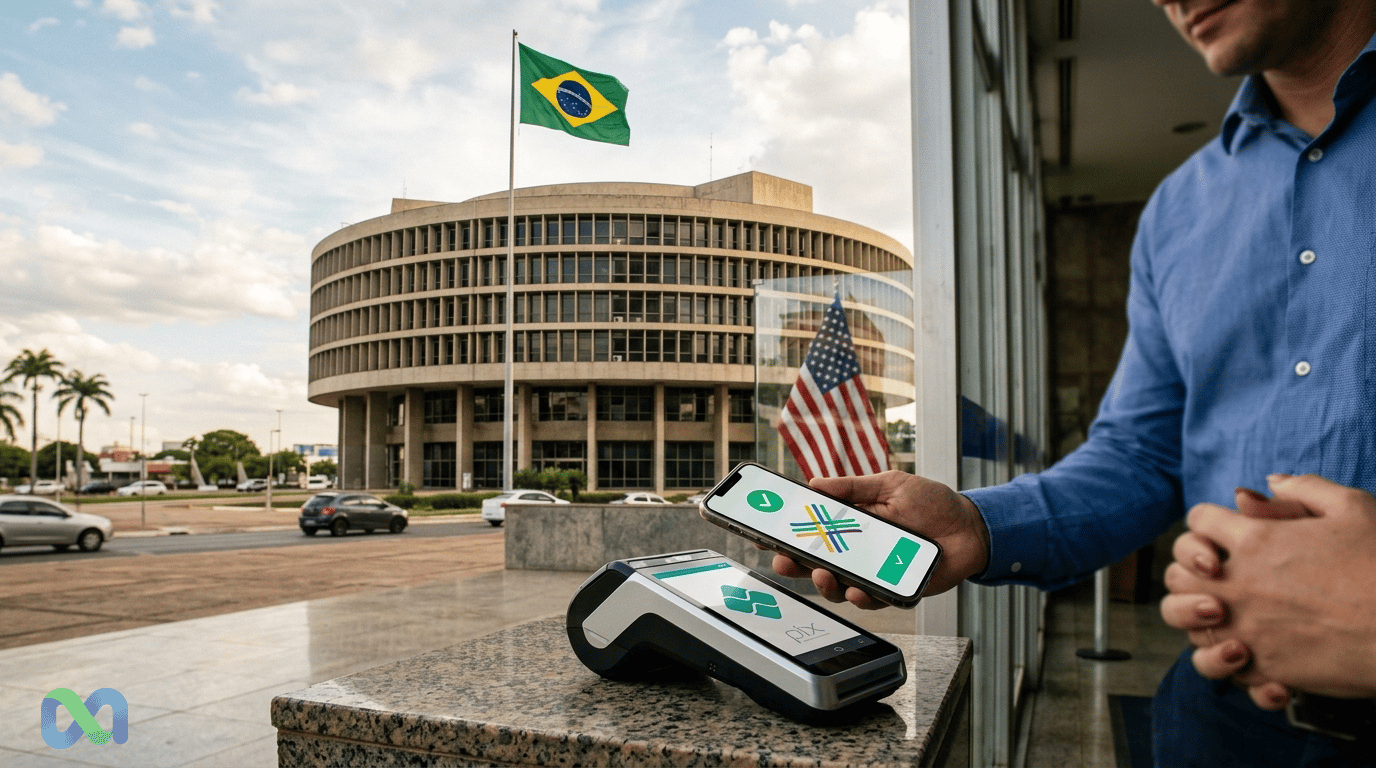
Pix Brazil Trump is more than a headline about a payment rail. It is a dispute over who captures value in everyday payments, who controls financial infrastructure, and how trade policy can be used against a domestic system that works.
The short version is direct. Pix became a target because Brazil built a fast, cheap, public instant-payment infrastructure that changed the economics of retail payments. It reduced room for private intermediaries and turned payments into a question of financial sovereignty.
Paul Krugman, the Nobel Prize winning economist, framed the issue in blunt terms. In his view, the American pressure looks less like a serious economic complaint and more like an attempt to punish Brazil for creating a system that works well.
For markets, the relevant question is narrower. Does this fight change probabilities around tariffs, the real, inflation, interest rates, or Brazil risk? The answer depends less on rhetoric and more on formal actions from the U. S. government.
This article separates fact, analysis, and market signal. It explains why Pix matters, how Visa and Mastercard fit into the debate, why Article 301 is important, and which indicators traders should monitor.
External sources used in this article include Brazil's Central Bank, the bank's open data portal, the USTR, and G1.
Short Answer: Why Did Pix Irritate Trump?
Pix irritated Trump because it lowered payment costs in Brazil and increased competition against private payment networks, including card schemes. From Washington's perspective, a public system that displaces American companies can be framed as a trade barrier. From Krugman's perspective, that framing looks like punishment for a Brazilian success.
That is the core of the Pix Brazil Trump dispute. Pix is not a Brazilian tariff against U. S. companies. It is not a formal ban on cards. It is a domestic infrastructure that changed incentives across the payment market.
When a merchant receives payment through Pix, part of the card-fee chain can disappear. When a consumer pays through Pix, settlement is fast and familiar. When millions of people do this every day, the potential revenue of private intermediaries comes under pressure.
That is why the American reaction matters. It signals that local financial infrastructure can become a trade-policy issue. The Pix Brazil Trump case shows how technology, competition, and geopolitics now overlap.
How Pix Changed Brazil's Payment Market
Pix was launched by Brazil's Central Bank in 2020. In only a few years, it became one of the country's main payment rails. The Central Bank tracks the system's scale, while its open data portal reports registered keys, settled transactions, and payment volume.
That scale matters. Pix is not a niche product. It now organizes payments between individuals, companies, government entities, and financial institutions. It also reduced dependence on slower processes such as traditional transfers, boletos, and part of routine card usage.
The most important change is economic. In a card payment, several players participate in the chain. Scheme, acquirer, issuer, and other agents split fees. The merchant usually receives funds later, unless it pays for receivables anticipation.
With Pix, settlement happens in seconds. For individuals, the direct cost is usually zero. For companies, the cost depends on the institution, but it often pushes down the level charged by private alternatives. That changes the bargaining position of banks, retailers, and consumers.
Think about a purchase worth R$100. With a card, part of the value may become fees, and settlement may take time. With Pix, the money arrives almost immediately. At national scale, that difference becomes margin for retailers, convenience for consumers, and lost pricing power for intermediaries.
This is the sensitive part. An efficient payment system does not need to exclude competitors to affect them. It only needs lower cost, faster settlement, and broad adoption.
Visa, Mastercard, and the Private Interest Behind the Fight
The criticism of Pix is easier to understand when you look at who earns money from payments. Visa and Mastercard operate global networks. They are not banks in the traditional sense, but they connect issuers, acquirers, merchants, and consumers.
The card model creates real value. It offers credit, fraud prevention, chargeback processes, installment options, rewards, and international acceptance. The comparison with Pix should not be simplistic.
Still, in simple domestic payments, Pix competes directly. It is fast. It is widely known. It has broad acceptance. It does not rely on the same fee chain as a card transaction.
That point explains Krugman's reading. If a country creates infrastructure that reduces costs for consumers and merchants, the natural economic response would be to study the model. The political response of pressuring the country reveals another interest: protecting companies affected by competition.
The boundary is delicate. Governments can challenge foreign policies when they discriminate against outside firms. But they can also overreach when they treat an efficient public infrastructure as if it were an unfair trade practice.
In Brazil's case, the tension increases because the Central Bank is both the system's organizer and a key regulator. Pix is not a private fintech trying to win market share. It is a public rail inside the national financial system.
That is why the dispute goes beyond cards. It touches sovereignty over data, payments, settlement, and regulatory design. Countries want control over critical infrastructure. Global companies want to preserve access and revenue. The conflict begins in that clash.
What Article 301 Is and Why It Matters
Article 301 is a U. S. trade-policy instrument. It allows Washington to investigate acts, policies, or practices from other countries that it considers unjustifiable, discriminatory, or restrictive to American commerce.
The USTR page on Article 301 investigations lists a process involving Brazil. Its scope includes digital trade, electronic payment services, preferential tariffs, intellectual property, ethanol, anti-corruption, and deforestation. In other words, Pix appears inside a broader trade-pressure package.
That distinction matters because an investigation is not the same as an effective tariff. An investigation creates risk, collects arguments, and opens the path to measures. But the economic effect depends on what is formally announced later.
For traders, this prevents a common reading error. Headlines can suggest immediate punishment. The official document may show only a procedural step. Between those two points, there can be hearings, public comments, political calculation, and diplomatic negotiation.
A strong signal would be a formal action with products, rates, timelines, and a clear justification. An intermediate signal would be a proposed action or detailed threat. A weak signal is only rhetoric without an operational document.
That ladder matters for FX, rates, and political risk. The more concrete the measure, the higher the chance that markets revise probabilities. The vaguer the threat, the higher the chance that it remains short-term noise.
Tariffs Against Brazil: Real Impact or Political Noise?
U. S. tariffs against Brazil can create impact, but the channel is not automatic. The effect depends on which products enter the list, the size of the tariff, Brazil's response, and the capacity to redirect trade flows.
Krugman's argument is that the offensive has weak economic grounds. That reading makes sense if the declared objective is to punish Pix as if it were a classic trade barrier. An efficient domestic payment system is not the same as a tariff on foreign companies.
Markets, however, do not wait for the final impact before moving. They react to uncertainty. An investigation can affect risk perception. A threat can move the dollar. A tariff announcement can enter the calculation for imported inflation and growth.
The FX channel is the first one to watch. If the conflict increases aversion to Brazil, the real can weaken. If the rhetoric loses force, the effect can fade quickly. Sensitivity depends on the global dollar, commodities, and flows to emerging markets.
The inflation channel is more limited, but it is not zero. U. S. tariffs on Brazilian products would affect specific exporters more directly. A Brazilian response could affect domestic prices if it reached relevant imported goods.
The COPOM channel is indirect. Brazil's Central Bank does not change interest rates because of one headline. It reacts to inflation expectations, the exchange rate, activity, and credibility. The tension only enters monetary policy if it contaminates those indicators.
That is the best investor reading of the Pix Brazil Trump story: separate political narrative from macro transmission. Pix may be the symbol of the dispute. Markets will price the concrete chain of effects.
Pix, Digital Sovereignty, and the New Politics of Payments
The conflict also reveals a larger shift. Payments are no longer just banking infrastructure. They are data, market power, and sovereignty.
Whoever controls the payment layer sees economic behavior. It sees frequency, ticket size, recurrence, sector, time, and relationships between consumers and merchants. That information has both commercial and regulatory value.
In the global private model, part of that layer moves through international networks. In the Pix model, a relevant part sits inside infrastructure organized by Brazil's Central Bank. That reduces external dependence and increases domestic capacity for innovation.
This sovereignty has costs and responsibilities. The regulator must preserve security, competition, availability, and governance. It must also avoid letting a public system suppress private innovation unfairly.
But sovereignty is not protectionism by definition. A country can build public infrastructure to reduce economic friction. If that infrastructure wins because it is cheaper and better, the trade debate becomes politically charged.
That is why the Pix case matters outside Brazil. Central banks are studying instant payments, digital currencies, open finance, and digital identity. Global companies are watching margins, access, and data. Similar disputes are likely to return.
How Traders Can Price the Conflict
For traders, the question is not whether Trump likes Pix. The question is which measurable events change the distribution of outcomes.
The first event is the trade investigation. It creates a calendar, documents, and hearings. Each procedural step can change the probability of effective action.
The second event is the tariff itself. The market needs to know whether there will be a measure, which rate applies, which products are covered, and when it starts. Without those details, pricing tends to be unstable.
The third event is Brazil's response. The government can negotiate, challenge the action, retaliate, use international forums, or try to reduce tension. Each path changes diplomatic risk and perceptions of governability.
The fourth event is the Central Bank's reaction. The BCB can defend Pix technically, publish data, adjust rules, or reinforce governance. A strong institutional response can reduce uncertainty.
The fifth event is market behavior. The dollar, the local rates curve, exporter shares, and inflation expectations help separate political noise from a real shock.
A disciplined monitoring matrix should ask five questions:
- Did the USTR publish a formal measure or only maintain consultation?
- Does the action directly mention electronic payment services?
- Does the tariff include a product list and implementation calendar?
- Did Brazil respond through negotiation or retaliation?
- Did FX and the rates curve react for more than one trading session?
This is the natural territory of prediction markets. Instead of debating only political intent, traders can turn the news into binary events: the investigation advances, a tariff is announced, Brazil backs down, the U. S. backs down, or a diplomatic agreement reduces risk.
Pix, Cards, and Private Systems: The Essential Comparison
Pix settles payments in seconds. Cards usually settle later, depending on the contract and arrangement. International private networks depend on the rules of each participant.
For individuals, Pix usually has no direct cost. With cards, the cost appears in merchant fees and can be passed through to final prices. In private networks, the cost varies by contract.
Intermediary revenue also changes. In a simple Pix transaction, it tends to be lower. In card payments, it is distributed across schemes, issuers, acquirers, and other participants.
Governance is another contrast. Pix operates inside infrastructure regulated by Brazil's Central Bank. Cards and international networks depend on private companies, even when they are locally regulated.
This comparison shows why the issue is not trivial. Cards remain useful, especially for credit, installment payments, rewards, and international purchases. Pix, however, dominates simple domestic payments because it removes friction.
When a system removes friction at national scale, it reorganizes profits. That reorganization is the economic center of the irritation.
What to Monitor Now
The conflict still depends on next steps. That is why the best tracking is disciplined and factual.
Monitor USTR releases. They indicate whether the investigation becomes a proposed action, another hearing, an agreement, or a tariff.
Monitor Brazil's Central Bank statements. The BCB can reinforce evidence on efficiency, security, and competition in Pix. That helps shape Brazil's technical defense.
Monitor the dollar. If the tension becomes Brazil risk, FX usually reacts before real indicators do.
Monitor the rates curve. It shows whether traders see inflation pass-through or only political noise.
Monitor sector exporters. A broad tariff and a tariff focused on a few products have very different effects.
Monitor Trump's rhetoric. It matters less than official documents, but it can change timing and diplomatic pressure.
Frequently Asked Questions About Pix, Trump, and the U. S.
Why is Trump against Pix in Brazil?
Trump targets Pix because the Brazilian system reduces economic space for private payment intermediaries. In Krugman's reading, American pressure tries to punish an efficient public model that lowered payment costs and increased competition.
Why does the U. S. criticize Pix?
The U. S. can criticize Pix when American companies argue that Brazilian public infrastructure creates a competitive disadvantage. The controversial point is whether this is an unfair trade barrier or competition caused by a better system.
Does Pix hurt Visa and Mastercard?
Pix can pressure Visa, Mastercard, and other payment agents when it replaces simple domestic card transactions. But it does not eliminate every card use case. Credit, installment payments, rewards, and international acceptance remain relevant.
What did Paul Krugman say about Pix?
Krugman defended Pix and criticized the American offensive. His core argument is that Brazil created an efficient system, and that Trump is trying to punish that success instead of recognizing that cheaper payments benefit consumers and companies.
What is Article 301?
Article 301 is a U. S. trade-policy tool. It allows Washington to investigate foreign practices considered unfair or restrictive to American commerce. In Brazil's case, the USTR included digital trade and electronic payment services in the scope. G1's coverage highlighted Krugman's interpretation that the pressure tries to punish a Brazilian success.
Are Trump's tariffs against Brazil already in force?
The key point is to check the official document. Investigation, proposal, and effective tariff are different stages. A tariff changes fundamentals only when there is formal action with products, rate, timeline, and execution.
Conclusion
Pix irritated Trump because it became a symbol of Brazilian financial autonomy. It shows that a public system can reduce costs, gain scale, and shift revenue away from global private intermediaries.
Krugman's interpretation reinforces that point. The attack does not appear to come from a clear economic flaw in Pix. It appears to come from discomfort with a model that worked too well for consumers, merchants, and Brazil's financial system.
Traders should still avoid two traps. The first is treating rhetoric as an effective tariff. The second is ignoring that rhetoric can move FX and risk perception before any formal measure appears.
The correct path is to monitor verifiable events: USTR documents, Brazil's response, Central Bank statements, the dollar, the rates curve, and exporter reactions. If those signals change, the conflict stops being only a headline.
This is educational and analytical content. It is not investment advice. To follow how trade policy, FX, COPOM, and Brazil risk evolve into probabilities, track Macro Markets analysis and prediction-market signals.
