




São Paulo 2026 Elections: Offices on the Ballot
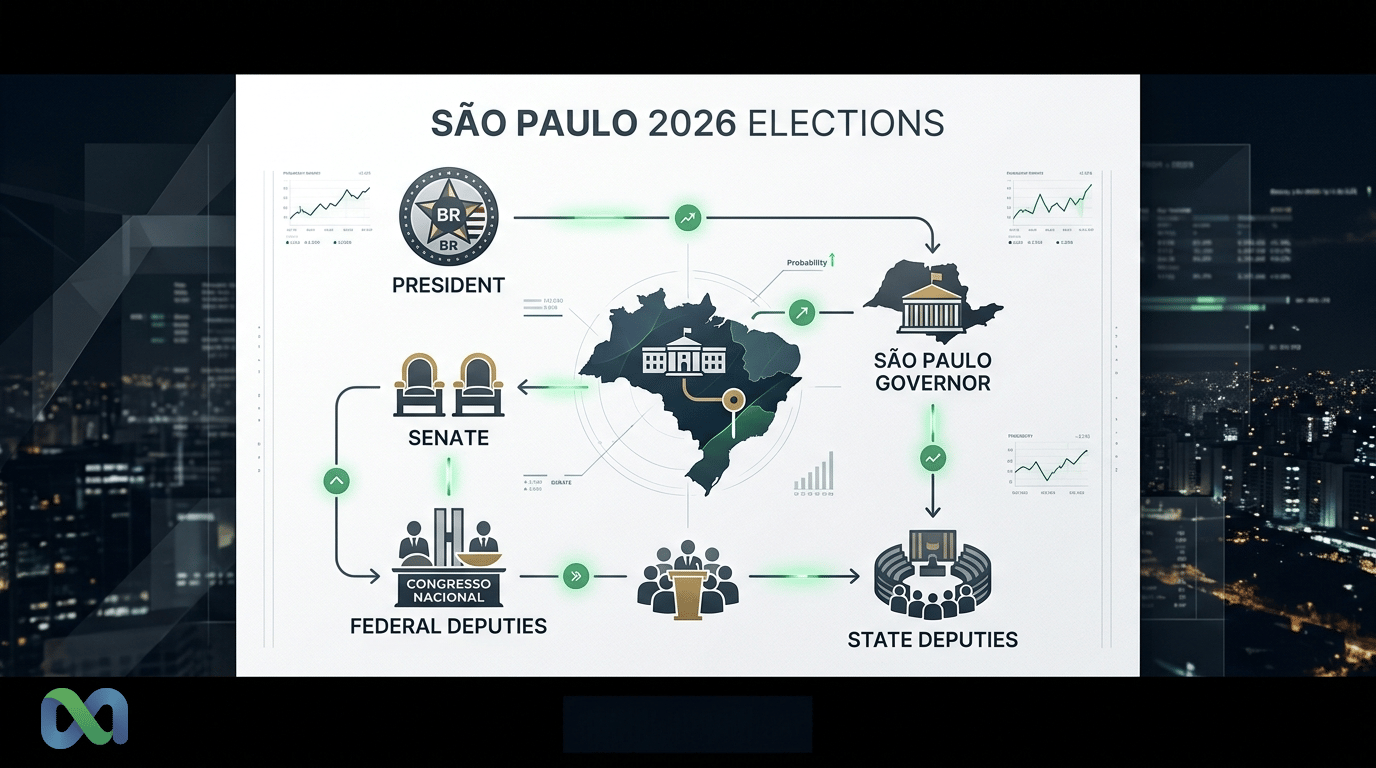
In the São Paulo 2026 elections, voters choose the president of Brazil, the governor of São Paulo, two senators, federal deputies, and state deputies. They do not vote for mayor or city council in this cycle. The offices on the ballot therefore cover national and state power: the federal government, Congress, the state government, and the São Paulo Legislative Assembly.
The confusion is understandable. Brazil alternates between general elections and municipal elections. In 2026, the focus is on offices that shape Brasília and the Palácio dos Bandeirantes, not city halls.
São Paulo matters even more because it has Brazil's largest electorate. It also elects the country's biggest delegation to the Chamber of Deputies. A shift in São Paulo can change party strength, coalition math, and the national reading of the campaign.
Below is a practical guide to every office on the ballot, what each one decides, and which races deserve the most attention.
What Offices on the Ballot Do São Paulo Voters Choose in 2026?
In the São Paulo 2026 elections, voters choose five types of office: president, governor, senator, federal deputy, and state deputy. The ballot may also show alternate senators tied to Senate tickets, but voters select the main candidate's ticket.
Here is the quick view:
| Office | Level | Number for São Paulo in 2026 | What it decides |
|---|---|---|---|
| President of Brazil | National | 1 | Federal government, ministries, budget, and foreign policy |
| Governor of São Paulo | State | 1 | State government, security, education, health, and infrastructure |
| Senator for São Paulo | National | 2 seats | The state's representation in the Federal Senate |
| Federal deputy for São Paulo | National | 70 seats | São Paulo's delegation in the Chamber of Deputies |
| State deputy for São Paulo | State | 94 seats | The São Paulo Legislative Assembly |
This table answers the main search intent: what offices are on the ballot in São Paulo in 2026. The most important distinction is between a general election and a municipal election.
In 2026, São Paulo does not choose a mayor. It also does not choose city council members. Those offices belong to municipal elections, which follow a different calendar.
Brazil's Superior Electoral Court lists the São Paulo 2026 elections cycle on its official election page. The court also explains the offices up for election in the São Paulo 2026 elections. Voters should use the TSE 2026 election page and official notices as the final reference for dates and rules.
What Does Each Office Decide in Practice?
A list of offices is useful only if voters understand what each role does. In São Paulo, the São Paulo 2026 elections ballot combines national choices with state-level choices.
Each office affects a different part of public decision-making. Some define the direction of the country. Others shape the state budget, laws, oversight, and political representation.
President of Brazil
The president leads the federal government. The president appoints ministers, sends proposals to Congress, manages the federal budget, and represents Brazil abroad.
In practice, the presidential election affects economic policy, social programs, foreign relations, federal taxes, and the government's relationship with Congress. It is usually the race with the highest national attention.
For analysts who follow prediction markets, the presidential race often becomes the central event. A change in the presidency can move expectations for interest rates, the exchange rate, fiscal risk, privatizations, and structural reforms.
São Paulo voters participate in the same national contest as voters in every other state. The state does not elect a separate president for São Paulo. Its votes are counted in the national total.
Governor of São Paulo
The governor runs the state government. In São Paulo, this office has exceptional weight because the state budget is large and the public administration serves millions of people.
The governor influences public security, state schools, state hospitals, metropolitan transport, roads, concessions, and economic development policies. Those decisions affect daily life across the state.
The São Paulo governor election also has national impact. The state often acts as a political showcase for parties and leaders with presidential ambitions.
That is why the result can signal political strength for 2026 and for the next cycle. Markets and analysts watch not only the winner, but also the margin, alliances, and second-round performance.
Senators for São Paulo
São Paulo elects two senators in the São Paulo 2026 elections. This happens in the São Paulo 2026 elections because Brazil renews two-thirds of the Senate in the São Paulo 2026 elections cycle.
Each state has three senators. Senators serve eight-year terms. Because renewal alternates between one-third and two-thirds, voters sometimes choose one senator and sometimes choose two.
The Senate approves important appointments, votes on national laws, reviews economic legislation, and participates in major institutional decisions. It also plays a central role in constitutional amendments, together with the Chamber of Deputies.
For São Paulo, the two 2026 Senate seats can change the balance of power in Congress. That makes the race more strategic than it may look at first glance.
Federal Deputies for São Paulo
São Paulo elects 70 federal deputies. This is the largest state delegation in Brazil's Chamber of Deputies.
Federal deputies vote on national laws, the budget, reforms, provisional measures, and bills sent by the executive branch. They also oversee the federal government.
The São Paulo delegation matters because it brings many votes to Brasília. Parties that grow in São Paulo often gain more bargaining power in Congress.
Voters can choose a candidate or a party list option, depending on the ballot rules. The result follows a proportional system. Therefore, votes for candidates from the same party or federation help determine how many seats that group wins.
State Deputies for São Paulo
São Paulo elects 94 state deputies to the Legislative Assembly. They vote on state laws, oversee the governor, and debate the state budget.
This office is more local than federal deputy. Even so, it affects issues close to voters, including state education, public security, regional transport, health policies, and fiscal oversight.
The Legislative Assembly also shapes governability. A governor with a strong base can approve projects more easily. A governor without a majority must negotiate more.
That is why the state deputy race helps explain how the next São Paulo government may work after inauguration day.
Is There a Mayor or City Council Election in 2026?
No. There is no mayoral or city council election in São Paulo in the São Paulo 2026 elections.
Mayors and city council members are chosen in municipal elections. The previous municipal cycle took place in 2024. The next municipal cycle is expected in 2028.
This difference avoids a common mistake. The São Paulo 2026 elections are part of a general election. It includes president, governor, senators, federal deputies, and state deputies.
So, if the question is what offices are on the ballot in São Paulo in 2026, the answer does not include city hall or the city council.
It is also worth remembering that the city of São Paulo does not hold a separate election for governor. All voters in the state choose the same state government.
Why São Paulo 2026 Elections Matter Nationally
São Paulo matters for three reasons: voters, seats, and political signaling. The state concentrates a large share of Brazil's electorate and often shapes national narratives.
First, the presidential result in São Paulo can strengthen or weaken national candidates. A narrow win in the state sends a different signal from a broad win.
Second, São Paulo's delegation in the Chamber of Deputies is the largest in the country. Party performance in the state helps define the balance of power in Brasília.
Third, the governor's race creates a political platform. Candidates for governor can support presidential campaigns, build alliances, and influence the economic debate.
For traders and analysts, São Paulo becomes a thermometer. For the São Paulo 2026 elections, it is not enough to follow national polls. Regional behavior, party strength, and possible second-round effects can all change the implied probability of political outcomes.
How to Read Market Probabilities
Election polls show voting intention at a specific moment. Prediction markets help show how participants price scenarios over time.
This reading does not replace official sources, polling, or political analysis. However, it adds a useful layer: an implied probability that changes when new information arrives.
In the São Paulo 2026 elections, that probability can react to debates, alliances, court decisions, economic performance, polls, and campaign events. The value is not a magic forecast. It is a live signal about how the market is processing new information.
Macro Markets follows this type of dynamic with a focus on Brazilian events. The goal is to turn political scenarios into observable probabilities, not loose guesses.
For the São Paulo 2026 elections, the most relevant markets will likely involve president, governor, Senate seats, congressional composition, and second-round scenarios when there is enough liquidity.
What Should Voters and Analysts Watch First?
Voters can start with four areas. They organize the race and reduce noise in the São Paulo 2026 elections.
The first is the presidential election. It defines the national axis of the campaign and often pulls state alliances in its direction.
The second is the São Paulo governor election. This race shows how national parties organize themselves in Brazil's largest state.
The third is the Senate. Because São Paulo elects two senators in 2026, the race can attract major names and cross-party alliances.
The fourth is the legislative delegation. Federal and state deputies may look less visible, but they define governability, budgets, and party power after the vote.
A strong reading combines these levels. A president can win the country while facing a difficult Congress. A governor can win São Paulo without a strong base in the state assembly.
Therefore, watching only the top of the ballot leaves important information out.
A practical reading order also helps analysts avoid false signals:
- Start with the official calendar and the rules published by the Electoral Justice. Dates, eligibility rules, and runoff rules set the boundaries for every forecast.
- Then follow the presidential race because it can change alliances in the state campaign. National momentum often affects fundraising, endorsements, and party negotiations.
- Next, track the governor race separately. São Paulo can move with the national race, but it can also create its own regional logic around security, transport, health, and the state budget.
- After that, watch the Senate tickets. Two seats create more strategic combinations than a one-seat Senate cycle, especially when parties try to balance ideological and regional names.
- Finally, review the proportional races for federal and state deputies. These races are harder to read candidate by candidate, but they decide the size of each party bloc after the election.
For prediction-market analysis, this order matters because each layer can move at a different speed. Polls may shift first in the presidential race. Coalition news may affect the governor race before it changes national expectations. Legislative projections may move later, after party lists and campaign resources become clearer.
The cleaner approach is to separate the ballot into decision layers. One layer chooses the executive branch. Another chooses representation in Brasília. A third chooses the São Paulo state legislature. When those layers are mixed together, the analysis becomes noisy. When they are separated, it is easier to see which information actually changes probabilities.
Last reviewed: May 14, 2026.
How to Use This Guide Without Getting Lost
Use this guide as a map of the ballot. First, check the office list. Then understand the role of each office. Finally, watch which races can change the political outlook for São Paulo and Brazil.
This sequence helps because elections include many names, parties, and alliances. Still, the ballot structure is fixed and can be understood in a few steps. Voters choose offices in the federal government, the state government, and the legislative branch.
For analysts, the order also matters. The presidential race tends to move the national debate. The São Paulo governor race shows regional strength. The congressional races show governability after inauguration.
If the goal is only to answer the practical question, remember the central line: in the São Paulo 2026 elections, voters choose president, governor, two senators, federal deputies, and state deputies.
Offices on the Ballot: São Paulo 2026 Elections FAQ
When is the vote?
The first round of the São Paulo 2026 elections is expected on October 4, 2026. If there is a second round for president or governor, the second vote is expected on October 25, 2026.
Official dates should always be checked against the Electoral Justice calendar. The São Paulo Regional Electoral Court also publishes guidance for voters in the state.
How many senators does São Paulo elect in 2026?
São Paulo elects two senators in 2026. The election renews two-thirds of the Senate, so every state chooses two seats in this cycle.
Is the vote for state deputy different from federal deputy?
Yes. A federal deputy represents São Paulo in the Chamber of Deputies in Brasília. A state deputy works in the São Paulo Legislative Assembly.
Both offices use a proportional system. That means votes for candidates and parties influence the distribution of seats.
Can voters choose candidates from different parties?
Yes. Voters can choose candidates from different parties for different offices. For example, a voter can choose one party for president and another party for deputy.
Which offices does São Paulo not vote for in 2026?
São Paulo does not vote for mayor or city council in 2026. There is no municipal election in this cycle of the São Paulo 2026 elections.
Conclusion
So, what offices on the ballot define the São Paulo 2026 elections? The direct answer is president, governor, two senators, federal deputies, and state deputies. Mayor and city council are not included.
The list looks simple, but the political weight is large. São Paulo influences the presidential race, defines a strategic state contest, and elects the largest delegation in the Chamber of Deputies.
That is why following 2026 requires more than watching candidate names. The better path is to track the calendar, alliances, polls, legislative composition, and market probabilities.
With that approach, voters understand what appears on the ballot. Analysts can also separate electoral noise from signals that truly change the scenario.
