




Trump Officials Brazil Visa Denials: Lula's Risk Signal
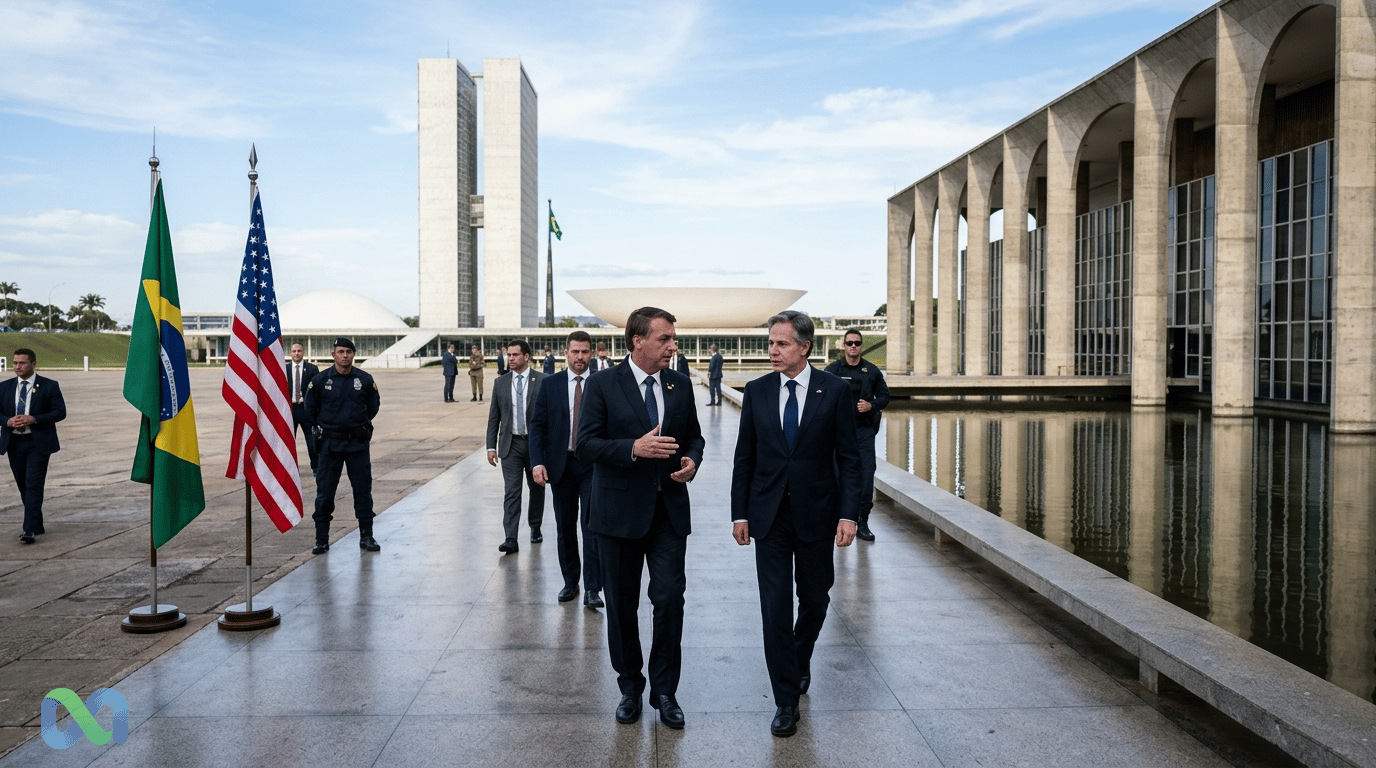
Trump officials Brazil visa denials have become another point of friction between Brazil and the United States. The case involves Riley Barnes and Samuel Samson, two names tied to the Trump administration who were trying to enter Brazil on a sensitive mission.
The first question was simple: who was blocked? The larger question is why Brazil's foreign ministry treated the trip as a political risk. According to coverage cited in the research brief, Brazilian officials suspected the mission could pressure local authorities and question the electoral system.
That detail changes the read. The Trump officials Brazil visa denials are not just a consular decision. The visa denial sits inside a longer sequence of tariffs, visa revocations, attacks on Brazil's Superior Electoral Court, and public pressure between Lula and Trump.
For markets, the question is direct. Do Trump officials Brazil visa denials become priced political risk, or do they remain diplomatic noise? The answer depends on the next formal moves. Statements matter, but documents, sanctions, and tariffs change the distribution of outcomes.
This article separates fact, allegation, and market signal. In our view at Macro Markets, diplomatic disputes matter when they turn into verifiable acts. The goal is to explain who the officials are, why Brazil blocked their entry, how the escalation formed, and which signals traders should monitor. Updated on July 27, 2026.
External sources used for this article include coverage from Jovem Pan, O Globo, and institutional pages from Brazil's Superior Electoral Court.
Who are the Trump officials in the Brazil visa denials?
The Trump officials Brazil visa denials cited in the brief involve Riley Barnes and Samuel Samson. Brazilian news coverage placed them at the center of a US mission that, in the view of Brazilian authorities, could touch the electoral system and the TSE.
The Trump officials Brazil visa denials gained weight because visa cases usually remain quiet. Governments can deny entry without making the episode public. This time, the political context made the case larger than the consular act.
Riley Barnes
Riley Barnes was identified in news reports as an official linked to the Trump government. Brazilian coverage associated him with a possible attempt to contact institutional actors in Brazil.
The sensitive point was not only his title. It was the alleged purpose of the trip. If the mission aimed to discuss elections, the TSE, or vote integrity, it entered politically delicate ground.
Brazil came out of a recent electoral cycle marked by attacks on voting machines. Because of that history, any foreign initiative that appears to question electoral authority receives a harder reading.
Samuel Samson
Samuel Samson was also cited as part of the blocked mission. Like Barnes, his name appeared in reports about the visa denials and the suspicion of electoral interference.
The available information still requires caution. Not every visa denial comes with a full public explanation. Analysts need to separate what media outlets reported from what governments formally confirmed.
Even so, Brazil's response indicates that Itamaraty saw enough risk to block entry. That is the politically relevant fact for markets.
What they were expected to do in Brazil
The mission behind the Trump officials Brazil visa denials involved contact around Brazil's political environment. Reports mentioned concern over possible questions about the electoral system and attacks on the TSE.
That explains the escalation. A normal diplomatic meeting rarely produces this type of response. A mission seen as an attempt to influence electoral institutions changes the tone.
Visas also work as a sovereignty tool. The receiving country decides who enters. When the denial targets officials from a powerful government, it also becomes a political message.
Why Lula's government blocked the trip
Lula's government blocked entry because it saw political risk in the mission, according to the coverage gathered in the brief. The central concern was that the officials could act on a Brazilian electoral issue.
This must be read precisely. A visa denial does not prove, by itself, that there was a concrete attempt at interference. It does show that the Brazilian government judged the risk high enough to stop the trip.
Itamaraty has room to decide in this area. A visa is not an automatic right to enter. It is a sovereign authorization tied to national interest, security, and consular rules.
The suspicion around Brazil's electoral system
Brazil's electoral system became highly sensitive after 2022. Attacks on voting machines, pressure on the TSE, and fraud narratives created a permanent defense posture around institutions.
In that context, a foreign mission linked to Trump raises alerts. The former US president built much of his recent political brand around election challenges in the United States. His allies often use the same language.
Brazil's concern did not appear in a vacuum. It rests on a recognizable political history. The perceived risk was importing an agenda of institutional contestation into Brazil.
The TSE at the center of the dispute
The TSE is the key institution in this story. It administers elections, judges electoral issues, and protects voting integrity.
When a foreign mission is associated with attacks on the TSE, the dispute stops being only diplomatic. It starts touching electoral legitimacy. That raises the political cost of allowing entry.
Lula's government also had an incentive to signal firmness. By denying the visas, it showed that Brazil's electoral agenda would not be mediated by foreign officials tied to Trump.
The timeline of Brazil-US escalation
The Trump officials Brazil visa denials should be read as part of a sequence. In isolation, they look like a limited diplomatic episode. Combined with tariffs, sanctions talk, and visa measures, they become a sign of deterioration.
From Darren Beattie to the blocked mission
The research brief mentions the Darren Beattie case as part of the background. It was linked to earlier friction involving US officials and Brazil.
That history matters because it creates a pattern. First come statements and political gestures. Then come consular measures. After that, the debate can move into trade, sanctions, or institutional pressure.
The denial involving Barnes and Samson fits that path. It shows that Brazil started to treat some US initiatives as direct risk, not normal protocol.
Tariffs, visas, and sanctions as pressure tools
Trump uses tariffs as political language. In his strategy, trade, migration, technology, and diplomacy can become bargaining instruments. Brazil has already appeared in debates over tariffs, Pix, exports, and its relationship with US institutions.
Visas also fit that toolkit. Revoking or denying a visa has a strong symbolic effect. It targets individuals, but it sends pressure toward governments.
Sanctions follow the same logic. They turn political disagreement into concrete cost. That is why analysts should track whether the tension stays rhetorical or moves into operational measures.
What changes for Brazil political risk?
The Trump officials Brazil visa denials change little in the short-term economy. By itself, it does not directly affect GDP, inflation, or interest rates. It does affect perceptions around the Brazil-US relationship, especially if escalation continues.
Political risk does not come only from major breaks. It also comes from repeated small events. When those events form a pattern, investors and traders revise scenarios.
The right question is whether the conflict is becoming institutional. If the answer is yes, the bilateral relationship can enter prices in markets about tariffs, FX, elections, and governability.
Impact on institutional confidence
Brazil's decision in the Trump officials Brazil visa denials can be read as institutional defense. The government signaled that electoral issues remain inside Brazilian rules. For part of the market, that reduces the risk of foreign interference.
At the same time, the measure can invite retaliation. If Washington responds with visas, tariffs, or sanctions, the conflict gains cost. In that case, institutional defense comes with diplomatic risk.
This dual effect matters. The same event can strengthen a domestic institution and worsen an external relationship. Markets need to weigh both sides.
Signals prediction markets should monitor
Prediction markets work best when vague events become verifiable questions. In this case, several objective signals matter.
The first is a formal response from the US State Department. If the United States treats the case as an affront, risk rises. If the response stays behind the scenes, the episode may fade.
The second is any new consular measure. Visa revocations against Brazilian officials would suggest reciprocity. That would broaden the retaliation cycle.
The third is the use of tariffs. If Trump connects the issue to trade, the risk stops being only diplomatic. Exporters and the real could react.
The fourth is the posture of the TSE. Statements, meetings, and security measures help show whether the court sees a real threat.
The fifth is the US Congress. Hearings or formal letters could turn the dispute into a political item in Washington.
Actors and implications
- Riley Barnes: an official linked to the Trump government. His visa was denied, according to reports. That signals Brazil blocked a mission it considered sensitive.
- Samuel Samson: an official linked to the Trump government. He was also cited in the visa denial. That reinforces the view of an organized mission, not an individual case.
- Itamaraty: Brazil's foreign ministry and visa authority. It blocked the officials' entry. The decision uses sovereign competence as institutional defense.
- TSE: Brazil's electoral institution. It appears at the center of the suspected interference risk. That raises the case from consular protocol to electoral risk.
- Trump government: the political source of the mission. It can respond with diplomatic pressure. Its reaction will define whether the episode becomes retaliation or noise.
- Lula government: the receiving government. It upheld the denial of entry. The move signals firmness on electoral sovereignty.
The list shows why the case should not be read as diplomatic gossip. Each actor moves a different layer: visas, elections, trade, institutional reputation, and the bilateral relationship.
How traders can turn the news into events
The headline around Trump officials Brazil visa denials is broad. For markets, it needs to become clear events. That process reduces noise and prevents rushed conclusions. Trump officials Brazil visa denials are a useful example of that method.
One market could track whether the United States announces consular retaliation against Brazilian officials. Another could track whether Trump announces a new tariff on Brazilian products by a specific date.
It would also make sense to track whether the TSE issues a formal measure on foreign interference. That would create an institutional marker, not just a narrative one.
Another relevant question is whether Lula and Trump lower the tone after diplomatic negotiation. De-escalation is also a priceable event.
The discipline is always the same: event, deadline, verifiable source, and resolution criterion. Without that, the debate becomes opinion. The practical checklist for the next six months has five signals: a US response, a new visa measure, a tariff, TSE action, and US congressional reaction.
Frequently asked questions
Can Brazil deny visas to foreign officials?
Yes. Granting a visa is a sovereign act. A country can deny entry for security, foreign policy, national interest, or other consular reasons. In many cases, the full explanation is not public.
Does the visa denial mean a diplomatic rupture?
No. Denying a visa is a hard measure, but it is not a rupture. The impact depends on the other government's response. If retaliation, tariffs, or sanctions follow, the crisis moves to another level.
What is the link to Brazil's 2026 election?
For Trump officials Brazil visa denials, the link comes from the suspicion that the mission could touch Brazil's electoral system and the TSE. Because 2026 will be a sensitive presidential cycle, foreign pressure on election rules is likely to draw a strong response.
Who are Riley Barnes and Samuel Samson?
Riley Barnes and Samuel Samson were cited as officials linked to the Trump government whose visas were denied by Brazil. According to reports, they were part of a mission seen by Brazilian authorities as sensitive for the electoral process.
Can this affect prediction markets on Brazilian politics?
It can if it creates measurable events. Consular retaliation, tariffs, sanctions, a TSE statement, or bilateral negotiations are signals that can shift probabilities. Without a formal act, the news is more likely to remain short-term noise.
Conclusion
The visa denial involving Trump officials is small in formal diplomatic terms. But it is large as a political signal. Brazil made clear that attempts to touch the electoral system are an issue of sovereignty.
For Lula, the decision reinforces institutional defense. For Trump, it can become another argument in a broader dispute with Brazil. For markets, the value lies in watching whether the tension produces verifiable acts.
The Trump officials Brazil visa denials also show how elections, visas, tariffs, and bilateral relations are mixing. That combination can affect risk perception before it affects economic indicators.
The lesson is simple: political risk deserves a price only when it leaves a verifiable trail. The best reading is disciplined. If there is a document, tariff, sanction, or retaliation, the market should revise probabilities. If there is only a statement, the chance of noise rises. Trump officials Brazil visa denials matter because they help mark that boundary.
Educational and analytical content. This content is not financial or investment advice. To follow how events around Brazilian elections, foreign policy, and Brazil risk evolve into probabilities, track Macro Markets analysis and markets.
