




World Cup 2026 Group A: Fixtures, Favorites, and Scenarios
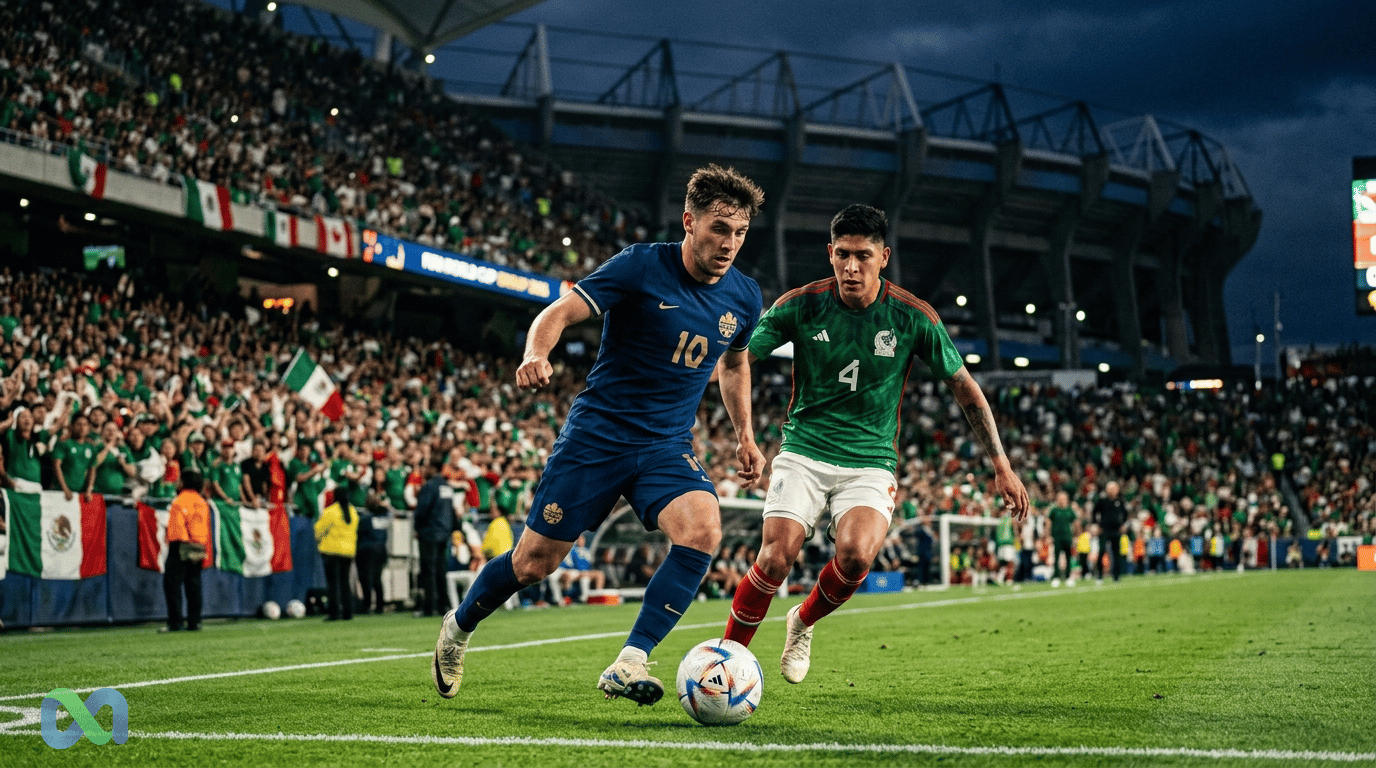
World Cup 2026 Group A opens the tournament with a symbolic match: Mexico vs South Africa at Estadio Azteca. The group brings together Mexico, South Africa, South Korea, and Czechia. It has a host nation, an experienced Asian side, a European contender, and an African underdog that can change the group immediately.
This guide organizes what matters before the ball starts rolling. You will see the World Cup 2026 Group A schedule, Brasília times, each team profile, the favorites, qualification scenarios, and the most relevant prediction markets.
The goal is not to sell certainty. A World Cup has injuries, lineups, travel, altitude, local pressure, and small changes in form. Therefore, the best way to read Group A is as a set of moving probabilities.
It is also important to separate facts from projections. The group composition and match calendar come from the official tournament schedule. Favoritism depends on recent form, squad depth, home advantage, history, and market information. That distinction is essential for analyzing World Cup 2026 Group A clearly.
What Is World Cup 2026 Group A?
World Cup 2026 Group A is made up of Mexico, South Africa, South Korea, and Czechia. The matches take place between June 11 and June 24, 2026. The top two teams advance directly, and the third-place team may still reach the knockout stage depending on its campaign.
This structure makes the group more open than in previous World Cups. With 48 teams, the group stage rewards consistency, but it also protects some third-place teams. As a result, a team can lose one match and still stay alive.
For Mexico, Group A carries extra pressure. The team plays at home and opens the World Cup in front of its supporters. For South Africa, South Korea, and Czechia, the first goal is simple: avoid a poor start and reach the final round with a real chance.
Group A Teams
The four teams arrive with different stories.
Mexico starts as the favorite because of home advantage. Its strengths are crowd support, familiarity, and the weight of being a host nation. The risk is feeling the pressure of the opener.
South Korea looks like a strong candidate to qualify. Its strengths are intensity, transition play, and international experience. The risk is relying too much on attacking efficiency.
Czechia is a direct rival for the top spots. Its strengths are structure, set pieces, and the European football tradition. The risk is having little margin if it falls behind early.
South Africa enters as a dangerous underdog. Its strengths are speed, energy, and the historic weight of the opening match. The risk is squad depth.
Mexico starts with a contextual edge. Playing at home matters, especially in the opening match. However, home advantage does not solve everything. South Korea has recent World Cup experience, and Czechia usually competes well against physical opponents. South Africa can also become a threat if it gets a result against Mexico.
How Group-Stage Qualification Works
Each team plays three matches. A win is worth three points. A draw is worth one point. A loss gives no points.
The top two teams advance directly to the knockout stage. In addition, the best third-place teams across all groups also advance. Because of that, four points can be extremely valuable. Three points may be enough in some scenarios, but goal difference and goals scored would matter.
In Group A, this format changes strategy. A team that draws its opener can still target five points. A team that wins the opener can manage risk better. On the other hand, a team that loses the first match faces immediate pressure.
Group A Schedule: Dates, Times, and Cities
The World Cup 2026 Group A schedule combines matches in Mexico and the United States. The opening game will be at Estadio Azteca in Mexico City on June 11. The official schedule may still receive operational adjustments, so this page should be updated closer to the tournament.
Even so, the base calendar already shows the logic of the group. Mexico and South Africa open the group. South Korea and Czechia play on the same day. Then the second round matches favorites against direct rivals. The final round is simultaneous, reducing the information advantage that comes from knowing another result in advance.
- 06/11/2026, 16:00 BRT: Mexico vs South Africa, Mexico City, Estadio Azteca.
- 06/11/2026, 23:00 BRT: South Korea vs Czechia, Guadalajara.
- 06/18/2026, 13:00 BRT: Czechia vs South Africa, Atlanta, Mercedes-Benz Stadium.
- 06/18/2026, 22:00 BRT: Mexico vs South Korea, Guadalajara.
- 06/24/2026, 22:00 BRT: Czechia vs Mexico, Mexico City.
- 06/24/2026, 22:00 BRT: South Africa vs South Korea, Monterrey.
For calendar checks, the primary source should be the official FIFA World Cup 2026 page. ESPN's World Cup coverage can also help validate times, cities, and updates. However, FIFA remains the final reference.
June 11: Mexico vs South Africa and South Korea vs Czechia
The opener between Mexico and South Africa sets the tone for World Cup 2026 Group A. If Mexico wins, the favorite narrative becomes stronger. If Mexico draws, the pressure rises before facing South Korea. If Mexico loses, the entire group changes.
South Korea vs Czechia is almost a parallel final. Both teams should fight for direct qualification. The winner of that match can enter the second round with a comfortable margin. The loser will have little room for error against Mexico and South Africa.
This first round also creates the first market signals. The score is not enough. Shot volume, territorial control, chance quality, and physical condition can show whether the result was sustainable.
June 18: Czechia vs South Africa and Mexico vs South Korea
The second round can split the group into blocks. Czechia vs South Africa may be decisive for the team that lost or drew its opener. For South Africa, that match may be the clearest route to keeping qualification hopes alive.
Mexico vs South Korea should be the technically strongest match of the round. Mexico will have support, but South Korea usually competes well at a high tempo. If the Koreans arrive with three points, they can play for control. If they arrive under pressure, they may attack earlier.
This is the kind of round where prediction markets often react quickly. A Mexico win can lower the probability of its rivals. A draw can keep three teams tightly packed.
June 24: Czechia vs Mexico and South Africa vs South Korea
The final round will be simultaneous. That matters a lot. Because both matches happen at the same time, teams cannot fully adapt their plan based on a result that has already finished.
Czechia vs Mexico can decide first place. It can also decide who avoids harder knockout-stage paths. South Africa vs South Korea may be a survival match, especially if one of the teams arrives with three or four points.
For simulation, this is the richest round. One goal in either match can change points, goal difference, goals scored, and the ranking among third-place teams.
Analysis of the Group A Teams
World Cup 2026 Group A does not have one absolute powerhouse. That increases the value of analysis. In groups with one obvious favorite, the debate usually focuses on second place. Here, Mexico has a contextual advantage, but South Korea and Czechia have real arguments.
South Africa starts on a lower tier. Even so, being an underdog does not mean being irrelevant. In a World Cup, a less favored team can change a group with a draw in the opener or a win in the second match.
Mexico: Home Advantage and Host-Nation Pressure
Mexico enters Group A with the most visible edge: playing at home. The opener at Estadio Azteca has historic, emotional, and competitive weight. Altitude, crowd support, and the atmosphere can push the team during pressure moments.
At the same time, that edge becomes a demand. Mexico cannot treat the match against South Africa as a formality. An opener without a win would change the mood of the group and increase urgency against South Korea.
Mexico's ideal path is simple. Win the opener, get points against South Korea, and reach the third round without needing to overexpose itself. That scenario increases the chance of leading World Cup 2026 Group A and preserving energy for the knockout stage.
The risk is too much anxiety. As a host nation, Mexico may rush attacks, cross too often, or leave spaces in transition. If the team controls tempo and pressure, it should remain the reference point of the group.
South Korea: Transition Play, Intensity, and Decisive Players
South Korea arrives with a familiar competitive profile. The team usually brings intensity, discipline, speed in transition, and players who can decide matches in open space. Against Mexico and Czechia, those elements can balance the games.
The first match against Czechia will be central. A win puts South Korea in an excellent position. A draw still works, as long as the team gets points against Mexico or South Africa. A loss, however, creates a difficult route.
South Korea's main strength is turning ball recoveries into fast attacks. That bothers teams that need to control possession. Against Mexico, this detail may be valuable because the host should have more of the ball and more obligation to attack.
The risk is efficiency. If South Korea creates chances but fails to convert, it can get trapped in low-scoring matches. In a World Cup with small margins, wasting one clear chance can change the whole table.
Czechia: European Strength and a Fight for Favoritism
Czechia enters World Cup 2026 Group A as a competitive European team. It should not be treated as a surprise. Its football tends to combine organization, set pieces, physical strength, and direct transitions.
That combination is dangerous in a group stage. Czechia may not dominate possession, but it can control important zones. It can also punish errors on set pieces, especially against rivals that defend the second ball poorly.
The match against South Korea should show Czechia's ceiling in the group. If it wins, Czechia starts competing for the top with Mexico. If it draws, the path remains open. If it loses, it will need to beat South Africa and take points from Mexico.
The risk is predictability. If the team struggles to create against mid blocks, it may depend too much on crosses and set pieces. Still, in a World Cup, that style can be enough to collect points.
South Africa: An Underdog With a Historic Opening Match
South Africa arrives as the underdog, but it has a rare opportunity. Opening the World Cup against the host nation can look like a disadvantage. However, it also offers a huge competitive incentive. A draw at Estadio Azteca would already change the group.
The first objective should be surviving the first 20 minutes. Mexico will have energy, crowd support, and emotional momentum. If South Africa gets through that stretch without conceding, it can gain confidence and attack space.
Against Czechia and South Korea, the challenge changes. South Africa will need to be more proactive at times. It cannot only react. To dream about the knockout stage, it must turn speed and intensity into real chances.
The margin for error is small. A heavy defeat in the opener can damage goal difference. A draw, on the other hand, puts pressure on the rivals. That is why South Africa is the team that changes the group most if it surprises early.
Group A Favorites and Qualification Scenarios
Group A favoritism should start with Mexico in front. The reason is not just squad quality. It is context. Host nation status, a home opener, favorable logistics, and a familiar environment help a lot in short tournaments.
South Korea and Czechia come right behind. Both have plausible paths to finish first or second. South Africa starts below them, but it can flip the group if it gets points in the opener.
Instead of locking in a fixed order, the best approach is to work with scenarios. That brings the analysis closer to the logic of prediction markets. Every result changes the probability distribution.
Base Scenario
In the base scenario, Mexico beats South Africa and takes at least one point against South Korea or Czechia. That puts the host close to qualification. First place would depend on direct matches against the Koreans and Czechs.
South Korea and Czechia would fight for the other direct spot. Their head-to-head match would carry enormous weight. Whoever wins that game can play the second round with more control.
South Africa would need points against Czechia or South Korea to chase a competitive third-place finish. Four points would be an excellent result. Three points might be enough, but it would depend on goal difference and comparison with other groups.
Pro-Mexico Scenario
In the pro-Mexico scenario, the host wins its first two matches. In that case, it reaches the final round already qualified and can manage the squad. The probability of finishing first rises sharply.
This path also increases the pressure on South Korea and Czechia. If either team slips against South Africa, the fight for second place becomes open. The group starts depending more on goal difference and goals scored.
For prediction markets, this scenario favors contracts on Mexico to win the group, Mexico to qualify, and Mexico to finish with seven or nine points. However, the decision must consider price. A good team can still be a bad trade if the probability is already too high.
Pro-South Korea or Pro-Czechia Scenario
In this scenario, South Korea or Czechia wins the opener and then takes points from Mexico. The reading changes quickly. Mexico can still qualify, but it no longer controls the group alone.
If South Korea beats Czechia and draws with Mexico, it reaches the final round in a strong position. If Czechia does the same, it gains strength because it passed the hardest test.
This scenario can create value in group-winner markets for anyone who identifies an underestimated team early. It also reinforces the importance of watching performance, not only the final score.
South Africa Surprise Scenario
A South Africa surprise starts in the opener. A draw against Mexico would already be enough to reprice World Cup 2026 Group A. A win would create a probability shock.
After that, the African team would need to maintain discipline. One surprise does not guarantee qualification. In short groups, the second match usually shows whether the first result was a real signal or noise.
If South Africa reaches the final round with three or four points, South Africa vs South Korea can become a direct decision. In that scenario, third place also becomes a major part of the analysis.
Prediction Markets for World Cup 2026 Group A
World Cup 2026 Group A is a good case for prediction markets because it has several layers. There is not only a group-winner market. There are qualification markets, first-place markets, points, goal difference, total goals, and match-by-match readings.
This diversity helps traders who think in scenarios. One person may not have conviction about the group winner, but may see value in South Korea to qualify. Another may disagree with Mexico's price, but like a points market.
On Macro Markets, the ideal reading is probabilistic. Price should reflect chance, not fandom. Therefore, every trade should start with a clear question: what real probability do I see, and what probability is the market showing?
Group Winner
The group-winner market is the most direct. It asks which team finishes first. Mexico should start strong in this market because of home advantage and the schedule. However, South Korea and Czechia should also have meaningful prices.
This market is sensitive to the first round. If Mexico wins well, its probability rises. If Mexico draws or struggles to create chances, the market may correct. If South Korea or Czechia wins the direct match, the top becomes more contested.
The best analysis compares schedule, style, and price. A favorite only has value when its real chance is higher than the chance implied by the price.
Qualification for the Knockout Stage
The qualification market is less binary than first place. Because third-place teams can advance, the question changes. It is not only “who leads?” but “who gets enough points to survive?”
This can favor consistent teams. A team that draws often may not win the group, but it can advance. Four points should be a strong mark. Five points almost always leaves a team well positioned.
For South Korea and Czechia, this market may be more interesting than group winner. For South Africa, it depends heavily on the opener. One point against Mexico would improve its chance of advancing.
Points and Goal Difference
Points and goal difference capture details that the group-winner market does not show. A team can finish second with a strong campaign. Another can qualify in third with a tight goal difference.
Goal difference will be critical if teams finish level on points. Because of that, heavy defeats hurt more than they seem. A team that loses by three goals may need to win by a large margin later.
This type of market requires discipline. It is not enough to know which team is better. You must estimate match tempo, attacking profile, blowout risk, and final-round incentives.
Match Markets
Match markets allow a more granular reading. Mexico vs South Africa measures the impact of the opener. South Korea vs Czechia measures the direct fight. Mexico vs South Korea can redefine the top.
There are also markets for total goals, both teams to score, exact score, and victory margin. In a World Cup, opening matches are often more cautious. However, an early goal changes everything.
The key point is to avoid isolated analysis. Each match changes the next one. A Mexico team already qualified may save energy in the third round. A South Korea side under pressure may take more risk. A Czechia team with positive goal difference may accept a draw.
How to Simulate World Cup 2026 Group A
Simulating Group A helps turn intuition into a scenario. Instead of simply saying “Mexico is favored,” you test scores, points, goal difference, and the final order. That reduces bias and improves probability reading.
A good simulator should answer three questions. First, how many points does each team get? Second, what goal difference remains after the three matches? Third, would the third-place team have enough of a campaign to advance?
This logic is especially useful in World Cup 2026 Group A because the group can become crowded. If Mexico, South Korea, and Czechia take points from each other, goal difference can decide. If South Africa steals points early, all four teams may stay alive until the end.
How to Test Result Combinations
Start with a base scenario. For example: Mexico beats South Africa, South Korea draws with Czechia, Mexico draws with South Korea, Czechia beats South Africa, Mexico draws with Czechia, and South Korea beats South Africa.
Then change only one result. Turn Mexico vs South Africa from a Mexico win into a draw. See the impact. Next, change South Korea vs Czechia. This method shows which matches carry the most weight.
It is also worth testing scores, not just winners. A 1-0 and a 3-0 produce the same points, but different goal differences. In a short group, goal difference can become the decisive criterion.
What to Watch in Points, Goal Difference, and Third Place
Four points are usually the minimum target for dreaming about the knockout stage. If a team reaches four points with a positive goal difference, it is well positioned. With a negative goal difference, it depends more on other groups.
Five points indicate a solid campaign. If a team draws two matches and wins one, it probably advances. If it wins two matches, it can fight for the top.
Three points are a risk zone. The team may advance, but it needs goal difference, goals scored, and favorable combinations. That is why losing narrowly matters. In a World Cup, a 1-0 defeat can be very different from a 3-0 defeat.
What Can Change Before the Opener?
World Cup 2026 Group A can still change a lot before June 2026. Lineups, fitness, injuries, friendlies, rankings, and coaching decisions can all alter the picture. Today's analysis should be treated as a starting point.
Mexico can gain strength if it arrives with a healthy squad and a stable environment. South Korea can rise if its key players arrive in good form. Czechia can grow if it confirms defensive solidity. South Africa can improve its probability if it shows progress against strong teams.
There are also external factors. Travel, climate, altitude, match sequence, and rest between games can affect performance. In a World Cup with three host countries, logistics will be part of the game.
Because of that, a pillar page for Group A must be alive. Probabilities should be reviewed after squad announcements, friendlies, medical news, and strong market moves.
Quick Summary of World Cup 2026 Group A
Group A is direct, but it is not simple. Mexico plays at home. That matters a lot. South Korea has a strong rhythm. Czechia has good organization. South Africa is trying to surprise.
The first match can change everything. If Mexico wins, it gains calm. If Mexico draws, it feels pressure. If Mexico loses, the group opens up.
South Korea vs Czechia also matters a lot. The winner of that duel gets a clear path. The loser must react quickly. A draw keeps both alive, but it increases the weight of the second round.
The final round should be tense. Both matches happen at the same time. As a result, nobody plays with full knowledge of the final scenario. Every goal can change position, goal difference, and qualification chance.
To follow the group well, use a simple rule. Look at points first. Then look at goal difference. Next, look at goals scored. Finally, compare the market price with your own reading.
This summary helps you read World Cup 2026 Group A without exaggeration. Mexico is strong, but it is not a guarantee. South Korea and Czechia can rise. South Africa needs a perfect start.
Simple Reading for Traders
Think of the group as a map. Each match opens one route. Each point closes another route. So do not look only at the shirt. Look at the moment.
If Mexico starts well, the group becomes calmer for the host. If South Korea beats Czechia, it gains strength. If Czechia wins, it becomes a real threat. If South Africa gets points, everyone must recalculate.
Also think about risk. A good trade does not come from fandom. It comes from a fair price. If you see a 40% chance and the market prices it like 25%, there is a difference. That difference is the point of analysis.
Use simple sentences to test your thesis. Mexico should win because of home advantage. South Korea can punish in transition. Czechia can grow on set pieces. South Africa needs to take little risk.
If the thesis does not fit into one clear sentence, it may still be confused. Go back to the schedule. Review points, goal difference, and calendar. Then decide whether there is value.
Rule of Thumb for the Group
Four points are good. Five points are very good. Six points are almost always enough. Three points need help. Two points make everything difficult. One point is too little. Zero points end the plan.
Goal difference also speaks. Winning by two goals helps. Losing by two goals hurts. In a short group, one late goal can be worth a qualification place.
Related Reading Before the Opener
To expand the analysis, compare this group with the World Cup 2026 format. The third-place qualification rule changes the value of every draw.
It is also worth following the full World Cup 2026 schedule. Match order, rest, and cities affect each team's price.
Finally, review how prediction markets work. That foundation helps you read probabilities, implied probability, and price movement without confusing support with value.
Frequently Asked Questions About World Cup 2026 Group A
Which teams are in World Cup 2026 Group A?
World Cup 2026 Group A has Mexico, South Africa, South Korea, and Czechia. The group opens the 2026 World Cup on June 11, with Mexico vs South Africa at Estadio Azteca.
When are the Group A matches in the 2026 World Cup?
The Group A matches take place on June 11, June 18, and June 24, 2026. The final round will be simultaneous, with Czechia vs Mexico and South Africa vs South Korea at the same time.
Who is favored in World Cup 2026 Group A?
Mexico starts as the contextual favorite because it plays at home and opens the tournament at Estadio Azteca. However, South Korea and Czechia are strong enough to fight for the top. South Africa is the underdog, but it can change the group if it gets points in the opener.
How does qualification work in Group A?
The top two teams advance directly to the knockout stage. In addition, the best third-place teams across all groups also advance. Because of that, points, goal difference, and goals scored can decide qualification.
What is the most important match in Group A?
South Korea vs Czechia is decisive for the direct fight for qualification. Mexico vs South Africa is also huge because it opens the tournament and can reprice the whole group on the first day.
Can South Africa qualify?
Yes. South Africa starts as the underdog, but it can advance if it gets points in the opener and wins a direct matchup. Four points would be a very competitive scenario for direct qualification or a third-place path.
Is it worth following Group A prediction markets?
Yes, for anyone who wants to measure probabilities dynamically. Prediction markets help turn news, lineups, and results into prices. Still, they involve risk, and probabilities change with new information.
Conclusion: World Cup 2026 Group A Is More Open Than It Looks
World Cup 2026 Group A starts with Mexico at an advantage, but it does not end there. Home advantage matters, the opener at Estadio Azteca matters, and the crowd can push the host. However, South Korea and Czechia have enough quality to fight for leadership or direct qualification.
South Africa is the surprise variable. If it gets points against Mexico, the whole group changes. If it loses narrowly, it can still react. If it loses by a wide margin, it will depend on a quick recovery.
The best way to follow the group is to combine schedule, tactical analysis, simulation, and prediction markets. That way, you avoid a static reading and follow Group A as it really works: a sequence of probabilities that change with every match.
Before the opener, simulate different results, follow squad announcements, compare market prices, and review your assumptions. In a World Cup with a new format, the details can decide who advances.
Checklist for Following Group A Before Each Round
Before each round, review a few simple points. They help separate relevant news from noise. They also help you avoid a reading based only on team names.
First, check probable lineups. A missing fullback changes buildup. A suspended defensive midfielder changes protection. A rested forward changes pressure and depth.
Second, look at rest and travel. Group A moves through different cities, and logistics matter in short tournaments. A team with less travel may arrive stronger in the second half.
Third, watch table incentives. A team that needs to win plays differently from a team that accepts a draw. This affects tempo, substitutions, and defensive risk.
Fourth, compare price and probability. If the market treats a result as almost certain, ask whether the match really justifies that level of confidence. Favoritism is not the same as value.
Fifth, follow goal difference. In a group stage with third-place qualifiers, goal difference becomes a kind of asset. One team may protect a 1-0 lead late, while another must push for a second goal.
This checklist also helps after matches. A win with few created chances may be weaker than it looks. A loss with good attacking volume may hide real improvement. Therefore, evaluate process and result together.
In World Cup 2026 Group A, that discipline will be useful from day one. Mexico vs South Africa will test pressure and environment. South Korea vs Czechia will test competitive level. From there, every round will adjust the qualification map.
