


World Cup 2026 mascot: who they are and what they mean
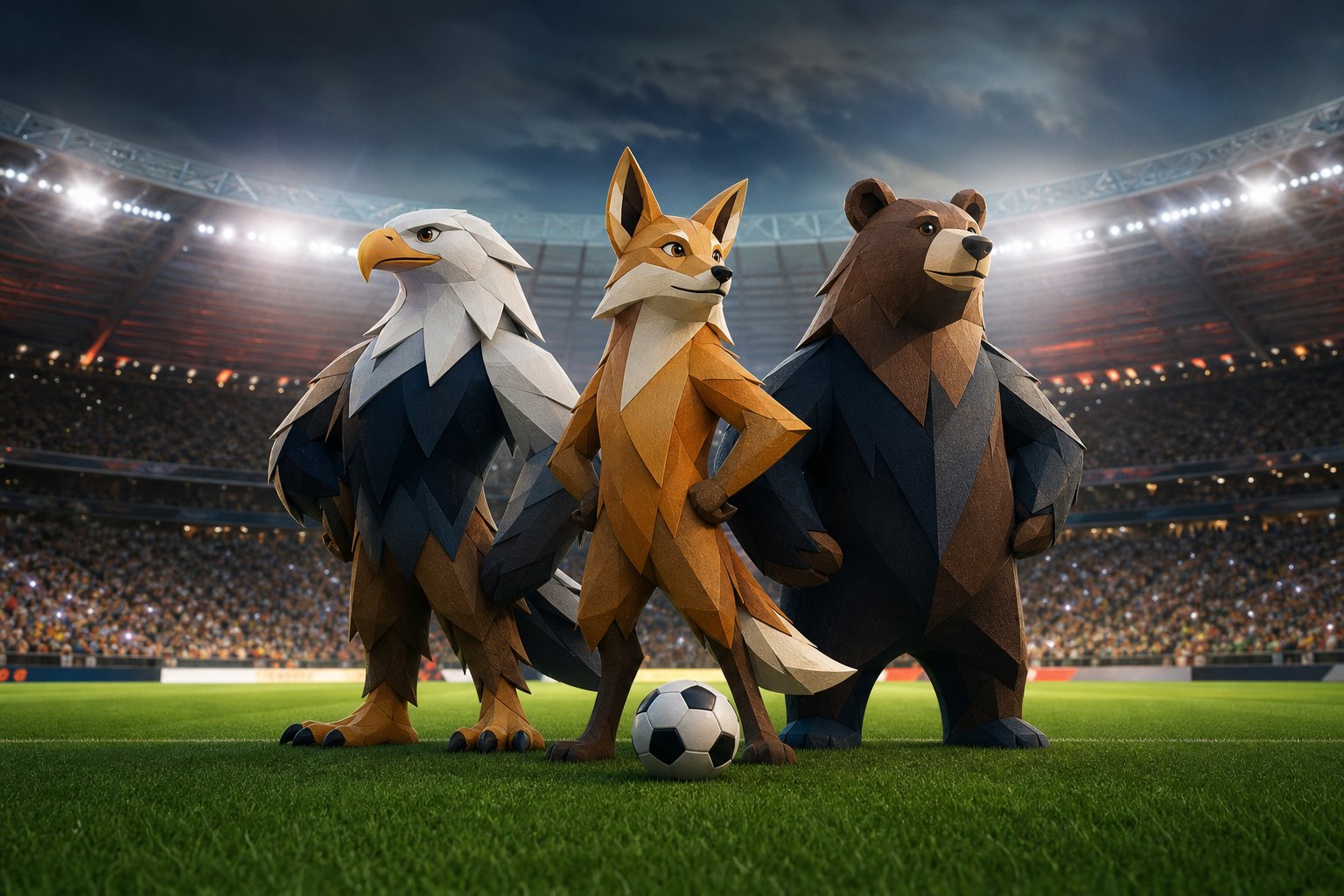
If you searched for the World Cup 2026 mascot, here is the short answer: FIFA introduced three official mascots for the tournament. Their names are Maple, Zayu, and Clutch. Each character represents one of the three host countries: Canada, Mexico, and the United States.
That is the point that confuses most searches. Many people expect a single mascot, as happened in other World Cup editions. In 2026, however, the official concept is different. The tournament's visual identity was built around a trio, which fits a World Cup shared by three countries and shaped by an expanded format.
In this guide, I break down what FIFA has already confirmed, what still circulates as media interpretation, and why this trio matters in the context of the 2026 World Cup. I also connect the topic to other core points of the tournament, including format, schedule, and bracket structure.
What is the World Cup 2026 mascot?
The 2026 World Cup will not have just one official mascot. FIFA introduced three characters: Maple, Zayu, and Clutch. Each one is tied to a host country. Maple represents Canada, Zayu represents Mexico, and Clutch represents the United States.
In practical terms, that answers most search intent. People looking for the World Cup 2026 mascot usually want to know whether there is already an official confirmation and what the names are. Right now, what FIFA has officially confirmed is this trio.
Short answer with the three names
- Maple: the mascot linked to Canada
- Zayu: the mascot linked to Mexico
- Clutch: the mascot linked to the United States
Which country each mascot represents
The choice of three mascots is not just an isolated visual detail. It reinforces the logic of the 2026 tournament, which will be played across three countries. That decision helps FIFA distribute the competition's identity across the hosts and build a broader narrative for the event.
If you want to understand how that approach also connects to the competition structure, it is worth reading our guide to the World Cup 2026 format.
Who are Maple, Zayu, and Clutch?
The three official names sit at the center of the tournament's communication. FIFA uses the trio as a bridge between local identity, entertainment, and the World Cup's global positioning. Instead of concentrating everything in a single symbol, the organization split representation across the three host countries.
Maple, the mascot linked to Canada
The name Maple directly evokes Canadian imagery. The most obvious association is the maple leaf, one of Canada's national symbols. That connection makes the character immediately recognizable, even for people who are just starting to follow the topic.
The key point here is to separate symbolism from literal confirmation. The name is official. More detailed interpretations about every feature of the character should be handled carefully unless FIFA itself has described them explicitly.
Zayu, the mascot linked to Mexico
Zayu is the character associated with Mexico. Among the three names, it is the one most likely to trigger search questions, because many readers want to know the exact meaning behind it. The safest approach is to keep the answer anchored in what FIFA officially presented and avoid turning media interpretation into institutional fact.
Because of that, any explanation about cultural symbolism should come with a clear distinction. There is room for editorial context, but readers need to know when they are looking at official confirmation and when they are reading a plausible interpretation.
Clutch, the mascot linked to the United States
Clutch represents the United States in the official trio. The name works well in sports language because it suggests decisive moments. Even so, the most important thing for SEO and editorial accuracy is not to overextend the symbolism. The most important thing is to note that the name is part of FIFA's official presentation for the 2026 tournament.
That kind of precision makes the article more useful. Readers do not need extra fluff. They need a clear answer about what has already been confirmed and the context necessary to understand the choice.
What the 2026 World Cup mascots mean
The strongest meaning of the trio lies in its institutional role. Maple, Zayu, and Clutch represent a World Cup shared by Canada, Mexico, and the United States. That is the central fact. The safest reading is that FIFA wanted to turn the tournament's multinational structure into simple, memorable visual language.
On top of that, the strategy helps distinguish the 2026 World Cup from previous editions. Instead of repeating the model of a single mascot, FIFA uses three characters to reinforce territorial diversity, continental scale, and the idea of a tournament outside the historical norm.
Cultural diversity across the host countries
In practice, the trio works as a visual shortcut for the hosts' diversity. Each country enters the tournament narrative not only through cities, stadiums, and the schedule, but also through its own character inside the official identity. That expands the event's communication and merchandising potential.
For English-speaking readers, it helps to compare this logic with earlier World Cup cycles, when one mascot had to condense the entire message of the event. In 2026, FIFA spreads that weight across three figures.
How FIFA introduced the characters
What matters here is the level of confirmation. When FIFA presents the mascots as official, that is the level of information the article should prioritize. Additional details, such as deep symbolic readings of each name, need to be treated carefully if they are not supported by a clear institutional explanation.
That caution matters because searches about mascots often mix official sources, social media, and third-party summaries. Useful content needs to filter that noise.
Why the 2026 World Cup has three mascots
The most direct answer is structural: the 2026 World Cup will be hosted by three countries. So three mascots work as a natural extension of that setup. The choice is not random. It connects with the political, commercial, and narrative design of the competition.
There is also a scale factor. The 2026 edition will be bigger than previous ones, with more national teams and a more complex organization. Having three official characters helps distribute identity and recognition across that broader ecosystem.
The link to the United States, Canada, and Mexico
The United States, Canada, and Mexico do not just share the map of the World Cup. They also share the tournament's symbolic responsibility. The mascots reinforce that split of visibility and turn the co-host structure into a visible part of the event's brand.
That context becomes even clearer when you read our complete World Cup 2026 guide, because there the tournament's logic is tied together with host cities, dates, and format.
The new format and the tournament identity
The 2026 edition marks a change in scale. The tournament is expanding, involving more host countries and a broader competitive structure. In that setting, three mascots work as part of the World Cup's visual repositioning.
If your search also includes the practical organization of the tournament, it is worth checking our pieces on the World Cup 2026 date, schedule, and kickoff times and the World Cup 2026 bracket and table.
What is official and what is interpretation about the mascots
This is where many competing articles fall short. Not everything circulating about the 2026 World Cup mascots carries the same weight. Some information is official and comes from FIFA. Other details come from media interpretation, social posts, and editorial summaries. Mixing those levels creates confusion.
What FIFA confirms
The official point today is that the 2026 World Cup will have three mascots called Maple, Zayu, and Clutch. They are linked to Canada, Mexico, and the United States. That is the factual core that answers the main search intent.
What appears as media and social interpretation
When very detailed explanations appear about name origin, species, cultural traits, and creative intent, the right question is simple: did FIFA say that, or is it a third-party reading? Not every interpretation is wrong. The problem is treating it like institutional confirmation without explicit backing.
That filter improves trust and helps the article age better. In topics with a strong visual and promotional angle, too much speculation often spreads light but persistent misinformation.
History of World Cup mascots
The tradition of World Cup mascots goes back decades. They help translate the tournament for a broader audience, strengthen the event's commercial identity, and create memories that last between editions.
The difference is that, in 2026, FIFA moves away from the standard model of a single central character. That makes the Maple, Zayu, and Clutch trio a meaningful exception in the recent history of the competition.
From 1966 to the 2026 World Cup
Since mascots were introduced in the modern World Cup era, the dominant model has been one main character per tournament. In 2026, that logic changes to reflect a tournament spread across three countries with a more explicit continental ambition.
Where Fuleco fits into that tradition
For many readers, Fuleco remains one of the most memorable references. The mascot of the 2014 World Cup helps explain why so many searches still expect a single mascot when they think about the tournament. The 2026 edition breaks exactly that expectation.
FAQ about the World Cup 2026 mascot
What is the official mascot of the 2026 World Cup?
FIFA introduced three official mascots for the 2026 World Cup: Maple, Zayu, and Clutch.
What are the mascots of the 2026 World Cup?
They are Maple, Zayu, and Clutch, each tied to one of the tournament's three host countries.
What does Zayu mean?
The safest answer is to rely only on what FIFA has officially presented. Extra readings about the meaning of the name should be treated as interpretation, not as automatic fact.
What animal is Fuleco?
Fuleco, the mascot of the 2014 World Cup, is a Brazilian three-banded armadillo. It became a strong reference point and helps explain why many searches still expect one mascot per edition.
What will be the mascot of the 2026 Olympics?
That is a different search and a different event. If your focus is the 2026 World Cup, the official information today is the trio Maple, Zayu, and Clutch.
Conclusion
The main point is simple. The 2026 World Cup will have three official mascots, not just one. Maple, Zayu, and Clutch represent Canada, Mexico, and the United States, and that choice matches the unprecedented structure of a World Cup shared by three countries.
For readers looking for a direct answer, that resolves the core question. For those who want more context, the most important thing is to distinguish FIFA's official information from interpretations circulating outside it. That filter matters for SEO, clarity, and editorial trust.
If you are building a fuller view of the tournament, it is worth continuing with connected content such as our World Cup 2026 complete guide, World Cup 2026 date, schedule, and kickoff times, and World Cup 2026 bracket and table.
Supporting external sources: FIFA and CNN Brasil.
Related reading: see more Macro Markets analysis on World Cup predictions.
