


Brazil 2026 Election Dates: October 4 and 25 Explained
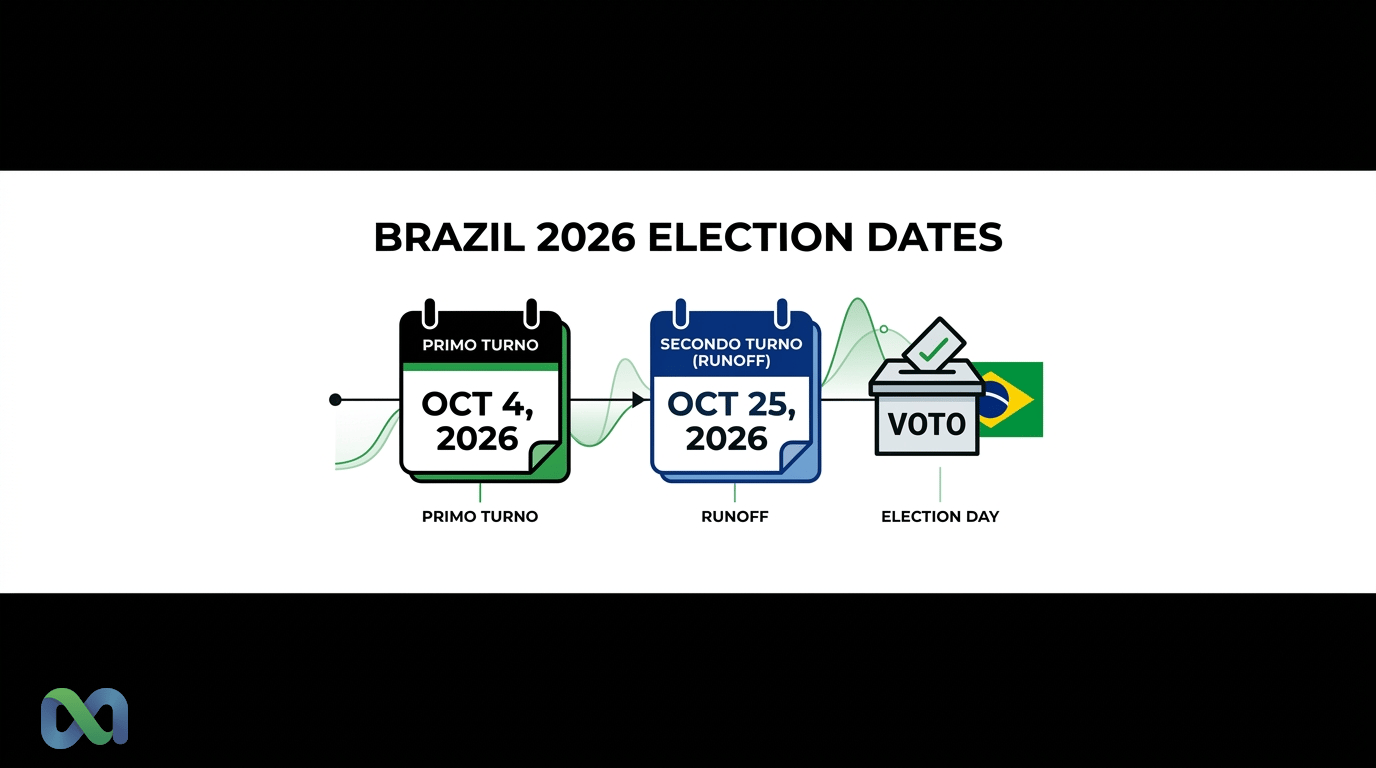
Brazil's 2026 election calendar set October 4 for the first round and October 25 for any required second round. Both dates are now past. The runoff rule applied to president and governors, while Senate and deputy contests were decided in a single round.
Reviewed November 7, 2026. This guide explains the dates, the offices on the ballot and the rules behind the calendar. The official TSE calendar is the source for the timetable. For voting procedures and the separate guide to each round, see our first- and second-round calendar.
Brazil 2026 election dates at a glance
| Date | Calendar milestone | How to read it now |
|---|---|---|
| July 20–August 5, 2026 | Party conventions | Completed calendar window for choosing candidates and alliances |
| August 15, 2026 | Candidate registration deadline | A deadline for candidacies, distinct from voter registration |
| August 16, 2026 | Start of general campaign advertising | Historical campaign milestone |
| October 4, 2026 | First-round voting date | Past; the main date for the general-election ballot |
| October 25, 2026 | Second-round date where required | Past; relevant to executive races that required a runoff |
These dates describe the election timetable. A date in the calendar does not by itself identify a winner, establish that a result is final or show whether a particular state needed a runoff. Use official election records for those questions.
Why Brazil voted on the first and last Sundays of October
Brazil's constitutional timetable places general elections on the first Sunday of October. Where a runoff is needed, the second vote falls on the last Sunday of that month. In 2026, those Sundays were October 4 and October 25.
The TRE-SP explanation of the constitutional dates connects the timetable with the rules for executive elections. The calendar therefore gives parties, voters, journalists and analysts a common reference before voting begins.
October 4: the first-round date
The first round brought the general-election contests onto one ballot day. President and governor races could be settled at that stage if a candidate met the valid-vote threshold. Senate and deputy contests did not have a second-round stage.
For a reader reviewing an old poll or market price, October 4 also separates two information sets. A pre-vote estimate describes expectations; a published count describes votes already recorded. Their dates and status should remain visible when they are compared.
October 25: the conditional second-round date
The calendar reserved October 25 for executive races that needed another vote. The condition belongs to each contest: it does not mean every office appeared again, or that every state followed the same path.
The interval between the two dates was three weeks. That window gave a runoff campaign a different setting from the first round: two remaining candidates, first-round vote totals and potential endorsements. Those are inputs for analysis, rather than a guarantee of the final result.
When does Brazil require a second round?
For president and governors, a candidate must receive more than half of valid votes to win in the first round. Blank and null votes are excluded from that denominator. If no candidate meets the threshold, the two leading candidates proceed to a second vote.
Consider a hypothetical first-round count with 100 votes cast: 10 blank or null and 90 valid. A candidate with 46 valid votes has 46 ÷ 90, or about 51.1% of valid votes. That clears half of valid votes even though it is only 46% of all votes cast.
This example explains the denominator; it is not a result from the 2026 election. Using turnout, registered voters or all ballots as substitutes for valid votes would answer a different question.
Deputies use a proportional system. Senate contests use their own single-round rules. Neither returns for a runoff merely because the presidential contest needs one.
Which offices were on the 2026 ballot?
| Office | Election structure | Second round possible? |
|---|---|---|
| President and vice-president | Executive ticket | Yes |
| Governor and vice-governor | State or Federal District executive ticket | Yes |
| Senator | State or Federal District contest | No |
| Federal deputy | Proportional contest | No |
| State deputy | Proportional contest | No |
| Federal District deputy | Proportional contest | No |
The executive and legislative contests belong to the same general-election calendar but follow different decision rules. A presidential headline cannot be used as a shortcut for the results of Congress or a state legislature.
For political analysis, this separation matters after the vote as well. The presidency, state governments and legislative composition describe different parts of the next governing cycle. Their official records should be checked separately.
How to read polls and prediction markets around these dates
Before a vote, polls and markets describe uncertainty. After voting, published results add evidence, while the status of counting, challenges and formal declarations still needs attention. Keep the observation time next to each number.
A poll is a sample collected during a fieldwork period. It has a method, population and uncertainty. A market price comes from transactions under a contract's rules. Neither is the official vote count, and neither measures exactly the same thing as the other.
Compare the same event and cutoff
Check whether a poll refers to the first round or a runoff, and whether it uses valid votes or another base. For a contract, read the outcome definition, resolution source and deadline. Similar candidate names do not prove that two figures describe the same event.
For a historical comparison, keep the last pre-vote observation separate from later prices. A figure captured after results were released cannot be presented as a prediction made beforehand. This distinction remains useful when studying prediction-market mechanics.
Use the calendar to organize evidence
A formal candidate registration, a new poll and an official result are different information events. Their weight depends on the question being asked. A registration confirms a candidacy request; it does not predict vote share. A poll estimates preferences; it does not decide a race.
The same care applies to congressional and state results. They can change an analyst's view of alliances and governability, but any conclusion needs the relevant result and an explanation of the connection. The date alone does not establish that relationship.
What remains useful after the voting dates?
The timetable is still useful for checking old articles, polling series and market histories. It helps identify whether a claim was made before conventions, after registration, between rounds or after voting ended.
Use this order when checking a claim:
- Identify the office and whether the claim concerns a date, candidacy, vote count or formal declaration.
- Open the official record for that subject and confirm its publication date.
- Check the geographic scope: national, state or Federal District.
- Keep projections and preliminary observations separate from final records.
- Cite the original source alongside any historical poll or market comparison.
This guide preserves the dates and explains their rules. For the broader timetable and voting context, use the companion round-by-round guide linked above. For results, follow the TSE's official election information.
Questions about Brazil 2026 election dates
What were the Brazil 2026 election dates?
October 4 was the first-round date. October 25 was the date reserved for second rounds in executive races where they were required. Both dates are past as of this review.
Was October 25 another vote for every office?
No. The runoff rule concerned president and governors. Senate and deputy contests were single-round elections under their respective rules.
Does a candidate need more than half of all ballots?
The executive first-round threshold uses valid votes. Blank and null votes are excluded. The worked example above shows why this can differ from a share of all ballots cast.
Is candidate registration the same as voter registration?
No. The August 15 deadline in this calendar concerned candidate registration. Voter services have their own deadlines and procedures, which should be checked with the Electoral Justice authorities.
Where can I check the official calendar and results?
Use the TSE calendar for dates and official election records for results. A calendar notice establishes the timetable; it does not establish who won.
How to use the dates now
Keep October 4 and October 25 attached to the correct round and office. When reading a historical poll, price or news report, compare its timestamp with those calendar milestones. Then open the official source for the specific fact you need.
