


Permutation Formula: Rules and Worked Counting Examples
The permutation formula counts ordered selections. If you choose r distinct items from n distinct items, use P(n, r) = n! / (n − r)!. The rule assumes that an item cannot be selected twice and that changing its position creates a different result.
For example, assigning six research topics to three ranked reporting slots produces 6 × 5 × 4 = 120 arrangements. Choosing three topics without ranking them produces only 20 groups. Both counts are correct, but they answer different questions.
Before calculating, define what a different outcome means. A large factorial cannot repair a sample space built around the wrong question.
When to Use the Permutation Formula
A permutation records both membership and position. The list A, B, C differs from B, A, C because the first two positions have changed. A combination records only membership, so those lists belong to the same group.
OpenStax's permutations lesson develops the rule by multiplying the choices available at each position. That is often the clearest method before introducing factorial notation.
In a financial research workflow, the positions might be first report, second report, and third report. The items might be six distinct subjects, labeled A through F. These labels identify hypothetical subjects; they are not current economic releases or live trading signals.
If the task is simply to select three subjects for a watchlist, their order may have no meaning. Use the combinations formula for that question. If the task assigns distinct priorities or responsibilities, preserve those roles in the count.
Writing an example outcome helps. Ask whether swapping two selected items changes the result you intend to measure. If the answer is yes, an ordered count is appropriate.
How the Formula Follows From Available Choices
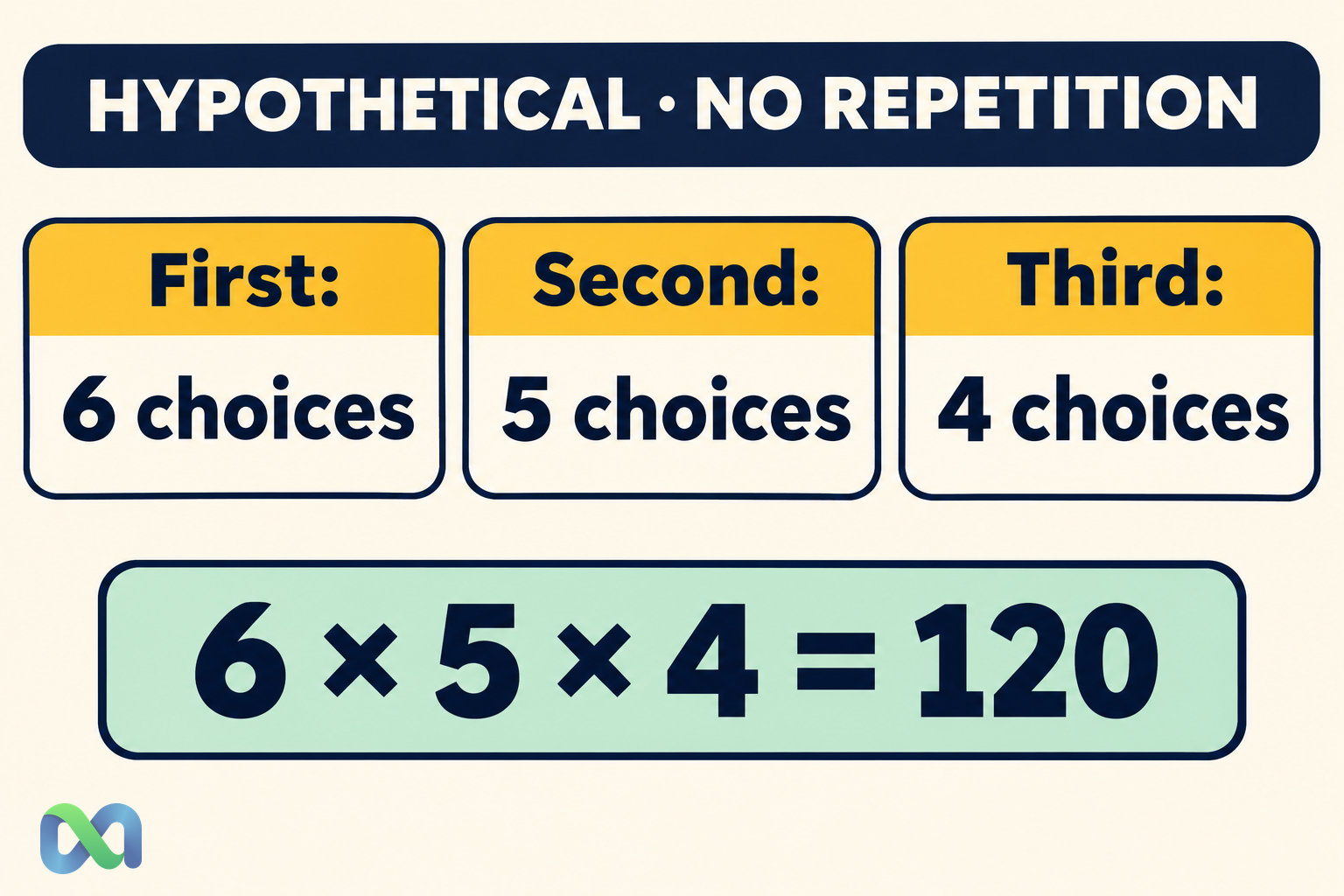
Suppose there are six distinct topics and three reporting slots. Any topic can fill the first slot. Once that topic is used, five remain for the second. Four remain for the third.
The count is therefore:
P(6, 3) = 6 × 5 × 4 = 120.
The factorial version expresses the same product:
P(6, 3) = 6! / 3! = 720 / 6 = 120.
A factorial multiplies the positive integers down to one. Thus, 6! means 6 × 5 × 4 × 3 × 2 × 1. Dividing by 3! cancels the factors for positions that are not being filled.
For a general ordered selection, start with n choices and stop after r positions. There are n choices, then n − 1, continuing through n − r + 1. That product equals n! / (n − r)!.
The basic formula uses whole numbers with 0 ≤ r ≤ n. Selecting more distinct items than exist is impossible under these rules. Do not pass a negative factorial to a calculator and treat the output as a valid count.
Worked Example: Rank Three of Six Research Topics
Imagine an analyst must arrange three distinct topics for a hypothetical briefing. Topic A cannot appear twice. The briefing A, C, F is different from C, A, F because the presentation order has changed.
The choices shrink as slots are filled:
| Position | Available choices |
|---|---|
| First | 6 |
| Second | 5 |
| Third | 4 |
| Ordered total | 120 |
Now change the assignment. The analyst only needs a three-topic group and does not care about presentation order. Each group can be arranged in 3! = 6 ways. Divide the ordered count by those six arrangements:
C(6, 3) = 120 / 6 = 20.
The difference between 120 and 20 comes entirely from the question's definition. It does not reveal which topic is most important, which event is most likely, or which forecast deserves the most capital.
If a portfolio review treats two slots as interchangeable, counting them as separate roles would inflate the result. Conversely, combining a lead role and a backup role would erase a distinction that may matter. Establish the roles before applying the formula.
Repetition Changes the Counting Rule
The phrase “with repetition” can describe two different situations. In one, you can choose the same item again for each slot. In the other, you are arranging a fixed collection that contains identical items.
For repeated choices, each slot retains the same number of options. If any of six topics can appear in each of three positions, there are 6³ = 216 sequences. A, A, B is now allowed. This is not the no-repetition calculation that gave 120.
For a fixed collection with identical items, begin with all positions and remove duplicate arrangements. Consider four hypothetical policy labels: C, C, H, and R. The two C labels are indistinguishable. There are:
4! / 2! = 24 / 2 = 12 distinct sequences.
Wolfram MathWorld's multinomial coefficient describes the general rule: divide the factorial of the total number of items by the factorial of each identical item's multiplicity.
These labels are a counting illustration, not a forecast of future policy decisions. A valid arrangement is a possible sequence under the chosen rules; it does not automatically receive the same probability as another arrangement.
How to Handle Restrictions Without Double-Counting
The standard permutation formula assumes every listed choice is available wherever the model permits it. Real tasks may include restrictions. Account for those restrictions explicitly rather than changing the factorial by intuition.
Return to six topics and three ranked slots. If topic A must be first, that slot has one choice. The remaining slots have five and four choices. The restricted count is 1 × 5 × 4 = 20.
Now use a different rule: topics A and B cannot both appear in the briefing. Start with the 120 unrestricted arrangements. Count the forbidden cases by choosing the third topic from C, D, E, or F, then arranging the three chosen topics.
There are 4 × 3! = 24 forbidden arrangements. The allowed total is therefore 120 − 24 = 96.
For more complex restrictions, cases can overlap. Subtracting each forbidden category separately may subtract the same arrangement twice. A small enumeration, a tree, or an inclusion-exclusion calculation can expose that problem.
Keep a written definition of the allowed outcomes. A count is easier to audit when another reader can reproduce both the inclusion rule and the exclusions.
A Count Becomes a Probability Only With a Model
If the 120 ordered briefings were selected uniformly at random, one specified briefing would have probability 1/120, about 0.83%. The equal-probability assumption is doing essential work in that calculation.
An analyst who deliberately ranks topics by importance is not choosing uniformly. The fact that 120 arrangements exist does not make each equally likely. The same distinction applies when counting sequences of market events: economic dependencies and event-specific probabilities may differ across sequences.
The conditional probability guide explains how probabilities change after information is known. Counting provides the possible outcomes; a probability model assigns weight to those outcomes.
Likewise, a large number of possible sequences says little about their financial value. The expected value formula combines probabilities with payoffs. Neither the number of arrangements nor a single selected path establishes an expected profit.
For an event contract, read the resolution rules before defining the sample space. The contract may concern one outcome, a ranking, or a condition tied to a specific time. Those are different objects to count and value.
Check a Permutation Calculation Before Using It
State the number of distinct items, the number of positions, whether positions differ, and whether reuse is allowed. Then solve a small version of the task by listing the outcomes. That small example often reveals an incorrect assumption faster than a larger calculation.
Use the product of available choices when it is clearer than writing two enormous factorials. For large inputs, factorials can exceed a calculator's numeric range even when the final ratio is manageable. A dedicated permutation function or exact-integer method avoids unnecessary rounding.
Check units as well. The output is a number of arrangements. It is not a percentage, a return, or a measure of confidence. Preserve that distinction when placing the result beside a financial example.
If the rules change midway through the analysis, recalculate the sample space. Adding a repeated option or removing an unavailable item changes the question, even if the formula on the page stays visually similar.
Frequently Asked Questions
What Is the Difference Between nPr and nCr?
nPr counts ordered selections without repetition. nCr counts unordered selections. For the same valid n and r, nPr equals nCr multiplied by r!, because each selected group has r! possible orders.
What Happens When r Equals n?
You are arranging every distinct item, so the count is n!. The denominator is 0!, which is defined as one. Arranging all six distinct topics gives 6! = 720 outcomes.
Why Is P(n, 0) Equal to One?
There is one empty ordered selection: choose nothing. That convention makes the counting rules consistent. It differs from asking for more distinct items than are available, which has no valid outcomes.
Does a Permutation Count Assume Independence?
The counting identity itself does not assign probabilities or assume independent events. Constraints still determine which arrangements are possible. Independence and equal likelihood become separate questions when you attach probabilities to those arrangements.
